admin
admin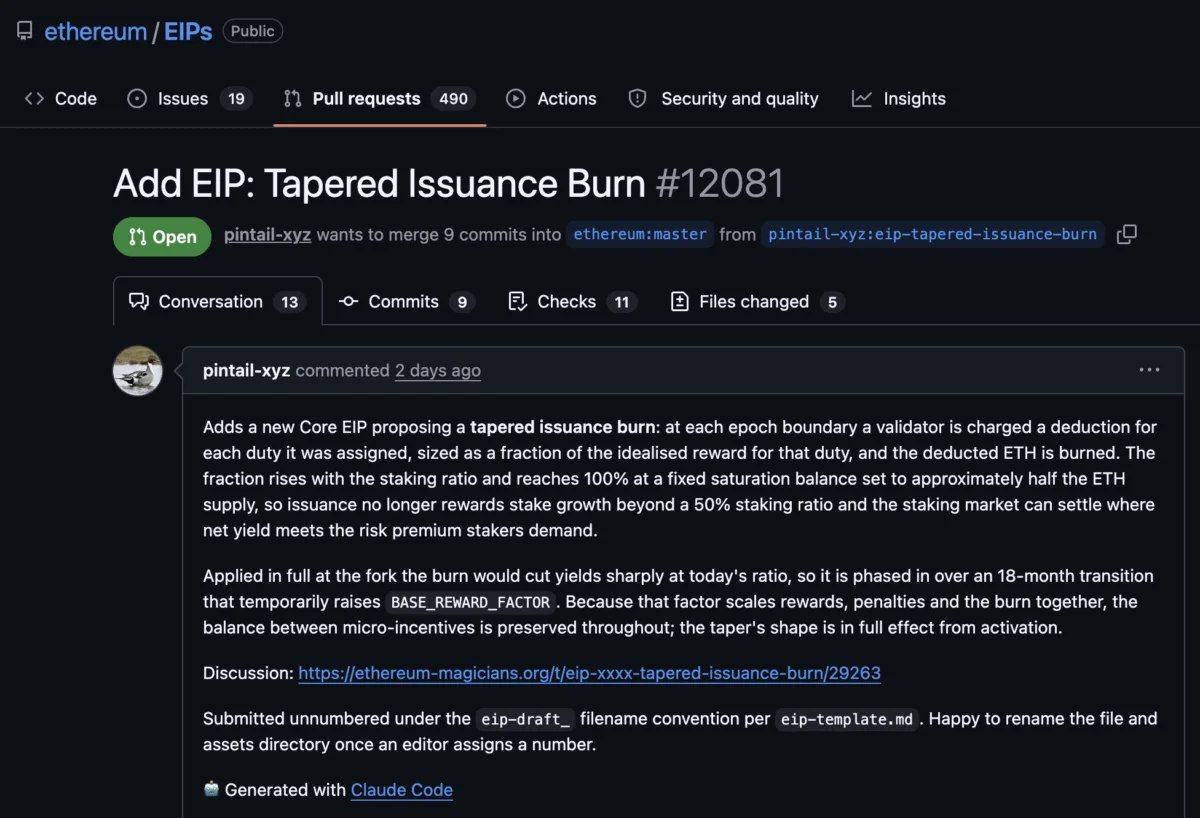
Ethereum is facing a critical juncture in its monetary policy as a new proposal, EIP-8363: Tapered Issuance Burn, has ignited a profound debate concerning the network’s ETH issuance policy. Submitted to the Ethereum EIPs repository on August 4, 2026, this proposal directly addresses the escalating amount of ETH staked within the network, which now surpasses one-third of the total supply, and the persistent, lengthy validator entry queue. The core of the discussion revolves around whether the current issuance mechanism is over-incentivizing staking, potentially leading to undesirable economic and decentralization outcomes. If adopted, EIP-8363 would systematically reduce staking rewards as the staking ratio climbs, aiming to neutralize any further economic incentive to stake once approximately 50% of the total ETH supply is committed to securing the network.
The Genesis of the Debate: Ethereum’s Proof-of-Stake Evolution
To fully grasp the significance of EIP-8363, it’s essential to understand Ethereum’s journey to its current Proof-of-Stake (PoS) consensus mechanism. Following "The Merge" in September 2022, Ethereum transitioned from an energy-intensive Proof-of-Work (PoW) system to PoS, where validators stake ETH to secure the network, process transactions, and propose new blocks. This shift dramatically reduced Ethereum’s energy consumption and laid the groundwork for future scalability upgrades.
Under PoS, validators are rewarded with newly issued ETH (consensus-layer rewards) for their participation, alongside transaction fees (execution-layer rewards). The issuance rate is dynamically adjusted, decreasing as more ETH is staked, designed to incentivize sufficient participation for network security without causing excessive inflation. However, the remarkable success of staking, evidenced by the consistent growth in staked ETH, has prompted a re-evaluation of this dynamic. The community is now grappling with the question of how much staking is "enough" and whether the current incentives are optimal for the long-term health and decentralization of the network.
This debate also builds upon previous monetary policy adjustments, most notably EIP-1559, implemented during the London hard fork in August 2021. EIP-1559 introduced a base fee burn mechanism for transactions, making ETH a potentially deflationary asset under high network usage. EIP-8363 seeks to further refine Ethereum’s economic model by addressing the issuance side of the equation, aiming for a more predictable and sustainable supply trajectory.
Unpacking EIP-8363: The Tapered Issuance Burn Mechanism
At its core, EIP-8363, officially titled "Tapered Issuance Burn," proposes an innovative approach to managing validator rewards. Instead of directly cutting the issuance rate, the proposal suggests burning a calculated portion of validator rewards. The authors, including Jerome de Tychey, president of Ethereum France and a prominent advocate, describe this as a Core EIP designed to introduce a deduction at each epoch based on a validator’s ideal reward, subsequently burning the deducted ETH. This "mint-then-burn" mechanism mirrors the EIP-1559 approach to transaction fees, aiming for consistency in Ethereum’s economic design.
The defining characteristic of EIP-8363 is its "taper" feature. The deduction percentage, which dictates how much of the validator’s ideal reward is burned, increases progressively as the staking ratio—the proportion of staked ETH to the total supply—rises. As the staking ratio approaches a critical threshold of approximately 50%, the burn rate on ideal consensus-layer rewards would incrementally increase to 100%. This means that beyond the 50% mark, net consensus-layer issuance would effectively cease to provide any additional economic incentive for new ETH to be staked. The goal is to create a clear economic ceiling for staking growth driven by consensus rewards.

According to de Tychey, the implementation of this yield reduction mechanism would be phased in gradually over an 18-month period. Accounting for an estimated six months required for hard fork preparation and community consensus, validators and staking providers would have nearly two years to adapt to the new economic reality. This extended transition period is intended to provide ample time for market participants to adjust their strategies and infrastructure, mitigating potential shocks to the ecosystem. The effective base reward factor, which determines the magnitude of staking rewards, would linearly decrease from 128 to 64 during this phase-in period, according to the proposal’s specifications.
The Staking Surge: Data Driving the Debate
The impetus for EIP-8363 stems directly from the unprecedented growth in Ethereum staking. Any adjustment to validator rewards is now a highly sensitive topic, given the significant economic interest tied to staking. As of the proposal’s submission, data from ValidatorQueue indicated that approximately 41.6 million ETH was staked on the network, representing a substantial 34.1% of the total circulating supply. This impressive figure is supported by a robust validator set of around 895,774 active validators. Furthermore, an additional ~2.5 million ETH remained in the entry queue, patiently awaiting activation, clearly demonstrating that demand for staking has shown no signs of abating.
With Ethereum’s total ETH supply hovering around 121.9 million ETH, the 50% staking milestone targeted by EIP-8363 translates to approximately 61 million ETH. While the network is not "near 50%" if judged solely by active stake today, the consistent growth rate of staking and the sheer size of the validator queue have transformed the discussion around issuance from a theoretical economic model into an urgent, practical policy issue.
Projections by proponents further underscore the preemptive nature of EIP-8363. Jerome de Tychey posits that if the entry queue remains saturated at its maximum churn rate, the amount of staked ETH could increase by approximately 1.75 million ETH per month. In a "conservative scenario" outlined by the proposal’s supporters, this trajectory could see over 70 million ETH staked by January 1, 2028, representing more than 55% of the total supply. This scenario, while a projection and not a guaranteed forecast, vividly illustrates the potential for runaway staking growth and serves as a powerful argument for introducing EIP-8363 before the staking ratio reaches or surpasses the 50% mark. The objective is to proactively manage the network’s economic incentives rather than reactively address an already entrenched problem.
The Case for Burning Issuance: Proponents’ Arguments
Supporters of EIP-8363 present a multi-faceted argument for its necessity, centering on the long-term health, economic sustainability, and decentralization of Ethereum. A primary concern is that the current staking incentive mechanism lacks a clear stopping point. De Tychey highlights that under the existing reward curve, the yield for staking does not drop below roughly 1.5% even if a hypothetical 100% of ETH were staked. If staking continues to be perceived as a relatively low-risk yield opportunity, this mechanism could persistently draw more ETH into staking, even when the network has already achieved sufficient economic security. This could lead to an inefficient allocation of capital and potentially diminish the utility of ETH in other parts of the ecosystem.
Key arguments include:
- Preventing Dilution for Non-Stakers: Excessive issuance, even for network security, can dilute the value of ETH held by those who do not stake. By capping the staking incentive, EIP-8363 aims to protect the economic interests of all ETH holders.
- Mitigating Risks of Liquid Staking Token (LST) Dominance: Proponents express concern that if staking becomes overly attractive, liquid staking tokens (LSTs) could increasingly replace raw ETH across the ecosystem. While LSTs offer flexibility, an over-reliance on them might diminish the foundational role of native ETH in various DeFi protocols and potentially introduce new systemic risks if their underlying liquidity or pegging mechanisms face challenges.
- Optimizing Economic Security without Over-Capitalization: The goal is to find a "Goldilocks zone" for economic security—enough staked ETH to ensure robust security against attacks, but not so much that it becomes economically inefficient or creates undue inflationary pressure. Proponents argue that a higher staking ratio does not automatically equate to a safer Ethereum, especially if new stake becomes highly concentrated among a few large custodians, staking providers, or institutional players (e.g., ETF issuers), which could undermine decentralization.
- Enhancing Supply Predictability: When combined with the existing EIP-1559 fee burn, EIP-8363’s tapered issuance mechanism promises a more predictable ETH supply trajectory. This predictability is seen as beneficial for investors, developers, and the broader ecosystem, fostering greater confidence in Ethereum’s long-term economic model.
- Sustainable Yield for Validators: By setting a clear cap, the proposal aims to establish a more sustainable and balanced yield environment for validators, ensuring they are adequately compensated for their service without creating an open-ended incentive structure that could lead to economic inefficiencies. Under the proposal’s model, issuance under the taper would peak at around 0.5% of total supply per year near a 20% staking ratio, then gradually taper down to 0 at 50%, providing a defined and manageable reward schedule.
A recent tweet from Jerome de Tychey, co-author of the EIP, encapsulated the sentiment: "New EIP: Tapered Issuance Burn. We just submitted an EIP to ethereum/EIPs: a minimal, market-driven fix to Ethereum’s issuance policy removing the incentive for stake growth beyond 50% of ETH supply." This highlights the perceived simplicity and market-oriented nature of the proposed solution.

The Pushback: Concerns from Stakers and DeFi
Despite the arguments for EIP-8363, the proposal has encountered significant pushback and raised substantial concerns across various segments of the Ethereum community, particularly among solo stakers and participants in the Decentralized Finance (DeFi) ecosystem. The potential for a major shift in monetary policy has sparked intense debate on forums like Ethereum Magicians, with many questioning the timing and the potential ramifications.
Key areas of concern include:
- Decentralization Risk to Solo Stakers: A prevalent argument against EIP-8363 is its potential negative impact on decentralization. Solo stakers, who operate their own nodes, often face higher operational costs, greater exposure to downtime risks, and complex tax obligations compared to large institutional staking providers or centralized custodians. If net rewards significantly decline, solo stakers may find their operations economically unviable and be forced to exit the market. This scenario could lead to further consolidation of staked ETH among large entities that benefit from economies of scale and robust infrastructure, directly counteracting the ethos of decentralization that underpins Ethereum.
- Rushed Monetary Policy Shift: Many community members have expressed apprehension that a fundamental monetary policy change of this magnitude should not be fast-tracked into a hard fork process, especially given its proximity to discussion deadlines for upcoming hard forks like Bogota. Critics argue that insufficient time for thorough debate, economic modeling, and impact analysis could lead to unintended consequences.
- Impact on Decentralized Finance (DeFi): The staking yield on Ethereum serves as a crucial reference rate for numerous ETH-denominated yield markets within DeFi. This includes liquid staking tokens (LSTs) and their derivatives, lending and borrowing protocols, and various fixed-yield products. If the base staking yield is sharply reduced, strategies that rely on LST collateral or the spread between staking yield and borrowing costs could be severely impacted. This could lead to a repricing of assets, reduced liquidity in certain markets, and a broader restructuring of DeFi strategies that are intricately linked to Ethereum’s staking economics.
- Tax Uncertainty: "Mint-then-Burn" vs. "Minting Less": The proposal’s choice of a "mint-then-burn" design, rather than simply "minting less" new ETH, has also been scrutinized. While consistent with EIP-1559, some argue that this design choice could introduce additional tax uncertainty for validators. Depending on jurisdiction, the "burning" of a portion of minted rewards might be interpreted differently by tax authorities than simply receiving a lower gross reward, potentially creating compliance complexities and unexpected liabilities for validators.
- Optimal Staking Ratio Debate: The choice of approximately 50% as the target threshold for eliminating further staking incentives has also been questioned. Critics ponder whether this specific percentage is truly optimal for balancing security, decentralization, and economic efficiency, or if it is an arbitrary figure that could be debated further. Some argue that a higher or lower threshold might be more appropriate depending on various network parameters and long-term goals.
The Path Forward: What Happens Next
As of now, EIP-8363 remains an active proposal under rigorous discussion and has not been approved for implementation. Its journey through the Ethereum governance process is still in its early stages. The GitHub Pull Request (PR) for EIP-8363 is currently undergoing review by core developers and community members, where technical specifications, potential vulnerabilities, and broader implications are meticulously scrutinized. The Ethereum Magicians forum continues to serve as the primary hub for feedback, where stakers, researchers, DeFi stakeholders, and other interested parties can voice their concerns, offer alternative solutions, and engage in constructive debate.
The immediate next step will be to observe whether EIP-8363 gains sufficient traction to be scheduled for core developers’ calls. These calls are critical junctures where key stakeholders discuss and prioritize EIPs, assessing their feasibility and alignment with Ethereum’s roadmap. If the proposal progresses through these discussions, the debate will inevitably shift from the fundamental question of whether issuance should be reduced to the more intricate and difficult implementation details. These include:
- How to reduce it: Refining the "mint-then-burn" mechanism or exploring alternatives.
- How long to phase it in: Adjusting the 18-month timeline to optimize for adaptation and minimize disruption.
- Appropriateness of the 50% threshold: Further modeling and debate on the ideal staking ratio.
- Burning validator rewards versus directly adjusting issuance: A deeper dive into the economic and tax implications of the chosen mechanism.
At present, with over one-third of its supply staked, Ethereum is demonstrably not yet near the 50% threshold. Therefore, EIP-8363 should be understood as a preemptive effort by its supporters to counter a potential future trajectory that they view as economically risky and detrimental to decentralization. It is not a reactive measure to an already crossed threshold. The debate surrounding this proposal is complex, touching upon fundamental aspects of Ethereum’s economic design, security model, and decentralization ethos. As the staking queue continues to grow, validator economics evolve, and the influence of liquid staking tokens expands, the scrutiny of EIP-8363 and its potential impacts is only likely to intensify, shaping the future of the world’s leading smart contract platform. The outcome will undoubtedly have lasting implications for every participant in the Ethereum ecosystem.