admin
admin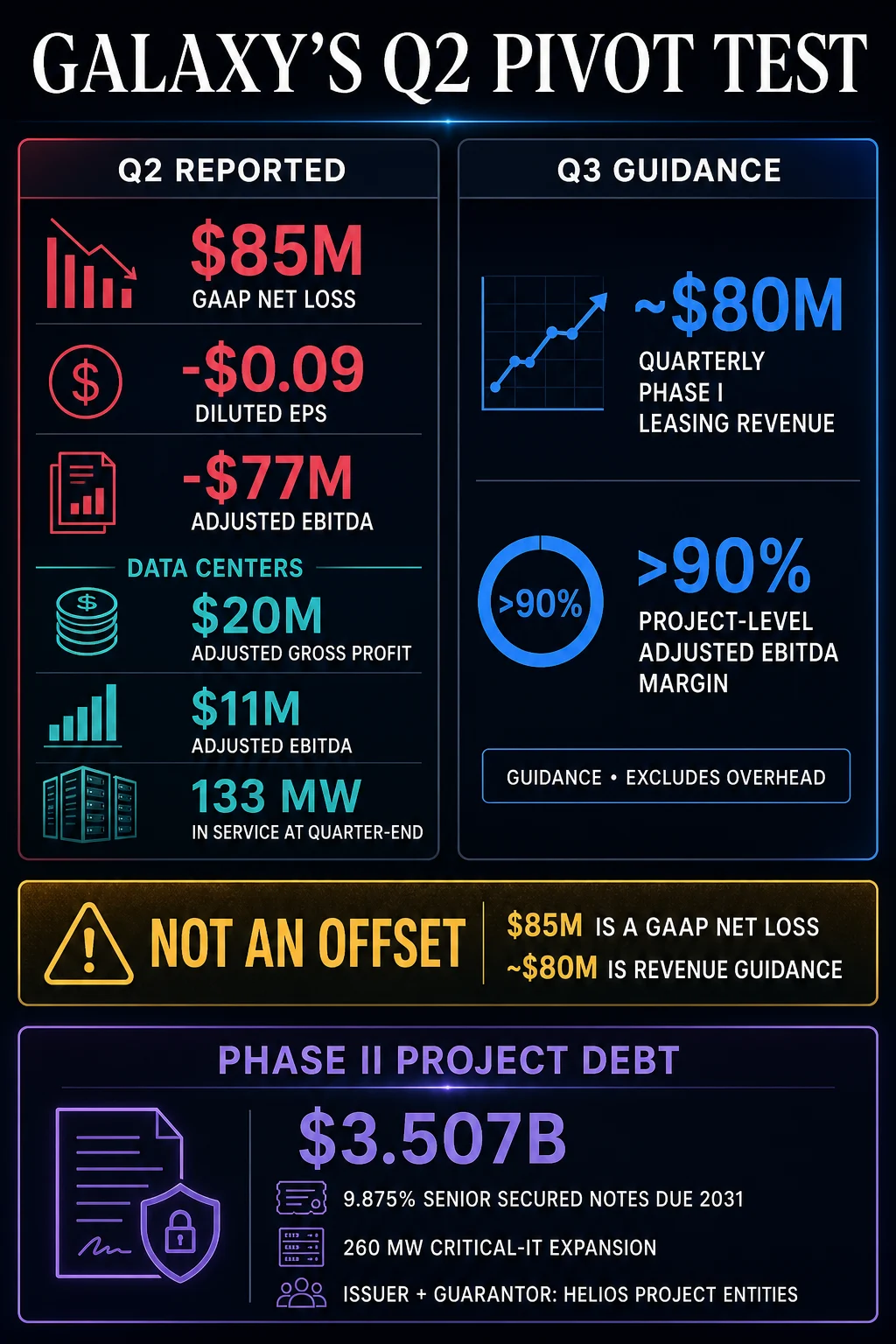
Galaxy Digital concluded the second quarter of 2026 with a significant net loss of $85 million, a financial outcome primarily attributed to the prevailing downturn in digital asset prices. Despite this considerable loss, the company marked a crucial milestone with the full activation of its 133 MW Phase I capacity under a long-term lease agreement with CoreWeave. This development is poised to introduce a new revenue stream from AI infrastructure, which is anticipated to provide a stabilizing influence on Galaxy Digital’s historically volatile earnings. The third quarter will serve as the first comprehensive test of whether this contracted data center income can effectively mitigate the company’s earnings fluctuations, which have been heavily influenced by the cryptocurrency market.
The company’s SEC-filed results revealed that diluted earnings per share (EPS) stood at a negative $0.09. This figure was mirrored by the adjusted EPS, a non-GAAP measure that also registered at negative $0.09. On a non-GAAP basis, Galaxy Digital reported an adjusted gross profit of $43 million, juxtaposed with a substantial adjusted EBITDA loss of $77 million. These financial metrics underscore the challenges faced by the company during the quarter.
Divergent Performance Across Business Segments
The financial performance within Galaxy Digital’s various business segments exhibited a stark divergence. The company’s strategic pivot towards AI infrastructure proved to be a bright spot, generating an adjusted gross profit of $20 million and an adjusted EBITDA of $11 million. This positive contribution reflects the successful ramp-up of its AI-focused data center capacity. In contrast, the Treasury and Corporate segment bore the brunt of the losses, recording an adjusted gross loss of $42 million and an adjusted EBITDA loss of $78 million. This substantial deficit in the Treasury and Corporate segment was primarily driven by unrealized losses stemming from its holdings in digital assets and other investment positions, highlighting the persistent impact of market fluctuations on these portfolios.
CoreWeave Lease Commences: A New Era for Data Center Revenue
A pivotal development for Galaxy Digital was the completion of its 133 MW Phase I data center capacity, all of which is now operational and contributing to revenue under the 15-year CoreWeave lease agreement. This marks the full deployment of the initial phase of its data center expansion strategy. Looking ahead to the third quarter, Galaxy Digital projects approximately $80 million in quarterly leasing revenue from this facility. Furthermore, the company anticipates a project-level adjusted EBITDA margin exceeding 90% for this segment, commencing in Q3. It is important to note that these Q3 figures are currently guidance, and the stated project margin excludes any associated overhead costs at the corporate level.
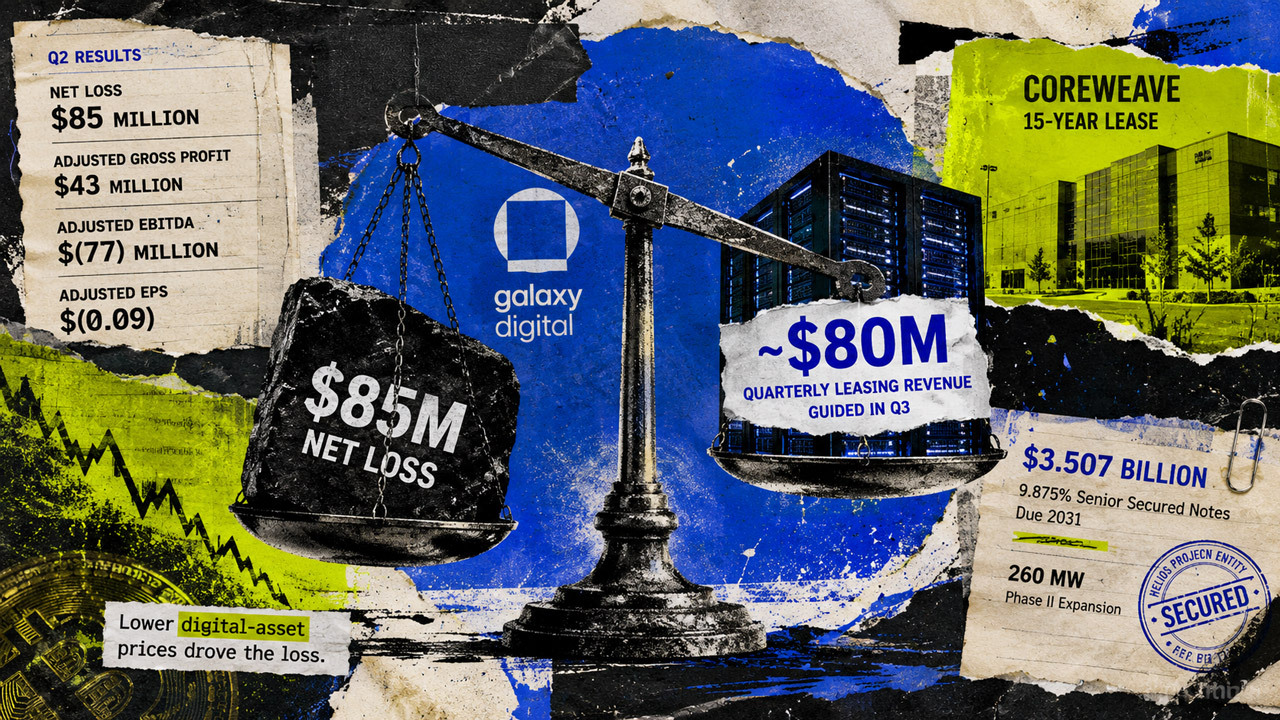
The projected $80 million in quarterly lease revenue from the CoreWeave agreement offers a potentially significant offset to the $85 million GAAP net loss reported for Q2. While the loss is reflected in Galaxy Digital’s consolidated GAAP bottom line, the $80 million figure represents projected top-line revenue from its data center operations. During the ramp-up phase in Q2, the Data Centers segment contributed $11 million in adjusted EBITDA, indicating the foundational build-up towards achieving the full lease economics. This new revenue stream, derived from a non-crypto-centric tenant, is a critical component of Galaxy Digital’s strategy to diversify its income sources and reduce reliance on the volatile digital asset markets.
Phase II Expansion and Significant Debt Financing
Beyond the operational Phase I capacity, Galaxy Digital is also advancing its Phase II expansion, which will add an additional 260 MW of capacity. This ambitious expansion is being financed through significant debt instruments. A subsidiary of the Helios project, known as Galaxy Helios Data Centers II LLC, successfully completed a substantial offering of $3.507 billion in senior secured notes. These notes carry a coupon rate of 9.875% and are due in 2031. The financing documents indicate that another project entity, Galaxy Helios II LLC, serves as a guarantor for these notes, reinforcing the structure of the debt at the project level. The senior secured notes are collateralized by the project assets and pledged equity in the issuer, providing a robust security framework for the bondholders. This approach of isolating project-level debt is a common strategy to manage financial risk and maintain flexibility at the corporate level.
The financing structure, with project entities acting as issuer and guarantor, aims to segregate the financial obligations associated with the data center expansion from Galaxy Digital’s broader corporate balance sheet. This is a crucial distinction for investors assessing the company’s financial health and its ability to manage its growing infrastructure investments. The success of this Phase II expansion will hinge on continued construction progress and the performance of its tenants, primarily CoreWeave, which remains the linchpin for securing the anticipated revenue streams.
CoreWeave: The Cornerstone of Galaxy Digital’s AI Infrastructure Strategy
The operational success and financial viability of Galaxy Digital’s AI infrastructure pivot are intrinsically linked to its relationship with CoreWeave. As detailed in Galaxy Digital’s quarterly filings, the Data Centers segment’s initial performance is heavily reliant on this key AI infrastructure customer. Phase I is now fully operational and is generating contracted revenue from entities operating outside the cryptocurrency ecosystem. This diversification is a strategic imperative for Galaxy Digital, as it seeks to establish a more predictable and stable revenue base. The company’s ability to secure and retain high-profile tenants like CoreWeave, and to execute on its substantial Phase II expansion, will be critical determinants of whether the data center segment can indeed deliver the steady income stream that Galaxy Digital anticipates.
A Strategic Shift Amidst Market Turbulence
Galaxy Digital’s Q2 performance encapsulates a broader strategic realignment driven by both market forces and ambitious growth plans. The company has been actively transitioning its business model to incorporate significant investments in AI infrastructure, recognizing the burgeoning demand for high-performance computing power. This pivot, while capital-intensive, is intended to create a more resilient and diversified revenue profile.

The year 2026 has been a period of significant investment and operational build-out for Galaxy Digital. The company’s strategy hinges on leveraging its expertise in managing large-scale infrastructure and energy-intensive operations, skills honed in the cryptocurrency mining sector, to serve the rapidly expanding AI market. The successful deployment of Phase I and the ongoing financing of Phase II are testaments to this strategic commitment.
However, the persistent volatility of the digital asset market continues to present headwinds. The unrealized losses on digital asset holdings underscore the inherent risks associated with this segment of Galaxy Digital’s business. The company’s ability to navigate these market fluctuations while simultaneously executing its ambitious AI infrastructure expansion will be closely watched by investors and industry analysts.
Implications for Future Performance
The coming quarters will be crucial in assessing the long-term impact of Galaxy Digital’s strategic shift. The projected $80 million in quarterly lease revenue from Phase I represents a substantial new income stream, and its consistent delivery will be key to offsetting losses from other segments and improving overall profitability. The success of the Phase II expansion, including securing tenants and managing project debt, will determine the company’s long-term capacity and revenue potential in the AI infrastructure market.
The market’s reaction to Galaxy Digital’s financial results and its strategic direction will likely depend on the company’s ability to demonstrate a clear path to sustained profitability, driven by its diversified revenue streams. The interplay between the stabilizing influence of its AI data center business and the inherent volatility of its digital asset holdings will continue to be a central theme in its financial narrative. The company’s ability to manage its substantial debt obligations associated with the Phase II expansion will also be a critical factor in its financial health and investor confidence. As Galaxy Digital moves forward, its execution on its AI infrastructure build-out and its management of its digital asset portfolio will be under intense scrutiny.