admin
admin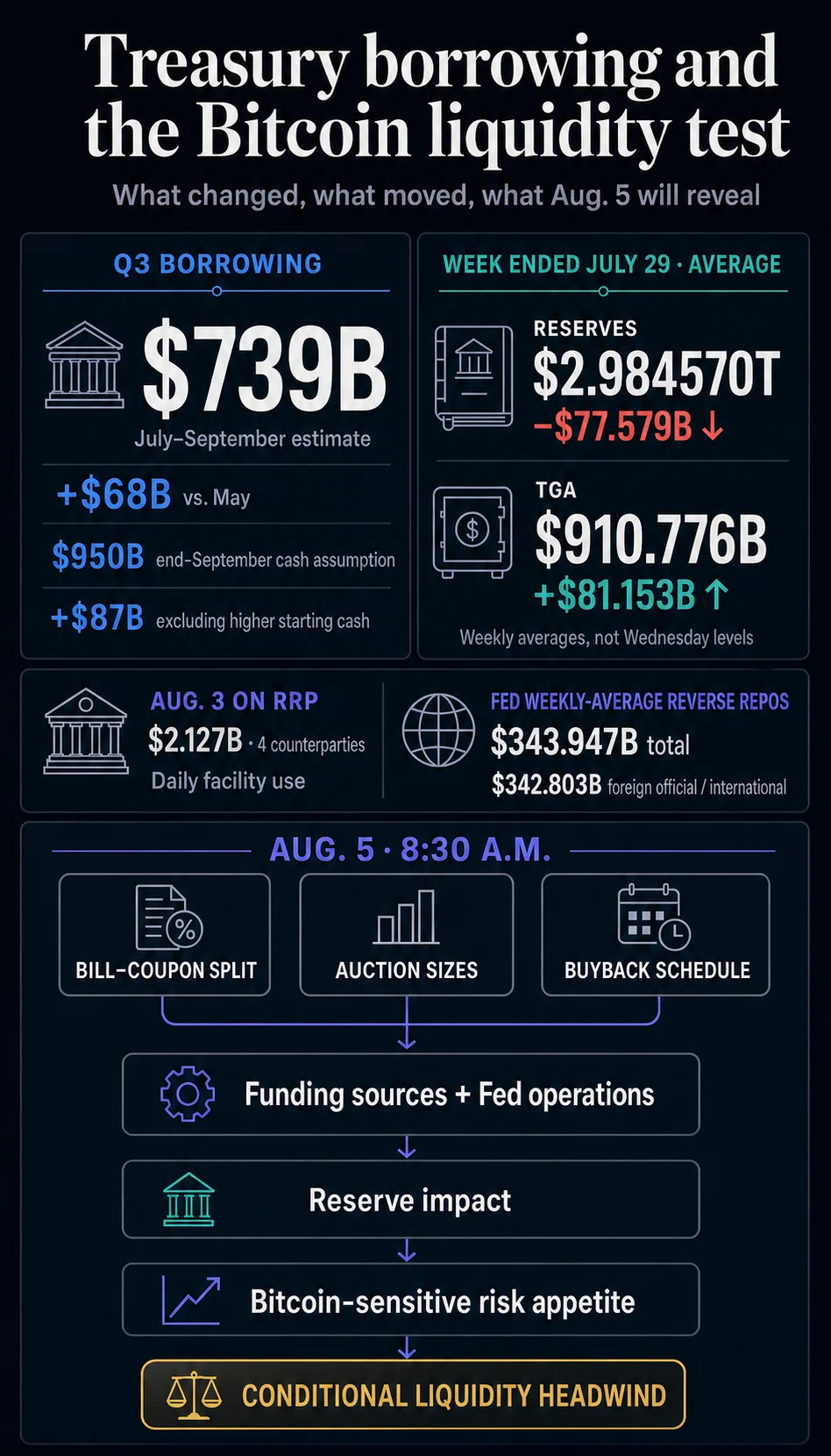
The financial markets are bracing for a significant liquidity event on August 5th, as the U.S. Treasury is poised to unveil its detailed financing plan for the third quarter. This announcement comes at a critical juncture, with recent data indicating a substantial outflow from bank reserves and an upward revision in the Treasury’s borrowing estimates. The interplay of these factors is drawing intense scrutiny, particularly concerning its potential impact on Bitcoin and broader risk appetite in the financial ecosystem.
Background: The Delicate Balance of Bank Reserves and Treasury Operations
Bank reserves, the funds that commercial banks hold at the Federal Reserve, play a crucial role in the monetary system. They are essential for banks to meet their reserve requirements, facilitate interbank lending, and support overall credit creation. Fluctuations in bank reserves can have ripple effects throughout the economy, influencing interest rates, lending activity, and asset prices.
The U.S. Treasury, responsible for managing the nation’s debt, influences these reserves through its borrowing and spending activities. When the Treasury collects taxes or issues debt, it draws funds from the economy, potentially reducing the amount of cash available in the banking system. Conversely, when the Treasury spends money, it injects liquidity back into the economy.
The Federal Reserve’s balance sheet management, including its open market operations and reserve requirements, also significantly impacts bank reserves. The Fed can use tools like quantitative easing or tightening to influence the overall level of liquidity in the financial system.
Recent Developments: A Draining of Reserves and Increased Borrowing Needs
Recent data points to a notable contraction in bank reserves. For the week ending July 29, weekly-average bank reserves experienced a decline of $77.579 billion. This decrease contrasts with the preceding week, highlighting a trend of liquidity withdrawal from the banking sector.
Simultaneously, the U.S. Treasury revised its borrowing estimate upwards for the period of July through September. The Treasury’s press release on August 3rd projected an end-September cash balance of $950 billion. When compared against the May 4th baseline, this represents an increase of $68 billion in projected borrowing needs. Further analysis reveals that after accounting for a $19 billion higher starting balance, the revised borrowing requirement escalates to $87 billion. This upward adjustment is primarily attributed to lower projected net cash flows, indicating a greater reliance on market financing.

It is crucial to note that the Treasury’s borrowing estimate is a net figure, reflecting the overall financing required to maintain its desired cash balance. This estimate excludes certain adjustments related to SOMA (System Open Market Account) auction add-on rollovers but includes financing for SOMA redemptions. While the Treasury’s figures focus on government financing, the downstream effects on cash and funding markets are where Bitcoin and other risk assets enter the equation.
The Federal Reserve’s Role and Conflicting Signals
The Federal Reserve’s H.4.1 release, which details its balance sheet, provides further insight into the dynamics of bank reserves. For the week ending July 29, weekly-average reserve balances stood at $2.984570 trillion, a decrease from $3.062149 trillion reported for the week ending July 22.
Interestingly, during the same period, the Treasury General Account (TGA), the Treasury’s primary cash account held at the Fed, saw a significant increase. From $829.623 billion to $910.776 billion, this rise in the TGA suggests that the Treasury was accumulating cash. On Wednesday, July 29th, the TGA stood at $970.442 billion, a substantial jump from $81.153 billion compared to the previous week’s average, and was the largest contributing factor to the $89.880 billion weekly-average increase in deposits other than reserve balances.
This confluence of events—a decline in bank reserves alongside a rise in the TGA—indicates a complex interplay of forces affecting liquidity. While the Treasury’s cash accumulation likely contributed to the reserve drain, other factors on the Fed’s balance sheet also played a role. The precise allocation of buyer funding sources and the Fed’s own operational activities can redirect the flow of liquidity, making it challenging to establish a direct, singular cause-and-effect relationship between Treasury cash levels and reserve declines.
The August 5th Financing Mix: A Critical Liquidity Test
The upcoming August 5th financing package from the U.S. Treasury is poised to be a pivotal moment for assessing the market’s liquidity conditions and, by extension, Bitcoin’s sensitivity to these factors. The Treasury is scheduled to release the detailed Q3 financing plan at 8:30 a.m. Eastern Time on August 5th. This package will break down the total borrowing requirement into specific instruments, including the split between Treasury bills and Treasury coupons, as well as the auction sizes for each. The inclusion of a buyback schedule will further refine the picture of the Treasury’s debt management strategy.
The composition of this financing mix will offer critical clues about where the Treasury intends to place the weight of its borrowing. A strategy heavily weighted towards Treasury bills, which are short-term debt instruments, typically draws liquidity from the short-term funding markets. The source of funds for investors purchasing these bills—whether from money market funds, institutional investors, or other entities—will determine the extent to which these operations impact broader bank reserves.
Conversely, an increased issuance of longer-dated Treasury coupons would signal a greater reliance on demand for fixed-income assets with longer maturities. This could potentially affect institutional investors’ appetite for other assets, including riskier ones like Bitcoin.

Expert Commentary and Market Indicators
Market participants are closely watching for any signals that could indicate potential liquidity tightening. In remarks delivered on July 9th, Roberto Perli, SOMA Manager at the New York Fed, noted that while reserves were generally considered ample, a substantial net issuance of Treasury bills in July and August 2026 could lead to tighter money markets. Perli, speaking in his personal capacity, also acknowledged the Fed’s flexibility to adjust reserve management purchases as market conditions evolve.
The New York Fed’s overnight reverse-repo (ON RRP) operation provides another gauge of liquidity. On August 3rd, the ON RRP facility accepted $2.127 billion from four counterparties. While this figure represents a single-day snapshot, the average for the week ending July 29th stood at $343.947 billion. Notably, a significant portion of this balance, $342.803 billion, was held by foreign official and international accounts, which are segregated from domestic overnight facility balances. The ON RRP facility acts as a floor for short-term interest rates by offering a safe place for market participants to park cash, and changes in its usage can signal shifts in the availability of liquid funds.
Implications for Bitcoin and Risk Appetite
The August 5th financing announcement is critical for Bitcoin and other risk-sensitive assets due to the direct and indirect ways that Treasury operations can influence financial liquidity.
- Liquidity Drain and Risk Appetite: A heavy reliance on short-term Treasury bill issuance could draw significant liquidity from money markets. If the funding sources for these bills are predominantly from entities that would otherwise be investing in riskier assets, it could lead to a reduction in capital available for Bitcoin and other cryptocurrencies. This, in turn, could exert downward pressure on Bitcoin’s price.
- Interest Rate Sensitivity: Increased Treasury borrowing, particularly if accompanied by rising yields, can make fixed-income investments more attractive relative to riskier assets. This could lead to a reallocation of capital away from Bitcoin towards safer, yield-bearing instruments.
- Market Sentiment: The overall tenor of the Treasury’s financing plan and any accompanying commentary can significantly influence market sentiment. A perceived tightening of liquidity or an indication of increased government borrowing needs could foster a more cautious investment environment, leading to a risk-off sentiment that negatively impacts Bitcoin.
- The "Liquidity Trap" Scenario: The term "liquidity trap" suggests a situation where injecting more money into the economy fails to stimulate borrowing or spending. In this context, a massive drain of reserves, coupled with increased Treasury borrowing, could create a scenario where financial conditions tighten significantly, making it more challenging for risk assets to find demand.
Looking Ahead: Monitoring the Aftermath
The true impact of the August 5th financing mix will become clearer in the days and weeks that follow. Market participants will be closely observing several key indicators:
- Actual Auction Results: The success of Treasury bill and coupon auctions, including the bid-to-cover ratios and yields, will reveal the market’s appetite for different debt maturities.
- Bank Reserve Levels: Continued monitoring of the Federal Reserve’s H.4.1 release will show whether bank reserves continue to decline or stabilize.
- Short-Term Interest Rates: Changes in the Federal Funds Rate, repo rates, and other short-term funding costs will indicate the tightness of liquidity.
- Bitcoin’s Price Action and Trading Volume: The cryptocurrency market’s reaction to the Treasury’s actions will provide a direct assessment of how Bitcoin and other digital assets are being impacted.
The interplay between U.S. Treasury financing operations and the broader financial markets, particularly the cryptocurrency space, remains a critical area of focus. The August 5th announcement is expected to provide a significant data point in understanding these dynamics and their implications for investor risk appetite. The ability of the market to absorb this financing without a substantial disruption to Bitcoin’s liquidity and broader risk sentiment will be a key test.