admin
admin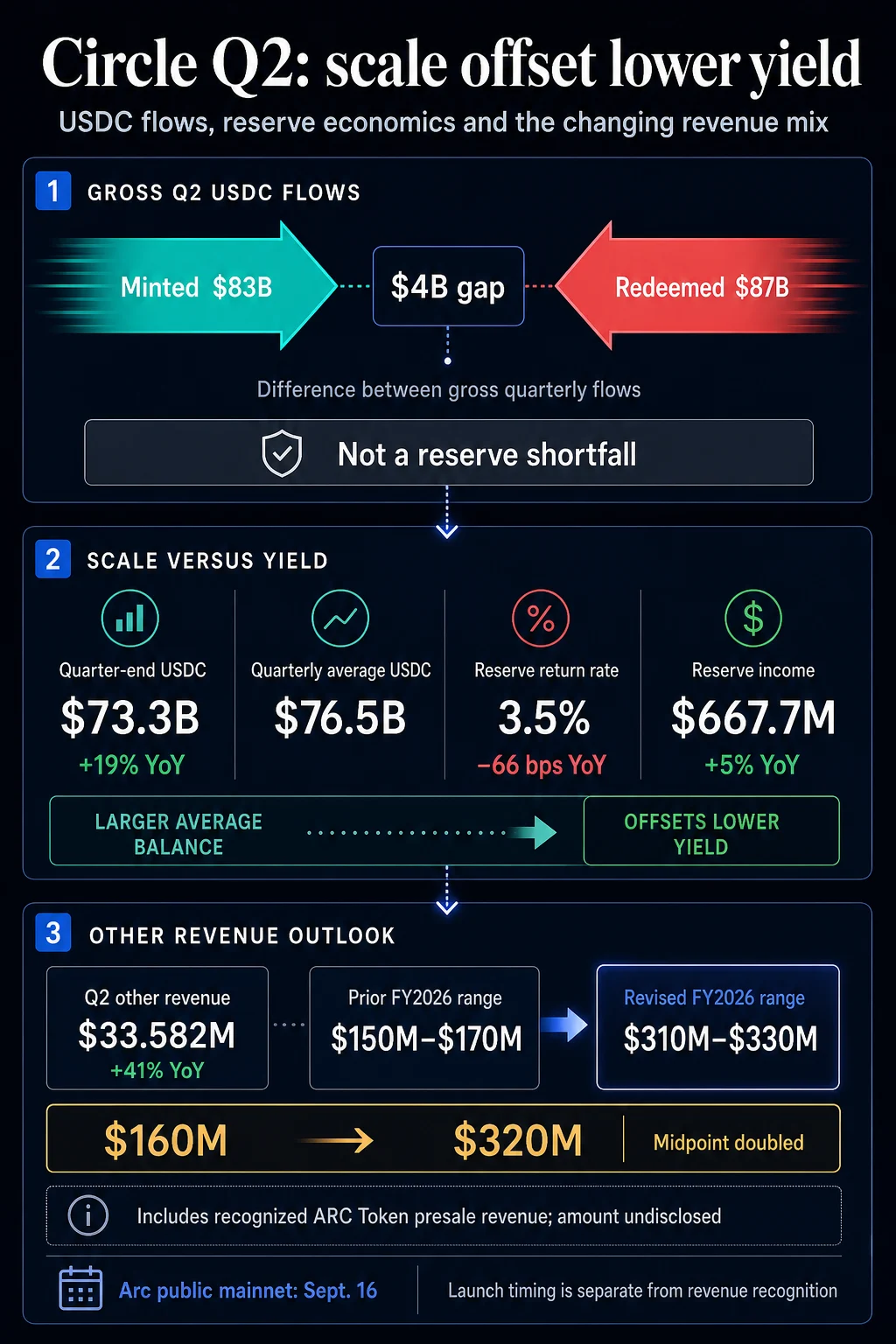
Circle’s robust stablecoin ecosystem navigated a challenging second quarter, as redemptions for its USD Coin (USDC) notably exceeded mints by approximately $4 billion. This outflow occurred against a backdrop of declining reserve yields, a factor that has intensified scrutiny on an undisclosed but significant contribution from the ARC Token presale, which is dramatically reshaping the company’s revenue projections. Despite the net outflow in customer-driven token movements, the overall circulation of USDC remained resilient, registering a substantial 19% year-over-year increase.
The latest financial disclosures from Circle, released on August 5, 2026, reveal a complex interplay of forces impacting its core operations. Gross redemptions for USDC totaled $87 billion, while minting activity reached $83 billion during the second quarter. This $4 billion differential represents the net flow of funds out of the USDC ecosystem as perceived by its customers. For users of Circle Mint, the platform for minting and redemption, this process involves converting fiat currency into USDC and vice versa. It is crucial to distinguish this customer flow activity from the operational adequacy of Circle’s reserves, which are meticulously managed to ensure the stablecoin’s peg.
Despite the net customer outflow, the total circulation of USDC at the close of the quarter stood at $73.3 billion. While this figure was slightly below the quarterly average of $76.5 billion, it still represented a significant 19% growth compared to the same period in the previous year. This sustained growth in circulation indicates a continued demand for USDC as a digital dollar, even as some users chose to convert their holdings back to fiat.
A key factor influencing Circle’s profitability during the quarter was the performance of its reserve assets. The reserve return rate experienced a decline, falling by 66 basis points year-over-year to 3.5%. This reduction in yield is attributed to broader market conditions and shifts in the Federal Reserve’s monetary policy. The Federal Reserve maintained its target range for the federal funds rate between 3.50% and 3.75% throughout both April and June of 2026, a period that saw a deceleration in the yield Circle could generate from its reserve portfolio. However, Circle managed to mitigate the impact of this lower yield through an expansion of its overall USDC balance. This larger base of circulating USDC, despite the reduced rate, led to a 5% increase in reserve income, which reached $667.7 million for the quarter.
The ARC Token Presale: A Game Changer for "Other Revenue"
While the dynamics of USDC minting and redemption, along with reserve performance, form the core of Circle’s operational narrative, the company’s "other revenue" stream has emerged as a significant growth engine, largely driven by an undisclosed contribution from the ARC Token presale. This segment of Circle’s business, which encompasses revenues beyond those generated directly from its stablecoin reserves, saw a substantial year-over-year increase of 41%, reaching $33.582 million for the quarter.
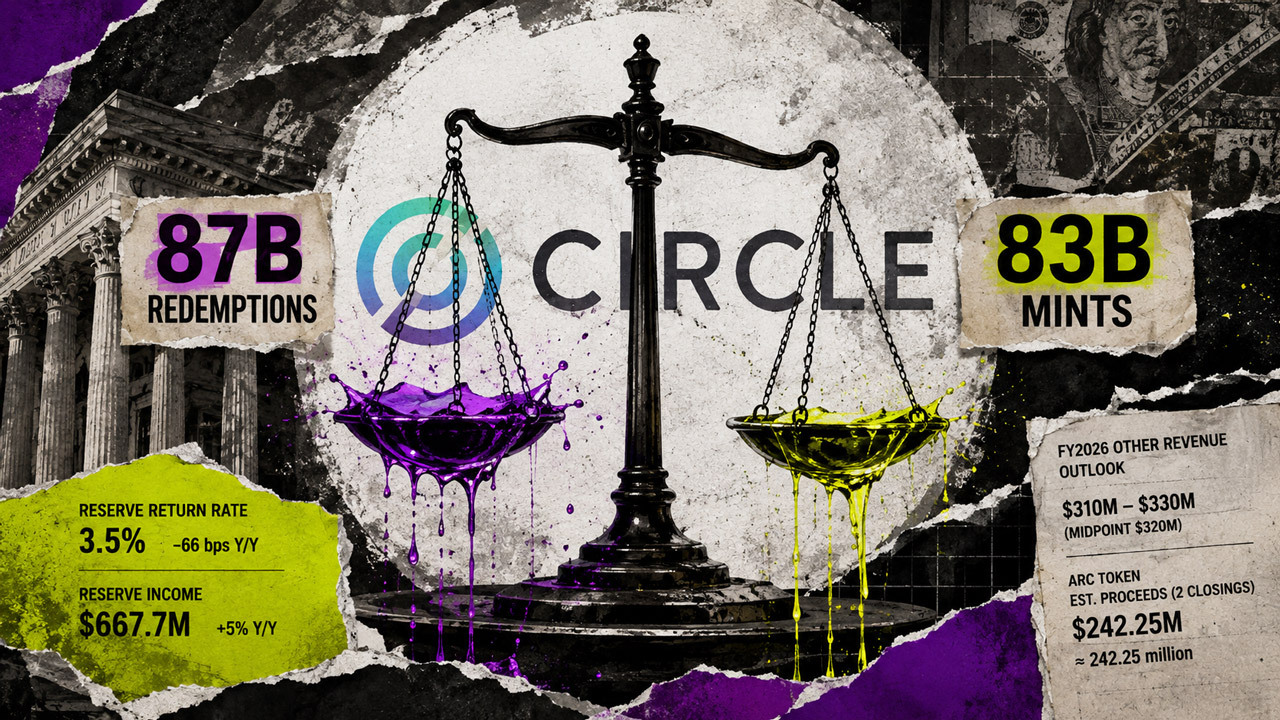
However, the most striking development lies in Circle’s revised revenue outlook for the full fiscal year 2026. The company has dramatically increased its guidance for "other revenue" to a range of $310 million to $330 million. This represents a near doubling of the midpoint of its previous outlook, which stood at $150 million to $170 million, as issued in May 2026. The midpoint of the revised guidance has leaped from $160 million to $320 million, signaling a profound shift in the company’s revenue expectations.
Circle has explicitly stated that this revised range incorporates recognized revenue from the ARC Token presale. Crucially, the company has not provided a specific breakdown of the ARC Token contribution, leaving its precise impact on the overall outlook as a subject of considerable interest. This lack of granular detail has amplified scrutiny, particularly given the substantial increase in the revenue forecast.
Background on the ARC Token and Circle’s Blockchain Ambitions
The ARC Token is integral to Arc, Circle’s proprietary blockchain network. Circle has previously disclosed financial details pertaining to the token’s development and fundraising. In earlier filings, the company reported an estimated $222 million in gross proceeds from the initial ARC Token closing, followed by an additional $20.25 million from a second closing. In total, these two closings generated approximately $242.25 million in estimated proceeds. It is important to note that these figures represent estimated proceeds from token sales, not necessarily recognized revenue. Furthermore, the purchase agreements for the ARC Token presale contain repayment rights under specific circumstances, adding a layer of complexity to the financial implications.
The public mainnet launch of Arc is slated for September 16, 2026. The earnings release clearly delineates the date of the mainnet launch as a separate event from the recognition of token revenue. This distinction is significant, as it suggests that the revenue being recognized is tied to the presale activities and not necessarily to the immediate operational performance of the Arc network post-launch.
Analysis of Implications and Market Context
The substantial increase in Circle’s "other revenue" outlook, primarily attributed to the ARC Token presale, has several important implications. Firstly, it highlights Circle’s strategic diversification beyond its stablecoin operations. While USDC remains its flagship product and a critical component of the digital asset economy, the company is actively developing and monetizing other ventures within the blockchain and Web3 space.
Secondly, the undisclosed nature of the ARC Token contribution raises questions about transparency and the potential volatility associated with this new revenue stream. While presales can generate significant upfront capital, their long-term revenue realization is often subject to market performance, adoption rates, and regulatory developments. The fact that this single, undisclosed contribution is responsible for nearly doubling the company’s "other revenue" forecast underscores its importance and the potential risks associated with over-reliance on such a concentrated source.

Thirdly, the context of declining reserve yields for USDC adds further weight to the significance of the ARC Token revenue. As the profitability of holding and managing reserves becomes more challenging in a low-yield environment, companies like Circle are increasingly incentivized to seek out and capitalize on alternative revenue streams. The ARC Token presale appears to have provided a timely and substantial boost in this regard.
The year-over-year increase in USDC circulation, despite the quarterly net outflow, suggests that the underlying demand for USDC as a stable medium of exchange and store of value remains robust. This resilience is a testament to the trust and widespread adoption that USDC has achieved in the market. However, the increasing focus on non-reserve-related revenue streams indicates a strategic pivot or an effort to enhance overall financial stability and growth in a dynamic market.
Market analysts are likely to closely monitor the performance of the Arc network post-launch and the actual recognized revenue from the ARC Token presale. The long-term success of this venture will be a key determinant of Circle’s future financial trajectory and its ability to maintain a diversified and sustainable business model in the rapidly evolving digital asset landscape. The company’s ability to clearly communicate the impact and sustainability of these new revenue streams will be critical in maintaining investor confidence and market perception.
The current market capitalization of USDC stands at approximately $71.75 billion, with a 24-hour trading volume of $9.22 billion. The circulating supply is closely aligned with its market capitalization, reflecting the stablecoin’s design to maintain a one-to-one peg with the US dollar. This stable performance in the core USDC market, juxtaposed with the significant growth in projected "other revenue," paints a picture of a company strategically navigating both the established and emerging frontiers of the digital economy. The coming quarters will undoubtedly provide further clarity on the interplay between Circle’s core stablecoin operations and its burgeoning ventures in the broader blockchain ecosystem.