admin
admin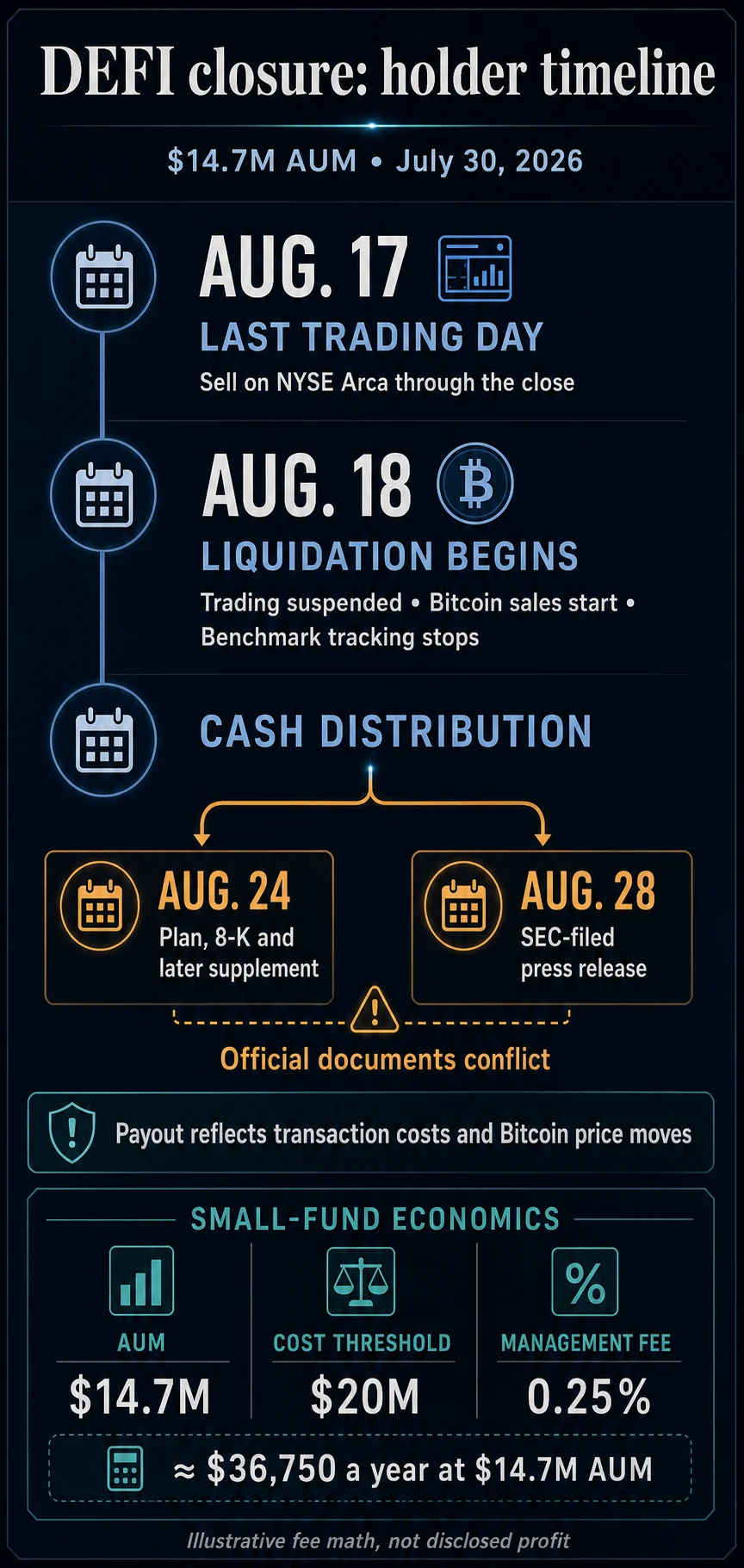
The Hashdex Bitcoin ETF, an early entrant in the cryptocurrency exchange-traded fund market that transitioned from a futures-based product to a spot Bitcoin fund in 2024 following the approval of the "Newborn Nine," is set to liquidate its approximately $14.7 million in assets. This closure, precipitated by a combination of escalating operational costs and a shrinking asset base, leaves investors with a rapidly approaching deadline to divest their holdings before the fund enters an unpredictable cash-out phase. The liquidation process, slated to commence on August 18, 2026, has introduced uncertainty regarding the final payout dates for shareholders, with official filings presenting conflicting timelines.
Key Dates and Investor Deadlines
Investors holding shares in the Hashdex Bitcoin ETF (ticker: DEFI) have until the close of NYSE Arca on August 17, 2026, to sell their positions on the open market. Failure to do so will result in their holdings being automatically processed through a cash wind-down as the fund begins its liquidation. This critical cutoff date signifies the cessation of creation and redemption basket orders, a mechanism essential for the creation and redemption of ETF shares in line with the underlying assets.
Following the trading halt on August 18, DEFI will commence the process of selling its Bitcoin holdings. Upon the completion of these sales, the ETF’s portfolio will shift entirely to cash, and it will cease to track its benchmark index. The availability of a secondary market for DEFI shares after trading suspension is considered uncertain, underscoring the urgency for investors to exit before this date.
Conflicting Payout Timelines Add to Investor Uncertainty
A significant point of contention and a source of considerable confusion for DEFI shareholders is the discrepancy in the projected payout dates for their liquidated assets. The official liquidation plan, filed with the U.S. Securities and Exchange Commission (SEC), along with Hashdex’s Form 8-K and a subsequent prospectus supplement, all suggest a cash distribution on or about August 24, 2026. However, a separate closure announcement also filed with the SEC provides a later date of August 28, 2026.
Adding to this ambiguity, Hashdex’s initial August 3 filing explicitly stated that these payout dates were subject to change. This divergence in official documentation leaves the precise timetable for investors to receive their cash proceeds unsettled, creating a palpable sense of unease within the shareholder community. The final payout will be determined by the net proceeds realized from the sale of Bitcoin, after accounting for all outstanding liabilities and transaction costs, including the expenses associated with liquidating the fund’s cryptocurrency holdings.

The Financial Squeeze: Operating Costs Outpace Assets
The primary catalyst for the Hashdex Bitcoin ETF’s closure has been identified as a persistent cost pressure that has rendered its continued operation unsustainable. The fund’s standing prospectus had previously warned that operating expenses could become "unreasonable" if the fund’s net asset value (NAV) fell below $20 million. As of July 30, 2026, DEFI reported approximately $14.7 million in assets under management (AUM). This significant shortfall between assets and the operational cost threshold created a financial squeeze, compelling Hashdex to initiate the wind-down.
The liquidation plan unequivocally states that maintaining the fund’s operation would be "unreasonable or imprudent" given the current financial standing. While the precise operating result that triggered this decision remains undisclosed in the filings, the annual management fee for the ETF is listed at 0.25%. On the July 30 AUM of $14.7 million, this would translate to approximately $36,750 in gross management fees annually, before the deduction of other fund expenses. The escalating operational costs, combined with the declining asset base, likely created a deficit that Hashdex deemed unrecoverable.
Market Context: The Evolution of Bitcoin ETFs
The Hashdex Bitcoin ETF was one of the earlier players in the burgeoning Bitcoin ETF landscape. Initially launched as a futures-based product, it was subsequently converted to a spot Bitcoin ETF in 2024. This conversion was part of a wave of approvals that saw several U.S. spot Bitcoin ETFs enter the market, often referred to as the "Newborn Nine." The spot ETFs offered investors direct exposure to Bitcoin without the complexities and potential tracking errors associated with futures contracts.
However, the competitive landscape for Bitcoin ETFs has become increasingly crowded and aggressive. The approval of multiple spot Bitcoin ETFs by the SEC led to intense competition for market share and assets. While larger players like BlackRock and Fidelity have managed to attract substantial inflows, smaller or earlier-stage ETFs have faced greater challenges in scaling their operations and managing costs effectively. The closure of DEFI highlights the economic realities of operating an ETF in a highly competitive environment, where achieving sufficient AUM is crucial for covering operational expenses and remaining profitable.
Implications for Investors and the Broader Market
The liquidation of the Hashdex Bitcoin ETF carries several implications for its shareholders and the broader cryptocurrency investment market. For DEFI holders, the immediate concern is the potential for losses due to the fluctuating price of Bitcoin during the liquidation period. The fund’s announcement warned that "Bitcoin may swing during the liquidation window, and Hashdex warned that the move could be substantial." This volatility introduces an element of risk for those who do not exit before the August 17 deadline.

Furthermore, the tax implications of this liquidation are significant. The liquidation plan treats the cash distribution as a liquidating distribution from a partnership for U.S. federal income tax purposes. This classification means that the tax treatment will vary depending on each individual holder’s circumstances, such as their cost basis in the ETF shares and any capital gains or losses realized. Hashdex has strongly advised its investors to consult with their own tax advisors to understand the specific tax consequences of the liquidation.
On a broader level, the closure of a spot Bitcoin ETF, even one with a relatively modest AUM, can be interpreted as a signal of the challenges faced by some firms in the nascent cryptocurrency ETF market. While the overall market for Bitcoin ETFs has seen significant growth and investor interest, this event underscores that not all participants will succeed. It suggests that economies of scale and efficient cost management are paramount for long-term viability in this sector.
The differing payout dates also highlight the importance of clear and consistent communication from financial institutions, especially during periods of significant corporate action like liquidation. Investors rely on accurate and timely information to make informed decisions, and conflicting statements can erode trust and create undue stress.
Hashdex’s Position and Future Outlook
While the provided information focuses on the mechanics of the liquidation, it is reasonable to infer that Hashdex, as the sponsor, has made this decision after careful consideration of its fiduciary responsibilities to its shareholders. The company is undertaking the responsibility for covering remaining liquidation expenses, a move that aims to mitigate further costs for investors.
Hashdex’s involvement in the Bitcoin ETF market is not solely defined by this single product. The company has expressed a commitment to offering innovative digital asset investment products. The closure of the DEFI ETF is a specific, fund-level decision driven by its unique financial circumstances, rather than an indictment of Hashdex’s broader strategy or its belief in the long-term potential of Bitcoin or other digital assets.
The market will continue to observe how other Bitcoin ETFs navigate the competitive landscape. Factors such as fee structures, product innovation, marketing strategies, and institutional adoption will play crucial roles in determining the success and longevity of these investment vehicles. The Hashdex Bitcoin ETF’s journey, from its inception to its impending liquidation, serves as a case study in the dynamic and often challenging environment of cryptocurrency-focused exchange-traded products. Investors in DEFI will be keenly watching the final days of August for clarity on their distributions and will need to navigate the tax implications of this event.