admin
admin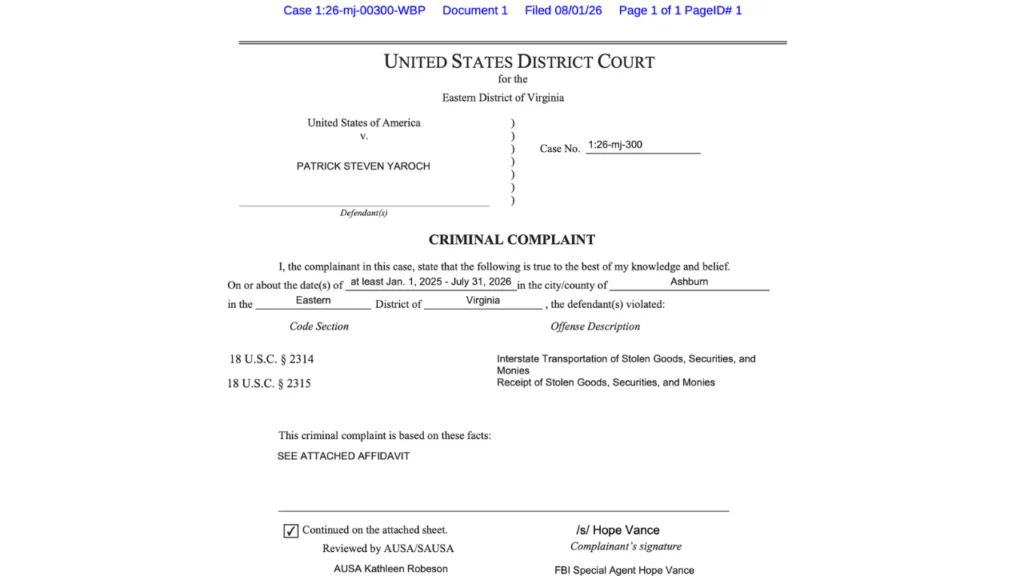
A former supervisory special agent with the Federal Bureau of Investigation, Patrick Steven Yaroch, has been formally charged with the theft of nearly $1 million in cryptocurrency, allegedly siphoned from digital wallets under active surveillance as part of a sensitive counterintelligence investigation. This high-profile case casts a stark light on the inherent risks of insider abuse within national security apparatuses, particularly as law enforcement increasingly navigates the complex landscape of digital assets in critical probes. Yaroch, who previously held a top-secret security clearance and was assigned to the FBI’s Counterintelligence Division, is accused of exploiting his highly privileged access to internal bureau systems to illicitly transfer cryptocurrency from wallets monitored by the FBI into accounts he personally controlled. His arrest on July 31 followed an alleged confession, with detailed court documents outlining the intricate scheme unsealed on August 1.
Allegations of Exploiting Privileged Access for Personal Gain
According to the criminal complaint filed in the U.S. District Court for the Eastern District of Virginia, the allegations against Yaroch paint a troubling picture of a trusted agent turning against the very systems he was sworn to protect. Yaroch was reportedly deeply involved in investigations targeting an unnamed "adversarial nation," granting him unparalleled access to highly sensitive intelligence, including the specific cryptocurrency wallets linked to a foreign target. These wallets were not immediately seized by the FBI but were instead under continuous monitoring as part of an ongoing intelligence operation, a common tactic designed to track transactions, identify networks, and gather further intelligence without alerting the targets.
Prosecutors allege that Yaroch became increasingly frustrated with what he perceived as government inaction regarding the prolonged monitoring and continued use of these crypto accounts. This alleged frustration, detailed in court filings, reportedly served as a catalyst for his subsequent actions. He is accused of leveraging his authorized access to obtain the recovery seed phrases for these monitored wallets. Seed phrases, typically a series of 12 or 24 words, are the master key to cryptocurrency wallets, providing complete control over the assets held within. With these critical credentials in hand, Yaroch allegedly created personal wallets and systematically transferred the cryptocurrency into accounts under his direct control. Investigators estimate that he carried out approximately 10 unauthorized transfers over a period exceeding a year while still actively serving in the bureau. The initial value of the stolen assets was estimated at over $900,000, which, according to statements Yaroch allegedly made to investigators, later appreciated to roughly $1 million, underscoring the volatile nature of digital currencies. He now faces federal charges of interstate transportation of stolen property and receipt of stolen property.
A Chronology of Deception and Confession
The timeline of events leading to Yaroch’s arrest reveals a gradual unraveling of his alleged scheme, culminating in an emotional confession. The investigation reached a critical juncture on July 28 when Yaroch reportedly initiated contact with a Department of Justice (DOJ) employee via Signal, an encrypted messaging application, requesting a private meeting. This unusual overture from a high-ranking FBI agent to a DOJ official immediately raised suspicions.

Following this request, Yaroch met with the official at FBI headquarters. During this meeting, prosecutors allege he became visibly emotional and, without prompt, admitted to stealing the cryptocurrency. This confession marked a significant turning point, providing investigators with the direct admission they needed to advance their case. Days later, FBI agents conducted an interview with Yaroch at his Virginia residence. During this interview, the affidavit states that Yaroch further acknowledged his actions, allegedly telling investigators, "I f***ed up." This candid admission, coupled with the prior confession, solidified the case against him.
Subsequent searches of his residence yielded a trove of incriminating evidence. Investigators recovered a Trezor hardware wallet, a physical device designed to securely store cryptocurrency offline, which contained significant digital assets. Alongside the hardware wallet, handwritten cryptocurrency seed phrases were discovered, further linking Yaroch to the illicitly accessed wallets. Digital assets were also found stored in a Kraken exchange account associated with Yaroch. Court filings indicate that this account alone contained approximately $188,570 in various assets, including around $166,000 in cash, nearly $18,000 in USD Coin (USDC), and smaller holdings of Bitcoin and other cryptocurrencies. The swift action by the FBI led to Yaroch’s immediate suspension, followed by the termination of his employment and his arrest just days later. An FBI spokesperson confirmed the bureau’s decisive response, stating, "As soon as the FBI became aware of these allegations, we immediately took action, began an investigation, and ultimately executed an arrest warrant." The bureau reiterated its commitment to upholding the highest ethical standards, emphasizing that it does not tolerate misconduct from its employees.
The Unprecedented Role of ChatGPT Searches as Evidence
One of the most intriguing and novel aspects of this criminal complaint is the prosecutors’ incorporation of Yaroch’s conversations with an artificial intelligence chatbot, ChatGPT, as part of the evidentiary record. This marks a potentially groundbreaking moment in U.S. legal proceedings, highlighting the evolving nature of digital forensics and the increasing relevance of AI interactions in criminal investigations.
Upon examining Yaroch’s phone, investigators uncovered a series of prompts and queries he had posed to ChatGPT, primarily revolving around managing wealth and relocating overseas. According to the affidavit, Yaroch first sought advice on how an individual with approximately $1 million could best invest the money to maximize returns. Days later, his inquiries became more specific and pointed, as he allegedly asked: "If you had a bucket of money (around $1 million) and you wanted to leave the USA and become a resident or citizen of an EU country, what would you do?" ChatGPT, leveraging its advanced language model, responded with detailed recommendations tailored to his presumed age, family circumstances, and expressed interest in moving to specific regions of Portugal or southern Italy, known for their favorable residency programs for investors.
Further investigation into Yaroch’s digital footprint revealed additional incriminating searches. These included queries concerning travel through Turkey, the process of moving to Greece, and drafts of emails related to overseas employment opportunities. Authorities also recovered concrete travel plans for Yaroch and his family to visit Portugal in September 2026, alongside various documents pertaining to Portugal. Moreover, records of several foreign trips he had already undertaken were discovered, trips that prosecutors allege had not been reported internally as required under strict FBI regulations for employees with sensitive access. These ChatGPT interactions and travel-related findings paint a picture of an individual actively planning a new life abroad, potentially using ill-gotten gains.
Broader Implications: Insider Threats, Digital Assets, and AI in Law Enforcement

The case of Patrick Steven Yaroch transcends a mere instance of theft; it resonates with significant broader implications for national security, financial crime investigations, and the evolving landscape of digital forensics. It starkly underscores the persistent vulnerability of even the most secure institutions to insider threats, a risk that is amplified when vast sums of digital assets are involved in sensitive investigations.
Insider Threats in the Digital Age: Intelligence and law enforcement agencies are inherently susceptible to insider threats, where trusted individuals exploit their access for malicious purposes. In the digital age, this threat vector has become more complex. Agents like Yaroch are granted extensive access to digital systems and sensitive information, including cryptographic keys and wallet seed phrases, which are the ultimate control mechanisms for digital assets. This case highlights that the "human element" remains the most critical vulnerability, even when robust technological safeguards are in place. The fact that Yaroch could allegedly obtain these confidential wallet credentials, available only through FBI systems, points to a potential gap in access controls or monitoring, or an extreme abuse of trust.
Cryptocurrency in National Security Investigations: The growing importance of cryptocurrency in national security and financial crime investigations cannot be overstated. Federal agencies routinely monitor digital wallets associated with ransomware groups, sanctioned entities, cybercriminals, terrorist organizations, and foreign intelligence operations. These digital assets often serve as critical breadcrumbs, allowing investigators to trace illicit financial flows, identify networks of conspirators, and gather intelligence on adversarial activities. The decision to monitor wallets rather than immediately seize assets, as was the case here, is a calculated strategic choice made on a case-by-case basis. It’s a delicate balance between preserving evidence for intelligence gathering and preventing the further use of illicit funds. Yaroch’s alleged actions not only diverted funds but potentially compromised an ongoing intelligence operation by disrupting the monitoring chain.
The Novelty of AI-Generated Conversations as Evidence: The inclusion of Yaroch’s ChatGPT conversations as evidence marks a significant development in criminal jurisprudence. While digital communications and internet search histories have long been admissible, AI interactions present new challenges and opportunities. These conversations offer a window into a suspect’s thought process, intentions, and planning, potentially providing a richer context than traditional search queries. This case could set a precedent for how AI-generated evidence is collected, presented, and challenged in court, raising questions about data privacy, the reliability of AI models, and the interpretation of human-AI interactions. Alongside blockchain transaction records, prosecutors in this case relied on a comprehensive array of digital and physical evidence, including data recovered from Yaroch’s phone, cryptocurrency wallets, exchange accounts, handwritten seed phrases, travel documents, and his alleged confession.
Institutional Response and Public Trust: The FBI’s swift response – immediate investigation, suspension, termination, and arrest – is crucial for maintaining institutional integrity and public trust. Incidents of insider theft within law enforcement can severely erode confidence in these critical agencies. By demonstrating decisive action, the FBI aims to reassure the public that misconduct is not tolerated and that accountability is paramount. However, the incident will undoubtedly prompt internal reviews of security protocols, access management for sensitive digital assets, and the monitoring of employee behavior, especially those with top-secret clearances and access to high-value digital targets.
Patrick Steven Yaroch remains in federal custody in Virginia as the criminal proceedings against him continue. As with all criminal defendants, he is presumed innocent unless and until proven guilty in a court of law. Should he be convicted, this case would not only represent one of the most significant insider theft cases involving cryptocurrency handled by the FBI but also one of the first major U.S. prosecutions in which conversations with artificial intelligence, specifically ChatGPT, play a notable and integral role in the government’s presentation of evidence. The outcome of this case will undoubtedly have lasting implications for how law enforcement agencies manage digital assets, combat insider threats, and adapt to the rapidly evolving technological landscape.