admin
admin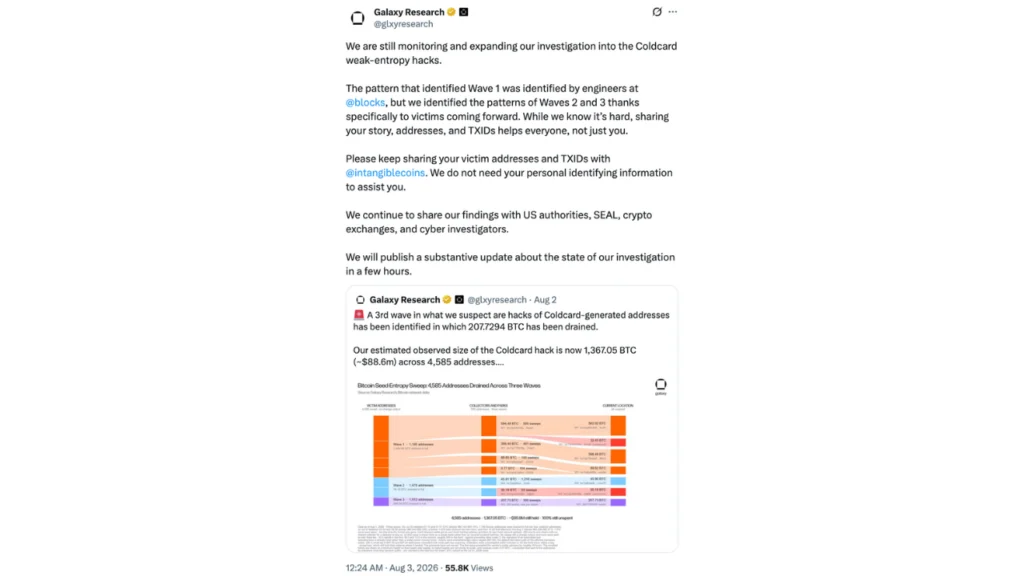
A sophisticated and rapidly expanding attack campaign, leveraging a long-dormant vulnerability in specific Bitcoin cold wallets, has now resulted in the theft of nearly $89 million worth of BTC from more than 4,500 unique wallet addresses. Blockchain researchers, closely tracking the illicit activity, warn that the campaign, which specifically targets wallets initialized with a vulnerable COLDCARD firmware released in March 2021, has progressed through multiple distinct waves and shows signs of potentially ongoing exploitation. This incident underscores a critical, albeit rare, security risk within the hardware wallet ecosystem: a fundamental flaw introduced during the initial wallet creation process can irrevocably compromise even the most diligently air-gapped and physically secured digital assets.
According to analysis by Onchain Lens, a prominent blockchain analytics firm, the exploit does not involve a direct compromise of the hardware wallet device itself. Instead, the attackers have ingeniously managed to reproduce the private keys associated with these vulnerable wallets. This reproduction is possible because the affected wallets were generated using recovery seeds with significantly weakened cryptographic entropy, making them susceptible to brute-force or deterministic attacks. This technical nuance means that even wallets that have remained offline for years, meticulously safeguarded against network-based threats, are now vulnerable to being drained by attackers who can derive their private keys entirely off-device. The revelation sends a chilling message to long-term Bitcoin holders who have relied on hardware wallets as the ultimate bastion of security for their digital wealth.
The Genesis of a Deep-Seated Flaw
The root cause of this widespread compromise dates back to a specific firmware release for COLDCARD hardware wallets in March 2021. COLDCARD, a popular choice among advanced Bitcoin users for its robust security features and air-gapped transaction signing capabilities, inadvertently introduced a critical bug in this particular version. Instead of utilizing the device’s secure hardware random number generator (HRNG) to create the foundational recovery seeds for new wallets, the faulty firmware defaulted to a less secure, predictable software randomizer.
Cryptographic entropy is paramount in generating secure private keys. A true random number generator produces unpredictable, unique sequences, ensuring that the vastness of possible private keys makes brute-force guessing practically impossible. When a software randomizer with insufficient entropy is used, the range of possible seeds shrinks dramatically, making them susceptible to a "seed dictionary attack" where an attacker systematically tests a limited set of predictable seeds until a match is found. Once a weak recovery seed is generated, the Bitcoin private keys derived from it are inherently compromised, regardless of how securely the physical device is stored or whether it ever connects to the internet. This fundamental flaw renders the core security promise of a hardware wallet—the secure, offline generation of private keys—null for affected users.

A Coordinated Onslaught: Three Confirmed Attack Waves
The initial signs of this sophisticated campaign surfaced dramatically on July 30. In a swift, coordinated operation lasting just 41 minutes, approximately 1,083 BTC, valued at over $70 million at current market prices, was stolen from 1,196 distinct Bitcoin addresses. The sheer speed and synchronized nature of these transactions immediately suggested that the perpetrator had already pre-computed and mapped a substantial portion of the vulnerable key space, enabling them to execute automated wallet sweeps with alarming efficiency. This initial wave targeted wallets with larger balances, indicating a strategic focus on maximizing immediate gains.
A second attack wave quickly followed, capitalizing on the momentum and likely the continued identification of vulnerable addresses. However, it was the third confirmed wave, unfolding over the subsequent weekend, that revealed a significant shift in the attacker’s tactics and scope. This phase broadened its focus to include wallets with much smaller balances, suggesting either a comprehensive sweep of remaining vulnerable targets or a new operational strategy to avoid detection by spreading the stolen amounts. According to detailed estimates from Galaxy Research, an investment management firm with a dedicated blockchain research division, roughly 207.7 BTC was drained during this latest confirmed phase. This brought the total observed losses across the three waves to approximately 1,367 BTC, now valued at nearly $89 million, impacting a staggering 4,585 unique Bitcoin addresses.
Researchers meticulously observing the illicit transfers also noted a discernible evolution in the attacker’s operational behavior between the waves. Initially, there might have been a tendency to consolidate stolen funds into a limited number of collector wallets. However, in later waves, each victim’s Bitcoin was routed to a separate destination address. This dispersal strategy is a classic tactic designed to complicate blockchain tracing and forensic analysis, making it significantly harder for investigators to follow the money trail and identify potential laundering avenues. Furthermore, the attacker transitioned to using Pay-to-Witness-Script-Hash (P2WSH) outputs, which offer more advanced spending conditions like multisignature or timelock scripts. This change could be an attempt to add another layer of obfuscation or prepare for more complex fund dispersal mechanisms.
Compounding the tactical shifts, each transaction in the later waves swept funds from multiple victims simultaneously, a marked improvement in efficiency compared to the first wave where addresses were emptied one by one. Galaxy Research analysts posit that these operational changes could signify two possibilities: either the same attacker is adapting their methods in response to increased public scrutiny and blockchain monitoring, or a distinct, second actor has independently identified and begun exploiting the same set of vulnerable wallets, leveraging similar technical capabilities.
A Lingering Threat: Warnings of a Possible Fourth Wave
The ominous campaign shows no definitive signs of abatement. On August 3, just days after the initial discovery, Alex Thorn, Head of Research at Galaxy Research, publicly identified transaction patterns consistent with what appears to be a fourth attack wave. Over a period of approximately 2.5 hours, researchers detected 218 suspicious transactions originating from 462 suspected victim addresses. This surge in activity was approximately 45 times higher than normal baseline transaction volumes, indicating a deliberate and concentrated effort.

After meticulously filtering out potential false positives and excluding multisignature wallets (which are generally less susceptible to this specific exploit due to their multi-key requirement), Galaxy Research narrowed the suspected dataset to approximately 709 addresses holding around 448.7 BTC. Thorn, however, provided a crucial caveat: this latest phase has not yet been definitively confirmed through direct victim reports, as the analysis relies primarily on observed transaction patterns. Despite this uncertainty, Galaxy Research swiftly published its findings, driven by the critical need to alert potential victims who might still have a fleeting window of opportunity to protect their remaining funds.
A Brief Window for Fund Recovery: The Role of Replace-by-Fee
Unlike the earlier, rapid-fire attacks, many of the suspected fourth-wave transactions observed were broadcast using Replace-by-Fee (RBF). RBF is a standard Bitcoin network feature that allows a sender to replace an unconfirmed transaction in the mempool (the queue of pending transactions) with a new version that pays a higher network fee. The intention is typically to expedite a transaction during network congestion.
In this grim scenario, RBF presents a narrow, time-sensitive opportunity for victims. If a user discovers an outgoing, unauthorized transaction while it is still unconfirmed and residing in the Bitcoin mempool, they may be able to submit a higher-fee replacement transaction of their own. By doing so, they can effectively "front-run" the attacker’s transaction, transferring their Bitcoin to a newly created, secure wallet before miners confirm the attacker’s illicit transfer. This requires immediate vigilance and swift action, as transactions can be confirmed in a matter of minutes, especially during periods of high network activity or when higher fees are paid.
Alex Thorn and other security experts have issued an urgent plea to anyone who may have generated a wallet using the vulnerable COLDCARD firmware (specifically, the March 2021 release) to immediately verify their Bitcoin balances. The most critical advice is to migrate any remaining funds without delay to wallets created with entirely fresh, securely generated recovery seeds. Researchers emphasize that simply updating the firmware on the existing COLDCARD device is insufficient, as the vulnerability lies in the initial seed generation. Any wallet created with the flawed firmware should be considered permanently compromised.
Self-Custody Under Renewed Scrutiny
The COLDCARD incident has ignited a fervent discussion within the broader Bitcoin and cryptocurrency communities, casting renewed scrutiny on the principles and practices of self-custody. Following the catastrophic collapse of centralized exchanges like FTX in 2022, a significant portion of investors embraced the mantra of "Not your keys, not your coins," leading to a mass exodus of assets from centralized platforms into self-custodied hardware wallets. The rationale was clear: by holding one’s own private keys, users could eliminate counterparty risk associated with third-party custodians.

However, the COLDCARD exploit serves as a stark reminder that while self-custody removes exchange risk, it does not eliminate all technical risks. Flaws in hardware wallet firmware, supply chain integrity, or the underlying cryptographic implementations can introduce equally devastating vulnerabilities. The incident highlights the complex interplay of hardware, software, and human factors in digital asset security, proving that even the most well-intentioned security measures can be undermined by a fundamental flaw.
The market’s immediate reaction provides a compelling data point. According to CryptoQuant, a blockchain analytics firm, Bitcoin transfers involving less than 1 BTC briefly surged to approximately 39,600 BTC in a single day. This marked the highest level of such transfers since the FTX bankruptcy, indicating a widespread, potentially panic-driven, movement of smaller holdings. Further blockchain analysis reveals that centralized exchanges recorded net inflows exceeding 15,000 BTC on August 1 alone, with major platforms including Binance, Kraken, OKX, and River receiving a substantial portion of this incoming Bitcoin. This trend suggests that some users, shaken by the hardware wallet compromise, may be temporarily seeking the perceived safety and insurance mechanisms of reputable centralized exchanges, despite the inherent counterparty risks.
Investigative Efforts and Industry Response
In response to the escalating crisis, Galaxy Research has taken proactive steps, sharing a list of approximately 600 suspected attacker addresses with U.S. federal investigators, blockchain compliance firms, and cybersecurity partners. This collaboration aims to bolster ongoing investigations, enhance fund tracing efforts, and potentially lead to the identification and apprehension of the perpetrators. Such coordinated efforts between private research firms and law enforcement agencies are becoming increasingly vital in combating sophisticated cybercrime within the crypto space.
The incident is also expected to prompt a broader re-evaluation of security standards and audit processes within the hardware wallet industry. Manufacturers may face increased pressure to implement more rigorous firmware testing, independent security audits, and transparent disclosure policies regarding any identified vulnerabilities. For users, the takeaway is clear: while hardware wallets remain a superior option for self-custody compared to software wallets or keeping funds on exchanges, the responsibility of due diligence falls squarely on the individual. This includes verifying firmware versions, understanding the security implications of seed generation, and promptly acting on security advisories from manufacturers and reputable research firms.
For users who may have initialized wallets using the affected COLDCARD firmware, the consensus among researchers is unequivocal: merely updating the device’s software is an insufficient remedy. The fundamental flaw is baked into the recovery seed itself. The only truly safe course of action is to create an entirely new wallet using a fresh, securely generated recovery seed on a verified, uncompromised device, and immediately transfer all remaining Bitcoin to this new, secure address. Any wallet generated using the flawed firmware should be considered permanently and irrevocably compromised, irrespective of how it has been stored or secured since its creation. The ongoing nature of the attacks underscores the urgency of this advice, as the window of opportunity for mitigation may be rapidly closing for many unsuspecting holders.