admin
admin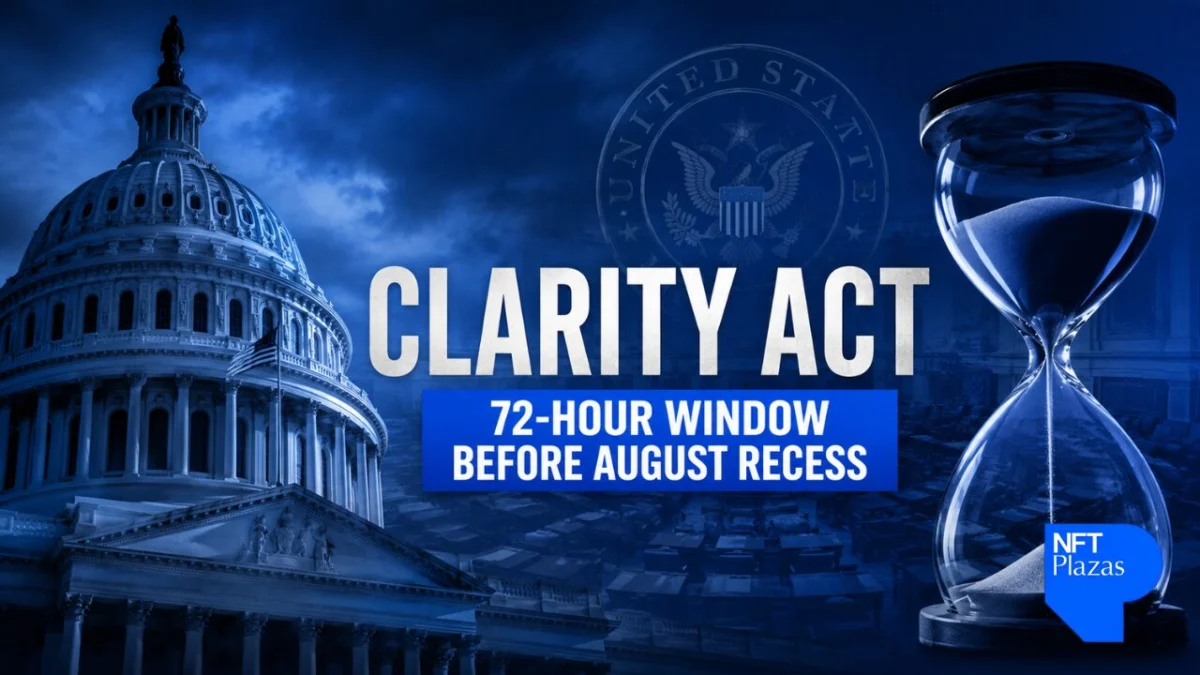
The U.S. Senate has entered a critical period for digital asset legislation, with the proposed Digital Asset Market Clarity (CLARITY) Act conspicuously absent from Monday’s official floor schedule. This omission leaves lawmakers with a rapidly diminishing window—just days—to initiate action on the landmark bill before Congress embarks on its scheduled August recess. The clock is ticking towards an August 10 departure for senators from Washington, D.g., requiring leadership to trigger procedural processes within approximately 72 hours if the comprehensive crypto market structure bill is to advance. Failure to meet this tight deadline would almost certainly defer consideration until mid-September, perpetuating the regulatory ambiguity that has long clouded the U.S. digital asset industry.
The Urgent Need for Regulatory Clarity
The CLARITY Act (H.R. 3633) represents a significant bipartisan effort to establish a clear regulatory framework for digital assets in the United States. For years, the burgeoning cryptocurrency industry has operated under a patchwork of existing laws, often leading to uncertainty, conflicting guidance from various agencies, and an enforcement-by-litigation approach by regulators like the Securities and Exchange Commission (SEC). This lack of a coherent framework has been widely cited by industry participants as a major impediment to innovation, investment, and consumer protection within the U.S. market.
The core objective of the CLARITY Act is to delineate the jurisdictional boundaries between the SEC and the Commodity Futures Trading Commission (CFTC). Currently, many digital assets exist in a grey area, with both agencies asserting potential oversight, leading to confusion about which assets are classified as securities and which as commodities. This ambiguity has resulted in numerous legal battles, hindered the growth of domestic crypto businesses, and potentially pushed innovation overseas. The proposed legislation aims to replace this overlapping oversight with a more defined and predictable regulatory structure, thereby fostering a more stable environment for exchanges, issuers, investors, and developers.
A Tightening Legislative Timeline
When the Senate reconvened on August 3, its published agenda presented a procedural vote solely on H.R. 6500, a federal spending bill. The CLARITY Act was conspicuously absent, and an examination of Senate records updated through July 31 confirmed that no cloture petition had been filed for the legislation. This procedural detail is crucial, as under standard Senate rules, leadership must file a cloture petition by August 5 to enable a procedural vote as early as August 7. This initial vote would not determine the bill’s passage but merely whether the Senate can commence debate on the legislation.
Even if this initial hurdle is cleared, the bill would still be subject to a period of debate, potential amendments, and a subsequent final vote. The remaining legislative days before the August 10 recess are therefore of paramount importance. If lawmakers fail to initiate consideration before this deadline, the CLARITY Act is likely to remain in legislative limbo until the Senate reconvenes in mid-September. A more protracted delay could carry even more significant consequences; should the CLARITY Act not receive approval before the conclusion of the 119th Congress in late 2026, the entire legislative process would have to be restarted in the subsequent congressional session, a prospect that would represent a substantial setback for the industry and advocates of regulatory reform.

The typical legislative journey for a complex bill often spans months, if not years, involving committee hearings, markups, floor debates, and reconciliation between chambers. The current situation highlights the extraordinary time pressure under which the CLARITY Act is operating, underscoring the urgency for Senate leadership to employ expedited procedural mechanisms.
Expedited Legislative Pathways
Despite the rapidly dwindling time, Senate leaders retain several procedural tools that could accelerate the consideration of the CLARITY Act. One such option is a bipartisan cloture petition. While a standard cloture petition requires a supermajority of 60 votes to overcome a filibuster and bring a bill to a vote, a bipartisan petition can sometimes expedite the timeline for bringing legislation to the floor, reflecting broad consensus.
Another, even faster, route is unanimous consent. This mechanism allows senators to bypass numerous procedural requirements entirely, fast-tracking a bill through the legislative process. However, the efficacy of unanimous consent is inherently fragile, as a single senator can block it, making it a challenging path for contentious legislation or bills with any significant opposition. So far, Senate leadership has not publicly indicated which, if any, of these fast-track options it intends to pursue, leaving stakeholders to speculate on the bill’s immediate future.
The decision to employ such measures often hinges on the perceived level of bipartisan support and the strategic priorities of the leadership. Given the known opposition from certain senators, unanimous consent appears less likely, placing greater emphasis on securing sufficient bipartisan backing for a swift cloture process.
Persistent Political Hurdles
Beyond procedural mechanisms, the CLARITY Act must garner adequate bipartisan support to advance. The path to passage is complicated by ongoing political divisions and specific concerns raised by several Democratic senators. Seven Democratic senators—Catherine Cortez Masto, Angela Alsobrooks, Cory Booker, Ruben Gallego, John Hickenlooper, Mark Warner, and Raphael Warnock—have voiced that the revised draft of the bill does not fully address their concerns. While negotiations are reportedly ongoing, the specific nature of these concerns often revolves around issues such as investor protection, market manipulation risks, environmental impacts of proof-of-work cryptocurrencies, and broader financial stability implications.
Furthermore, Senator Elizabeth Warren, a vocal critic of the cryptocurrency industry, remains firmly opposed to the legislation. Her consistent stance underscores a broader ideological divide within Congress regarding the role and regulation of digital assets. Meanwhile, Senate Majority Leader John Thune has pragmatically suggested that the bill is unlikely to reach the floor before the recess without substantial Democratic backing, casting a shadow of uncertainty over its near-term prospects. The political calculus requires navigating these entrenched positions and finding common ground that can bridge the gap between those advocating for innovation and those prioritizing stringent regulation.

The cryptocurrency market, valued at over $2 trillion globally, has become a significant economic force, but its regulatory future in the U.S. remains a contentious political issue. Balancing the desire to foster innovation with the need to protect consumers and maintain financial stability is a complex task that has eluded consensus for years.
The Ethics Debate: A Key Sticking Point
One of the primary impediments to the CLARITY Act’s progression has been the debate surrounding ethics provisions governing cryptocurrency activities by public officials. To address these critical concerns and potentially broaden bipartisan appeal, former President Donald Trump reportedly agreed to support language that would prohibit the president, vice president, members of Congress, senior federal officials, and their spouses from issuing or sponsoring digital assets for personal financial gain. These proposed restrictions are slated to remain in effect until January 20, 2029.
The inclusion of such ethics clauses is designed to mitigate potential conflicts of interest, prevent insider trading, and ensure public trust in the integrity of government officials dealing with a nascent and often volatile asset class. Supporters of the legislation hope that these revisions will be instrumental in attracting additional bipartisan support, particularly from those concerned about transparency and accountability in public service. However, it remains uncertain whether these concessions will be sufficient to secure the necessary votes for passage, as some critics may argue for even more expansive or permanent prohibitions. The ethics dimension highlights the unique challenges posed by digital assets, which blur lines between traditional financial instruments and new technological paradigms.
Mounting Industry Pressure and National Security Imperatives
Beyond the halls of Congress, calls for definitive action on cryptocurrency regulation continue to intensify. Former U.S. Defense Secretary Mark Esper recently underscored the CLARITY Act’s significance as a national security priority. He argues that the establishment of clear digital asset rules is essential for strengthening the United States’ competitive position on the global stage. Without a robust and predictable regulatory environment, the U.S. risks ceding its leadership in financial technology and innovation to other nations that are actively developing their own comprehensive frameworks, such as the European Union with its Markets in Crypto-Assets (MiCA) regulation.
The national security dimension extends to issues of illicit finance, where a clear regulatory landscape can help track and deter the use of digital assets by bad actors, while a fragmented approach might create vulnerabilities. Maintaining technological leadership is also crucial in an era where digital currencies and blockchain technology are increasingly seen as strategic assets.
Crypto companies and industry groups have consistently urged senators to act swiftly, emphasizing that the persistent absence of a comprehensive regulatory framework continues to discourage both domestic and international investment while stifling innovation. Industry statistics often highlight the substantial capital that has flowed out of the U.S. to more crypto-friendly jurisdictions, as well as the job creation potential lost due to regulatory uncertainty. The CLARITY Act, by establishing a clearer division of authority between the SEC and the CFTC, is seen as a vital step towards creating the stability and predictability necessary for the industry to thrive responsibly.

Simultaneously, SEC Chairman Paul Atkins has indicated that the agency is prepared to develop its own crypto regulatory framework if Congress fails to pass the CLARITY Act. This statement underscores the growing pressure for regulatory reform and signals that a regulatory vacuum will not be tolerated indefinitely. While the SEC’s proactive stance could provide some form of guidance, an agency-led framework might lack the comprehensive scope and democratic legitimacy of congressionally enacted legislation, potentially leading to further industry challenges or even more litigious disputes. The industry generally prefers a legislative solution for its permanence and breadth.
Economic Implications and Global Standing
The ongoing regulatory uncertainty in the U.S. has profound economic implications. The digital asset market, which has seen explosive growth in recent years, represents a significant sector for investment, job creation, and technological advancement. A prolonged lack of clarity can lead to several negative outcomes:
- Capital Flight: Businesses and investors may choose to operate in jurisdictions with more predictable regulatory environments, leading to a loss of capital and talent from the U.S.
- Stifled Innovation: Startups and established companies may hesitate to invest in new blockchain technologies or digital asset products without clear rules, hindering the nation’s technological competitiveness.
- Reduced Investor Confidence: Ambiguity can deter both retail and institutional investors, leading to a less robust and liquid market.
- Disadvantage in Global Race: As countries like the UAE, Singapore, and the UK advance their crypto regulatory frameworks, the U.S. risks falling behind in a critical emerging technology sector.
The CLARITY Act aims to address these issues by providing a foundation upon which the U.S. can build a thriving and responsible digital asset ecosystem, ensuring it remains at the forefront of financial innovation.
A Pivotal Week Ahead
The CLARITY Act’s absence from Monday’s Senate schedule does not signify a permanent stall for the legislation, but it has drastically constrained the available timeframe for lawmakers. Over the next few critical days, Senate leaders face a pivotal decision: whether to initiate the procedural process through a standard cloture filing, which would require significant political will and strategic maneuvering, or to attempt a faster legislative route, such as unanimous consent, which carries its own set of challenges. This decision must be made before senators depart for the August recess.
For the vast and rapidly evolving cryptocurrency industry, the outcome of this week will be determinative. It will decide whether long-awaited market structure reforms finally begin their journey through the Senate, offering a glimmer of hope for a clearer regulatory future, or if they remain in a state of limbo for at least another month, thereby prolonging the pervasive uncertainty for exchanges, digital asset issuers, investors, and regulators alike. The stakes are exceptionally high, with the future of digital asset innovation and leadership in the United States hanging in the balance.