Dwi Wanna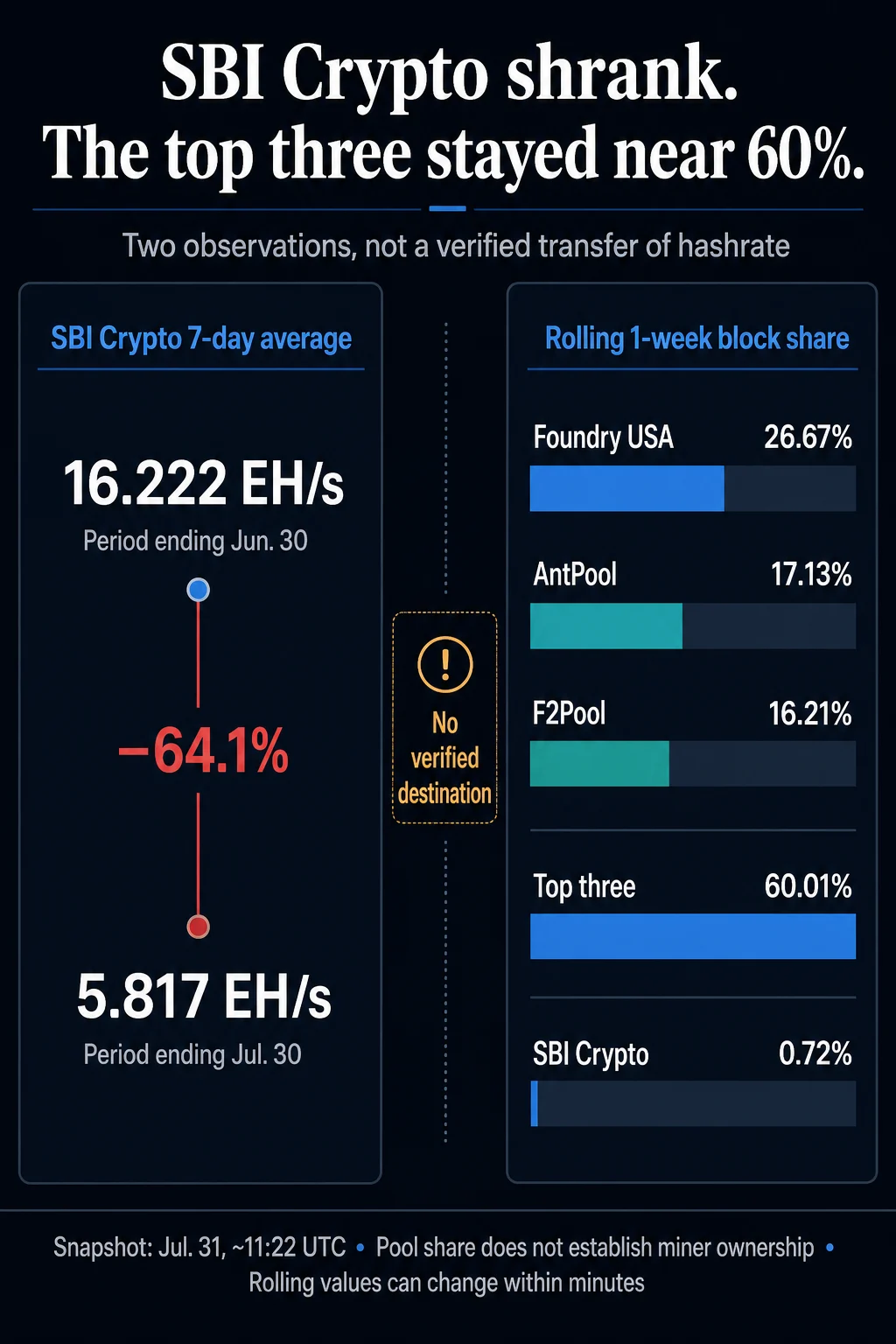
The cessation of operations by SBI Crypto, a subsidiary of the Tokyo-based financial services giant SBI Holdings, marks a significant shift in the geographical distribution of Bitcoin’s hashing power. On July 31, 2026, the company officially terminated its Bitcoin mining pool service, concluding a month-long retreat that saw its contributed hashrate plummet by more than 60%. This exit coincides with a period of intense consolidation within the Bitcoin mining industry, as three dominant entities—Foundry USA, AntPool, and F2Pool—now collectively account for approximately 60% of the network’s total block production.
The departure of a major institutional player from Japan underscores the increasing difficulty for mid-tier pools to compete against the economies of scale achieved by North American and Chinese-linked mining titans. While SBI Crypto’s decline was documented throughout the month of July, the finality of its shutdown provides a stark data point for analysts monitoring the centralization of the world’s largest decentralized ledger.
Chronology of the SBI Crypto Shutdown
The timeline for SBI Crypto’s withdrawal was structured to allow for a "graceful disconnect" of its remaining participants. According to official announcements from the company, the first major cutoff occurred at 22:00 UTC on July 30, 2026 (07:00 JST on July 31). At this juncture, the pool stopped accepting new shares from connected mining hardware.
Following the initial cutoff, SBI Crypto scheduled a comprehensive shutdown of its Stratum servers—the protocol used for communication between mining hardware and the pool—by 23:59:59 UTC on July 31. While the active mining operations have ceased, the company’s web portal remains accessible to allow former participants to review historical data and monitor the status of their final payouts. However, the company has yet to specify the long-term schedule for final distributions or the ultimate expiration date for API and portal access.
The retreat was not an overnight occurrence but rather the culmination of a steady decline in participation. Data tracking SBI Crypto’s seven-day average Bitcoin hashrate shows a drop from 16.222 exahashes per second (EH/s) for the period ending June 30, to just 5.817 EH/s by July 30. By the morning of July 31, operational statistics indicated the pool’s 24-hour average had withered to approximately 0.452 EH/s, representing a negligible fraction of the total network hashrate.
The Rise of the Mining "Big Three"
As SBI Crypto exited the stage, the vacuum in the mining sector has been largely absorbed by three "mega-miners." On July 31, data from Hashrate Index revealed a significant concentration of power. Foundry USA, the largest pool by volume, held 26.67% of the attributed blocks. AntPool followed with 17.13%, and F2Pool rounded out the trio with 16.21%.
Combined, these three entities controlled 60.01% of the network’s block production at the time of the reading. While hashrate distribution is a rolling metric that fluctuates based on luck and variance, the 60% threshold is a symbolic and practical milestone that has raised concerns among decentralization advocates.

Foundry USA
Owned by the Digital Currency Group (DCG), Foundry USA has become the cornerstone of North American mining. Its dominance is attributed to its institutional-grade compliance, transparent payout structures, and its role as a primary partner for large-scale publicly traded mining firms in the United States.
AntPool
Historically linked to the hardware manufacturing giant Bitmain, AntPool remains a dominant force in the global market. Its longevity and deep integration with ASIC supply chains provide it with a competitive edge that has allowed it to maintain a top-tier position for over a decade.
F2Pool
As one of the oldest surviving mining pools, F2Pool has managed to navigate multiple market cycles. Its ability to aggregate hashrate from a diverse global base of individual and institutional miners has kept it consistently in the top three, even as newer competitors have entered the field.
Analyzing the Impact of Concentration
The concentration of 60% of the hashrate among three entities introduces several layers of risk and discussion regarding the security of the Bitcoin network. In a purely decentralized system, the distribution of power is intended to prevent any single entity or small group of entities from exerting undue influence over transaction processing.
The 51% Attack Threshold
While 60% control by three distinct companies does not equate to a single entity holding a majority, it does reduce the number of parties that would need to collude to execute a 51% attack. Such an attack could theoretically allow for the reorganization of blocks or the "double-spending" of coins. However, industry experts argue that the economic incentives of these pools—whose business models rely on the long-term value and security of Bitcoin—make such collusion highly improbable.
Transaction Censorship
A more immediate concern than a 51% attack is the potential for transaction censorship. Large, regulated pools, particularly those based in the United States like Foundry USA, may face regulatory pressure to exclude certain transactions from the blocks they mine. When three pools control 60% of the hashrate, the likelihood of a censored transaction being included in a block decreases significantly, as a transaction would have to wait for one of the minority pools to pick it up.
Protocol Governance
The "Big Three" also hold significant sway over protocol upgrades. In Bitcoin’s history, miners have played a pivotal role in signaling for or against changes to the software (such as SegWit or Taproot). A high level of concentration means that a very small group of executives could effectively veto or fast-track changes to the Bitcoin network.
Market Context: Why SBI Crypto Pulled the Plug
SBI Crypto’s exit is reflective of a broader trend of institutional consolidation. The Japanese firm was one of the few major banks-backed entities to enter the mining space directly. Its departure may be attributed to several factors inherent in the 2026 mining landscape.

- Margin Compression: Following the 2024 halving, the block reward was reduced to 3.125 BTC. In 2026, with the network difficulty at or near all-time highs, mining margins have become razor-thin. Pools that do not operate with massive scale or integrated hardware businesses often find it difficult to maintain profitability.
- Regulatory Climate in Japan: While Japan has been a pioneer in cryptocurrency regulation, the compliance costs for a regulated financial subsidiary like SBI Crypto to operate a global mining pool are substantial. The administrative overhead of managing KYC/AML for thousands of individual miners across various jurisdictions may have outweighed the revenue generated by the pool’s fees.
- Shift in Corporate Strategy: SBI Holdings has recently signaled a pivot toward broader digital asset services, including institutional custody and carbon-neutral blockchain initiatives. Maintaining a legacy mining pool that was losing market share may no longer align with the group’s long-term ESG (Environmental, Social, and Governance) goals.
The Search for the Missing Hashrate
One of the most pressing questions following SBI Crypto’s shutdown is the destination of its lost hashrate. Aggregate data from mempool.space and other telemetry providers do not identify a clear migration path.
Weekly data buckets show that Foundry, AntPool, and F2Pool actually saw slightly lower estimated hashrates in the partial week following July 27 compared to the prior week. This suggests that the hashrate previously directed toward SBI Crypto may have dispersed among smaller, "boutique" pools, moved to private solo-mining operations, or simply been turned off as older hardware became unprofitable.
Other mid-tier pools like Luxor showed a slight rise in activity, while others, such as Braiins, saw declines. The lack of a clear "winner" in the wake of SBI’s exit indicates that the miners using SBI were likely a diverse group of participants rather than a single large entity moving its fleet to a competitor.
Future Outlook for Bitcoin Mining
The closure of SBI Crypto serves as a reminder of the volatile and competitive nature of the Bitcoin infrastructure layer. As the network matures, the "industrialization" of mining appears to be favoring a few large players who can leverage geographical advantages, cheap energy contracts, and superior hardware access.
However, the Bitcoin community is not without tools to combat this centralization. The development and adoption of Stratum V2—a new mining protocol—is designed to give individual miners more control over the selection of transactions, even when they are part of a larger pool. This would effectively decouple the hashrate from the block-construction process, mitigating the risks of censorship even if a few pools remain dominant in terms of payout distribution.
As the industry moves toward the latter half of 2026, the focus will likely remain on the resilience of smaller pools and the potential for new, decentralized mining cooperatives to challenge the hegemony of the "Big Three." For now, the exit of SBI Crypto marks the end of an era for Japanese institutional mining and a definitive step toward a more concentrated, albeit highly professionalized, mining ecosystem.