admin
admin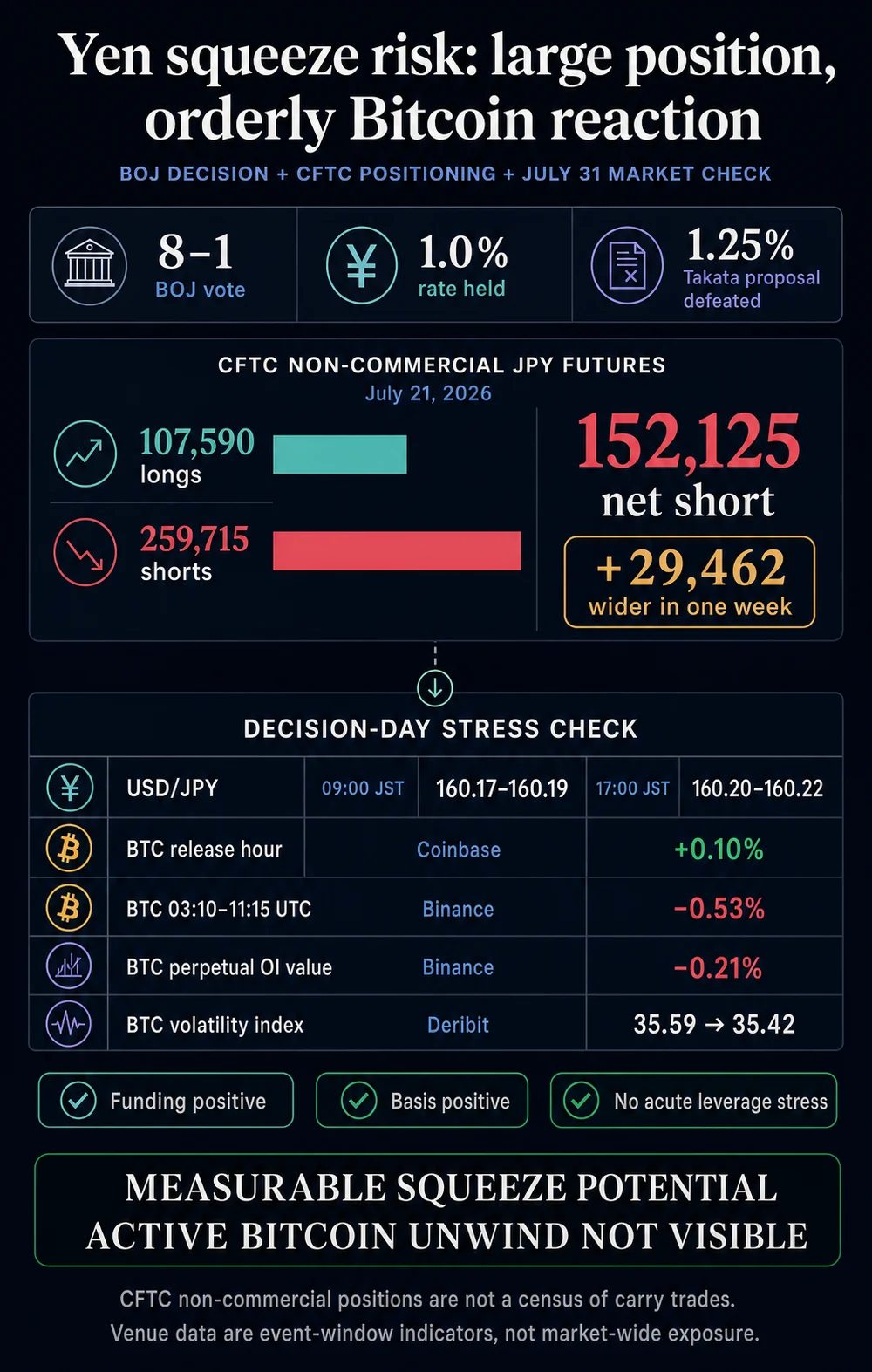
Bitcoin’s leverage gauges registered a muted response following the Bank of Japan’s (BOJ) recent monetary policy decision, a development that occurred against the backdrop of a significantly expanded short position in yen futures. While the market largely shrugged off the BOJ’s announcement, the growing yen short, which escalated from 152,125 contracts on July 21 to 163,412 contracts by July 28, presents a discernible pressure point for leveraged traders, particularly those with positions in Bitcoin. The failed attempt by board member Hajime Takata to advocate for a 1.25% interest rate hike now looms as a focal point for market observers.
The Monetary Policy Meeting of the Bank of Japan, held on Friday, concluded with the board voting 8-1 to maintain the overnight call rate at approximately 1.0%. Hajime Takata cast the sole dissenting vote, advocating for a more aggressive tightening to 1.25%. This divergence, while not immediately impactful on market sentiment, signals a potential fault line within the BOJ’s policy outlook, especially given recent inflation trends.
Yen Futures Show Significant Short Accumulation
Data from the Commodity Futures Trading Commission (CFTC) for the week ending July 28 revealed a substantial net short position in yen futures. The report detailed 101,271 non-commercial long positions and a considerably larger 264,683 short positions. This disparity resulted in speculators holding a net short of 163,412 contracts, an increase of 11,287 contracts from the previous week. During the same period, long positions decreased by 6,319 contracts, while short positions saw an addition of 4,968 contracts.
The CFTC classifies these positions as "non-commercial," a broad category that can obscure the specific identities and motivations of the traders involved. This lack of transparency is particularly relevant given the potential for a sharp reversal in the yen’s trend. A sudden rush of traders seeking to exit these short positions could trigger a significant appreciation of the yen, potentially leading to a cascading margin call scenario for leveraged Bitcoin positions held by the same entities. The identities of those carrying both the yen short and Bitcoin long positions remain undisclosed, adding an element of uncertainty to the market’s interconnectedness.
Bitcoin’s Indifference to the BOJ’s Decision
The Japanese yen experienced minimal fluctuation against the US dollar in the immediate aftermath of the BOJ’s rate announcement. Official BOJ reference rates for USD/JPY hovered between 160.17 and 160.19 at 9 a.m. Tokyo time and then between 160.20 and 160.22 at 5 p.m. The broader trading session in Tokyo saw the USD/JPY pair range between 159.39 and 160.90, with the policy release occurring mid-session. This limited price action made it difficult to ascertain a clear, direct market reaction to the BOJ’s decision.
On cryptocurrency exchanges, Bitcoin’s price movement also remained subdued. Coinbase’s BTC-USD pair saw a modest gain of approximately 0.1% between 3 a.m. and 4 a.m. UTC. Meanwhile, Binance’s BTCUSDT pair experienced a slight decline of about 0.53% between 3:10 a.m. and 11:15 a.m. UTC. The price action throughout the remainder of the trading day continued to be characterized by modest shifts.
Crypto Derivatives Show No Significant Leverage Break
The derivative markets for Bitcoin also exhibited a lack of significant reaction. Binance’s perpetual futures open interest, measured in dollar terms, saw a minor decrease of approximately 0.21%. Funding rates remained positive, indicating a prevailing bullish sentiment among futures traders, and the quarterly futures basis stayed above the spot price, further suggesting a stable, albeit not overwhelmingly bullish, market.
Deribit, another major derivatives exchange, reported even quieter activity. Funding rates on its Bitcoin perpetual contracts trended downwards towards zero, signaling a decrease in borrowing costs for short positions. The Bitcoin volatility index on Deribit edged slightly lower, from 35.59 at 3 a.m. UTC to 35.42 at 11 a.m. UTC. A snapshot of futures at the end of this period indicated a positive term structure, implying that futures contracts were trading at a premium to the spot price, a common characteristic of a stable or moderately bullish market. The data from these eight-hour, venue-specific windows suggests that the BOJ’s decision did not trigger any discernible increase in speculative activity or a shift in leverage on Bitcoin derivatives.
Hajime Takata’s Dissent and Inflationary Pressures
The persistent dissent from Hajime Takata highlights a potential undercurrent of concern regarding inflation within the Bank of Japan. The BOJ’s July outlook report projected that inflation, excluding fresh food, would consistently exceed 2% from the latter half of fiscal year 2026. The report also flagged upside risks to the Consumer Price Index (CPI). This inflationary outlook lends greater significance to Takata’s call for a higher interest rate. While his solitary vote was insufficient to alter the immediate policy, future meetings will be closely watched to determine if his stance gains broader support among the board members. A shift in consensus towards higher rates would represent a significant policy pivot for Japan, which has maintained an ultra-loose monetary policy for an extended period.

The Interplay of FX and Crypto Markets
The potential for a significant market event lies in the confluence of a strengthening yen and a contraction in crypto open interest, coupled with declining funding rates and rising volatility. Such a scenario would indicate a broad deleveraging across speculative assets, potentially triggered by a sharp reversal in the yen. The current data, however, does not point to such a synchronized move. The absence of these indicators on Friday suggests that the market is not yet pricing in a significant risk stemming from the yen’s current short positioning, despite the growing contract numbers.
The yen’s journey to its current elevated short position has been driven by a widening interest rate differential between Japan and other major economies, particularly the United States. As central banks in other nations have raised rates to combat inflation, the Bank of Japan has largely maintained its accommodative stance, leading to a depreciation of the yen. This has made it attractive for carry trades, where investors borrow in a low-interest-rate currency (like the yen) to invest in higher-yielding assets elsewhere. The substantial short position in yen futures suggests that many market participants are betting on further yen depreciation.
Broader Implications for Global Markets
A sharp and unexpected appreciation of the yen could have far-reaching consequences. Japanese investors are significant holders of foreign assets, including US Treasury bonds and global equities. A stronger yen would reduce the dollar-denominated value of these holdings, potentially leading to repatriation of funds and a ripple effect across global financial markets.
For Bitcoin, a substantial yen short unwinding could directly impact its price. Many institutional investors and hedge funds operate with global portfolios that often include both FX positions and cryptocurrency holdings. If a significant entity is heavily short the yen and long Bitcoin, a forced liquidation of yen shorts due to adverse price movements could necessitate the sale of other assets, including Bitcoin, to meet margin requirements. The lack of transparency in CFTC’s "non-commercial" category makes it difficult to pinpoint the exact scale and nature of this interconnected risk.
The Bank of Japan’s next policy meeting will be crucial. Any indication of a shift in their stance, or further dissent from board members like Takata, could serve as a catalyst for a re-evaluation of the yen’s trajectory. Until then, the market appears to be content with the status quo, but the growing yen short remains a latent risk factor that could surprise participants accustomed to Bitcoin’s relative isolation from traditional macroeconomic events. The current stability in Bitcoin’s leverage gauges may not persist if the yen’s leveraged positions come under significant pressure.