admin
admin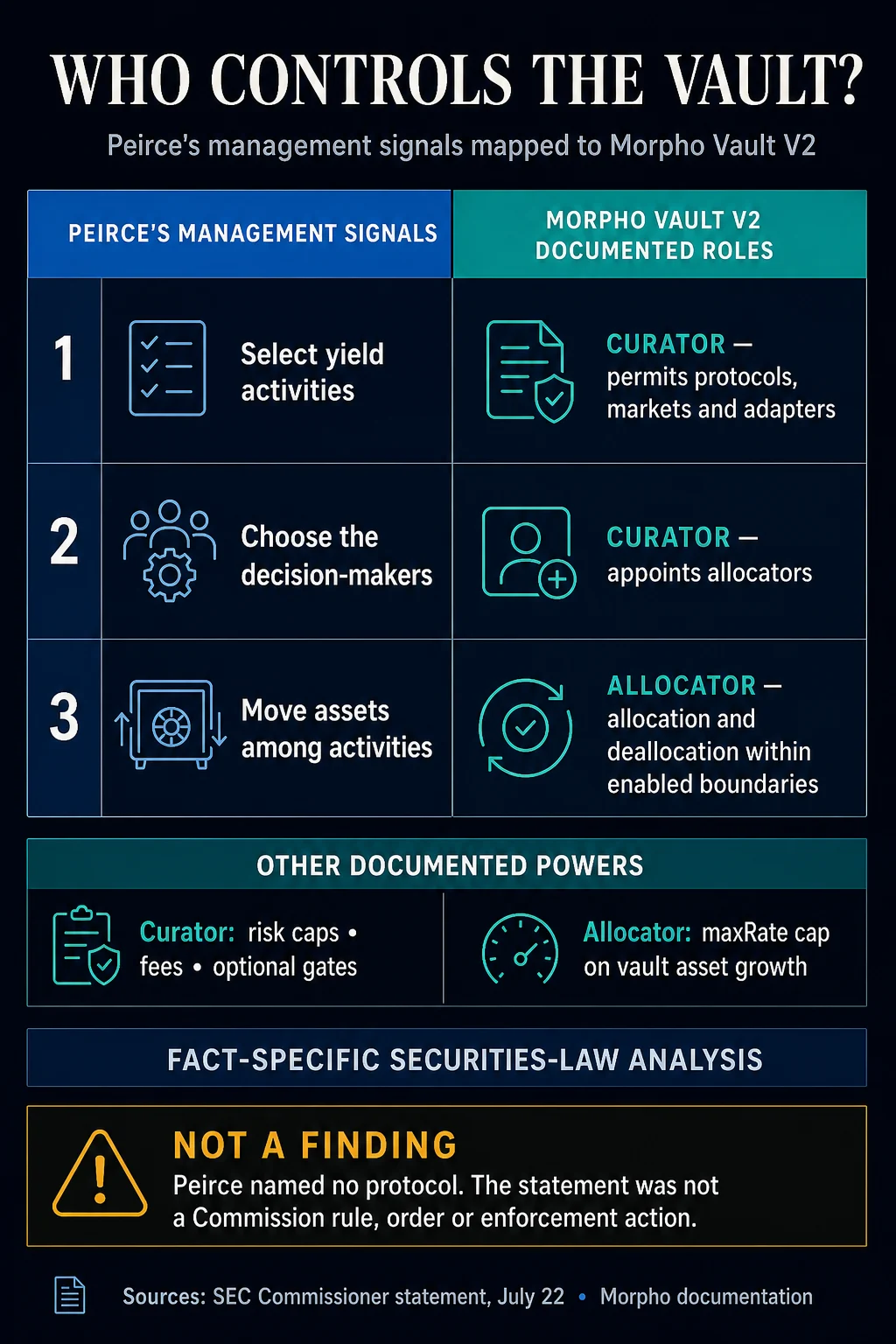
SEC Commissioner Hester Peirce has sounded a significant warning regarding the burgeoning world of cryptocurrency yield vaults, suggesting that many could be operating in violation of federal securities laws. Her recent statement highlights a critical distinction: when human intervention plays a role in managing how digital assets generate yield, these vaults may cross the line from automated financial tools into regulated investment funds. The architecture of Morpho Vault V2, with its clearly defined roles for "curators" and "allocators," presents a compelling case study that could illuminate the regulatory path forward, and potentially trigger broader scrutiny across the decentralized finance (DeFi) landscape.
The core of Commissioner Peirce’s concern lies in the element of human control over investment decisions. In her July 22nd statement, she articulated that while some crypto vaults operate purely on immutable code, others delegate significant decision-making power to individuals. It is precisely this delegation of authority – particularly concerning the selection of yield-generating strategies and the active management of assets within those strategies – that raises federal securities-law questions. Even the process of deciding who wields this authority can be a factor in regulatory assessment.
Morpho, a prominent decentralized lending protocol, has introduced its Vault V2, which aims to package curated lending strategies into on-chain vaults. While users interact with smart contracts, the underlying operational framework involves human oversight. In this model, "curators" are empowered to choose the specific protocols, markets, and assets that a vault can engage with. They establish the risk parameters and appoint "allocators" who are then responsible for moving assets within these predefined boundaries. This division of labor, according to Peirce’s framework, directly corresponds to key indicators of potential securities-law applicability.
Peirce’s statement, while not naming any specific protocol like Morpho, serves as a broad advisory. It emphasizes that the legal classification of a crypto vault depends heavily on its specific structure and operational activities. She placed these vaults on a spectrum, ranging from those governed solely by code to those with significant human management. The implications for DeFi could be substantial, potentially impacting a wide array of yield-generating products that rely on active human management to optimize returns.
The Anatomy of Control in Morpho Vault V2
To understand the potential regulatory implications, it is crucial to dissect the roles and responsibilities within Morpho Vault V2. The "curator" acts as the architect of the vault’s strategy. This role encompasses several critical functions:
- Protocol and Market Selection: Curators determine which DeFi protocols and lending markets the vault can interact with.
- Asset Allocation Parameters: They set the overarching risk limits and guidelines for how assets can be deployed.
- Adapter Configuration: Curators enable specific on-chain "adapters" that facilitate interactions with chosen protocols.
- Allocator Appointment: Crucially, curators select the individuals or entities who will execute the day-to-day asset movements within the vault.
These powers align closely with Commissioner Peirce’s highlighted concerns: the selection of available yield routes and the selection of parties responsible for making allocation decisions. Furthermore, Morpho Vault V2 grants curators control over performance and management fees, the recipients of these fees, and optional compliance gates. While Peirce did not explicitly identify fee-setting as a standalone trigger for securities-law concerns, it is a significant aspect of financial management that regulators often examine.
The operational execution, however, is largely delegated to the "allocators." These individuals are responsible for the routine deployment and withdrawal of assets from the approved lending markets. They also possess the ability to set a maxRate, which dictates the maximum rate at which vault assets can grow. It is important to note that Morpho’s documentation does not equate this control with direct authority over setting borrower interest rates, loan-to-value ratios, or liquidation thresholds – elements that Peirce discussed in the context of lending strategies specifically.
Navigating the Regulatory Tightrope
Even with immutable smart contract code, the dynamic nature of the crypto market means that vault portfolios can undergo constant change. Curators retain the ability to update vault settings, thereby shaping the vault’s risk profile and investment strategy. Actions that introduce greater risk typically undergo a timelock mechanism, though these can sometimes be set to zero, allowing for immediate implementation. Furthermore, mechanisms like "cap cuts" and "sentinel interventions" can be executed without delay. In a process of "abdication," a curator can permanently disable specific timelocked powers, demonstrating a significant degree of ongoing control.
This distributed model of control raises questions about which of Commissioner Peirce’s analogies might apply. She suggested that some vaults could resemble fixed unit investment trusts, while others might be viewed as management investment companies or separately managed accounts. The involvement of individuals in managing these vaults or lending strategies could also trigger considerations related to investment adviser regulations.
For Morpho Vault V2, the ultimate regulatory determination would likely hinge on a detailed examination of several factors: the specific types of assets the vault holds, the ongoing configuration powers that remain active, and the practical manner in which curators and allocators exercise their respective roles. Commissioner Peirce’s statement serves as a crucial signal, raising these pertinent questions without providing definitive answers for any single protocol, including Morpho.
The Broader Implications for Decentralized Finance
Commissioner Peirce’s cautionary remarks are not isolated incidents. The U.S. Securities and Exchange Commission (SEC) has been increasingly vocal and active in its pursuit of entities it deems to be operating unregistered securities offerings or violating other securities laws within the digital asset space. This latest statement signals a potential broadening of this focus to include DeFi protocols that exhibit characteristics of managed investment vehicles, even if they operate under the guise of decentralized autonomy.
The implications of such regulatory action could be far-reaching. If crypto yield vaults are indeed deemed securities, their operators could face significant legal and financial repercussions. This would necessitate compliance with stringent registration requirements, disclosure obligations, and investor protection rules that are standard for traditional financial products. For many DeFi projects, which have often prioritized agility and innovation over formal regulatory compliance, this could present an existential challenge.
A Timeline of Regulatory Scrutiny:

- Early 2020s: Rise of DeFi protocols offering high yields through various mechanisms, including lending, staking, and yield farming.
- Mid-2020s: Increased SEC enforcement actions against crypto firms for alleged violations of securities laws, particularly concerning unregistered offerings and unregistered exchanges.
- July 22, 2026: SEC Commissioner Hester Peirce releases a statement expressing concerns about crypto yield vaults and their potential classification as unregistered investment funds when human control is involved.
- Ongoing: The DeFi community and legal experts analyze Peirce’s statement and its potential impact on protocols like Morpho Vault V2, anticipating potential regulatory actions or guidance.
The underlying principle of securities law is investor protection. Regulators are concerned that investors in these crypto vaults may not fully understand the risks involved, especially when the decision-making process is opaque or relies on individuals who may not be subject to fiduciary duties or regulatory oversight. The SEC’s historical approach has been to apply existing securities laws to new financial products and technologies, rather than creating entirely new regulatory frameworks.
Data and Market Context
The crypto lending market, of which yield vaults are a part, has seen significant growth and subsequent volatility. Platforms offering yield generation have attracted billions of dollars in assets under management. However, several high-profile collapses, such as Celsius Network and Three Arrows Capital, have underscored the inherent risks associated with these often complex and opaque financial structures.
For instance, during periods of high market demand and perceived low risk, yield rates on stablecoins in DeFi lending protocols could reach double digits, far exceeding traditional savings account interest rates. However, these higher yields often came with increased exposure to smart contract risk, impermanent loss, or the credit risk of underlying borrowers. Commissioner Peirce’s statement suggests that the SEC is looking beyond the technical implementation of these yields and scrutinizing the governance and management structures that enable them.
The token for Morpho, MORPHO, has seen fluctuations in its market performance, reflecting the broader sentiment and developments within the DeFi ecosystem. As of July 27, 2026, MORPHO’s market capitalization stands at approximately $1 billion, with a 24-hour trading volume of around $17.31 million. The price of MORPHO has experienced minor downward movement in the short term, with a 1.24-hour change of -0.16%, indicating a degree of market caution or reaction to broader market trends. However, its performance over longer periods, such as 30 days (+8.93%), suggests a more complex and potentially positive underlying trend, influenced by protocol development and market adoption.
Potential Industry Reactions and Adaptations
The crypto industry is accustomed to navigating evolving regulatory landscapes. If the SEC’s interpretation gains traction, projects operating yield vaults may need to consider several strategic adjustments:
- Increased Transparency: Providing clearer disclosures about the human roles involved in management, the risks associated with those roles, and the decision-making processes.
- Structural Re-evaluation: Designing vaults that rely more heavily on automated, code-driven strategies with minimal human intervention, or exploring registered fund structures.
- Jurisdictional Considerations: Evaluating operations in jurisdictions with more favorable or clearer regulatory frameworks for DeFi.
- Legal Counsel Engagement: Proactively seeking legal advice to ensure compliance with existing securities laws.
The challenge for regulators and the industry alike is to strike a balance between fostering innovation in DeFi and ensuring adequate investor protection. Commissioner Peirce’s statement is a clear signal that the SEC is actively engaged in this balancing act, and that the era of largely unchecked, human-managed crypto yield generation may be facing a significant regulatory reckoning. The specifics of how protocols like Morpho Vault V2 are ultimately classified will likely set important precedents for the future of decentralized finance.