admin
admin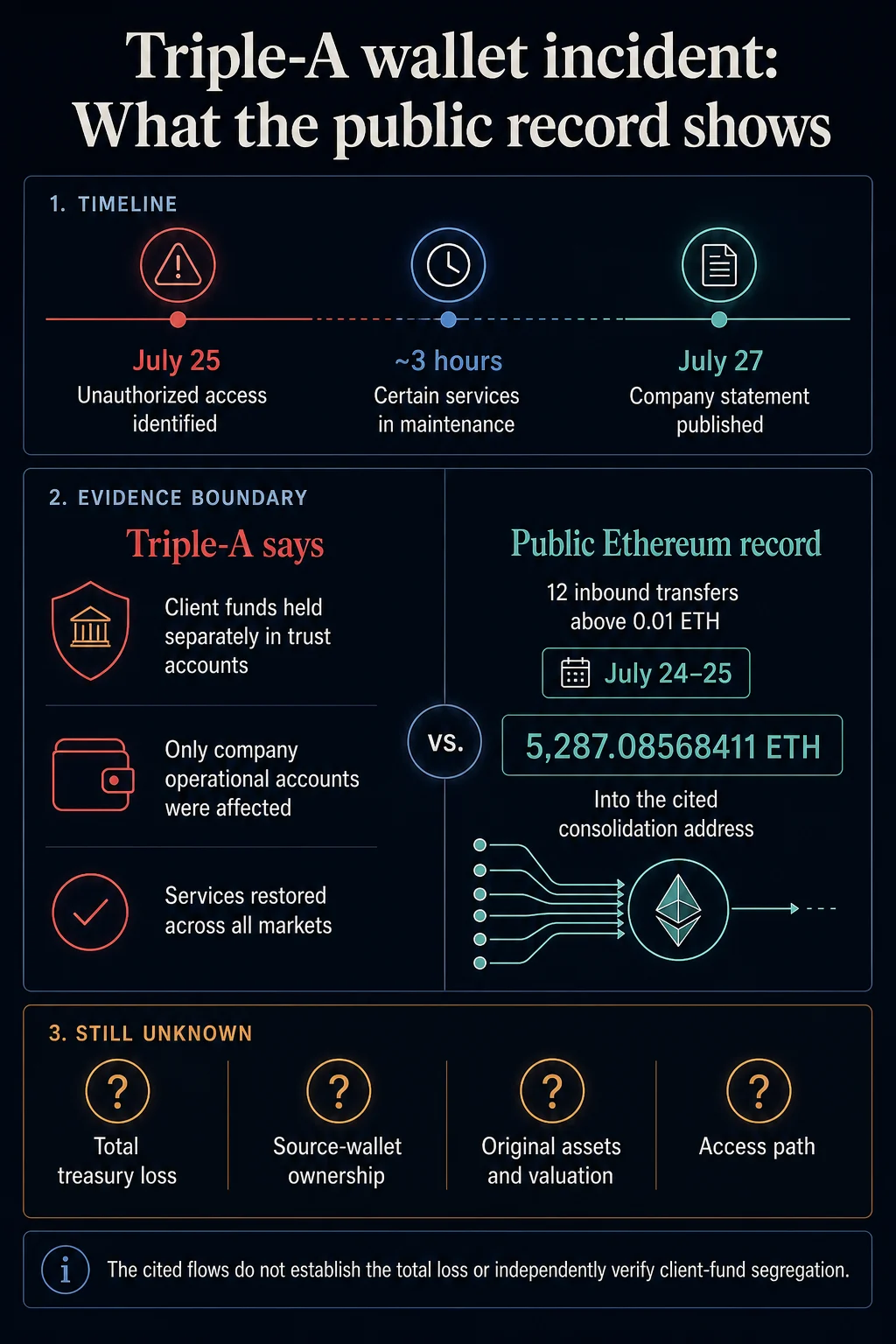
Singapore-based stablecoin payments firm Triple-A has confirmed a security incident involving unauthorized access to its internal digital asset wallets, though the company asserts that client funds remain segregated and unaffected. While Triple-A has stated the breach was contained and did not impact client money, on-chain data reveals a significant movement of Ethereum (ETH) into a single, unconfirmed address, raising questions about the scale of the treasury loss and the precise access vector. The firm has not publicly disclosed the exact amount of its treasury that was drained or provided specific details on how the unauthorized access occurred, leaving a crucial gap between its assurances and the publicly visible on-chain activity.
Chronology of the Incident and Disclosure
The incident reportedly came to light on July 25, according to Triple-A’s official statement released on July 27. The company stated that certain services were temporarily placed into maintenance mode for approximately three hours as they worked to secure the affected infrastructure and conduct thorough security checks. Following this period, Triple-A announced the restoration of all services, confirming that transactions and settlements were proceeding normally across all markets.
The official statement from Triple-A was released two days after the firm identified the breach, a timeline that cybersecurity experts often scrutinize. While the company emphasized that it does not custody digital assets for its clients, and that client funds are held separately in trust accounts with safeguarding institutions, the revelation of an internal breach nonetheless casts a shadow over operational security. The Monetary Authority of Singapore (MAS) mandates stringent customer-money protection requirements for entities holding a Major Payment Institution license, which Triple-A possesses for domestic and cross-border transfers, merchant acquisition, and digital payment token services. The extent to which Triple-A’s internal security protocols met these obligations during the incident remains a subject of ongoing review.
On-Chain Data Reveals Significant ETH Movement
Independent on-chain analysis has identified a specific Ethereum address, 0x01F83B5d4fb30E8AA3daC1681B4048D9135253b1, as a potential consolidation point for funds linked to the security incident. Data from Etherscan, a blockchain explorer, indicates a series of twelve inbound transfers of Ethereum into this address on July 24 and July 25. These transfers collectively amount to approximately 5,287.08568411 ETH.

This on-chain trail clearly demonstrates the flow of a substantial amount of Ether into a single destination. However, it is crucial to note the limitations of this data in the absence of direct confirmation from Triple-A. The public transaction records do not definitively establish when the unauthorized access began, nor do they reveal the total value of Triple-A’s treasury loss. Furthermore, the origin of these funds, the specific source wallets that were compromised, and their original asset composition before any potential swaps or bridging activities remain unconfirmed by the company.
Triple-A’s Position and Unanswered Questions
In its official statement, Triple-A reiterated that the financial impact of the incident was confined to specific operational accounts and that the losses are being fully absorbed from the company’s treasury reserves. The firm clarified that the affected wallets were operated by its Singaporean entity, Triple A Technologies Pte. Ltd., and that other group entities and operations were not compromised. While Triple-A has stated its continued ability to meet its liabilities, the absence of a disclosed asset list, wallet addresses, or a precise loss figure leaves a significant void in public information.
The company has stated that it is actively collaborating with a range of entities to address the situation. This includes engaging with cybersecurity and blockchain-forensics specialists, the Singapore Police Force, and other relevant authorities to trace the compromised assets and facilitate recovery efforts. Despite these collaborative measures, two central questions persist: the exact scale of the treasury loss and the specific methodology or vulnerability exploited to gain access to the affected wallets.
Regulatory Context and Client Fund Segregation
Triple-A Technologies Pte. Ltd. is registered with the Monetary Authority of Singapore (MAS) as a Major Payment Institution. This designation signifies that the company is authorized to conduct a range of financial services, including domestic and cross-border payment services, merchant acquisition, and the issuance and redemption of digital payment tokens. A cornerstone of such regulatory authorization is the obligation to protect client funds. MAS regulations typically require licensed payment institutions to segregate client assets from their own operational funds to ensure that client money is protected in the event of a firm’s insolvency or operational issues.
Triple-A’s assertion that client money was not affected by this incident hinges on the effectiveness of its client fund segregation mechanisms. The fact that the breach was reportedly limited to internal operational wallets, and not directly to client accounts or funds held in trust, is a critical distinction. However, the incident serves as a stark reminder of the constant vigilance required in the digital asset space. Even with robust segregation protocols, the security of a firm’s internal infrastructure is paramount to maintaining trust and operational integrity.

Broader Implications for the Stablecoin Ecosystem
The incident at Triple-A, while seemingly contained by the company, has broader implications for the stablecoin ecosystem and the broader digital asset industry. As stablecoins aim to provide a bridge between traditional finance and the volatile world of cryptocurrencies, their perceived stability and security are paramount. Any event that raises questions about the operational security of a stablecoin issuer or a significant payment processor can have a ripple effect on market confidence.
The lack of immediate transparency regarding the scale of the loss and the method of the breach, while perhaps a strategic decision by Triple-A to manage the situation, can lead to speculation and unease within the community. The on-chain data, while not directly contradicting Triple-A’s claims, highlights the importance of independent verification and the role of blockchain analytics in providing a more complete picture of events.
The incident underscores the ongoing challenges in securing digital assets. The sophisticated nature of cyber threats necessitates continuous investment in advanced security measures, rigorous internal audits, and a proactive approach to risk management. For firms operating in the regulated financial technology space, maintaining robust cybersecurity is not merely a technical requirement but a fundamental aspect of regulatory compliance and customer trust.
The investigation by Triple-A with law enforcement and forensic experts will be crucial in understanding the full scope of the breach and in developing enhanced security protocols to prevent future occurrences. The market will be watching closely for further disclosures and updates from the company as the investigation progresses. The ultimate resolution of this incident will likely influence how other firms in the industry approach similar security challenges and how they communicate with their stakeholders during times of crisis. The dual narrative of internal breach and assured client safety will continue to be scrutinized as more details emerge.