Dwi Wanna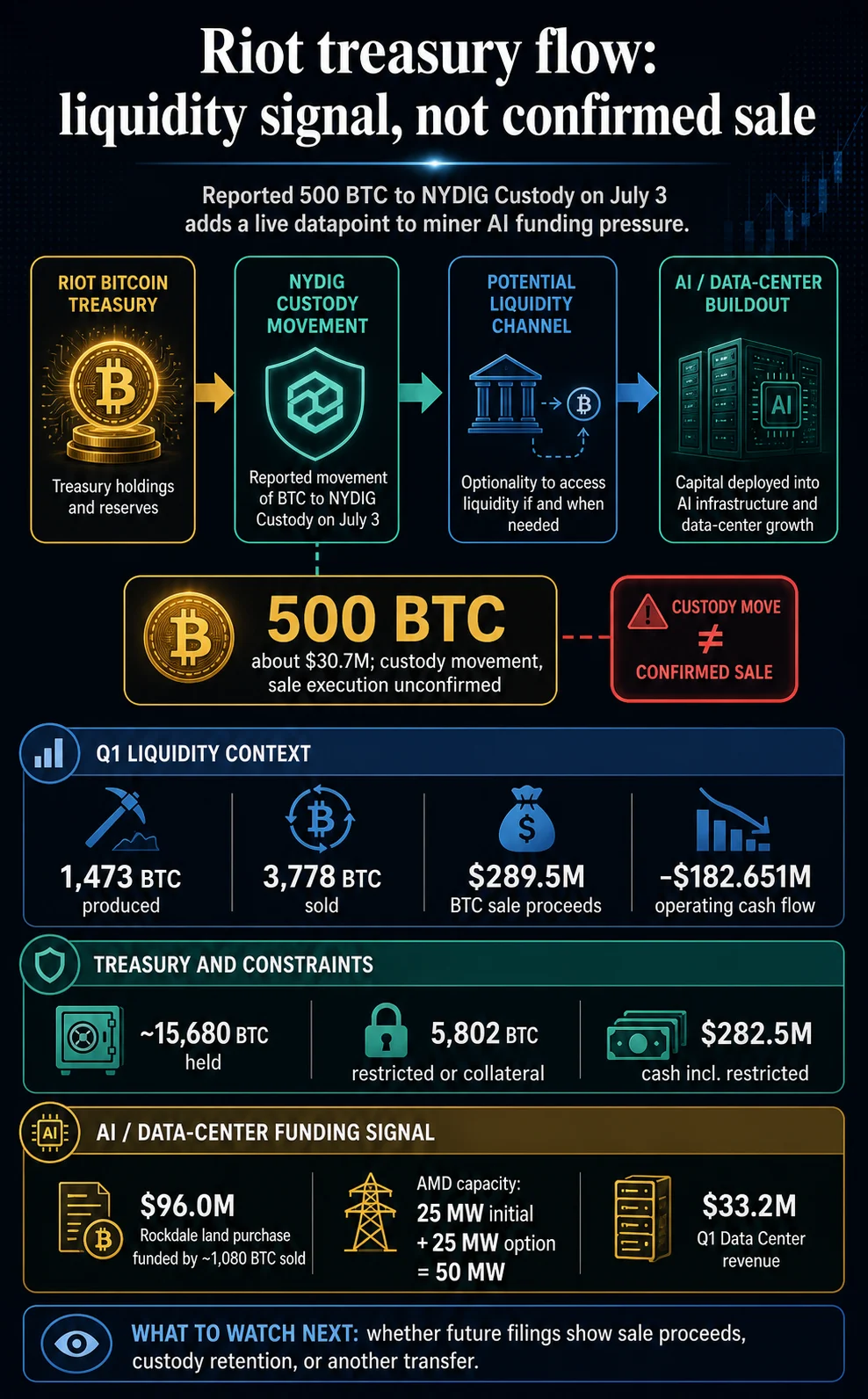
The digital asset mining sector is witnessing a fundamental shift in how treasury management intersects with infrastructure development, highlighted by Riot Platforms’ recent movement of 500 Bitcoin (BTC) to NYDIG Custody. On July 3, on-chain monitoring data confirmed the transfer of approximately $30.7 million worth of Bitcoin from Riot’s controlled wallets to the institutional custody provider. While the available records indicate a movement of assets rather than an immediate market sale, the transaction serves as a critical liquidity signal for investors and analysts monitoring how public miners are financing their transition into the high-performance computing (HPC) and artificial intelligence (AI) sectors.
This movement is not an isolated event but rather a continuation of a broader capital allocation strategy. Riot Platforms has previously disclosed a series of Bitcoin sales, the classification of certain holdings as restricted collateral, and a strategic pivot toward data center expansion that requires significant upfront capital. In an environment where operating costs are rising and the competitive landscape for power capacity is intensifying, the mobilization of treasury assets has become a primary tool for corporate survival and growth.
Strategic Context of the 500 BTC Transfer
The transfer to NYDIG Custody carries significant weight because it follows a period of intense financial activity for Riot. In its first-quarter production and operations update, the company reported the production of 1,473 BTC. However, during the same period, Riot sold 3,778 BTC, generating approximately $289.5 million in net proceeds at an average price of $76,626 per coin. This data reveals that Riot is currently liquidating its treasury at a rate of more than two and a half times its quarterly production volume.
Despite these aggressive sales, Riot maintained a substantial treasury at the end of the quarter, holding between 15,679 and 15,680 BTC. A critical detail in the company’s financial disclosures is that 5,802 BTC of this total was categorized as restricted or held as collateral. This suggests that a significant portion of Riot’s "HODL" (Hold On for Dear Life) strategy has already been leveraged to secure financing or meet contractual obligations. The latest 500 BTC movement to NYDIG, therefore, functions as a live liquidity marker, potentially staging the assets for future sale or use as collateral in new financing rounds.
Chronology of Riot’s Data Center and AI Evolution
To understand why Riot is liquidating Bitcoin during a period of market volatility, one must look at the company’s infrastructure timeline. Riot is no longer positioning itself solely as a Bitcoin miner; it is evolving into a diversified digital infrastructure provider.
In January, Riot announced a landmark "fee simple" acquisition of 200 acres of land in Rockdale, Texas. The $96.0 million purchase was funded entirely through the monetization of 1,080 BTC from the company’s balance sheet. This event set a clear precedent: Bitcoin is being treated as a "liquid land bank" that can be converted into physical infrastructure whenever strategic opportunities arise.
Following the land acquisition, Riot entered into a data center lease and services agreement with AMD. The initial agreement covered 25 megawatts (MW) of critical IT load capacity. By April, the demand for high-density power prompted AMD to exercise an option for an additional 25 MW, bringing the total contracted capacity to 50 MW. This expansion into the AI and HPC space contributed to Riot’s first quarter of data center revenue, which reached $33.2 million. The majority of this revenue was derived from tenant fit-out services, indicating that Riot is actively building out environments for third-party clients rather than just running its own mining rigs.
Financial Analysis: The Pressure of Negative Operating Cash Flow
The necessity of Bitcoin sales becomes apparent when examining Riot’s cash flow statement. For the three months ended March 31, Riot reported a negative operating cash flow of $182.651 million. During the same period, the proceeds from Bitcoin sales totaled $289.484 million. Without these sales, the company would have faced a significant liquidity crunch, as its cash on hand—including restricted cash—stood at $282.5 million.
The financial data paints a picture of a company in a "build-out" phase. The costs associated with maintaining a massive mining fleet, coupled with the capital expenditures required for the Rockdale site and the AMD partnership, exceed the cash generated by mining operations alone. Consequently, the Bitcoin treasury acts as a vital buffer. The 500 BTC moved to NYDIG represents roughly $30.7 million in potential liquidity that could be used to offset ongoing operating losses or fund the next stage of data center construction.
Riot Liquidity and Operational Metrics
| Metric | Reported Figure | Strategic Implication |
|---|---|---|
| Q1 BTC Produced | 1,473 BTC | Baseline mining output post-halving |
| Q1 BTC Sold | 3,778 BTC | Liquidation exceeding production for capex |
| Q1 BTC Sale Proceeds | $289.5 Million | Primary source of non-dilutive capital |
| Q1 Operating Cash Flow | -$182.651 Million | Highlights reliance on treasury for operations |
| Total BTC Treasury | ~15,680 BTC | Significant remaining buffer for future growth |
| Restricted/Collateral BTC | 5,802 BTC | Assets already committed to financial structures |
| Rockdale Land Purchase | $96.0 Million | Funded by 1,080 BTC; proves treasury utility |
| Latest NYDIG Movement | 500 BTC (~$30.7M) | Potential staging for sale or collateralization |
The AI Pivot and the Revaluation of Power Capacity
Riot’s strategy reflects a broader trend among public Bitcoin miners who are navigating the post-halving landscape. As the block reward for mining Bitcoin decreased in early 2024, the "hashprice"—a measure of mining profitability—fell to historic lows. This has forced miners to seek alternative revenue streams that utilize their most valuable asset: grid-scale power capacity and electrical infrastructure.
The demand for AI data centers has created a valuation premium for companies that already possess "behind-the-meter" power access and land. By converting mining sites into AI-ready facilities, Riot is essentially arbitrageing its power costs. While Bitcoin mining provides a volatile but immediate return, AI infrastructure leases offer long-term, stable cash flows. However, the hardware required for AI—such as NVIDIA H100 or AMD Instinct GPUs—is significantly more expensive than Bitcoin ASICs, necessitating the massive capital outlays seen in Riot’s recent filings.
Industry observers note that other major players, such as Hut 8 and Core Scientific, have followed similar paths. Core Scientific recently signed a multi-billion dollar deal with CoreWeave to provide high-performance computing services, a move that significantly boosted its stock price and changed its market perception from a "struggling miner" to an "AI infrastructure play." Riot’s 500 BTC movement suggests it is preparing for a similar scale of investment.
Market Reactions and Investor Implications
The market’s reaction to miner transfers is often one of caution, as large movements are frequently precursors to sell-side pressure. However, institutional analysts suggest that for companies like Riot, these transfers should be viewed through the lens of capital allocation rather than mere "dumping."
If Riot continues a steady rhythm of moving Bitcoin to custodians like NYDIG, the market may begin to price in a "normalized" sell rate. This transparency allows investors to distinguish between a miner selling out of desperation and a miner selling to fund accretive assets like data centers. The distinction is vital for Riot’s valuation; if the market perceives the company as a growing AI infrastructure provider, it may trade at a higher multiple than a pure-play Bitcoin miner.
Furthermore, the use of Bitcoin as a funding stack reduces the need for Riot to issue new equity, which would dilute existing shareholders. By selling Bitcoin at prices near $70,000 to $76,000, Riot is effectively using its "digital gold" to build "physical gold"—the data centers that will house the next generation of computing power.
Future Outlook: Beyond the 500 BTC Signal
The ultimate fate of the 500 BTC moved to NYDIG will likely be revealed in Riot’s next quarterly filing or monthly production update. If the coins remain in custody, they may be part of a new lending or collateralized borrowing arrangement. If they are sold, the proceeds will almost certainly be funneled into the Rockdale expansion or the AMD fit-out project.
The broader implication for the Bitcoin market is that public miners are no longer passive holders. They have become active participants in the liquidity cycle, using their treasuries to fund a massive industrial pivot. As AI and Bitcoin mining continue to converge over the use of energy resources, the "cadence" of these transfers will become a primary indicator of how quickly the sector is evolving.
For Riot Platforms, the challenge remains balancing its identity. It must maintain enough Bitcoin exposure to satisfy its core investor base while liquidating enough of that exposure to fund the infrastructure required for the AI era. The 500 BTC transfer is a small but clear signal that the company is leaning toward the latter, prioritizing the "bricks and mortar" of the digital age over the "coins" themselves. As the build-out continues, the market will be watching to see if this aggressive capital allocation strategy results in the diversified, high-margin revenue Riot has promised its stakeholders.