Dwi Wanna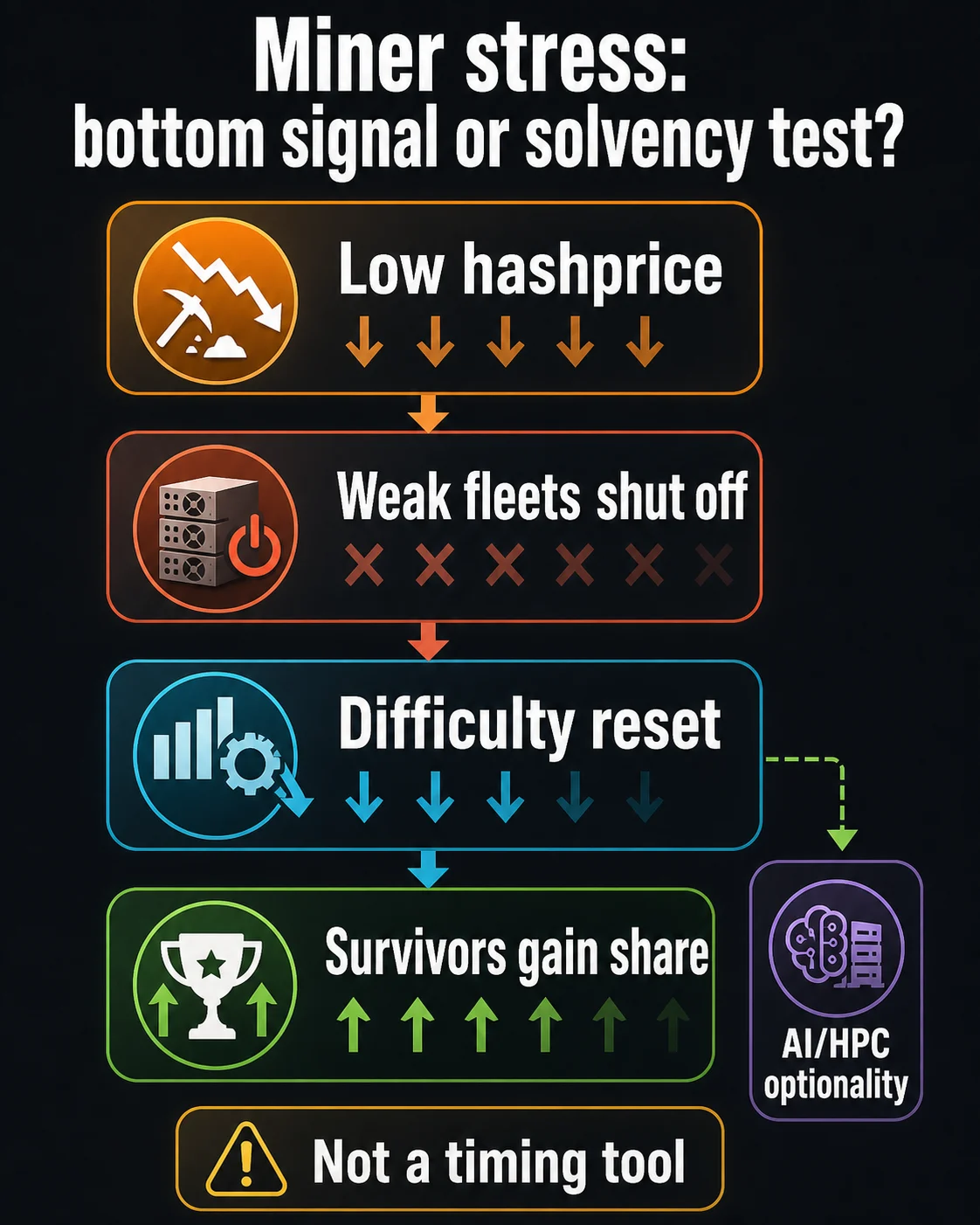
The global Bitcoin mining sector is currently navigating a period of intense operational pressure, as a key composite indicator of miner stress has plummeted to levels historically associated with market bottoms. This development, highlighted by a series of technical signals circulating through the digital asset analyst community, suggests that the mining industry is undergoing a significant "shakeout" phase. For market participants, these signals are often interpreted as a precursor to a potential price recovery; however, for the miners themselves, the situation represents a high-stakes test of solvency, operational efficiency, and balance sheet resilience.
At the center of this observation is the Miner Cycle Stress Composite, which has recently fallen to new lows for the 2026 cycle. This composite is a sophisticated tool used by analysts to gauge the health of the mining ecosystem. It primarily combines the Puell Multiple—a metric that measures the dollar value of daily Bitcoin issuance against its one-year moving average—with an inverted Miner Capitulation Index. When this composite enters "undervalued" territory, it indicates that miners are earning significantly less than their historical averages, often forcing inefficient operators to shut down their machines and liquidate their Bitcoin holdings to cover fixed costs.
The Mechanics of Miner Stress: Hashprice and Revenue Compression
To understand the severity of the current climate, one must look at "hashprice," a term coined by Luxor’s Hashrate Index to describe the expected value of one petahash per second (PH/s) of mining power per day. Hashprice is arguably the most critical metric for a mining business because it accounts for Bitcoin’s market price, network difficulty, and transaction fees. It essentially tells a miner exactly how much revenue they can expect for the computational work they provide to the network.
In early June 2026, the USD hashprice fell by 9.0% in a single week, dropping to approximately $32.56 per PH/s/day. While there was a slight rebound to $33.74 by mid-June, the forward-looking market remains pessimistic, with six-month forward contracts pricing the average hashprice at roughly $32.13. For many operators, these figures represent the "break-even" point or worse. When the hashprice stays in the low-$30s, the margin for error evaporates, particularly for those utilizing older hardware or paying higher-than-average electricity rates.
The divergence in profitability between modern and legacy hardware has never been more pronounced. Data from the Hashrate Index reveals a sharp split in compute revenue based on fleet efficiency, measured in Joules per Terahash (J/TH). High-efficiency fleets—those operating at sub-19 J/TH—are currently earning roughly $81 per Megawatt-hour (MWh) of compute revenue. In contrast, older fleets operating in the 25-38 J/TH range are earning approximately $43 per MWh. Given that many industrial-scale miners face all-in electricity and hosting costs between $45 and $60 per MWh, a significant portion of the global hashrate is currently operating at a gross loss.
A Chronology of the 2026 Miner Shakeout
The current stress regime did not emerge in a vacuum; it is the result of a steady erosion of margins throughout the first half of 2026. A chronological review of the year’s data provides context for how the industry reached this tipping point:
- First Quarter 2026: The network hashrate reached an all-time high as miners deployed new, more efficient machines (such as the S21 and M60 series) in anticipation of a sustained price rally. The 30-day simple moving average for hashrate sat at 1,066 EH/s.
- April – May 2026: Bitcoin’s price began to stabilize in the mid-$60,000 range, but network difficulty continued to climb, further diluting the rewards for individual miners. Hashprice began its descent toward the $35 level.
- June 2026: The "stress signal" was officially triggered. Hashrate Index reported a 5.8% quarterly decline in network hashrate, falling to 1,004 EH/s. Analysts estimated that approximately 252 EH/s of marginal capacity—largely composed of older 25+ J/TH hardware—had gone offline.
- July 2026: The Miner Cycle Stress Composite hit its cycle low. On July 6, despite Bitcoin trading at $63,007 with a market capitalization of $1.26 trillion and 58.0% dominance, the internal economics of mining remained decoupled from the spot price, keeping the pressure on the "survivor" class of miners.
The Difficulty Adjustment: Bitcoin’s Self-Correcting Mechanism
The Bitcoin protocol is designed to handle periods of miner stress through its difficulty adjustment algorithm. Every 2,016 blocks (approximately every two weeks), the network evaluates how quickly blocks were found. If the hashrate has dropped because miners have turned off their machines, the difficulty decreases, making it easier and more profitable for the remaining miners to find blocks.
This mechanism is why "miner capitulation" is often viewed as a bullish signal for the long term. As the weakest, most inefficient operators are forced out, the network’s difficulty resets to a lower level. This improves the profit margins for the survivors, even if the price of Bitcoin remains stagnant. This process effectively transfers market share from debt-heavy, inefficient miners to well-capitalized, low-cost operators. Historically, the point at which the hashrate bottomed and began to recover alongside a difficulty drop has frequently coincided with the ultimate price bottom of a market cycle.
Strategic Responses: Curtailment, Sales, and Consolidation
Miners are currently employing four primary strategies to navigate this period of suppressed hashprice:

1. Operational Curtailment: Miners with flexible power agreements are choosing to shut down during peak energy price hours or during periods when the hashprice falls below their marginal cost of production. This allows them to avoid losses and, in some cases, earn revenue by selling power back to the grid.
2. Treasury Liquidations: For many public and private miners, the "HODL" strategy is becoming increasingly difficult to maintain. To cover debt obligations and operational expenses, miners are being forced to sell their mined Bitcoin or use it as collateral for loans. This adds selling pressure to the market, which can contribute to the "capitulation" phase where price and hashrate find a local floor.
3. Corporate Consolidation: The current environment favors public mining companies with access to capital markets. These firms are using the downturn to acquire distressed assets, including land, power contracts, and hardware, from smaller or more leveraged competitors. This is leading to an increasingly institutionalized and centralized mining landscape.
4. The Pivot to Artificial Intelligence (AI): One of the most significant shifts in the 2026 cycle is the diversification into High-Performance Computing (HPC) and AI data centers. Companies like Core Scientific, Bitdigital, and others have begun repurposing their infrastructure to host AI workloads, which often offer higher margins and more stable revenue than Bitcoin mining. This pivot provides a hedge against hashprice volatility, though it requires significant capital expenditure to upgrade cooling and electrical systems.
Analysis of Market Implications
The current reading of the Miner Cycle Stress Composite serves as a critical diagnostic for the health of the Bitcoin network. However, analysts caution that it should be viewed as an "alarm" rather than a "timing" device. While the signal suggests that the market is in a zone where bottoms have historically formed, it does not preclude further downside if the global macroeconomic environment shifts or if Bitcoin’s price experiences a deeper correction.
The broader implication is a "flight to quality" within the mining sector. The industry is moving away from a model where any operator with a machine and a plug could be profitable. In the 2026 landscape, survival is predicated on three pillars: access to ultra-low-cost electricity (often below $0.04 per kWh), the latest generation of hardware (sub-20 J/TH), and a diversified revenue stream that may include AI or grid-balancing services.
Future Outlook and Signals to Watch
As the industry moves into the second half of 2026, several key indicators will determine whether this miner stress signal truly marked a market bottom or merely a pause in a deeper shakeout.
First, the stabilization of the network hashrate is paramount. If the hashrate continues to decline, it indicates that the purge of inefficient hardware is still underway. Second, the behavior of public mining equities will be telling; if these companies continue to sell BTC at high volumes, it suggests that cash flow remains a primary concern. Conversely, if public miners begin to increase their "HODL" positions again, it may signal that they believe the worst of the revenue compression is over.
Finally, the success of AI and HPC integrations will be closely monitored. If these pivots translate into meaningful earnings, it could decouple the valuation of mining stocks from the price of Bitcoin, creating a new class of "energy infrastructure" companies.
In conclusion, the Bitcoin mining industry is currently at a crossroads. The technical signals of stress are undeniable, mirroring the darkest days of previous bear markets. Yet, the network’s inherent self-correction mechanisms and the strategic evolution of its major players suggest that while the "pain" is immediate, it is a necessary part of the cycle that paves the way for future network stability and potential market recovery. Whether this signal proves to be a definitive bottom depends on the hashprice’s ability to reclaim the $40 level and the industry’s capacity to absorb the ongoing economic squeeze.