admin
admin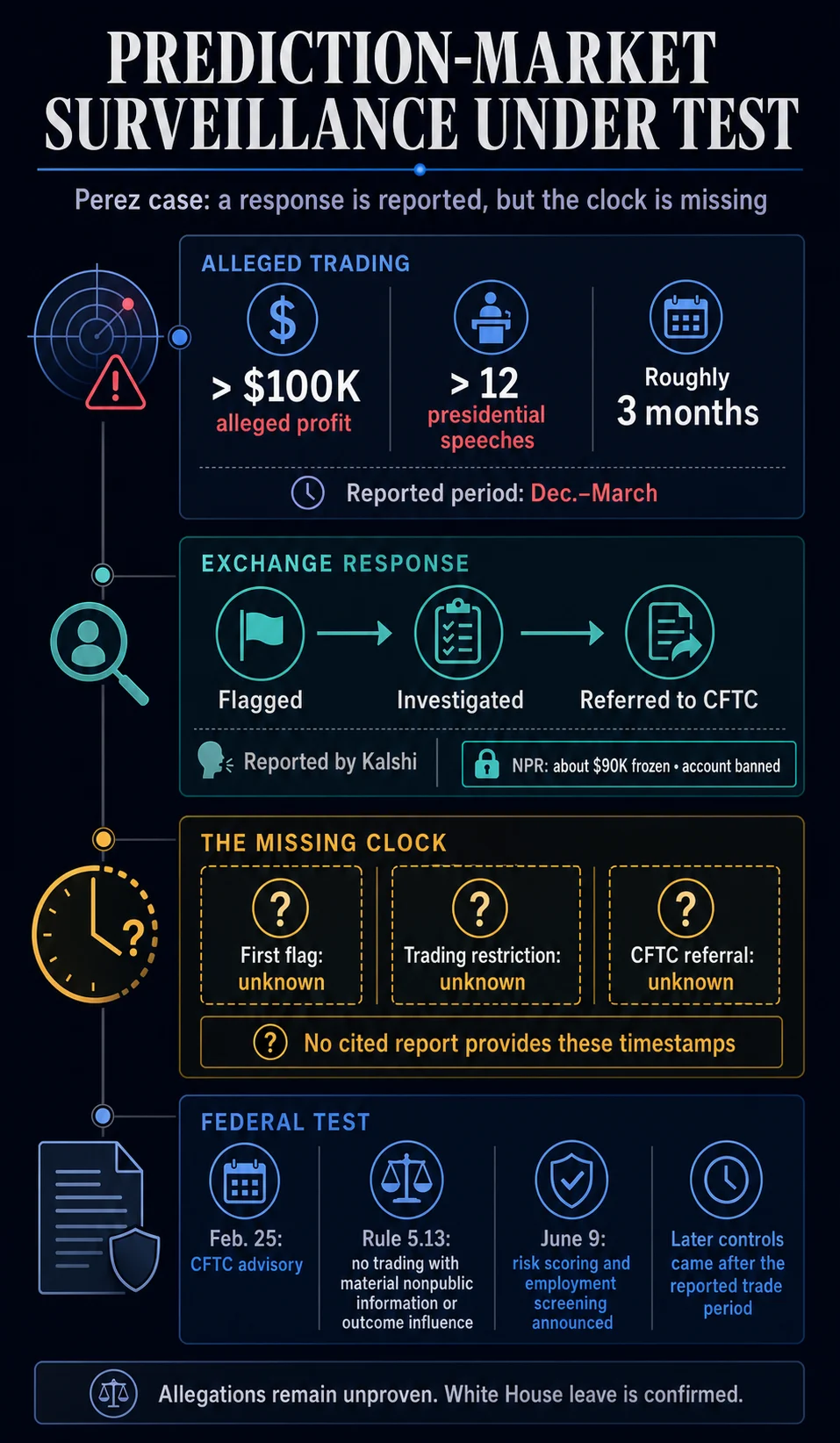
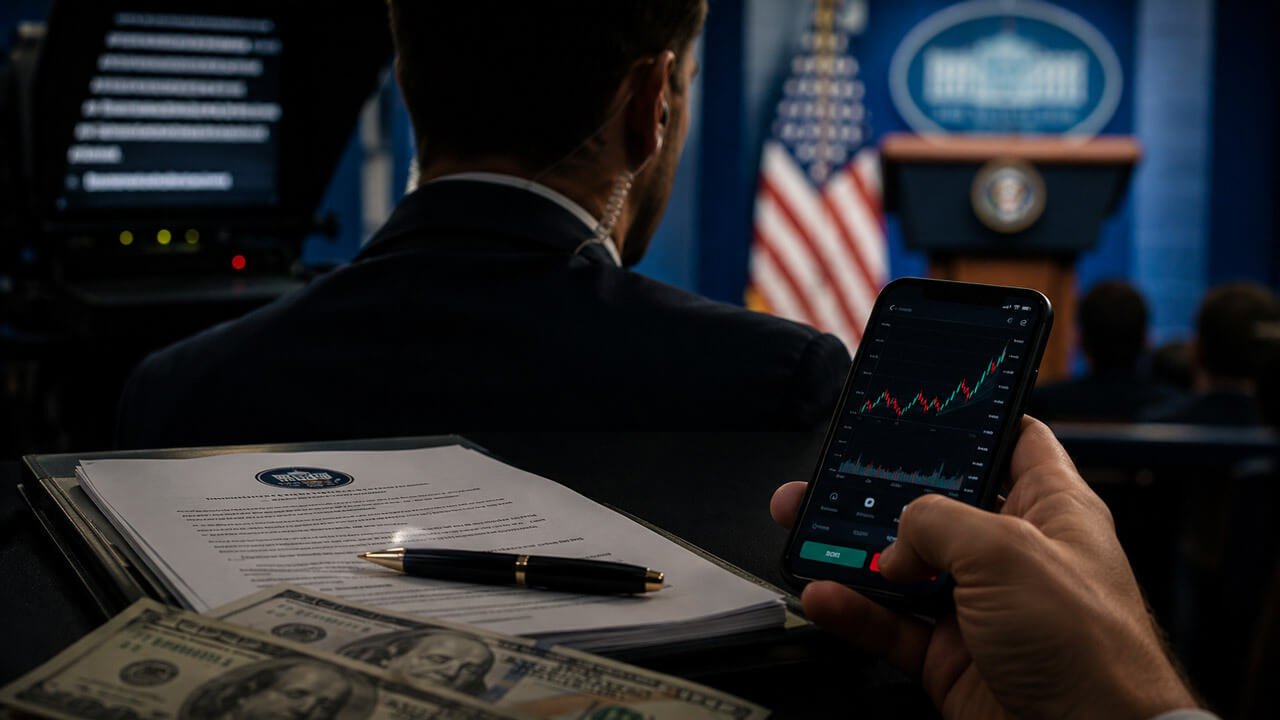
The White House has placed Gabriel Perez, a long-time teleprompter operator for President Donald Trump, on unpaid administrative leave following allegations that he leveraged advance access to the President’s prepared remarks to accrue over $100,000 in profits through trading on the prediction market platform Kalshi. The reported incidents, which allegedly span more than a dozen speeches over a roughly three-month period, have triggered an investigation and raised significant concerns about the integrity of information flow and market surveillance. Perez is reportedly in discussions with the Commodity Futures Trading Commission (CFTC) regarding a potential settlement.
Background of the Allegations
The core of the allegations centers on the claim that Perez, by virtue of his role in preparing President Trump’s speeches, had access to remarks before they were publicly delivered. This privileged information, it is alleged, was then used to place trades on Kalshi, a platform that allows users to bet on the outcome of future events, including political speeches. The implication is that Perez profited by knowing the content of these speeches, and therefore the likely outcomes of events tied to them on the prediction market, before the general public and other traders.
Sources familiar with the matter, speaking to ABC News, indicated that the alleged trading activity involved over a dozen speeches and occurred over approximately three months. The Commodity Futures Trading Commission (CFTC), the federal regulator overseeing derivatives markets, has declined to comment on the ongoing investigation.
Kalshi, the exchange where the alleged trades took place, issued a statement asserting that its internal surveillance team detected the unusual activity. The company claims it promptly investigated the trades and subsequently referred its findings to the CFTC. Separately, NPR reported, citing unnamed sources, that Kalshi froze approximately $90,000 associated with Perez’s account and barred him from further participation on the platform.
The Crucial Timeline: A Gap in Public Reporting
A critical element of this unfolding story is the precise timing of Kalshi’s detection and intervention. While multiple news outlets, including ABC News, The Associated Press, and NPR, have reported on the allegations and Kalshi’s response, a definitive timeline detailing when the first alert was triggered, when trading restrictions were imposed, or when the referral to the CFTC was made remains conspicuously absent from public reports. This lack of specific timestamps makes it challenging to ascertain the full extent of the alleged trading and the efficacy of Kalshi’s surveillance mechanisms in preventing further illicit activity.
Without this crucial chronological data, it is impossible to determine whether Kalshi’s actions were taken before all of the alleged trading occurred, or if the platform’s intervention came after a significant portion of the activity had already transpired. This information is vital for understanding the speed and effectiveness of the exchange’s internal controls and their deterrent impact.
Kalshi’s Surveillance and Regulatory Framework
Kalshi operates within a regulatory environment designed to prevent market manipulation and ensure fair trading practices. The CFTC’s February advisory explicitly stated that the misappropriation of confidential information, when in breach of a duty, can constitute a violation of Section 6(c)(1) of the Commodity Exchange Act and Regulation 180.1. This advisory underscored the regulatory body’s stance on insider trading within prediction markets.
Furthermore, the advisory highlighted the independent responsibility of designated contract markets, such as Kalshi, to maintain robust audit trails, conduct thorough trading surveillance, and enforce their own rules. Kalshi’s own rulebook explicitly prohibits members who possess material nonpublic information or exert influence over an event’s outcome from trading related contracts. It also mandates the review and investigation of any unusual trading activity.
The infographic accompanying the original report, though lacking specific dates for Kalshi’s actions, visually represented the alleged trading metrics, Kalshi’s reported response, and the broader regulatory framework. The absence of specific timestamps for Kalshi’s surveillance, trading restriction, and referral to the CFTC leaves a significant gap in the public understanding of the events.
Broader Implications for Prediction Markets and Information Integrity
The allegations involving Gabriel Perez are not isolated incidents but appear to be part of a larger pattern of concerns surrounding the integrity of prediction markets. The CFTC has previously issued general warnings about prediction markets, and CryptoSlate has reported on a separate case involving a Special Forces soldier arrested for insider trading on Polymarket. The current situation, however, is notable for the alleged source of insider information—access to White House speeches—and the use of a federally regulated exchange.
This development also coincides with a significant announcement from Trump Media & Technology Group (TMTG) on July 16. TMTG revealed plans for "Truth API," a paid data feed designed to provide institutional clients with near-instantaneous access to posts from influential accounts on Truth Social, including President Trump’s. Scheduled to launch on August 1, the service is explicitly targeted at high-frequency and algorithmic trading firms, where even minor delays in information delivery can have substantial financial implications.

While the Truth API concerns faster access to information after publication, and the Perez allegations relate to nonpublic information before publication, both developments underscore the burgeoning financial ecosystem built around receiving President Trump’s potentially market-moving communications ahead of the general public. These adjacent markets, one focused on rapid post-publication dissemination and the other on pre-publication insider knowledge, highlight a shared commodity: the value of timely information in a rapidly evolving digital landscape.
Kalshi’s Recent Integrity Measures
In response to growing concerns about market integrity, Kalshi announced new measures on June 9, including the implementation of market risk scores and employment verification for users participating in certain high-risk markets. These safeguards were introduced after the reported December-to-March period during which Perez allegedly conducted his trading. It remains unclear whether these new safeguards were applied to presidential-mention markets immediately after their rollout or if similar checks were already in place prior to the alleged incidents. The effectiveness and timing of these new measures in light of the Perez allegations are yet to be fully determined.
Analysis of the Response and Future Outlook
The alleged actions of Gabriel Perez raise critical questions about the adequacy of internal controls and surveillance within prediction markets, even those regulated by federal bodies. While Kalshi’s surveillance system appears to have detected unusual activity, leading to a referral to the CFTC and a reported freeze of funds and user ban, the repeated nature of the alleged trading and the absence of precise timestamps for these interventions cast a shadow over their immediate deterrent effect.
The regulatory framework is in place, and the CFTC has made its position clear regarding the misuse of material nonpublic information. The key challenge now lies in the transparent and timely application of these rules and the demonstrable effectiveness of the surveillance systems employed by exchanges. The outcome of the CFTC’s investigation into Perez’s alleged activities, and any subsequent enforcement actions, will likely provide further clarity on how these sophisticated market dynamics are policed and what the future holds for the integrity of prediction markets. The incident serves as a stark reminder of the constant vigilance required to maintain a fair and equitable trading environment, particularly when sensitive information is involved.