Dwi Wanna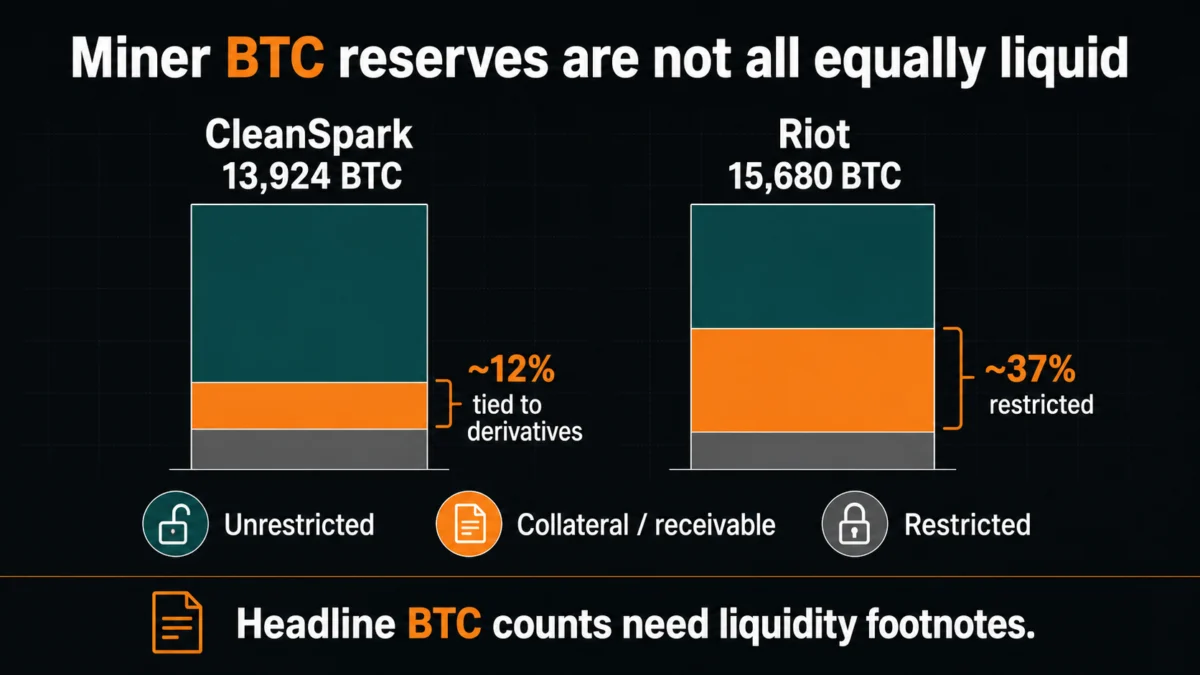
The landscape of the cryptocurrency mining industry is undergoing a fundamental transformation as top-tier operators transition from simple "HODL" strategies to complex treasury management and sophisticated financial engineering. CleanSpark, currently ranked as the 11th-largest public Bitcoin treasury holder among operating companies, recently released its operational update for June 2026, revealing a nuanced breakdown of its Bitcoin holdings that suggests a shift in how the market must evaluate corporate balance sheets. While the headline figure of 13,924 BTC remains a testament to the company’s scale, a critical footnote in the report indicates that 1,719 BTC—approximately 12% of the total—was posted as collateral or recorded as a receivable linked to derivative transactions.
This disclosure highlights a growing trend among public miners where reported Bitcoin balances are no longer monolithic reserves of liquid assets. Instead, these "stacks" are increasingly utilized in financing, risk-management mechanisms, and yield-generating derivatives. As the industry matures and faces tightening margins, the distinction between "headline reserves" and "deployable liquidity" has become the primary metric for investors assessing the long-term viability of mining operations.
The Decomposition of the Modern Mining Treasury
For years, the primary metric for a successful Bitcoin miner was the sheer size of its treasury. In the bullish cycles of 2021 and 2024, a large Bitcoin balance was viewed as a sign of institutional strength and a lever for future capital appreciation. However, the June 2026 update from CleanSpark demonstrates that the reserve count is no longer a single, fungible number.
CleanSpark’s operational activity in June provides a roadmap for this new complexity. During the month, the company produced 614 BTC through its mining operations. However, its total treasury movement was influenced by far more than just raw production. The company reported selling 179 BTC at spot prices to cover immediate operational expenses. More significantly, it navigated the derivatives market by selling 250 BTC pursuant to call exercises and acquiring 25 BTC through put exercises. Additionally, the company acquired 244 BTC related to a delta-neutral basis trade—a strategy typically used to capture the spread between spot and futures prices while minimizing exposure to price volatility.
The inclusion of 1,719 BTC as collateral or receivables means that a significant portion of CleanSpark’s holdings is currently serving a functional role in financing or settlement rather than sitting as a readily available cash equivalent. This does not suggest financial instability; rather, it reflects a move toward sophisticated capital efficiency. By pledging Bitcoin as collateral, miners can access liquidity for expansion—such as purchasing new ASIC hardware or developing data center infrastructure—without triggering the tax consequences or market impact of a direct sale.
Comparative Analysis: Riot Platforms and the Restricted Balance Precedent
CleanSpark is not the only industry giant moving toward this multi-tiered treasury structure. Riot Platforms, another titan in the sector, provided a broader comparison point in its Q1 2026 operations update. Riot reported a total of 15,680 BTC held at the end of the quarter. However, a staggering 5,802 BTC—roughly 37% of the total holdings—was classified as "restricted."
The disparity between CleanSpark’s 12% encumbered balance and Riot’s 37% restricted balance illustrates the different strategic paths being taken by market leaders. Restricted Bitcoin can stem from a variety of requirements, including debt covenants, collateral for long-term power purchase agreements (PPAs), or escrowed amounts for pending acquisitions.
In Riot’s case, the quarter also saw the company sell 3,778 BTC for $289.5 million in net proceeds. This aggressive monetization, combined with a high percentage of restricted assets, suggests a strategy focused on massive infrastructure scaling. For investors, the takeaway is clear: two companies with similar headline Bitcoin totals may have vastly different "stress buffers." A miner with 15,000 BTC that is mostly unrestricted has significantly more maneuverability during a market downturn than a miner with the same balance but a 40% restriction rate.
The Macroeconomic Context: Rising Costs and the AI Pivot
The timing of these nuanced treasury disclosures is critical, as the broader Bitcoin mining ecosystem faces a period of intense economic pressure. As of early July 2026, the price of Bitcoin hovered near $62,000, representing a significant 50% decline from its October 2025 all-time high. This price contraction has coincided with a dramatic increase in the cost of production.

According to the CoinShares Q1 2026 mining report, the weighted-average cash cost for listed miners to produce a single Bitcoin rose to approximately $79,995 in the final quarter of 2025. This increase is attributed to rising global energy costs, increased difficulty in the Bitcoin network, and the aging of less efficient hardware. With the "hashprice"—the expected value of 1 PH/s of hashing power per day—languishing near $30, it is estimated that between 15% and 20% of the global mining fleet is currently operating "underwater," or at a loss on a pure cash-cost basis.
To survive this environment, miners are diversifying their revenue streams. CoinShares projections suggest that by the end of 2026, listed miners could derive as much as 70% of their revenue from High-Performance Computing (HPC) and Artificial Intelligence (AI) colocation services. This is a massive leap from the 30% revenue share seen in previous years. The shift has been fueled by over $70 billion in announced deals involving GPU colocation and cloud service agreements with hyperscalers like Amazon Web Services, Microsoft Azure, and Google Cloud.
This pivot to AI requires immense upfront capital for specialized chips (such as NVIDIA H100s or B200s) and cooling infrastructure. Consequently, the question for the market has shifted from "Who has the most Bitcoin?" to "Who has the most deployable Bitcoin?"
Chronology of the Treasury Evolution (2021–2026)
The journey to the current state of miner treasuries can be traced through several distinct phases over the last five years:
- The Accumulation Era (2021–Early 2022): Public miners adopted a "HODL" strategy, rarely selling their mined Bitcoin. Capital was raised primarily through equity dilution in a low-interest-rate environment.
- The Great Deleveraging (Late 2022–2023): Following the collapse of FTX and the subsequent crypto winter, miners were forced to sell thousands of BTC at market lows to cover debt obligations and operational costs. This period taught the industry the dangers of being "asset rich but cash poor."
- The Halving Preparation (2024–2025): Miners began using basic derivatives to hedge against the 2024 halving. The goal was to lock in prices to ensure survival during the expected period of reduced block rewards.
- The Institutional Maturity Phase (2026): Miners like CleanSpark and Riot now operate like sophisticated financial institutions. They use delta-neutral trades, yield-bearing collateralization, and strategic restricted reserves to navigate a market where production costs exceed spot prices.
Analysis of Implications: Liquidity as the Ultimate Stress Test
The shift toward collateralized and derivative-linked Bitcoin has profound implications for market volatility and investor risk assessment. If Bitcoin prices and hashprice remain weak, the first point of failure in the industry may not be a network-wide collapse, but rather a liquidity crunch within specific companies.
The assumption that every coin reported on a balance sheet can be liquidated to pay power bills or fund AI buildouts is no longer valid. When a portion of a treasury is tied up in a delta-neutral trade or pledged as collateral for a loan, that Bitcoin is essentially "locked." If a company faces a sudden margin call or an unexpected spike in energy costs, the restricted or pledged nature of these assets could prevent them from being used as a buffer.
Furthermore, the use of derivatives introduces counterparty risk. While CleanSpark’s use of puts and calls is a standard hedging practice, the efficacy of these tools depends on the stability of the exchanges and financial institutions on the other side of the trade. In a stressed market, the "receivables" mentioned in CleanSpark’s footnote become a point of scrutiny: how quickly can those receivables be converted to cash, and what is the risk of default?
Looking Ahead: The Q2 and Q3 Benchmarks
As the industry moves into the second half of 2026, the upcoming quarterly reports will be a litmus test for the sector. Investors will be looking for transparency beyond the headline totals. The key metrics to watch will include:
- Unencumbered BTC Ratio: The percentage of total Bitcoin holdings that is free of restrictions, pledges, or derivative ties.
- AI Revenue Growth: Whether the massive investments in HPC are beginning to offset the cash-flow deficits from Bitcoin mining.
- Operational Cash Cost vs. Spot Price: How effectively miners are lowering their "all-in" costs through hardware upgrades and energy-curtailment programs.
CleanSpark’s recent disclosure is likely a preview of a new industry standard. As Bitcoin mining becomes increasingly integrated with global energy markets and AI infrastructure, the "footnote" will continue to matter more than the headline. The companies that thrive will be those that maintain not just the largest treasuries, but the most liquid and strategically managed ones. In the current era of $80,000 production costs and $62,000 prices, liquidity is not just an accounting detail—it is the difference between expansion and extinction.