admin
admin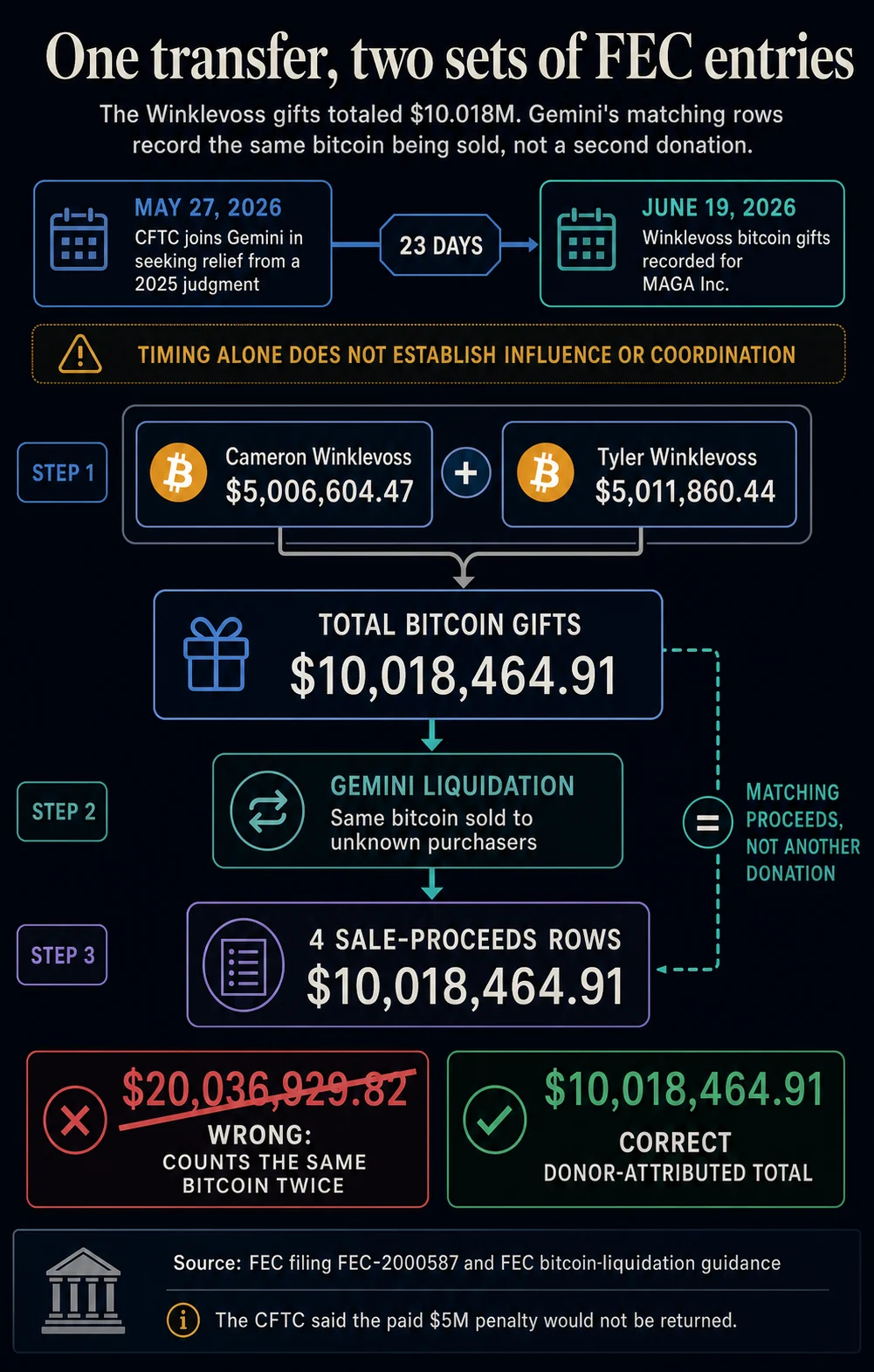
Newly disclosed Federal Election Commission (FEC) filings reveal a significant financial contribution from Gemini co-founders Cameron and Tyler Winklevoss to MAGA Inc., the prominent super political action committee (PAC) supporting former President Donald Trump. The twins collectively donated $10,018,464.91 in Bitcoin to the PAC on June 19, 2026. This substantial donation occurred just 23 days after the Commodity Futures Trading Commission (CFTC) announced it had joined Gemini, the cryptocurrency exchange founded by the Winklevoss brothers, in seeking relief from a prior judgment. While the FEC filings meticulously detail the transaction, they offer no direct evidence of a quid pro quo or explicit link between the donation and the regulatory action.
The FEC records indicate that MAGA Inc. liquidated the donated Bitcoin through Gemini, with the exchange acting as the facilitator for the sale to unknown purchasers. This detail is crucial, as FEC regulations require political committees to identify the exchange through which any donated cryptocurrency is sold. The identity of the ultimate buyer, however, can remain anonymous and does not count as a contributor under campaign finance law. The filings clearly delineate the amounts contributed by each twin: Cameron Winklevoss’s portion totals $5,006,604.47, while Tyler Winklevoss contributed $5,011,860.44. The four separate entries on June 19, all naming Gemini, precisely sum to the total donation amount, underscoring that these entries represent the liquidation of a single, large Bitcoin donation rather than multiple, independent contributions.
This recent disclosure builds upon previous financial support from the Winklevoss twins to MAGA Inc. An earlier FEC filing from July 2025 had already attributed approximately $1.015 million in Bitcoin donations made in January of that year to the twins. The June 2026 contribution represents a nearly tenfold increase in their disclosed financial backing for the Trump-aligned PAC, highlighting a growing commitment of significant digital asset wealth to political endeavors.
Background: The CFTC’s Shift in Stance on Gemini
The context surrounding the CFTC’s decision to seek relief from the 2025 judgment against Gemini is a critical element in understanding the broader implications of these financial disclosures. The CFTC’s amended joint motion, filed shortly before the Winklevoss donation, articulated several key reasons for its revised position. The agency stated that a thorough review of the case concluded the complaint against Gemini likely would not have been initiated under current enforcement standards.

Central to the CFTC’s reconsideration were identified credibility issues with a whistleblower’s account, which formed a significant basis for the initial action. Furthermore, the agency pointed to perceived weaknesses in the evidence presented, including crucial supporting materials that were requested by a commissioner but not supplied prior to the case’s authorization. The CFTC also noted that Gemini faced impediments to its defense due to privilege and relevance objections raised during the proceedings. A particularly salient point was the agency’s assertion that regulatory authority had been improperly utilized as leverage for settlement.
Beyond these procedural and evidentiary concerns, the CFTC also acknowledged Gemini’s status as a victim of fraud, a factor that may have influenced the agency’s discretionary judgment. Additionally, a shift in federal digital asset policy, potentially reflecting evolving regulatory approaches or a greater understanding of the nascent cryptocurrency market, may have contributed to the agency’s willingness to revisit the prior judgment.
Chronology of Events and Financial Disclosures
The timeline of these events is particularly noteworthy:
- Prior to June 19, 2026: The CFTC had initiated an enforcement action against Gemini, leading to a 2025 judgment, which included a $5 million penalty that Gemini had already paid.
- May 28, 2026: The CFTC filed an amended joint motion with Gemini, requesting the court to vacate the consent order or, alternatively, to lift its remaining prospective provisions, including a permanent injunction. This marked a significant procedural step in the agency’s reconsideration of the case.
- June 19, 2026: Cameron and Tyler Winklevoss each made substantial Bitcoin donations to MAGA Inc. These donations were processed and liquidated through Gemini.
- July 21, 2026 (Publication Date): Newly filed FEC records publicly disclose the June 19 donations, bringing the total financial support from the Winklevoss twins to MAGA Inc. to over $11 million, including the earlier January 2025 contribution.
The proximity of the CFTC’s motion for relief and the Winklevoss twins’ substantial donation raises questions about potential influence, although the available documentation does not provide direct proof of such a connection. The FEC filing, by its nature, focuses on the financial transaction and the reporting requirements associated with it, rather than the motivations or potential influences behind the contribution.
Supporting Data and Regulatory Framework
The FEC filing details the precise value of the Bitcoin donated by each twin on June 19, 2026. Cameron Winklevoss’s contribution, valued at $5,006,604.47, and Tyler Winklevoss’s contribution, valued at $5,011,860.44, together amount to the total $10,018,464.91 liquidated by MAGA Inc. The fact that the Bitcoin was sold through Gemini is a direct consequence of FEC regulations governing the reporting of in-kind contributions, particularly those involving cryptocurrencies. These rules are designed to ensure transparency in political financing by identifying the source of funds, even when those funds are in a non-traditional asset class like Bitcoin. The anonymity afforded to the ultimate purchasers of the Bitcoin is a standard provision in campaign finance law, preventing the identification of individuals or entities that may not wish to be publicly associated with their transaction.

The previous $5 million penalty imposed on Gemini by the CFTC in 2025 had been paid and satisfied. The joint motion filed by the CFTC and Gemini sought to vacate or modify the prospective aspects of the order, meaning the penalty itself was not subject to being returned. The focus of the motion was on preventing future injunctions or restrictions that could impact Gemini’s operations.
Broader Impact and Implications
The substantial Bitcoin donations from the Winklevoss twins to a major political PAC, particularly in close proximity to a regulatory action involving their cryptocurrency exchange, are likely to intensify scrutiny on the independence of regulatory bodies like the CFTC. As lawmakers continue to deliberate on the future structure of cryptocurrency oversight and potentially grant the CFTC expanded authority, such financial disclosures can fuel debates about potential conflicts of interest and the influence of large industry players on regulatory processes.
This situation underscores a broader trend in political finance where a concentrated group of industry executives can deploy significant financial resources into political committees, often while their companies are simultaneously navigating complex enforcement policies. The timing, while not definitive proof of influence, is sufficiently close to warrant public attention and raises important questions about the perception and reality of regulatory impartiality. The ability of individuals to leverage substantial digital asset holdings for political contributions presents a new frontier in campaign finance, one that regulators and the public will likely continue to monitor closely. The case highlights the intricate interplay between the rapidly evolving digital asset landscape, the established framework of political funding, and the ongoing efforts to ensure fairness and transparency in both arenas. The Winklevoss twins’ actions, as detailed in these FEC filings, serve as a compelling case study in this dynamic intersection.