Dwi Wanna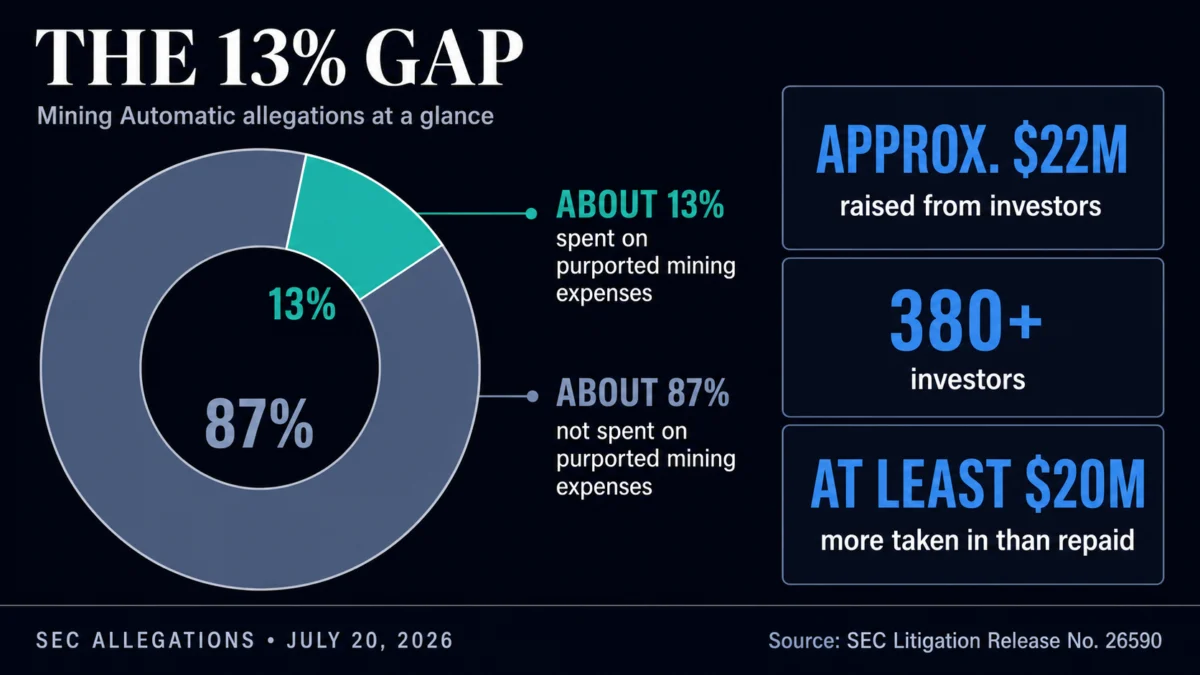
The United States Securities and Exchange Commission (SEC) has initiated legal action against Zan Shaikh and his company, Bright Vision Distribution LLC, which operated under the trade name Mining Automatic, following allegations of a massive fraudulent scheme. According to the federal regulator, the venture successfully solicited approximately $22 million from more than 380 investors by promising lucrative and guaranteed monthly returns from Bitcoin mining operations. However, the SEC’s complaint reveals a stark disparity between the company’s promises and its actual business practices, alleging that a mere 13% of the total funds raised—approximately 13 cents of every dollar—was ever directed toward the purchase or operation of cryptocurrency mining equipment.
The SEC filed its partially settled charges on July 20, 2026, in a move that underscores the ongoing regulatory scrutiny of the digital asset sector. The complaint alleges that between June 2023 and May 2025, Shaikh and Mining Automatic misled investors regarding the viability and profitability of their mining enterprise. While investors were led to believe their capital was funding a high-tech infrastructure designed to generate consistent passive income, the regulator claims the operation was never equipped to deliver the promised returns. Instead, a significant portion of the $22 million was allegedly diverted to fuel an aggressive marketing machine designed to attract new victims, cover Shaikh’s personal lifestyle expenses, and fund unrelated business ventures.
The Mechanics of the Alleged Mining Automatic Fraud
The core of the SEC’s case rests on the misrepresentation of how investor capital was deployed. In the world of cryptocurrency mining, profitability is traditionally tied to the "hash rate" of the hardware, electricity costs, and the market price of the underlying asset—in this case, Bitcoin. Mining Automatic allegedly bypassed these economic realities by operating what appears to be a classic Ponzi-like structure, where the appearance of a functioning business is maintained primarily through the influx of new capital rather than genuine commercial activity.
According to the SEC, the defendants took in at least $20 million more than they ever returned to their investors. This massive deficit highlights the unsustainable nature of the venture. By spending only $2.86 million (13% of $22 million) on actual mining-related costs, the company lacked the computational power necessary to generate the "guaranteed" monthly returns it advertised. The SEC asserts that the defendants used the majority of the remaining $19 million to sustain the scheme’s growth through digital marketing and to enrich Shaikh personally.
Chronology of the Scheme and Regulatory Intervention
The timeline of the Mining Automatic operation suggests a multi-year effort to capitalize on the public’s interest in digital assets. While the SEC complaint specifically focuses on the window between mid-2023 and mid-2025, broader investigations indicate that the groundwork for the scheme may have been laid much earlier.

- 2022 – Early 2023: Initial business formations and the launch of various entities associated with Zan Shaikh, including Bright Vision Distribution and potentially RankOne Ecommerce.
- June 2023: The period defined by the SEC as the start of the primary fraudulent offering. Marketing materials began circulating, promising guaranteed returns from Bitcoin mining.
- 2024: The height of the capital raising phase, during which the majority of the 380+ investors were onboarded.
- May 2025: The conclusion of the period cited in the SEC complaint, marking the point where the regulator began formalizing its evidence against the defendants.
- July 20, 2026: The SEC officially files partially settled charges against Zan Shaikh and Bright Vision Distribution LLC.
- Present: The FBI Boston Division continues its outreach to identify additional victims who may have been targeted by Shaikh’s various business entities.
Expanding the Scope: The FBI’s Involvement and Affiliated Entities
While the SEC’s primary focus is on the securities law violations, the Federal Bureau of Investigation (FBI) has launched a parallel effort to determine the full scale of the alleged misconduct. The FBI’s Boston Division has established a dedicated victim-information page, signaling that the number of affected individuals could be significantly higher than the 380 currently identified by the SEC.
The FBI’s investigation spans a wider array of companies linked to Zan Shaikh and his associates. In addition to Mining Automatic and Bright Vision Distribution, the Bureau is seeking information related to:
- YT Automatic: Another entity purportedly involved in automated income streams.
- RankOne Ecommerce: A business potentially involved in dropshipping or online retail automation.
- Replic8: An affiliate entity whose specific role in the scheme is currently under investigation.
The inclusion of these companies suggests that the alleged fraud may not have been limited to cryptocurrency mining but may have extended into other "automated" business models that are frequently used to lure investors seeking passive income. The FBI’s questionnaire covers a broader timeframe, reaching back to 2022, and encourages anyone who invested in these entities to come forward.
Legal Consequences and the Path to Recovery
Zan Shaikh and Mining Automatic have agreed to proposed permanent injunctions as part of a partial settlement. These injunctions, which are subject to the approval of a federal court, would legally bar the defendants from further violations of the anti-fraud and registration provisions of federal securities laws. Furthermore, Shaikh has agreed to an officer-and-director bar, which would prevent him from serving as a leader of any publicly traded company in the future, as well as a conduct-based injunction.
However, the most critical aspect for the 380-plus investors—the recovery of their lost funds—remains highly uncertain. Under the terms of the partial settlement, the court will decide on the amounts for "disgorgement" (the repayment of ill-gotten gains), prejudgment interest, and civil penalties at a later date, following a motion by the SEC.
History suggests that in cases where funds have been spent on personal expenses and marketing, the actual recovery rate for investors can be distressingly low. If the $20 million gap identified by the SEC represents money that has already been spent or dissipated, the "unannounced and uncertain" nature of investor distributions mentioned in the report becomes a significant concern for the victims.

The Broader Context of Crypto Mining Scams
The Mining Automatic case is part of a larger trend of "mining-as-a-service" (MaaS) frauds that have proliferated as Bitcoin’s value and mainstream recognition have grown. These schemes often exploit the technical complexity of cryptocurrency mining to confuse investors. Because the average person may not understand the intricacies of ASIC hardware, electricity cooling costs, or network difficulty adjustments, they are more likely to believe claims of "guaranteed" or "automated" profits.
Regulatory bodies like the SEC and the Commodity Futures Trading Commission (CFTC) have repeatedly warned that any investment opportunity promising "guaranteed" returns in the volatile crypto market is a major red flag. In previous years, similar schemes such as BitConnect and Mining City resulted in billions of dollars in losses, often following the same pattern: high-budget marketing, a focus on recruitment, and a lack of transparency regarding actual mining operations.
Analysis of Implications for the Digital Asset Industry
The fallout from the Mining Automatic case has several implications for both investors and the broader cryptocurrency industry.
- Increased Regulatory Scrutiny: This case reinforces the SEC’s position that many crypto-related investment contracts fall under the definition of securities. The regulator’s ability to track the flow of funds from investor deposits to marketing and personal accounts demonstrates its increasing sophistication in auditing digital and traditional financial trails.
- The "Due Diligence" Mandate: For investors, the case serves as a cautionary tale about the necessity of verifying physical infrastructure. Legitimate mining operations often provide third-party audits of their data centers, real-time hash rate monitoring, and transparent energy contracts. The absence of these verified metrics in the Mining Automatic case was a precursor to the current legal crisis.
- Reputational Damage to Legitimate Mining: Fraudulent schemes like this cast a shadow over legitimate, publicly traded mining companies that operate with transparency. As regulators crack down on bad actors, the barrier for entry for legitimate startups may increase due to more stringent compliance requirements.
- The Role of Law Enforcement Cooperation: The joint efforts of the SEC and the FBI indicate a coordinated federal response to financial fraud in the digital age. By utilizing both civil penalties (SEC) and potential criminal investigations (FBI), the government aims to create a more robust deterrent against similar schemes.
Conclusion and Next Steps
The next formal step in the legal process is the court’s review of the proposed judgments against Zan Shaikh and Bright Vision Distribution. If approved, the litigation will move into the phase of determining monetary relief. Meanwhile, the FBI continues to collect data from potential victims, which could lead to further charges or a widening of the case to include other associates or business entities.
For the hundreds of investors who contributed their savings to Mining Automatic, the road ahead is long. While the SEC’s intervention provides a sense of accountability, the physical recovery of the $22 million remains the ultimate, and perhaps most difficult, objective. As the investigation continues, the case stands as a stark reminder of the risks inherent in the "automated" investment frontier and the vital importance of regulatory oversight in protecting the integrity of the financial markets.