admin
admin
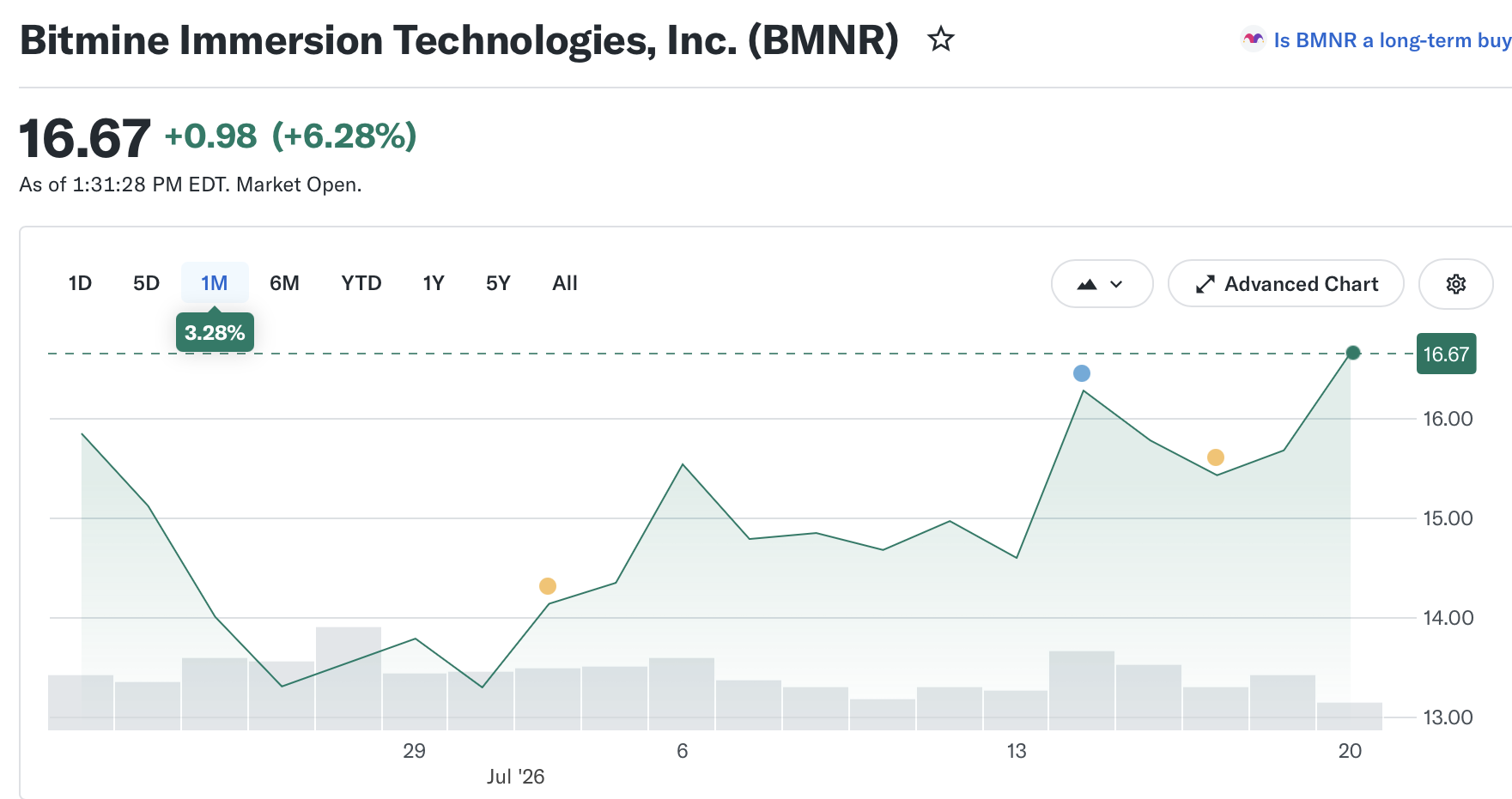
Top Ethereum treasury company Bitmine announced Monday that its Ether holdings had surged to 5.78 million tokens, a substantial figure representing approximately 4.8% of Ethereum’s total circulating supply. This milestone brings the firm remarkably close to its publicly stated objective of accumulating 5% of all Ether (ETH) in existence, a strategic move that underscores its long-term conviction in the digital asset. The announcement coincided with a notable uplift in Bitmine’s share price, which climbed over 6% in Monday afternoon trading, contributing to a 3.3% gain over the past month.
Bitmine’s Strategic Accumulation and Staking Prowess
Bitmine’s latest treasury update revealed a consistent accumulation strategy, with the company adding a further 7,430 ETH to its reserves over the past week alone. This incremental acquisition highlights an ongoing commitment to expanding its Ether footprint. A significant portion of Bitmine’s accumulated ETH, approximately 4.9 million tokens, representing roughly 85% of its entire Ether treasury, is actively staked. This staking is facilitated through the company’s robust validator network and strategic partnerships, a core component of its business model designed to generate yield from its digital asset holdings.
The company’s strategic emphasis on staking is not merely about holding assets but about actively participating in the Ethereum network’s security and consensus mechanisms, thereby earning rewards. This operational model is exemplified by its institutional staking platform, MAVAN. Earlier this month, Bitmine reported that MAVAN had generated a substantial $45.7 million in staking and validation revenue during the three-month period ending May 31. This revenue stream proved to be exceptionally lucrative, accounting for an impressive 98% of the company’s total revenue for that quarter. Such figures not only validate Bitmine’s staking strategy but also position it as a significant player in the Ethereum ecosystem’s economic landscape, demonstrating the viability of large-scale institutional staking as a primary revenue driver.
Beyond its dominant Ether holdings, Bitmine’s broader financial health appears robust. The company valued its total crypto, cash, and marketable securities at an impressive $11.5 billion. While Ether constitutes the overwhelming majority of its digital asset portfolio, this valuation also includes 207 Bitcoin (BTC) and a substantial $385 million in cash and other marketable securities, providing a diversified financial base. In a move aimed at enhancing shareholder value, Bitmine also executed a significant share repurchase program during the week, buying back 5.5 million shares under its previously authorized $4 billion program. This demonstrates a company confident in its valuation and committed to returning capital to its investors.
Broader Market Context: Ethereum’s Ascendance Amid Shifting Crypto Dynamics

Bitmine’s proactive accumulation of Ether comes at a pivotal time for the cryptocurrency market, marked by shifting investment strategies among major institutional players and a notable outperformance of Ethereum relative to Bitcoin. In a contrasting development, MicroStrategy, the world’s largest corporate Bitcoin holder, recently paused its Bitcoin acquisition efforts for a second consecutive week. Instead of adding to its substantial BTC reserves, MicroStrategy focused on raising capital through stock sales, bolstering its cash reserves to more than $3.2 billion. This strategic pivot by MicroStrategy, traditionally a staunch Bitcoin maximalist, underscores a broader re-evaluation of treasury management strategies in the evolving digital asset landscape.
Against this backdrop, Ethereum (ETH) has demonstrated superior market performance over recent periods. According to CoinGecko data at the time of writing, ETH recorded gains of approximately 6.7% over the past seven days and an impressive 10% over the past month. This contrasts favorably with Bitcoin (BTC), which registered gains of roughly 5.8% and 2.6% over the same respective periods. Ethereum’s robust performance can be attributed to several factors, including ongoing network developments, increasing utility through decentralized applications (dApps), and growing institutional interest, further amplified by strategic moves like Bitmine’s large-scale accumulation and staking. The narrative around Ethereum is increasingly shifting from merely being a speculative asset to a foundational layer for a vast digital economy, attracting more sophisticated capital.
The Robinhood Chain Effect: Fueling Ethereum’s Institutional Narrative
A significant catalyst contributing to the renewed optimism surrounding Ethereum, particularly from an institutional perspective, is the recent launch of Robinhood Chain. Earlier this month, the popular trading platform Robinhood unveiled its proprietary Ethereum Layer-2 network, built on Arbitrum, specifically designed for tokenized stocks. This development represents a monumental step towards integrating traditional financial assets with blockchain technology, leveraging Ethereum’s underlying security and decentralization.
In its nascent stages, Robinhood Chain has already demonstrated considerable traction, attracting more than $141 million in bridged Ether within its first two weeks of operation. This rapid influx of capital reignited a crucial debate within the crypto community: whether the institutional adoption of Ethereum’s scaling networks ultimately drives demand for the native ETH token. The thesis is that as more value and activity migrate to Layer-2 solutions built on Ethereum, the demand for ETH, as the base layer’s monetary asset and fee-paying mechanism, will inevitably increase.
Industry analysts have weighed in on the implications of Robinhood Chain. Max Shannon, a senior research analyst at Bitwise, articulated to Cointelegraph that Robinhood Chain reflects the "growth of the Ethereum ecosystem," particularly its expanding appeal among traditional financial institutions. This sentiment suggests a maturing ecosystem capable of supporting complex financial products and catering to the stringent requirements of established finance.
However, the precise impact on ETH’s valuation remains a subject of nuanced discussion. Lorenzo Valente of ARK Invest offered a dual perspective, arguing that while Robinhood Chain unequivocally supports the bullish case for ETH as the ecosystem’s primary monetary asset, it simultaneously might weaken the investment thesis that Ethereum derives significant value from Layer-2 fee revenue. The implication here is that if Layer-2s become highly efficient at reducing transaction costs, the direct fee revenue flowing to the main Ethereum chain from these scaled transactions might decrease, even as the overall ecosystem value grows. Nevertheless, the increased utility and demand for block space on Layer-2s could indirectly benefit ETH through increased demand for staking or as a collateral asset.
Adding to the positive sentiment, Bernstein analysts on Monday raised their price target for Robinhood shares, elevating it to $160 from $130 per share. This upward revision was predicated on their investment thesis that the online brokerage’s next phase of growth will be primarily driven by tokenized equities and prediction markets, rather than solely traditional crypto trading. The firm specifically highlighted Robinhood Chain as critical proprietary infrastructure for tokenized real-world assets (RWAs). This strategic move enables Robinhood to develop on-chain financial products autonomously, without reliance on third-party blockchains, giving it a competitive edge in the burgeoning RWA market. The ability to tokenize stocks and other real-world assets on a proprietary blockchain network opens up new avenues for liquidity, fractional ownership, and 24/7 trading, potentially revolutionizing how traditional assets are managed and traded.
The tangible impact of Robinhood Chain’s launch on the price of ETH has been evident. The price of Ether has climbed approximately 20% since the chain officially launched on July 1, rising from roughly $1,582 to around $1,900 at the time of writing. This significant price appreciation underscores market participants’ belief that such institutional-grade infrastructure developments are fundamentally bullish for Ethereum’s long-term value proposition and adoption trajectory.
Strategic Implications and Future Outlook
The confluence of Bitmine’s aggressive Ether accumulation strategy, the impressive revenue generated by its staking operations, and the successful launch of institutional platforms like Robinhood Chain paints a clear picture of Ethereum’s accelerating maturity and growing acceptance within mainstream finance. Bitmine’s near achievement of holding 5% of all circulating ETH is not just a statistical milestone; it signifies a deep-seated institutional conviction in Ethereum’s role as a programmable monetary layer and a robust decentralized computing platform. Such large-scale holdings, particularly when actively staked, contribute to the network’s security and stability, fostering greater trust and attracting further investment.
The success of MAVAN, Bitmine’s staking platform, demonstrates the economic viability of institutional-grade staking services. As the Ethereum network continues to evolve and scale, the demand for secure and efficient staking solutions is likely to grow, positioning companies like Bitmine at the forefront of this lucrative sector. The ability to generate substantial revenue from staking provides a sustainable business model that is directly aligned with the health and decentralization of the Ethereum network.
Furthermore, the introduction of Robinhood Chain marks a critical juncture for the broader integration of traditional finance with blockchain technology. The focus on tokenized equities and real-world assets represents a significant expansion of Ethereum’s utility beyond native cryptocurrencies and NFTs. This development is likely to draw in new segments of institutional capital and users who are seeking efficiency, transparency, and new investment opportunities that blockchain technology can offer. While the debate regarding direct Layer-2 fee revenue’s impact on ETH’s value continues, the overall growth of the Ethereum ecosystem and its increasing relevance to global finance undoubtedly strengthen the fundamental case for Ether as a vital digital asset.
Looking ahead, the evolving regulatory landscape, potentially influenced by initiatives like the "Clarity Act" mentioned in related discussions, could further shape institutional engagement with digital assets. Greater regulatory clarity would provide a more secure environment for large-scale investments and operational deployments, accelerating the trend of companies like Bitmine and Robinhood deepening their commitments to the Ethereum ecosystem. The current trajectory suggests a future where Ethereum is not merely a decentralized application platform but a foundational layer for a new era of tokenized finance, with strategic players like Bitmine leading the charge in asset accumulation and infrastructure development.