admin
admin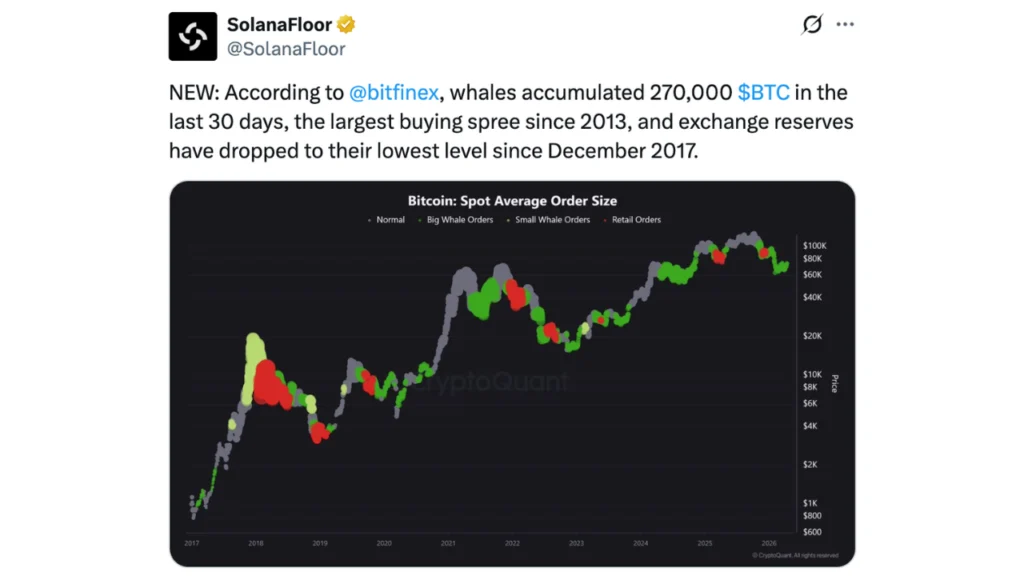
Bitcoin is once again approaching a critical inflection point. Trading near the mid-$70,000 range, the market appears calm on the surface—but underneath, structural forces are shifting rapidly. A surge in large-holder accumulation, combined with collapsing exchange reserves, is reshaping supply dynamics in a way not seen in over a decade. The question now dominating investor discourse is simple: does this tightening supply set the stage for a decisive breakout toward $80,000, and potentially beyond? This current consolidation phase, often perceived as a period of relative quiet, masks a profound rebalancing of supply and demand that could dictate Bitcoin’s trajectory for the foreseeable future. The digital asset’s journey has always been characterized by cycles of intense volatility and periods of strategic repositioning, and the present moment appears to be a prime example of the latter, with significant implications for its valuation.
The Unprecedented Supply Squeeze: A Decade in the Making
The most striking development comes from on-chain data, revealing a supply dynamic that harks back to Bitcoin’s nascent stages. Over the past 30 days, Bitcoin whales—typically defined as entities holding 1,000 or more BTC—have aggressively accumulated approximately 270,000 BTC. At current market prices, this represents an astounding capital allocation exceeding $20 billion. This marks the most aggressive accumulation phase since 2013, a pivotal period that preceded one of Bitcoin’s earliest and most significant bull runs, fundamentally altering its market capitalization and public perception.
This isn’t merely a short-term anomaly or opportunistic buying. On-chain analytics firm Glassnode, which tracks these large wallets, has highlighted the sustained nature of this trend. In previous cycles, isolated spikes in whale activity could sometimes be attributed to internal transfers between corporate wallets or custodial reshuffling. However, the persistence of this month-long accumulation trend suggests a high degree of conviction among these large players. It reflects a strategic move by institutional and high-net-worth individuals who appear to be positioning themselves ahead of a potential repricing event, signaling a deep belief in Bitcoin’s long-term value proposition and an anticipation of future price appreciation. The sheer volume of this accumulation underscores a deliberate shift of supply from potentially speculative hands to long-term holders.
Exchange Reserves Evaporate: Liquidity Shrinks to 2017 Levels
Concurrently with this whale accumulation, Bitcoin exchange reserves have plummeted to their lowest level since December 2017. This metric is arguably more critical than the daily price fluctuations, as it directly impacts market liquidity and potential sell-side pressure. Coins held on exchanges are considered liquid, meaning they can be sold instantly by traders or investors. Conversely, coins moved off exchanges, often into secure cold storage or institutional custody, represent a strong commitment to longer-term holding behavior.
When large volumes of BTC leave exchanges, the immediate sell-side liquidity shrinks dramatically. This creates a critical imbalance where fewer bitcoins are available for purchase on open markets. Historically, such conditions lead to what traders refer to as a "thin order book environment," where even modest buying pressure can trigger outsized price moves due to a lack of available sellers at prevailing prices. The last time exchange reserves were this low, Bitcoin was on the cusp of its parabolic rally to nearly $20,000 in 2017. This historical context provides a powerful backdrop, suggesting that these conditions often precede significant volatility expansions, which, while not always immediate, can be explosive once a catalyst emerges. The rise of Bitcoin spot Exchange Traded Funds (ETFs) in major markets has played a significant role in this dynamic, as these funds purchase Bitcoin and move it into secure, off-exchange custody to back their shares, effectively removing supply from the liquid market.

The Halving and Inelastic Supply: Reinforcing Scarcity
Bitcoin’s fixed supply of 21 million units has always been central to its value proposition, distinguishing it from fiat currencies subject to inflationary pressures. However, today’s market structure amplifies this inherent scarcity in novel and impactful ways. More than 20 million BTC have already been mined, leaving a dwindling amount of new supply to enter the market. The recent 2024 halving event further exacerbated this scarcity by reducing the block reward for miners from 6.25 BTC to just 3.125 BTC. This effectively halves the rate at which new bitcoins are introduced, significantly slowing the expansion of circulating supply.
Layer on top of this:
- Persistent whale accumulation: Large entities are actively removing substantial amounts of BTC from the liquid market.
- Declining exchange reserves: The readily available supply for trading is at multi-year lows.
- Lost and dormant coins: A significant portion of Bitcoin’s total supply is estimated to be permanently lost or held in dormant wallets, further reducing the effective circulating supply.
This confluence of factors is no longer just a theoretical narrative of scarcity; it is a measurable supply shock in progress. Importantly, the price has not yet fully reflected this tightening. Bitcoin still trades roughly 40% below its projected 2025 all-time high near $126,000 (as referenced in the original article, indicating a forward-looking or historical peak depending on the exact date of original publication), or its widely recognized all-time high around $73,798 set in March 2024. This divergence—tight supply but subdued price action—is precisely where both significant opportunity and risk lie, as markets often adjust sharply when such imbalances become undeniable.
Institutional Adoption and Fragmented Demand Dynamics
If supply is the coiled spring, demand is the trigger that will release its energy. The introduction of spot Bitcoin ETFs in early 2024 marked a watershed moment, opening Bitcoin to a vast new pool of institutional and retail capital. Recent ETF flow data, however, paints a picture of demand that is recovering but unevenly. Large inflows on certain days are interspersed with sudden outflows, reflecting a cautious and sometimes volatile positioning driven by macro uncertainty, profit-taking, and rebalancing activities within traditional finance portfolios.
This inconsistency matters. A sustained rally towards $80,000 and beyond requires several key elements:
- Consistent, net positive ETF inflows: Indicating broad-based institutional and retail adoption.
- Broad-based retail participation: Beyond just institutional money, a healthy market needs engagement from individual investors.
- A stable or improving macroeconomic backdrop: Favorable interest rate environments, controlled inflation, and geopolitical calm tend to foster risk-on sentiment, benefiting assets like Bitcoin.
Right now, demand is undoubtedly present, but its fragmentation explains why Bitcoin has repeatedly failed to break cleanly and decisively above the $75,000–$76,000 resistance zone. Sellers remain active at these price levels, indicating that while underlying supply tightens, there’s still enough overhead resistance or profit-taking pressure to prevent a swift upward move. Analysts from major financial institutions are closely monitoring these ETF flows as a bellwether for sustained demand, often pointing to the need for several consecutive days or weeks of strong net inflows to provide the necessary momentum for a breakout.

Technical and Derivatives Landscape: Setting the Stage for a Squeeze?
Another layer of complexity, and potential bullish signal, emerges from the derivatives markets. Funding rates, which are periodic payments exchanged between long and short positions in perpetual futures contracts, have recently turned negative. This means that short traders are paying long traders, typically reflecting a bearish sentiment or an overcrowded short position. Paradoxically, negative funding rates often appear near local bottoms or precede upward price movements.
Why this counter-intuitive behavior? Because heavy short positioning creates the ideal conditions for a short squeeze. If the spot price of Bitcoin continues to rise, these short sellers are forced to close their positions to mitigate losses. Closing a short position involves buying back the underlying asset, which adds further buying pressure to the market, effectively "squeezing" the price higher and accelerating the rally. Bitcoin has already climbed impressively from the low-$60,000 range to flirt with $75,000 while funding rates have remained negative or neutral, rather than exhibiting the typical positive funding seen during strong rallies. This divergence suggests two critical points:
- The rally has been primarily driven by spot buying: Rather than leveraged speculation.
- The market is not yet overcrowded on the long side: Leaving room for fresh capital to enter without immediately hitting a wall of existing long positions.
This implies that if a significant buying impulse emerges, supported by spot demand, the cascade of short liquidations could provide a powerful accelerant, pushing Bitcoin past key resistance levels with greater velocity than anticipated. Open interest, which measures the total number of outstanding derivatives contracts, remains elevated, indicating significant capital deployed in these markets, ready to react to price triggers.
The $80,000 Threshold: Psychological and Structural Significance
The $80,000 level is far more than just another round number on the chart; it represents a confluence of psychological and structural resistance points.
- Psychological Barrier: Round numbers often act as psychological magnets for traders and investors, attracting limit orders for both selling and buying. Breaking $80,000 would be a major confidence boost, signaling renewed upward momentum and potentially attracting a fresh wave of retail and institutional capital that might have been waiting for a clear breakout.
- Structural Resistance: Based on historical price action and volume profiles, levels around $75,500 and then $80,000–$80,600 represent significant resistance zones where previous selling pressure or profit-taking occurred. A decisive move above $75,500, particularly on strong trading volume, is widely seen by technical analysts as opening a relatively clear path toward $80,000.
- All-Time High in Multiple Currencies: For investors holding in various fiat currencies, Bitcoin has already reached or surpassed all-time highs against currencies like the Japanese Yen, Euro, and British Pound. Breaking $80,000 could mark new all-time highs against other significant currencies, further solidifying its global appeal.
Beyond $80,000, the market structure becomes even more interesting. With limited nearby supply at higher valuations, price discovery could accelerate quickly. This is where the current setup becomes highly asymmetric:
- Potential Upside: If the supply shock truly manifests and demand strengthens, there’s considerable room for rapid appreciation due to thin liquidity at higher price levels.
- Limited Downside (due to structural support): The significant accumulation by whales and the removal of supply from exchanges suggest strong underlying support, potentially limiting severe downside corrections, even if demand falters temporarily.
This asymmetry implies that the reward-to-risk ratio might be favorable for those betting on an upward breakout, assuming macro conditions do not severely deteriorate.

Broader Macroeconomic Influences: The Final Vote
Despite the compelling bullish supply dynamics and technical setups, Bitcoin does not trade in isolation. Macroeconomic factors continue to hold significant sway over its performance as a risk asset.
- Interest Rates and Inflation: Decisions by central banks, particularly the U.S. Federal Reserve, regarding interest rates directly impact the attractiveness of risk assets versus safer investments like bonds. Higher rates can increase the opportunity cost of holding non-yielding assets like Bitcoin, while lower rates or quantitative easing tend to be supportive. Inflation data also plays a role, as Bitcoin is often touted as an inflation hedge.
- Geopolitical Stability: Global events, such as conflicts, trade disputes, or political instability, can trigger "risk-off" sentiment, leading investors to divest from perceived higher-risk assets, including cryptocurrencies. Recent market behavior has shown that macro shocks can still override strong on-chain signals, with ETF outflows during periods of geopolitical stress highlighting how quickly sentiment can shift.
- U.S. Dollar Strength: A stronger U.S. dollar can make dollar-denominated assets like Bitcoin relatively more expensive for international investors, potentially dampening demand.
This creates a dual identity for Bitcoin: it is both a structurally unique asset with its own internal supply-demand mechanics, and a macro-sensitive risk asset that responds to broader global economic currents. Until macro conditions stabilize and offer a clearer direction, this tension will persist, introducing an element of external uncertainty to an otherwise internally bullish picture.
Analyst Perspectives and Future Trajectories: Three Scenarios Ahead
Market analysts and on-chain experts are largely in agreement about the underlying supply compression but differ on the immediate catalysts and timing for a decisive price move. From here, Bitcoin faces three realistic paths:
Bull Case:
- Conditions: Sustained, robust ETF inflows continue, indicating strong institutional and retail demand. Whale accumulation persists, further reducing liquid supply. The macroeconomic backdrop remains stable or improves, with no significant interest rate hikes or geopolitical shocks.
- Outcome: A decisive breakout above the $75,500 resistance zone on strong volume. This triggers a rapid move toward $80,000, potentially leading to quick price discovery toward higher resistance levels, possibly in the high-$80,000s or even $90,000s in a short timeframe, fueled by short squeezes and FOMO (Fear Of Missing Out) from sidelined capital.
Neutral Case:
- Conditions: Demand remains inconsistent, with ETF flows fluctuating between inflows and outflows. Macroeconomic uncertainty persists, preventing a clear risk-on environment.
- Outcome: Bitcoin price ranges between $70,000 and $75,500. Accumulation by large holders continues quietly beneath the surface, further tightening supply without immediate price action. This phase could last for weeks or even months, building greater pressure for a future breakout.
Bear Case:

- Conditions: A significant macroeconomic shock occurs, such as unexpected interest rate hikes, a severe recession, or a major geopolitical escalation. This leads to a widespread risk-off sentiment across global markets, causing demand for Bitcoin to fade significantly, potentially triggering large ETF outflows.
- Outcome: Despite the tight underlying supply, price retests lower support levels, potentially falling to the $68,000–$70,000 range or even lower towards the low-$60,000s. This scenario highlights that even with strong internal fundamentals, external shocks can temporarily override market structure.
Notably, even the neutral case is structurally constructive. Supply compression does not disappear; it simply continues to build, waiting for the opportune moment when demand finally aligns with the underlying scarcity.
A Market Quietly Repricing Itself: The Long-Term Implications
The most important takeaway from the current market environment is not solely the $80,000 target itself, but rather the profound underlying transformation of Bitcoin’s market structure. For months, price action has appeared relatively muted, characterized by consolidation and attempts to break resistance. But beneath that calm surface, a significant redistribution of wealth and supply is taking place:
- From Weak Hands to Strong Hands: Bitcoin is moving from short-term speculators or those with less conviction into the wallets of long-term holders and institutions.
- From Liquid Exchanges to Illiquid Storage: Supply is being systematically removed from readily tradable venues into more secure, less accessible forms of custody.
This is how sophisticated markets often prepare for large, sustained moves—not with immediate noise and hype, but with quiet rebalancing and strategic positioning. The current setup suggests that Bitcoin is no longer trading in a loose, highly liquid environment where large orders can be absorbed without significant price impact. Instead, it is operating within an increasingly tightening system where supply is becoming remarkably inelastic. And in such systems, when genuine and sustained demand finally returns with conviction, price does not simply drift higher; it has a historical tendency to reprice sharply and quickly, reflecting the new reality of scarcity.
Conclusion: $80,000 Is a Test, Not the Destination
Bitcoin’s push toward $80,000 is not merely a technical milestone; it is a crucial test of this evolving market structure. If demand proves strong enough to absorb the remaining sell-side liquidity at these levels, the implications extend far beyond a single price point. It would confirm that the supply shock is real and potent, signaling that the next major phase of the Bitcoin market cycle has indeed begun. If, however, demand remains fragmented or external macro pressures intensify, the market may continue consolidating, quietly tightening further as patient accumulators continue to absorb available supply.
Either way, one thing is becoming increasingly clear: Bitcoin is no longer abundant where it matters most—on the liquid market. The confluence of historic whale accumulation, rapidly dwindling exchange reserves, and the relentless impact of the halving has created an environment of unprecedented scarcity. And when supply disappears before price fully reacts, history suggests the subsequent market move is rarely subtle, often characterized by rapid acceleration as the market attempts to find a new equilibrium reflecting its fundamental value. The journey to $80,000 is thus a pivotal moment, a barometer for the underlying health and future potential of the world’s leading cryptocurrency.