admin
admin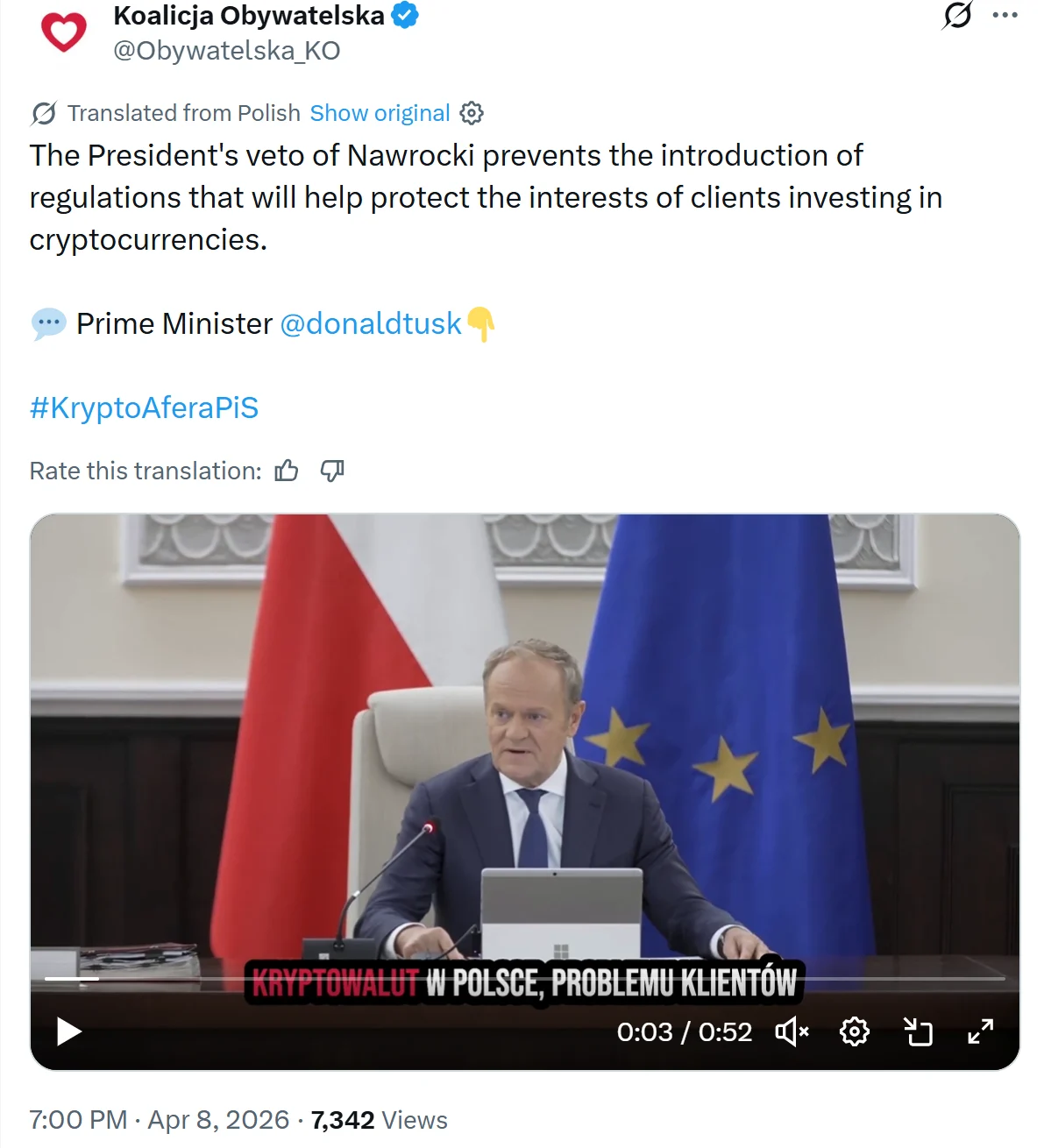
The political impasse surrounding Poland’s digital asset regulation has intensified following the parliament’s latest failure to overturn a presidential veto, prolonging the country’s unique status as the sole European Union member state yet to implement the bloc’s Markets in Crypto-Assets Regulation (MiCA). In a critical vote held on Friday, lawmakers fell short of the supermajority required to override the veto issued by President Karol Nawrocki, signaling a continued deadlock over the future of cryptocurrency oversight in one of the EU’s largest economies.
The vote saw 243 Members of Parliament (MPs) support the government’s effort to bypass the presidential objection, while 191 MPs voted to uphold the veto. The outcome left the government 20 votes shy of the 263-vote threshold needed to successfully override a presidential veto, as reported by local media outlet TVP World. This marks the second time the government, led by Prime Minister Donald Tusk, has been thwarted in its attempts to fast-track legislation aimed at harmonizing Poland’s crypto framework with the EU’s comprehensive MiCA standards. The repeated rejections underscore a deep ideological and political rift between the executive and legislative branches regarding the appropriate level of state intervention in the burgeoning digital asset sector.
The Heart of the Dispute: Aligning with MiCA
At the core of this protracted legislative battle is the Polish government’s ambition to integrate the European Union’s groundbreaking Markets in Crypto-Assets Regulation (MiCA) into national law. MiCA, a landmark regulatory framework, officially came into effect in June 2023, with various provisions rolling out through 2024 and 2025. Its primary objectives are multifaceted: to foster innovation and competitiveness within the EU’s digital finance sector while simultaneously ensuring financial stability, protecting consumers and investors, and addressing potential risks related to market integrity and illicit financial activities.
The regulation establishes a unified licensing and operating framework for crypto-asset service providers (CASPs) across all EU member states. This includes stringent requirements for authorization, operational resilience, governance, and capital adequacy. MiCA also introduces specific rules for the issuance and admission to trading of various crypto assets, particularly stablecoins, demanding transparency and robust reserve management. For instance, issuers of asset-referenced tokens (ARTs) and e-money tokens (EMTs) face strict authorization requirements and prudential safeguards. The framework aims to eliminate regulatory arbitrage within the EU and provide legal certainty for businesses operating in the crypto space, which in turn is expected to attract investment and foster legitimate growth.
As the largest economy in Central Europe and a significant member of the EU, Poland’s failure to adopt MiCA leaves a notable gap in the bloc’s harmonized regulatory landscape. This isolated position not only creates regulatory uncertainty for Polish crypto businesses and investors but also complicates cross-border operations for firms seeking to leverage MiCA’s ‘passporting’ rights – the ability to operate across the EU with a single license. Industry analysts have pointed out that Poland’s delay could deter foreign investment in its digital asset sector, potentially pushing innovative startups and established firms towards more predictable regulatory environments in neighboring EU countries.
A Timeline of Legislative Obstacles
The current parliamentary setback is the latest chapter in a series of legislative defeats for the crypto regulation bill:
- December 2023: The First Veto: The initial version of the crypto regulation bill, strongly supported by Prime Minister Tusk’s government, passed through the Polish parliament. However, President Karol Nawrocki swiftly exercised his veto power, citing concerns about the bill’s potential for "excessive regulation," its "limited transparency," and the "potential burden on small businesses" operating in the nascent crypto sector. This move immediately highlighted the friction between the President, whose political background is often associated with the previous conservative Law and Justice (PiS) party, and the newly formed centrist-liberal coalition government.
- December 2023: Government’s Swift Resubmission: Undeterred by the presidential rejection, the Tusk government acted quickly. Within days of the first veto, lawmakers reintroduced a new draft of the regulation. While government officials claimed it was an "improved" version designed to address the President’s concerns, critics from various circles, including some legal experts and industry commentators, suggested that the new bill was "virtually unchanged" from its original form, leading to skepticism about its prospects.
- February 2024: The Second Veto: As anticipated by many, President Nawrocki again vetoed the resubmitted bill. His statement at the time was resolute: "I will not sign a wrong law just because it was passed again by the parliamentary majority. A wrong law that passed a hundred times still remains a wrong law." This firm stance underscored his unwavering objections and signaled a deeper ideological resistance to the government’s approach to crypto regulation, reinforcing the political stalemate.
- Friday’s Vote: Another Parliamentary Defeat: The latest attempt by the parliament to override the second presidential veto proved equally unsuccessful. With 243 votes in favor of the override and 191 against, the government failed to garner the constitutionally mandated 263 votes (a three-fifths majority of MPs present) necessary to enact the bill into law without presidential assent. This outcome confirms the significant challenge the Tusk government faces in pushing through key legislative initiatives, especially when confronted by a determined president.
Divergent Views from the Top: Presidential Concerns vs. Government Warnings
The ongoing dispute reveals a fundamental disagreement on regulatory philosophy between President Nawrocki and Prime Minister Tusk’s government.
President Nawrocki’s Stance:
President Nawrocki has consistently articulated his objections based on several key principles. His primary concern revolves around the potential for "excessive regulation." He argues that the proposed bill, despite its aim to align with MiCA, could stifle innovation and impose undue administrative and financial burdens on Poland’s small and medium-sized enterprises (SMEs) that are increasingly exploring digital assets. In a nation where SMEs are a significant engine of economic growth, such concerns resonate with a segment of the business community and political spectrum that favors less government intervention. Nawrocki has also pointed to "limited transparency" within the bill’s provisions, suggesting that certain aspects might not be clear enough or could lead to unintended consequences for market participants.
His position often reflects a broader conservative approach to economic policy, prioritizing individual liberty and minimizing state interference where possible. Critics of the bill, aligning with the President’s view, argue that overly prescriptive regulations could push legitimate Polish crypto businesses abroad, leading to a "brain drain" of talent and capital rather than fostering a robust domestic industry. They advocate for a more nuanced, perhaps phased, implementation that allows for greater flexibility and adaptation to the rapidly evolving crypto landscape.
Prime Minister Tusk and Finance Minister Domański’s Arguments:
Conversely, the government, spearheaded by Prime Minister Tusk and Finance Minister Andrzej Domański, frames the immediate adoption of MiCA as an urgent necessity for investor protection and market integrity. Finance Minister Domański has repeatedly warned that the absence of clear regulatory rules risks turning the Polish digital asset market into an "El Dorado for fraudsters." This vivid analogy highlights the government’s concern that without a robust legal framework, consumers and businesses are highly vulnerable to scams, market manipulation, and illicit financial activities, eroding trust in the nascent sector.
The government emphasizes that regulatory clarity is not merely about compliance but about providing a safe and predictable environment essential for both individual investors and institutional players. They argue that MiCA’s comprehensive safeguards, such as requiring crypto exchanges to be licensed, mandating transparent disclosures for token offerings, and establishing robust anti-money laundering (AML) protocols, are crucial to mitigate risks. Furthermore, they contend that delaying MiCA implementation puts Poland at a disadvantage within the EU, as Polish firms face an uneven playing field compared to their counterparts in other member states that have already adopted the framework. The government also sees it as vital for Poland’s international reputation as a reliable and compliant member of the European Union.

The Broader Implications: Economic, Regulatory, and Political Fallout
The ongoing stalemate carries significant ramifications across various sectors:
Economic Impact:
For Poland’s domestic crypto industry, the prolonged regulatory uncertainty is proving detrimental. Businesses operating in the digital asset space face a challenging environment where the rules of engagement remain undefined. This lack of clarity makes it difficult for companies to plan long-term investments, scale operations, or attract venture capital. Some Polish crypto firms have already begun exploring options to obtain licenses in other EU jurisdictions that have implemented MiCA, such as Lithuania, Malta, or France, to ensure their ability to operate within the harmonized EU market. This potential "regulatory exodus" could lead to a loss of innovative businesses, skilled talent, and tax revenue for Poland.
For investors, both retail and institutional, the absence of a clear regulatory framework means continued exposure to higher risks. Without MiCA’s protections, consumers lack formal avenues for recourse in cases of fraud, platform failures, or market manipulation. This could stifle broader adoption of digital assets by mainstream users and traditional financial institutions, limiting the growth potential of Poland’s crypto economy. The government’s warning about an "El Dorado for fraudsters" is a stark reminder of the vulnerabilities inherent in an unregulated market.
Regulatory Standing within the EU:
Poland’s status as the only EU member state yet to implement MiCA also poses a challenge to its relationship with the European Union. The European Commission expects all member states to transpose EU directives and regulations into national law within specified timelines. Continued non-compliance could lead to infringement proceedings against Poland, potentially resulting in fines or other punitive measures. Beyond legal repercussions, the delay could also strain Poland’s political standing within the bloc, particularly after recent efforts by the new government to mend ties following years of disputes with Brussels under the previous administration. It undermines the principle of a unified single market for digital assets, creating fragmentation that the EU specifically sought to avoid with MiCA.
Political Ramifications:
Domestically, the crypto bill saga vividly illustrates the enduring political tensions between President Nawrocki and Prime Minister Tusk’s coalition government. Despite the change in government leadership, the presidential veto power, often seen as a remnant of the previous political era, remains a significant obstacle to the new administration’s legislative agenda. This ongoing power struggle can slow down critical reforms and create an environment of legislative gridlock, affecting not only crypto regulation but potentially other areas of policy where the President and government hold divergent views. The inability to push through a key EU-mandated regulation also raises questions about the government’s effectiveness and its ability to deliver on its promises.
The Zonda Controversy: A Tangential but Illuminating Dispute
Further complicating the already fraught regulatory landscape is the high-profile controversy surrounding Zonda, reportedly Poland’s largest crypto exchange. The platform has found itself directly embroiled in the political crossfire, with allegations and counter-allegations adding another layer of complexity to the debate.
Prime Minister Donald Tusk escalated tensions by publicly accusing Zonda of having links to "illicit funding" and alleging connections to "Russian criminal networks," citing intelligence reports. These serious accusations, made in the context of the crypto regulation debate, implicitly bolster the government’s argument for stricter oversight to combat financial crime. Tusk’s remarks immediately drew a sharp response from Zonda’s leadership.
Przemysław Kral, CEO of Zonda, vehemently denied the accusations, calling attempts to "drag me and Zonda into the current political squabbles" both "absurd and harmful to the Polish innovation market." Kral indicated his intention to "take appropriate legal steps to protect my personal rights," suggesting potential defamation lawsuits. This direct confrontation between the head of government and a leading crypto business highlights the intense scrutiny and political pressure now facing the digital asset sector in Poland.
Adding another layer of intrigue, Kral recently disclosed that he does not control access to a crypto wallet reportedly holding a substantial sum of approximately $330 million (equivalent to about 4,500 BTC). He claims this wallet remains under the control of Sylwester Suszek, Zonda’s former CEO, who reportedly disappeared in 2022. This revelation, amidst ongoing withdrawal issues faced by Zonda customers, further complicates the exchange’s operational integrity and underscores the inherent risks and governance challenges that can arise in the absence of robust regulatory frameworks. While Zonda has reportedly lobbied against the specific version of the bill proposed by the government, the accusations against it now serve as potent examples for the government’s narrative about the urgent need for comprehensive regulation to protect consumers and prevent illicit activities.
The Path Forward: What’s Next for Poland’s Crypto Landscape?
With the latest parliamentary attempt to override the presidential veto having failed, Poland’s digital asset sector faces continued uncertainty. The government has several options, though none are straightforward:
- Redrafting the Bill: The most likely path forward for the Tusk government is to significantly revise the crypto regulation bill, aiming to incorporate specific changes that address President Nawrocki’s stated concerns about excessive burden on businesses and transparency. This would require substantial negotiation and compromise between the government and the presidential office, a process that has proven difficult thus far. A truly "improved" version, distinct from the previous drafts, might stand a better chance of gaining presidential assent.
- Seeking Alternative Legislative Avenues: While less common for such comprehensive legislation, the government could explore other legal mechanisms or ministerial ordinances to implement certain aspects of MiCA that do not require full parliamentary approval, though this would likely be limited in scope and not a complete solution.
- Pressure from the European Commission: The European Commission is expected to continue monitoring Poland’s progress on MiCA implementation. Should the stalemate persist, the Commission could initiate formal infringement procedures, which would exert additional pressure on both the President and the government to find a resolution. The financial and reputational costs of such proceedings could eventually compel action.
- Industry Adaptation: In the interim, Polish crypto businesses will likely continue to adapt to the ambiguous regulatory environment. This may involve increasing compliance efforts in anticipation of eventual MiCA adoption, exploring partnerships with licensed entities in other EU states, or even relocating some operations to more stable regulatory jurisdictions.
The political struggle over crypto regulation in Poland is more than just a debate about digital assets; it is a microcosm of the broader power dynamics within the Polish government and its relationship with the European Union. Until a resolution is found, Poland’s digital asset sector will remain in a state of flux, navigating a complex interplay of domestic politics, EU mandates, and the ever-evolving landscape of cryptocurrency.