admin
admin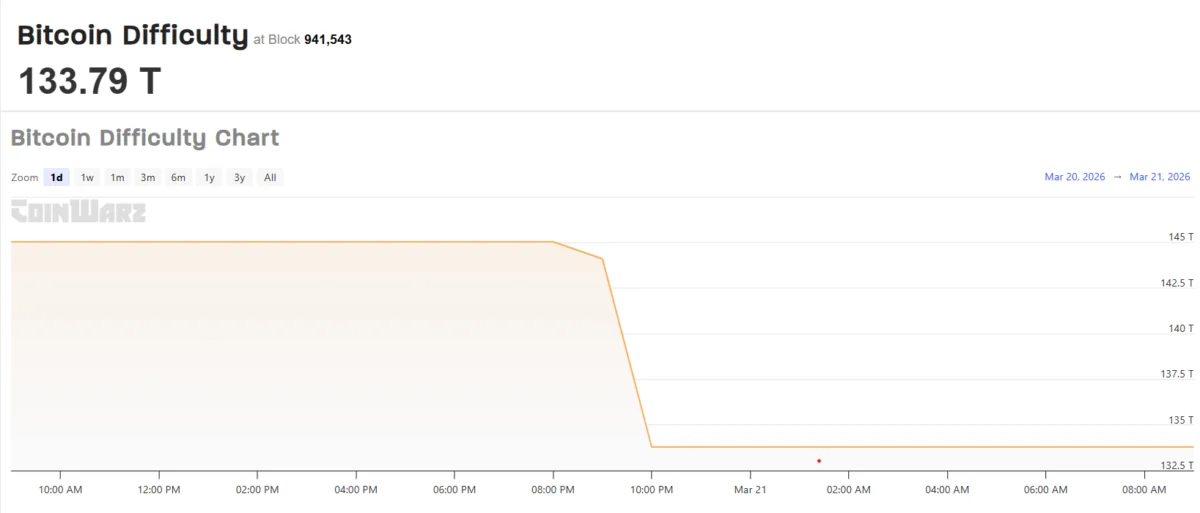
Bitcoin’s mining difficulty experienced a significant downward adjustment of approximately 7.7% on March 20, recalibrating to 133.79 trillion at block 941,472, according to data compiled by CoinWarz. This marks the sharpest decline observed since a similar dip in February, signaling notable shifts within the cryptocurrency mining landscape. The reduction pushes the network’s computational challenge down from figures around 145 trillion in mid-March and roughly 148 trillion at the commencement of the year, providing a temporary reprieve for operational mining firms. A lower difficulty level translates into less computational effort required to successfully mine a block and earn the associated reward, thereby incrementally enhancing revenue per unit of hashrate for miners who maintain their operations online.
Understanding Bitcoin’s Difficulty Adjustment Mechanism
The intrinsic design of the Bitcoin network incorporates a self-regulating mechanism known as the difficulty adjustment. This crucial feature is engineered to maintain a consistent block production rate, aiming for approximately one new block every 10 minutes. Bitcoin’s underlying Proof-of-Work (PoW) consensus algorithm requires miners to solve a complex cryptographic puzzle to validate transactions and add new blocks to the blockchain. The "difficulty" of this puzzle is not static; it dynamically adjusts every 2,016 blocks, a cycle that typically spans about two weeks.
The primary objective of this adjustment is to counteract fluctuations in the total computational power, or hashrate, dedicated to securing the network. When an influx of new miners or more powerful mining equipment joins the network, the hashrate increases. Without an adjustment, blocks would be found much faster than the 10-minute target, leading to an accelerated issuance of new bitcoins. Conversely, if miners disconnect or less efficient hardware becomes unprofitable, the hashrate declines, causing block production to slow down significantly. In either scenario, the network recalibrates the difficulty to bring the average block time back to its target. This ingenious system ensures the predictable issuance schedule of Bitcoin, a core tenet of its monetary policy, and maintains the network’s robust security regardless of external factors influencing miner participation. The difficulty is measured in terahashes (TH), petahashes (PH), or exahashes (EH), representing the number of hash calculations performed per second. A higher difficulty number signifies a greater computational challenge for miners.
Recent Volatility in Mining Difficulty: A Timeline
The latest difficulty reduction was a direct consequence of sustained slower-than-target block production over the preceding 2,016-block epoch. Insights from CloverPool data revealed that the average block time had extended to approximately 12 minutes and 36 seconds, significantly exceeding Bitcoin’s 10-minute ideal. This prolonged deviation from the target mandated the network’s automated recalibration to a lower difficulty setting.
This recent adjustment follows a period of notable volatility in the network’s mining difficulty. Just a month prior, in February, Bitcoin’s difficulty had experienced a sharp drop. This earlier decline was largely attributed to severe weather-related disruptions across the United States, particularly in regions with high concentrations of mining operations. These extreme weather events led to temporary power outages and operational shutdowns for numerous large American mining facilities, causing a substantial portion of the global hashrate to go offline. However, as power conditions normalized and affected miners restored their operations, the hashrate swiftly returned to the network. Consequently, the difficulty rebounded robustly by approximately 15%, demonstrating the network’s resilience and capacity for self-correction in response to sudden shifts in mining power. The current 7.7% drop, while significant, indicates a more gradual but persistent withdrawal or reallocation of hashrate compared to the sudden, event-driven fluctuations seen in February. From a peak of roughly 148 trillion at the start of 2024, the difficulty has seen a general downward trend, punctuated by the February rebound, underscoring the dynamic interplay between miner activity and network parameters.
Immediate Impact on Bitcoin Miners and Profitability
For the Bitcoin mining industry, the 7.7% reduction in difficulty offers a tangible, albeit potentially temporary, boost to profitability. With less computational work required to find a valid hash and claim a block reward, miners experience an immediate improvement in their revenue per unit of hashrate. This means that existing mining rigs, particularly older or less efficient models that might have been operating at razor-thin margins, suddenly become more profitable. This can extend the operational lifespan of some facilities and potentially defer decisions to upgrade or shut down.
However, this positive effect must be viewed within the broader economic context facing miners. The industry has been grappling with escalating power costs, intense competition for energy resources, and the inherent volatility of Bitcoin’s price. While a difficulty drop makes mining easier, it does not fundamentally alter the cost structure of electricity, which remains the single largest operational expense for miners. Furthermore, the overall hashrate dedicated to the network continues to be substantial, and the competitive landscape remains fierce. Therefore, while the adjustment provides some breathing room, it does not solve the long-term strategic challenges faced by mining companies, many of whom are actively seeking more stable and diversified revenue streams. The temporary increase in profitability might encourage some miners to stay online or even slightly increase their hashrate, which could, in turn, lead to a subsequent difficulty increase in the next adjustment cycle if block times accelerate.
The AI-Driven Diversification: A Strategic Imperative

The latest difficulty reset coincides with a pronounced strategic pivot by several publicly listed Bitcoin mining companies towards Artificial Intelligence (AI) and high-performance computing (HPC) infrastructure. This diversification is driven by a quest for more predictable and potentially higher returns on their substantial investments in power infrastructure and data center capacity, especially as the profitability of pure Bitcoin mining faces increasing pressure from rising energy costs and impending Bitcoin halving events.
Crypto industry figures, such as trader Ran Neuner, have even argued provocatively that AI has emerged as "Bitcoin mining’s biggest competitor," going as far as to claim that "AI has killed Bitcoin forever." While such statements are hyperbolic, they highlight a very real and growing competition for vital resources—primarily electricity and data center space—between these two rapidly expanding technological sectors. Bitcoin mining and AI data centers share significant infrastructural commonalities: both require massive amounts of cheap, reliable electricity, sophisticated cooling systems, and secure physical facilities. Miners, having already built out extensive data centers and secured significant power purchase agreements, find themselves uniquely positioned to leverage these assets for AI workloads.
Several prominent Bitcoin miners are already executing this strategic shift. Core Scientific, a leading Bitcoin miner, recently secured a substantial credit facility of up to $1 billion from Morgan Stanley, explicitly earmarking funds for data center development, a move widely interpreted as facilitating a broader expansion into HPC and AI services. Similarly, MARA Holdings (Marathon Digital Holdings), another major player, has been exploring opportunities beyond pure Bitcoin mining, aiming to optimize its energy assets. Hut 8, known for its robust data center operations, has swung to a significant loss but has simultaneously anchored its pivot from Bitcoin mining with a substantial $7 billion AI data center lease. This move underscores a clear intention to reallocate resources and focus on providing infrastructure for AI model training and inferencing. Cipher Mining has also indicated its strategic direction by acquiring data center sites in markets like PJM (Pennsylvania-Jersey-Maryland Interconnection), known for its competitive power prices, with an eye towards supporting high-performance computing needs that extend beyond Bitcoin. These companies are actively reallocating existing capacity, upgrading infrastructure to support higher-density computing, or even reducing their dedicated Bitcoin hashrate in favor of more lucrative or stable AI-related contracts.
The economic rationale is compelling: AI workloads often offer more stable, long-term contracts with diversified clients, potentially insulating companies from the volatile price swings inherent in cryptocurrency markets. This allows them to monetize their significant power and infrastructure investments more consistently. The move is not merely a reaction to falling Bitcoin profitability but a proactive strategy to capitalize on the burgeoning demand for AI computational resources, leveraging existing core competencies in large-scale data center operations and energy management.
Industry Reactions and the Future Landscape
The strategic shift towards AI by Bitcoin miners has elicited varied reactions across the crypto industry. While some view it as a pragmatic evolution necessary for survival and growth in a capital-intensive industry, others express concern about the potential for hashrate migration away from Bitcoin, which could, in extreme scenarios, impact network security (though this is highly unlikely given the scale of the network).
Bitdeer, another major mining entity, provided a stark example of this strategic reorientation in February. The company liquidated 943 BTC from its reserves and sold newly mined coins, effectively reducing its corporate Bitcoin holdings to zero. In its weekly update on March 21, Bitdeer confirmed that its BTC holdings remained at zero. This aggressive move suggests a focus on operational liquidity and potentially a re-evaluation of its asset allocation strategy, freeing up capital for other ventures, possibly including the expansion into HPC services. Such decisions highlight the intense financial pressures and strategic recalculations occurring within the mining sector.
The competition for electricity and data center capacity between Bitcoin mining and AI is likely to intensify. As AI models become more complex and require even greater computational resources, the demand for specialized data centers and large power allocations will surge. This could drive up electricity prices, further squeezing the margins of traditional Bitcoin miners who do not diversify. Conversely, for those miners who successfully pivot, their existing infrastructure and expertise become incredibly valuable assets in the AI race.
Broader Implications for Bitcoin Network Health
Despite the significant adjustments and the strategic shifts within the mining industry, Bitcoin’s network health remains robust. The difficulty adjustment mechanism is functioning precisely as designed, demonstrating the network’s inherent adaptability and resilience. It ensures that regardless of the ebb and flow of miner participation, the average block time remains consistent, upholding Bitcoin’s predictable monetary policy and transaction finality.
The current difficulty drop, while making mining temporarily easier, does not inherently weaken the network’s security. Bitcoin’s security is derived from the immense cumulative hashrate dedicated to it globally. Even with a 7.7% reduction, the hashrate remains astronomical, making a 51% attack—where a malicious entity controls the majority of the network’s hashrate—an extraordinarily costly and improbable endeavor. The automated adjustments are a testament to Bitcoin’s decentralized nature; no central authority dictates these changes, ensuring the network responds organically to market forces and operational realities.
The next difficulty adjustment is currently projected for around April 3, though this estimate is dynamic and subject to change with each new block mined. The upcoming Bitcoin halving event, expected in April 2024, will further reduce the block reward by 50%, intensifying the need for miners to optimize efficiency or diversify revenue streams. This will undoubtedly prompt further strategic decisions within the industry, potentially accelerating the trend of miners integrating AI workloads into their business models. Ultimately, the ability of the Bitcoin network to adapt to changing conditions, including shifts in miner incentives and technological competition, is a core strength that contributes to its long-term viability and security.