admin
admin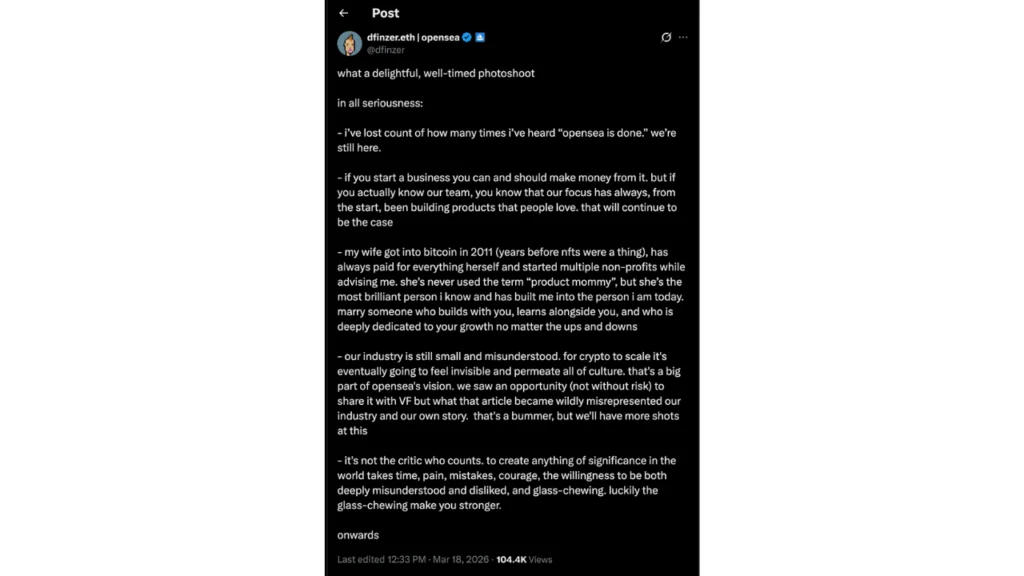
OpenSea, once the undisputed titan of the non-fungible token (NFT) marketplace, has announced the indefinite postponement of its long-anticipated SEA token launch, a decision that sharply underscores the severe pressures confronting digital asset platforms in a persistently cooling market. This strategic delay, initially targeted for a Q1 2026 token generation event and slated for public debut around March 30, reflects a profound recognition of deteriorating market conditions and a significant internal recalibration as the company navigates an increasingly competitive and subdued NFT landscape. The announcement, delivered by CEO Devin Finzer on March 16, signals a clear departure from OpenSea’s earlier roadmap and highlights a growing consensus across the industry: meticulous timing and foundational utility are now as critical as disruptive innovation.
OpenSea’s Strategic Pause: A High-Stakes Token Launch Delayed
The SEA token was widely anticipated as a cornerstone of OpenSea’s next phase of evolution, intended to debut as part of a Q1 2026 token generation event. This milestone was expected to usher in a new era of decentralized governance, enhanced liquidity, and community-driven incentives, mirroring the trajectory of many successful Web3 platforms. Instead, the company has chosen to delay the rollout indefinitely, offering no revised launch date, a move that has sent ripples through the digital asset community.
CEO Devin Finzer addressed the decision candidly, acknowledging its gravity and potential impact on a community eagerly awaiting the token. “A delay is a delay. I’m not going to dress it up, and I know how it lands,” Finzer stated, emphasizing the team’s firm stance against launching under unfavorable conditions. His subsequent declaration, "SEA only launches once," powerfully encapsulates the high stakes involved. For a platform of OpenSea’s historical prominence, a token launch is not merely a technical release but a pivotal moment that shapes market perception, establishes tokenomics, and dictates long-term utility and adoption. A poorly timed or executed debut risks undermining user confidence, suppressing initial demand, and severely limiting the token’s potential to drive ecosystem growth. The decision, therefore, reflects a pragmatic approach aimed at preserving the long-term viability and credibility of the SEA token and the OpenSea platform itself.

(Source: Devin Finzer’s X post, March 16, 2026: https://x.com/dfinzer/status/2033637755838992569)
The Unforgiving Landscape: NFT Market’s Prolonged Winter and Macroeconomic Headwinds
The broader context behind OpenSea’s delay is impossible to ignore: a prolonged and severe contraction of the NFT market. Following an unprecedented boom in 2021 and early 2022, which saw monthly trading volumes soar into the tens of billions of dollars across the ecosystem, the market has entered a deep "crypto winter." This period has been characterized by sharp declines in asset prices, reduced liquidity, and a significant exodus of speculative capital.
Recent data paints a stark picture of this downturn. OpenSea, which processed an astounding $5 billion in monthly trading volume in January 2022 at the peak of the frenzy, recorded just $81 million in the month preceding the announcement. This represents a staggering decline of over 98%, illustrating the severity of the market’s contraction and the precipitous drop in investor interest and trading activity. Broader market analytics confirm this trend; the overall NFT market capitalization has plummeted, with many "blue-chip" collections seeing their floor prices erode significantly from all-time highs.

Accompanying this decline is a pervasive issue of thin and unevenly distributed liquidity. While a handful of established, high-profile NFT collections continue to command attention and occasional high-value sales, the vast majority of digital assets struggle to generate consistent demand or robust secondary market activity. This imbalance creates an inherently fragile environment for new token launches, particularly those that depend on an active, liquid trading ecosystem to establish fair value and utility.
Adding to the complexity are broader macroeconomic and cryptocurrency market headwinds. Persistent inflation concerns, rising interest rates globally, and increased regulatory scrutiny have dampened overall sentiment across the digital asset space. Bitcoin and Ethereum, the bellwethers of the crypto market, have experienced significant volatility, further constraining capital flows into more speculative sectors like NFTs. In such an environment, introducing a new token, even from a well-established platform like OpenSea, carries heightened risk of an underwhelming debut, poor price discovery, and limited long-term adoption. For OpenSea, the conclusion was unequivocally clear: launching SEA into such a weak and uncertain market could do irreparable harm to its future prospects.

Weak NFT market conditions drive caution
Eroding Dominance: OpenSea’s Battle for Market Share Amidst Fierce Competition
The decision to delay the SEA token also reflects OpenSea’s dramatically altered position within the NFT ecosystem. At its zenith, OpenSea commanded an estimated 95% market share, acting as the primary gateway for millions of users into NFT trading and processing billions of dollars in monthly transactions. It was, for all intents and purposes, synonymous with NFTs. However, that dominance has since eroded significantly due to intensified competition and a broader shift in market dynamics.
Competitors such as Blur and Magic Eden have aggressively entered the market, capturing substantial portions of OpenSea’s former user base and trading volume. Blur, in particular, disrupted the landscape by introducing innovative models like "bid-to-earn" and prioritizing professional traders with highly optimized interfaces, lower fees, and robust incentive programs. Magic Eden has expanded its multi-chain support, notably on Solana before expanding to Ethereum, attracting users with diverse needs and preferences. As a result of these competitive pressures and the overall market contraction, OpenSea’s market share has declined to roughly 29%, a stark reminder that its first-mover advantage is no longer sufficient to guarantee market leadership.
This shift is not isolated to OpenSea; the entire NFT sector has undergone a period of intense consolidation and restructuring. Many smaller platforms have scaled back operations or exited the market entirely in early 2026, unable to sustain themselves amidst dwindling liquidity and user engagement. OpenSea’s delay, therefore, can be interpreted as a critical component of a larger industry recalibration, where adaptability, sustainable business models, and a focus on core utility are paramount for survival over rapid expansion.
A Strategic Pivot: Beyond NFTs – OpenSea’s Vision for a Broader Digital Asset Platform
Rather than proceeding with a potentially underwhelming token debut, OpenSea is strategically shifting its focus toward robust product development and comprehensive platform improvements. This pivot suggests a recognition that the future of digital assets extends beyond the narrow confines of profile picture (PFP) NFTs and art collectibles. The company has indicated that upcoming updates will prioritize enhanced mobile functionality, crucial for broader mass adoption, and expanded cross-chain trading capabilities, which are essential for navigating an increasingly fragmented multi-chain ecosystem.
Central to this repositioning is a stated vision to support a "trade everything" paradigm. This suggests OpenSea aims to capture a much broader segment of on-chain activity, potentially including tokenized real-world assets (RWAs), game assets, domain names, and other forms of digital property. The delay of the SEA token, in this context, reframes its role. Instead of being the immediate centerpiece of OpenSea’s next phase, the token is now positioned as a complementary component—intended to be introduced only after the underlying platform has been significantly strengthened and better aligned with current and future market realities.
This approach reflects a more cautious, infrastructure-first mindset, one undoubtedly shaped by the lessons learned from previous crypto cycles where unsustainable hype often overshadowed foundational development. By prioritizing a more resilient, versatile platform, OpenSea is signaling a long-term commitment to utility and user experience, aiming to build a sustainable ecosystem before attempting to tokenize its governance and value capture mechanisms.
Reworking Incentives: Balancing Immediate Refunds with Future Token Rewards
Alongside the token delay, OpenSea is restructuring its user incentives through a multi-faceted approach that blends immediate compensation with long-term optionality. Recognizing that many users incurred trading fees during a period of declining market activity and anticipation of a token, OpenSea is offering a choice. Users who participated in Rewards Waves 3 through 6 will have the option to claim full refunds on trading fees incurred during those specific periods.
However, this benefit comes with a crucial trade-off: those who accept these immediate refunds must forfeit their accumulated "Treasure Chests." These Treasure Chests are digital entitlements tied to potential future token rewards, meaning they represent eligibility for the eventual SEA token distribution. This decision effectively forces users to make a strategic choice between short-term certainty (recouping immediate costs) and long-term speculation (maintaining eligibility for a future token whose value and launch timeline are currently uncertain).
This nuanced incentive structure aims to address immediate user sentiment while retaining a loyal base willing to bet on OpenSea’s long-term vision. It also serves as a mechanism to manage expectations regarding the token’s eventual value and distribution. While OpenSea has yet to provide full details on the claims process, it is expected to be time-sensitive as the platform transitions away from its existing rewards framework and toward a new model designed for the evolving market.

OpenSea homepage
Bridging the Gap: 60-Day Zero-Fee Trading Initiative
Further underscoring its commitment to user retention and engagement during this transitional period, OpenSea will introduce a 60-day zero-fee trading window, commencing March 31. This temporary removal of trading fees is a direct tactical response designed to stimulate activity, encourage new transactions, and retain users at a time when the platform risks losing momentum due to the token delay and intense competition.
This aggressive pricing strategy also serves as a crucial bridge between the existing rewards system, which is being phased out, and whatever new, sustainable fee structure the company ultimately implements. After the promotional period concludes, OpenSea plans to introduce a revised fee model, though specifics have not yet been disclosed. This move aligns OpenSea with broader industry trends, where platforms increasingly rely on competitive fee incentives, airdrops, and promotional campaigns to attract and retain users in an intensely competitive and price-sensitive environment. By temporarily eliminating fees, OpenSea hopes to reignite trading volume and foster a more active community while it reconfigures its long-term strategy.
Broader Market Implications: A Bellwether for the NFT Ecosystem’s Maturity
OpenSea’s decision to delay its flagship token launch carries significant implications not just for the company, but for the broader NFT ecosystem. As a former market leader and a prominent name in Web3, OpenSea’s actions often serve as a bellwether for industry trends and sentiment.
The delay signals a clear shift towards maturity within the NFT market. The era of launching tokens primarily on hype and speculative fervor appears to be waning, replaced by a more pragmatic approach that prioritizes foundational utility, robust product development, and strategic timing. This could encourage other platforms to similarly re-evaluate their token launch strategies, potentially leading to more thoughtful and sustainable tokenomics across the sector.
For investors and developers, OpenSea’s cautious stance raises questions about the market’s readiness to absorb new, high-profile initiatives. If even a platform of OpenSea’s scale and historical success deems the current environment unsuitable for a token launch, it underscores the persistent challenges of liquidity, user acquisition, and value discovery in the current digital asset climate. This could lead to a further flight of capital from speculative ventures towards projects with demonstrable utility and strong fundamentals. Ultimately, the delay highlights that the NFT market is still navigating its path out of a prolonged bear cycle, requiring patience and strategic foresight from all participants.
Reset or Red Flag? Navigating Uncertainty in OpenSea’s Future
The key question now facing OpenSea, and indeed the broader digital asset market, is whether this indefinite delay represents a disciplined strategic reset or a warning sign of deeper, more systemic challenges.
On one hand, the decision demonstrates commendable discipline and a commitment to long-term positioning over short-term optics. By choosing not to rush a high-profile token launch into an unfavorable market, OpenSea is prioritizing the eventual success and credibility of the SEA token. The introduction of fee refunds and the temporary zero-fee trading period further suggest a willingness to absorb near-term costs and potential revenue losses in order to rebuild trust, stimulate engagement, and buy time for strategic adjustments. This proactive approach could be seen as a necessary step for OpenSea to regain its footing and adapt to a more competitive landscape.
On the other hand, the indefinite nature of the delay underscores the fragility of the current NFT ecosystem. If a platform of OpenSea’s scale, brand recognition, and historical dominance is unwilling to launch a token in today’s environment, it inevitably raises questions about the overall health and readiness of the market to support new, high-value initiatives. The absence of a revised timeline adds to this uncertainty, leaving users and investors to interpret the delay through the lens of broader market sentiment, which remains largely cautious. Without clear guidance on when, or under what specific conditions, the SEA token will eventually launch, stakeholders are left in a state of ambiguity, which could impact long-term commitment and investment.

(Source: Devin Finzer’s X post, March 16, 2026: https://x.com/dfinzer/status/2034140999027655085)
The Road Ahead: OpenSea’s Evolution in a Post-Hype Digital Asset Landscape
For OpenSea, the path forward will critically depend on its ability to effectively execute on its evolving vision. The company’s renewed emphasis on cross-chain functionality, enhanced mobile accessibility, and expanded trading capabilities suggests a clear recognition that the future of digital asset platforms extends far beyond the initial speculative fervor of NFTs alone. This strategic pivot towards a more inclusive, versatile "trade everything" platform could be a crucial differentiator in a market increasingly demanding interoperability and broad utility. Whether this vision resonates with a diverse user base and attracts new liquidity remains to be seen.
The SEA token, whenever it eventually launches, will undoubtedly play a critical role in this reimagined ecosystem. However, its success will depend less on initial hype and more on the strength, robustness, and sustained utility of the underlying platform it supports. In a digital asset market that has demonstrably moved beyond the excesses of speculative mania, fundamental value, user experience, and long-term sustainability matter more than ever.
OpenSea’s decision to delay its much-anticipated SEA token may not have been the headline the company desired, nor the immediate gratification the community sought. Yet, in the harsh light of a protracted digital asset winter and intense competitive pressures, it may very well be the prudent, foundational decision OpenSea needed to ensure its long-term relevance and success in the ever-evolving landscape of Web3. The coming months will be crucial in demonstrating whether this strategic pause positions OpenSea for a powerful resurgence or merely prolongs its struggle for market dominance.