Dwi Wanna
The sudden migration of 51,000 Bitcoin (BTC) from mining-affiliated wallets to centralized exchanges has sent a clear signal to the global financial markets: the digital gold rush is entering a period of profound structural transformation. Between October 9 and October 15, 2024, data from on-chain analytics firm CryptoQuant revealed that mining entities offloaded approximately $5.6 billion worth of assets, primarily to Binance. This movement, which included a single-day peak of 14,000 BTC on October 11—the largest such transfer since July 2024—comes on the heels of a broader $19 billion market rout that has left many operators struggling to maintain profitability.
This massive liquidation event is not merely a reaction to short-term price volatility; it represents a strategic pivot. As the economics of pure-play Bitcoin mining become increasingly precarious following the April 2024 halving event, the industry’s largest players are liquidating reserves to fund a massive technological migration into the burgeoning sector of Artificial Intelligence (AI) and High-Performance Computing (HPC).
The Mechanics of Miner Liquidation and Market Pressure
In the cryptocurrency ecosystem, the movement of coins from "cold" miner wallets to "hot" exchange wallets is traditionally viewed as a bearish indicator. Historically, miners act as the backbone of the network, typically accumulating rewards during periods of price appreciation. However, when the cost of production exceeds the market value of the asset, these entities are forced to tap into their reserves to cover operational overhead, including electricity bills, hardware maintenance, and debt servicing.
Analysis from blockchain researcher ArabChain suggests that these transfers are multi-faceted. While direct liquidation for fiat currency is the most likely driver, some miners utilize exchange platforms to access sophisticated financial instruments. By moving BTC to exchanges like Binance, operators can use their holdings as collateral for derivatives contracts, allowing them to hedge against further price declines or secure financing for infrastructure upgrades without immediately selling their entire positions. Nevertheless, the sheer volume of the recent $5.6 billion transfer suggests a widespread need for immediate liquidity across the sector.

The timing of this "sell-off" coincides with a period of intense competition within the network. For much of early 2024, miners remained net accumulators, banking on the post-halving "supply shock" to drive prices to new all-time highs. However, with the expected price surge failing to materialize with sufficient velocity to offset the 50% reduction in block rewards, the industry is now witnessing a reversal of that accumulation trend.
A Chronology of Increasing Difficulty and Diminishing Returns
The current crisis for miners has been months in the making. To understand the gravity of the $5.6 billion move, one must examine the timeline of Bitcoin’s network difficulty and the subsequent erosion of profit margins throughout 2024.
- April 2024: The Halving. Bitcoin underwent its fourth halving, reducing the block reward from 6.25 BTC to 3.125 BTC. This event effectively doubled the cost of production for most miners overnight.
- May – August 2024: The Hashrate Arms Race. Despite lower rewards, major public mining firms continued to deploy more efficient machines, such as the Bitmain Antminer S21 series. This led to a relentless increase in network difficulty as firms fought for a larger slice of a smaller pie.
- September 2024: Peak Difficulty. Bitcoin mining difficulty reached a historic peak of over 150 trillion. This metric, which adjusts roughly every two weeks, measures how much computational power is required to find a new block. Seven consecutive positive adjustments made it the most difficult environment in the network’s 15-year history.
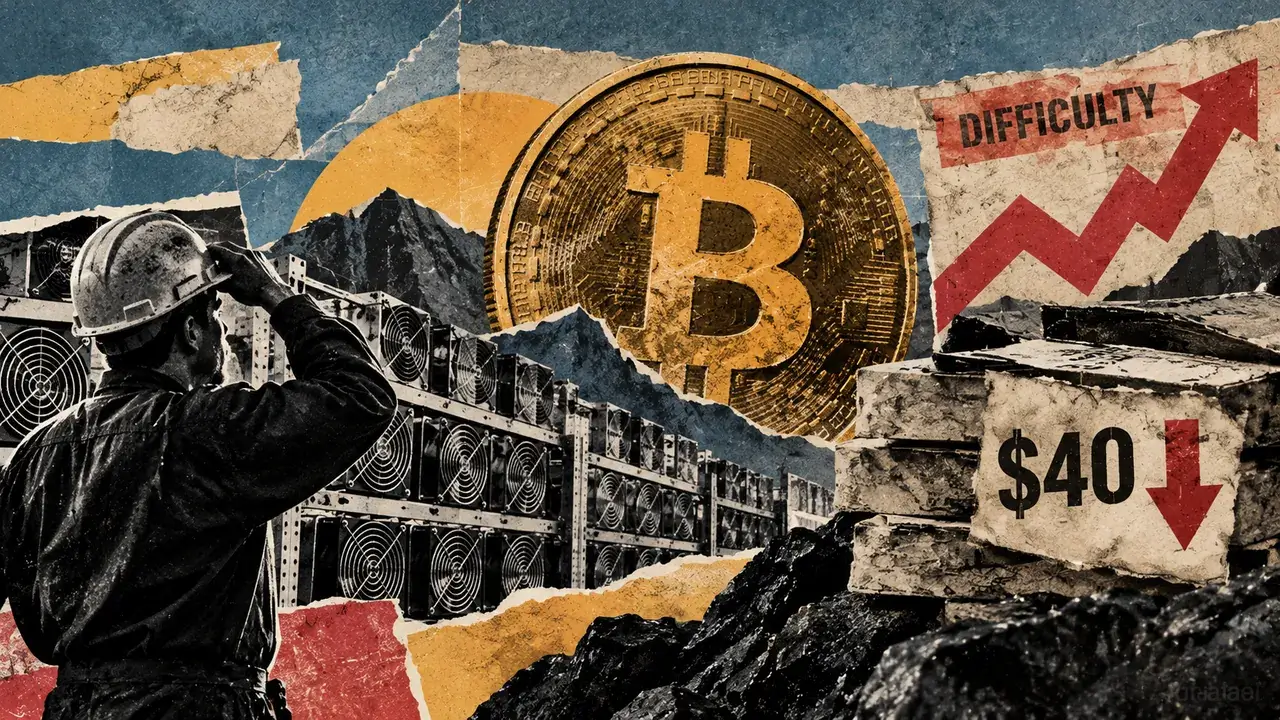
- October 2024: The Breaking Point. By early October, the "hashprice"—a metric representing the expected value of 1 terahash of hashing power per day—plummeted to approximately $45. This is near the lowest level ever recorded, signaling that even those with access to ultra-cheap electricity are operating on razor-thin margins.
While a recent difficulty adjustment at block 919,296 provided a modest 2.73% relief, it has done little to improve the overall fiscal health of the industry. The primary issue remains the collapse of transaction fee revenue.
The Paradox of Transaction Fees
A critical component of the Bitcoin security model is the eventual transition from block rewards to transaction fees as the primary incentive for miners. However, 2024 has proven to be a disappointing year for fee generation. According to data from Hashlabs, the average fee per block has hovered around 0.036 BTC, the weakest performance since 2010.
Mining analyst Jaran Mellerud has highlighted a dangerous complacency within the sector regarding these fees. "It is a paradox that so many bitcoin miners completely disregard transaction fees," Mellerud noted. He warned that within a decade, as block rewards continue to halve, these fees will become the sole source of income. The current lack of fee-generating activity—driven by a slowdown in "Ordinals" inscriptions and "Runes" protocol usage—has left miners entirely dependent on the spot price of Bitcoin, which has remained volatile.

In this "zero-sum" environment, every additional unit of computing power added to the network by a competitor reduces the payout for everyone else. For smaller operations running older hardware, such as the once-dominant S19 series, the cost of electricity now exceeds the value of the Bitcoin produced, leading to a "capitulation" phase where machines are powered down and reserves are sold to exit the market.
The AI Escape Plan: A New Revenue Paradigm
Faced with the prospect of obsolescence, the industry’s giants are looking toward the Silicon Valley AI boom as a lifeline. The infrastructure required for Bitcoin mining—massive electrical substations, high-grade cooling systems, and high-bandwidth fiber connectivity—is remarkably similar to what is needed for AI data centers.
The economic incentive for this transition is staggering. Data from Digital Mining Solutions indicates a clear disparity in revenue potential:
- Bitcoin Mining: A 1-megawatt (MW) site utilizing top-tier hardware can generate roughly $896,000 in annual revenue, assuming a Bitcoin price of $100,000.
- AI/HPC Hosting: The same 1-MW site, if retooled to host GPUs for AI training or inference, can yield up to $1.46 million in annual revenue.
Furthermore, unlike the volatile, "hit-or-miss" nature of mining rewards, AI hosting typically involves long-term, stable contracts with corporate clients. This predictability is highly attractive to institutional investors and lenders who have grown weary of the crypto market’s boom-and-bust cycles.
Companies like Core Scientific have already led the way, signing multi-billion-dollar deals to provide infrastructure for AI firms. This pivot allows these companies to remain solvent and even profitable during Bitcoin bear markets, using the steady cash flow from AI to subsidize their mining operations or wait for the next crypto bull run.

Nico Smid, founder of Digital Mining Solutions, observed that the two industries are now in direct competition for "the same critical resources: power, infrastructure, people, and capital." This competition is driving up the value of "power-ready" land, making it more profitable for some miners to simply lease their land and power access to tech giants like Amazon or Google rather than mining Bitcoin themselves.
Analysis of Implications for the Bitcoin Network
The mass movement of $5.6 billion to exchanges and the subsequent pivot to AI have significant implications for the future of the Bitcoin network.
Short-Term Market Volatility
The immediate influx of 51,000 BTC onto Binance creates a "supply overhang." Even if the miners do not sell all the coins at once, the knowledge that such a large volume is sitting on an exchange can suppress price action, as traders anticipate potential sell pressure. Historically, these periods of miner capitulation have marked local price bottoms, but only after a period of painful consolidation.
Structural Changes in Hashrate
As mining facilities transform into hybrid AI-crypto data centers, the "stickiness" of Bitcoin’s hashrate may change. If a significant portion of the network’s power is diverted to AI during periods of low Bitcoin profitability, the network’s total hashrate could become more elastic, fluctuating based on the relative profitability of "Compute vs. Hash."
Centralization Risks
The high capital requirements for retooling facilities for AI/HPC may favor the largest, publicly traded mining firms. Smaller, independent miners lack the capital to make this transition, potentially leading to a more centralized mining landscape where a handful of diversified "compute giants" control the majority of the network’s security.

Long-Term Security Model
The shift toward AI highlights a potential flaw in the current mining incentive structure. If miners find more consistent and higher returns in AI, the incentive to secure the Bitcoin blockchain may diminish unless transaction fees or BTC prices rise significantly. The industry is currently watching to see if "Bitcoin-native" innovations can revive the fee market to keep miners focused on the blockchain.
Conclusion
The $5.6 billion transfer to Binance marks a watershed moment for the cryptocurrency industry. It is the physical manifestation of a sector in transition—liquidating the assets of the "old" mining economy to build the infrastructure of the "new" AI economy. While the move adds short-term pressure to Bitcoin’s price, it also demonstrates the adaptability of the companies that secure the network. By diversifying into AI, miners are ensuring their own survival, though the long-term impact on Bitcoin’s decentralized security model remains a subject of intense debate among analysts and stakeholders. As the global compute landscape continues to evolve, the line between "crypto miner" and "data center provider" is likely to disappear entirely.