admin
admin
The European Union’s Markets in Crypto-Assets (MiCA) regulation is significantly reshaping the digital asset landscape, leading to a noticeable slowdown in new exchange listings globally. While fully implemented by December, the initial phase of MiCA, focusing on stablecoin legislation that went live at the end of June, has already prompted significant adjustments from exchanges and service providers targeting the EU market. This regulatory tightening, coupled with persistent pressure in the United States, is contributing to a more cautious approach to introducing new digital assets to trading platforms.
MiCA: A Comprehensive Regulatory Overhaul for the EU Crypto Market
MiCA represents a landmark effort by the European Union to establish a harmonized and supervised framework for the burgeoning digital asset market. Unlike previous regulatory initiatives, MiCA specifically addresses the rapidly expanding decentralized finance (DeFi) sector, aiming to provide clarity and security for both investors and businesses operating within the bloc. The regulation’s scope is notably broad, extending beyond EU member states to encompass any entity offering crypto-asset services to EU customers or utilizing the Euro in their operations, irrespective of their geographical headquarters. This "extraterritorial scope" means that global exchanges and crypto firms must comply with MiCA if they wish to serve the European market.
The core objectives of MiCA include standardizing the issuance, trading, and custody of various digital assets, including stablecoins, utility tokens, and asset-referenced tokens. For stablecoins, the regulation introduces stringent requirements related to reserves, governance, and redemption policies to mitigate risks to financial stability and consumer protection. This proactive stance on stablecoins, often viewed as a bridge between traditional finance and the crypto ecosystem, signals the EU’s commitment to fostering a more mature and regulated digital asset industry.
The Ripple Effect: Global Exchanges Adapt to MiCA’s Reach
Even before its full implementation, MiCA’s influence is being felt across the global cryptocurrency market. The June 30th deadline for stablecoin legislation has already forced major exchanges to re-evaluate their offerings and operational strategies. Kraken, for instance, has publicly considered delisting Tether’s USDT in Europe due to the complexities and potential compliance burdens associated with MiCA rules for such assets. This decision highlights the direct impact of the regulation on established trading pairs and the potential for market fragmentation as exchanges choose to prioritize compliance in certain jurisdictions.
The extraterritorial nature of MiCA means that companies outside the EU are compelled to adapt if they wish to maintain or gain access to the European customer base. This necessitates a thorough understanding of MiCA’s provisions, potentially requiring significant investments in legal, compliance, and operational infrastructure. The uncertainty surrounding the precise interpretation and enforcement of certain aspects of MiCA also contributes to a climate of caution among businesses.

US Regulatory Headwinds Compound Global Slowdown
The increasing regulatory pressure in the United States has further amplified the global trend toward a more conservative approach to new exchange listings. The U.S. has witnessed a series of enforcement actions and pronouncements from regulatory bodies like the Securities and Exchange Commission (SEC) and the Commodity Futures Trading Commission (CFTC), creating a complex and often challenging environment for crypto companies.
The upcoming 2024 Presidential elections have also injected a political dimension into the cryptocurrency debate in the U.S. Digital assets, particularly Bitcoin, are increasingly becoming a focal point in political discourse, with various candidates and parties expressing differing views on regulation and adoption. This political uncertainty has put U.S.-based companies and exchanges on edge, leading to a heightened sense of caution regarding new ventures and listings. The finalization of crypto broker tax reporting rules by the U.S. Treasury and IRS also adds another layer of compliance for entities operating in the U.S. market.
Data Reveals a Significant Slowdown in New Exchange Listings
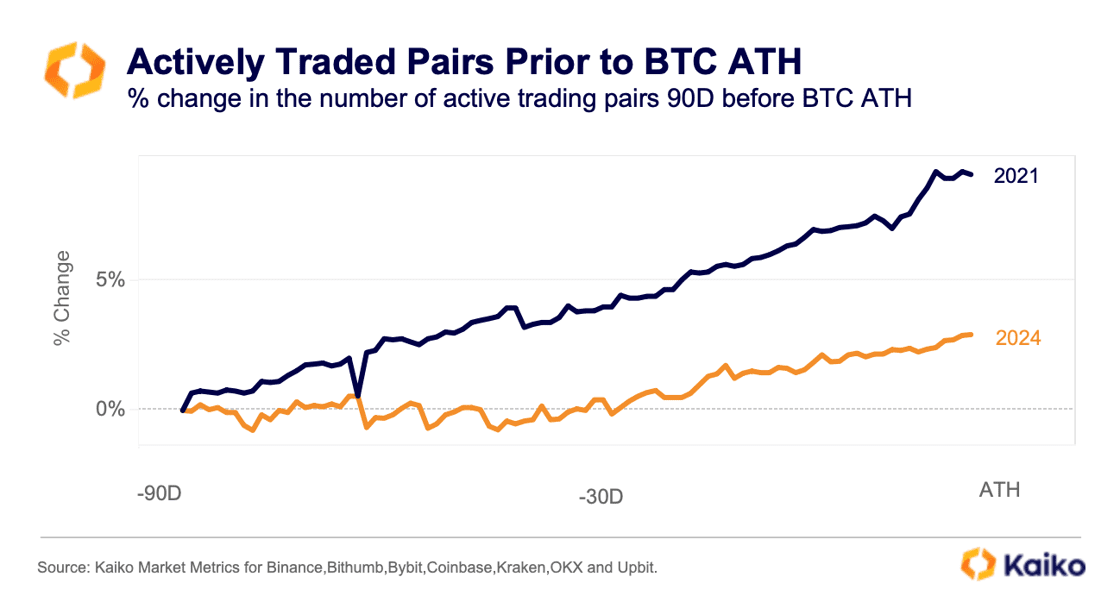
Analysis of market data corroborates the anecdotal evidence of a slowdown. Kaiko, a leading cryptocurrency market data provider, has observed a significant shift in the rate of new exchange listings. The peak of the 2021 bull run saw a rapid expansion in the number of new trading pairs listed across major exchanges. However, this growth has decelerated considerably.
Kaiko’s data indicates a notable decline in the growth rate of new trading pairs. Prior to Bitcoin’s all-time high in 2021, the growth rate hovered around 9%. This figure has since dropped to approximately 3% in the lead-up to the 2024 market peak. This reduction signifies a more deliberate and selective approach by exchanges in adding new assets to their platforms, reflecting a response to both regulatory pressures and a more mature market sentiment.
[Insert Figure 1: Graph showing the percentage change in the number of active trading pairs on centralized exchanges in 2021 and 2024. Caption: Graph showing the percentage change in the number of active trading pairs on centralized exchanges in 2021 and 2024 (Source: Kaiko)]
The graph illustrates a clear trend of deceleration in the listing of new trading pairs on centralized exchanges. This slowdown is a direct consequence of the evolving regulatory landscape and a more risk-averse market environment. Exchanges are likely prioritizing established, compliant assets and conducting more rigorous due diligence on new entrants to avoid potential regulatory scrutiny and associated risks.

Exchange-Specific Trends: Binance’s Challenges and Bybit’s Resilience
Diving deeper into the data reveals distinct trends among individual exchanges. Binance, once the dominant force in the market, has experienced a slower pace of growth in its active trading pairs compared to its peers. The exchange’s number of active trading pairs currently stands 14% below its 2022 peak. While MiCA is a contributing factor to this slowdown in its European operations, Binance has also faced a series of global regulatory challenges.
The ongoing legal troubles, including charges against its founder and former CEO, Changpeng Zhao, and the significant fines and penalties imposed, have undoubtedly impacted Binance’s global standing and operational capacity. Furthermore, the legal battles faced by Binance.US in the past year have also played a substantial role in diminishing its market dominance. These multifaceted challenges have likely led Binance to adopt a more cautious strategy regarding new listings, focusing on solidifying its existing operations and navigating existing regulatory hurdles.
[Insert Figure 2: Graph showing the number of active newly listed trading pairs on centralized exchanges from January 2020 to July 2024. Caption: Graph showing the number of active newly listed trading pairs on centralized exchanges from January 2020 to July 2024 (Source: Kaiko)]
This chart visually represents the historical trend of new exchange listings, highlighting the peak in 2021 and the subsequent decline. The data suggests a more discerning approach to listing new assets, with exchanges becoming more selective in response to market conditions and regulatory pressures.
In contrast to Binance, exchanges like Bybit have demonstrated resilience and even growth in their listing activities. Bybit experienced a surge in active trading pairs, reaching an all-time high during the market rally in May. This success can be attributed, in part, to its customer base, which is predominantly located in regions outside the direct purview of MiCA. This geographical diversification provides Bybit with a buffer against the immediate impact of EU regulations.
Similarly, exchanges in South Korea, particularly Bithumb, have witnessed rapid growth in new listings, even outpacing competitors like Upbit. This surge has, in turn, attracted increased regulatory attention from South Korean authorities, who are still in the process of developing a comprehensive regulatory framework for the domestic cryptocurrency industry. The dynamic growth in emerging markets, often driven by factors like inflation, currency volatility, and less stringent regulatory environments, highlights the diverse landscape of the global crypto market.
Broader Implications: Market Maturation and Emerging Market Resilience
The slowdown in new exchange listings, coupled with a potential shift towards more stablecoin-denominated trading pairs on compliant exchanges, contributes to a broader narrative of market maturation. As regulatory frameworks like MiCA solidify, the industry is likely to move towards a more established and less speculative phase. This could lead to greater institutional adoption and a more predictable investment environment.
However, the trend also underscores the significant differences in regulatory approaches across jurisdictions. While the EU and U.S. are imposing stricter controls, emerging markets continue to offer a more open environment for crypto innovation and adoption. These markets are often driven by different economic imperatives, such as the need for alternative financial services, hedging against currency devaluation, or facilitating cross-border remittances.
The resilience and increased demand for cryptocurrencies in these emerging economies suggest that the global crypto market will continue to evolve, albeit with regional variations. The long-term impact of MiCA and other regulatory initiatives will be a key determinant in how this evolution unfolds, potentially leading to a more bifurcated global crypto landscape characterized by highly regulated Western markets and more dynamic, less regulated emerging markets. The focus on compliance and investor protection in established economies may foster trust and long-term sustainability, while the innovation and accessibility in emerging markets could continue to drive adoption and utility. The interplay between these forces will shape the future trajectory of cryptocurrency exchange listings and the broader digital asset ecosystem.