Dwi Wanna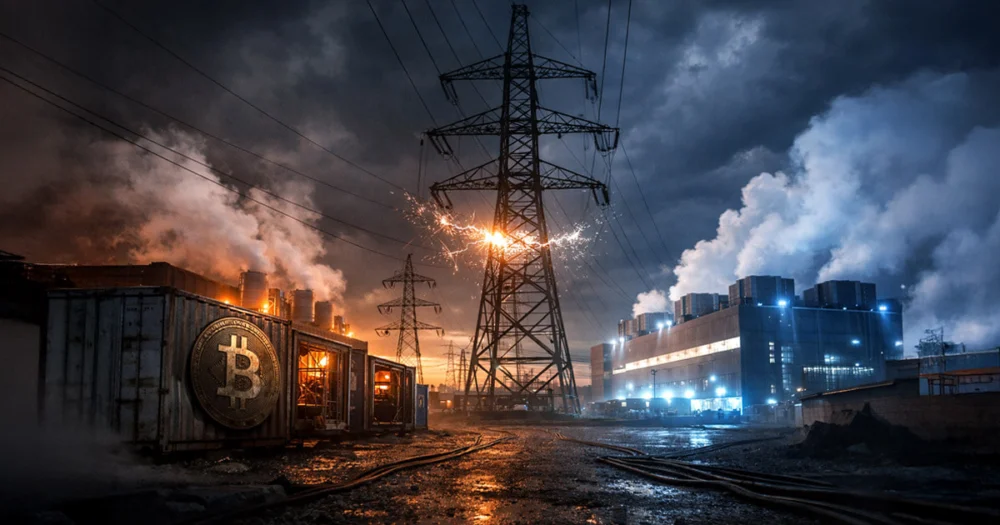
The central thesis of BlackRock’s report is that the AI buildout is approaching a series of "physical limits" that investors are currently underpricing. Chief among these constraints is electricity. The BII projects a scenario where AI-driven data centers could consume up to 24% of the total United States electricity supply by 2030. Such a staggering increase would necessitate a total reordering of the American industrial landscape, affecting everything from utility capital expenditure (capex) to the geographic siting of new manufacturing hubs. For the cryptocurrency industry, specifically Bitcoin mining, this forecast serves as a warning of an impending "energy war" where the primary weapon is not hash rate, but guaranteed access to the baseload power of the grid.
The Evolution of the Energy Crisis: From Chips to Megawatts
The current tension is the result of a multi-year shift in the technology sector’s resource requirements. Between 2022 and 2024, the primary bottleneck for AI development was the availability of specialized semiconductors, specifically NVIDIA’s H100 GPUs. However, as supply chains for chips have stabilized, the constraint has shifted downstream to the infrastructure required to house and power them. BlackRock estimates that total capital spending intentions for the AI buildout through 2030 fall within the range of $5 trillion to $8 trillion, with a disproportionate share directed toward compute facilities, cooling systems, and specialized energy infrastructure.
This surge in demand comes at a time when the U.S. electrical grid is already under significant stress. According to a Department of Energy (DOE) report involving the Lawrence Berkeley National Laboratory, data center load growth in the U.S. has tripled over the last decade. Current projections suggest this demand will double or even triple again by 2028. Other research bodies offer slightly more conservative but still alarming figures; the Electric Power Research Institute (EPRI) modeled a scenario in 2024 where data centers could represent between 4.6% and 9.1% of U.S. generation by 2030. The World Resources Institute (WRI) places that figure between 6.7% and 12%. BlackRock’s "up to 24%" figure represents the most aggressive end of the analytical spectrum, signaling a belief that the market is severely discounting the sheer scale of the AI revolution’s appetite for power.
The Bitcoin Mining Model: A History of Flexibility
To understand why this poses a threat to the crypto sector, one must examine the business model of Bitcoin mining. Since the 2021 migration of hash power from China to the United States, miners have positioned themselves as "good citizens" of the grid. Bitcoin mining is a highly mobile and interruptible process. Unlike a hospital or a traditional data center, a mining rig can be shut down in seconds without losing data or damaging the underlying network.
This flexibility has been the cornerstone of the industry’s political and operational defense. In Texas, the Electric Reliability Council of Texas (ERCOT) has pioneered programs specifically for "large flexible customers." These programs incentivize Bitcoin miners to operate when power is abundant and prices are low, and to "curtail" or power down during periods of peak demand, such as summer heatwaves or winter freezes.
A prominent example of this occurred in August 2023. Riot Platforms, one of the largest Bitcoin miners in North America, reported in an SEC filing that it curtailed its power usage by more than 95% during peak demand periods that month. In exchange for supporting grid reliability, Riot received $31.7 million in energy credits from ERCOT. For years, this was seen as a win-win: miners got cheap power, and the grid got a massive, controllable "shock absorber."
The Inflexible Demand of Artificial Intelligence
The conflict arises because AI data centers operate on an entirely different philosophy. Training Large Language Models (LLMs) and providing real-time inference for consumer applications requires 24/7 uptime and high-reliability "baseload" power. While a Bitcoin miner is a shock absorber, an AI data center is a shock creator. They do not want to power down; they require constant, high-density energy to maintain the cooling systems and processing cycles necessary for their workloads.
As these hyperscalers—companies like Microsoft, Google, and Amazon—scramble for capacity, they are entering the same markets that Bitcoin miners once dominated. In regions like Northern Virginia (the world’s largest data center hub) and the Permian Basin in Texas, the competition for "interconnection" has become fierce. An interconnection queue is the list of projects waiting to be plugged into the grid. Currently, many regions face delays of five to seven years for new high-voltage connections.
BlackRock’s report suggests that in a world of scarce grid access, the political and economic support will naturally gravitate toward AI. Artificial intelligence is increasingly viewed as a matter of national security and economic competitiveness. Lawmakers are more likely to prioritize a data center that powers medical research or national defense over a Bitcoin mine that validates decentralized transactions.
Shifting Political Optics and Regulatory Pressure
The political narrative surrounding energy use is also shifting. For years, Bitcoin mining has faced criticism for its perceived "waste" of energy. The industry’s rebuttal has always been its ability to utilize stranded energy or act as a flexible load. However, the rise of AI changes the "opportunity cost" of a megawatt.
When a local utility has to choose between approving a 500-megawatt Bitcoin mine or a 500-megawatt AI campus, the decision often comes down to perceived social utility and job creation. Traditional data centers generally employ more high-skilled staff per megawatt than highly automated Bitcoin mines. Furthermore, the "AI as infrastructure" narrative is gaining traction among both Democratic and Republican lawmakers, who see it as the backbone of the future economy.
This asymmetry is likely to lead to a more challenging regulatory environment for crypto miners. We are already seeing utilities and grid operators adjusting rate structures to favor "firm" or "productive" loads. In some jurisdictions, there are discussions about imposing additional "impact fees" on crypto miners to fund the grid upgrades necessitated by the broader tech boom.
The Strategic Pivot: From Hashing to Hosting
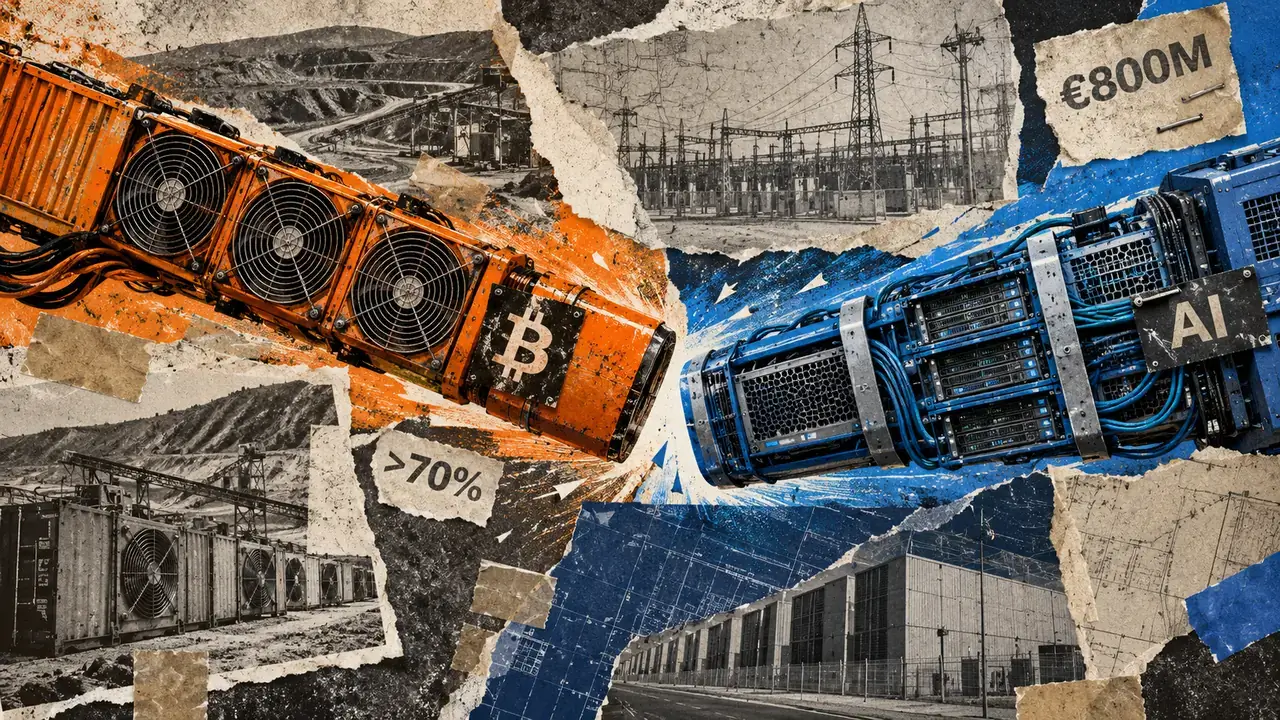
Recognizing this shift, several major players in the Bitcoin mining space have begun to hedge their bets. A significant trend in 2024 and 2025 has been the "pivot to AI." Mining companies are realizing that their most valuable asset is no longer their fleet of ASICs (Application-Specific Integrated Circuits), but their "energized land"—the permits, substations, and power contracts they already hold.
Companies like Core Scientific and Northern Data have signed multi-billion-dollar deals to host AI GPU clusters for cloud providers. This transition is technically challenging; Bitcoin mines are typically "low-tier" facilities with basic cooling and minimal redundancy. AI workloads require Tier III or Tier IV data center specifications, involving sophisticated liquid cooling and uninterruptible power supplies (UPS).
The cost of retrofitting a Bitcoin mine for AI can be astronomical, sometimes exceeding $10 million per megawatt. However, for many miners, the prospect of long-term, fixed-price contracts from AI companies is more attractive than the volatile daily revenue of Bitcoin mining, especially following the 2024 halving event which cut mining rewards in half.
Implications for the Future of Digital Infrastructure
The BlackRock forecast marks the end of an era of "cheap abundance" for digital infrastructure. The firm’s analysis suggests that the next decade will be defined by the "physicality" of the digital world. The constraints on growth will not be the ingenuity of code or the speed of chips, but the availability of copper, transformers, turbines, and permits.
This will likely result in a "barbell" outcome for the Bitcoin mining industry. On one side, we will see highly integrated "grid-service" miners. these firms will survive by becoming essential components of utility planning, operating almost as a form of "virtual power plant" that helps integrate renewable energy by soaking up excess wind and solar power. They will accept lower margins in exchange for a secure, if intermittent, place on the grid.
On the other side, the industry will see the emergence of "AI-Crypto Hybrid" firms. These companies will leverage their early arrival in power markets to become diversified compute providers. They will use their sites to host a mix of high-uptime AI workloads and flexible Bitcoin mining, using the latter to "fill the gaps" in their power usage and maximize the efficiency of their infrastructure.
The broader impact on the U.S. economy cannot be overstated. If BlackRock’s 24% projection proves accurate, the U.S. will need to undertake a massive expansion of its generating capacity, likely involving a renaissance in nuclear power and a rapid buildout of natural gas and renewable assets. For investors, the message is clear: the "AI trade" is no longer just a bet on Silicon Valley; it is a bet on the industrial heartland and the fundamental physics of the electrical grid. The "love affair" between crypto and AI may be cooling, but the competition for the energy that powers them both is just beginning.