admin
admin
The rapid expansion of the user base occurred despite significant market volatility and the looming specter of a bear market in the latter half of the year. This resilience highlights a fundamental shift in market sentiment, transitioning from speculative retail interest to a more structured, institutionally-backed asset class. The year 2021 served as a landmark period for the industry, characterized by the introduction of Bitcoin as legal tender in El Salvador and the entry of major financial institutions and Fortune 500 companies into the space. These developments have provided a veneer of legitimacy that was previously lacking, encouraging a broader demographic of investors to explore digital currencies.
The Exponential Growth of Global Crypto Ownership
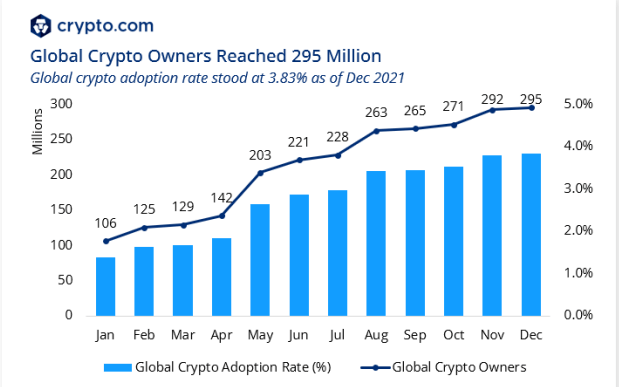
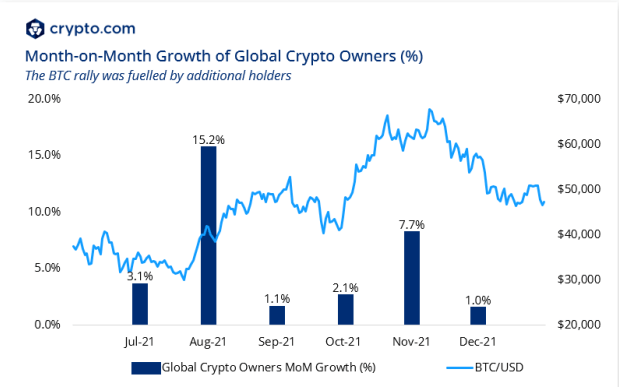
To understand the magnitude of the 2022 forecast, it is essential to examine the granular data from the preceding year. The 178% increase in the total number of crypto users throughout 2021 was not a linear progression but rather a series of surges driven by specific market events. In January 2021, the market stood at 106 million users. By the end of the second quarter, this number had already eclipsed 200 million. The most significant month-on-month growth occurred in August, when the user base expanded by 15.2%. This particular spike preceded Bitcoin’s climb to its all-time high of $69,000 in November, suggesting a strong correlation between new user influx and upward price action.

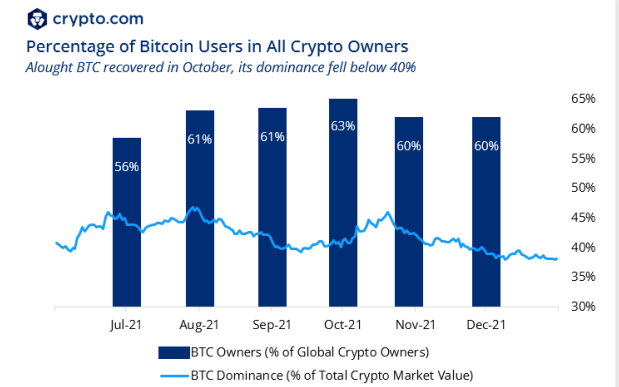
As of early 2022, the distribution of these users remains heavily weighted toward the industry’s two largest assets. Approximately 176 million individuals, or nearly 60% of the total crypto-owning population, hold Bitcoin. In contrast, Ethereum ownership is estimated at 23 million users. However, a significant overlap exists, with roughly 23% of the global user base holding both Bitcoin and Ethereum in their portfolios. This concentration of ownership suggests that while thousands of alternative coins (altcoins) exist, the "Big Two" continue to serve as the primary on-ramps for the vast majority of the world’s investors.
Chronology of Adoption: Key Milestones in 2021
The journey to 295 million users was paved by several high-profile events that altered the public perception of digital assets. The timeline of 2021 reveals a clear evolution in how cryptocurrency is integrated into the global economy:
- Q1 2021: Institutional Validation. The year began with Tesla announcing a $1.5 billion Bitcoin purchase and MicroStrategy continuing its aggressive acquisition strategy. These moves signaled to the corporate world that Bitcoin could serve as a viable treasury reserve asset.
- Q2 2021: The Regulatory Tussle and Retail Peak. As Dogecoin and other "meme coins" captured retail imagination, China intensified its crackdown on crypto mining. Despite the resulting price correction, the user base continued to grow as investors viewed the dip as an entry point.
- Q3 2021: Sovereign Adoption. In September, El Salvador officially adopted Bitcoin as legal tender. This was a watershed moment, representing the first time a nation-state integrated a decentralized digital currency into its national financial infrastructure.
- Q4 2021: Mainstream Financial Integration. The launch of the first Bitcoin Futures ETF in the United States provided a regulated avenue for institutional and retirement funds to gain exposure to the asset, coinciding with Bitcoin’s peak valuation in November.
This chronology suggests that adoption is no longer solely dependent on price appreciation but is increasingly driven by utility, regulatory clarity, and the integration of crypto services into traditional fintech apps like PayPal, Venmo, and Cash App.
Bitcoin vs. Ethereum: A Divergence in Adoption Rates
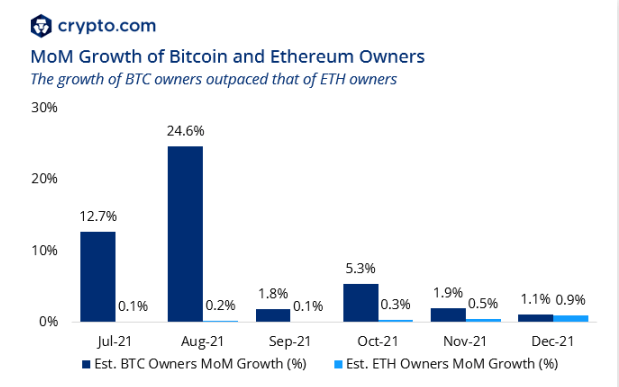
One of the most striking revelations in the Crypto.com report is the disparity in growth rates between Bitcoin and Ethereum during the second half of 2021. Between July and December, the number of Bitcoin owners grew by a robust 37.5%. During the same six-month period, the number of Ethereum owners remained nearly stagnant, growing by a mere 1.4%.
This stagnation is particularly noteworthy given Ethereum’s central role in the Decentralized Finance (DeFi) and Non-Fungible Token (NFT) sectors. Analysts point to several factors that may have hindered Ethereum’s adoption among new retail users. Primary among these is the issue of "gas fees"—the transaction costs required to use the network. Throughout 2021, Ethereum’s popularity led to severe network congestion, frequently pushing transaction fees to hundreds of dollars. For a small-scale retail investor looking to purchase $100 worth of an asset, a $50 to $100 gas fee represents a prohibitive barrier to entry.
Furthermore, the rise of "Ethereum killers"—alternative blockchains such as Solana, Avalanche, and Binance Smart Chain—as well as Layer-2 scaling solutions like Polygon, has fragmented the market. These platforms offer faster transactions and lower fees, drawing away users and total value locked (TVL) that would otherwise have contributed to Ethereum’s growth statistics. Crypto.com’s data, which primarily tracks users on centralized exchanges, may also partially explain the discrepancy. Bitcoin is often viewed as "digital gold," a simple buy-and-hold asset that is easily managed on a centralized exchange. Ethereum, conversely, is a functional platform; its users are more likely to move their assets off exchanges and into private wallets to interact with DeFi protocols—movements that are more difficult to track in aggregate user surveys.
Methodological Nuances and the "Invisible" DeFi Market
While the 1-billion-user projection is compelling, the methodology behind the data warrants closer inspection. The figures provided by Crypto.com are derived from an aggregate of data across 24 of the world’s largest centralized exchanges. The researchers use on-chain signals to cross-reference and eliminate double-counting of addresses belonging to the same individual. However, this approach inherently favors assets that are primarily traded on exchanges.
The report potentially underestimates the true scale of the cryptocurrency ecosystem by not fully accounting for the decentralized exchange (DEX) market. Platforms like Uniswap and PancakeSwap have millions of active users who may not maintain significant balances on centralized exchanges. Additionally, the growing use of privacy-focused wallets and the increasing number of people using crypto for remittances in developing nations—often through P2P (peer-to-peer) networks—suggests that the actual number of global users might already be higher than the reported 295 million.
Broader Implications: A New Global Financial Order
The move toward one billion users carries profound implications for the global financial system. When the internet reached one billion users in 2005, it had already begun to fundamentally transform commerce, communication, and media. If cryptocurrency follows a similar adoption curve, the year 2022 could mark the transition of digital assets from a niche interest to a foundational component of global finance.
For Bitcoin, maintaining a 60% share of a one-billion-user market would mean that 600 million people would hold the asset. Such a level of distribution would likely lead to a significant reduction in volatility, as the market becomes too deep and liquid for individual "whales" to manipulate prices easily. It would also likely force a more uniform global regulatory response. As a larger percentage of the voting public in major economies becomes invested in digital assets, political pressure to provide clear, fair, and supportive regulatory frameworks will inevitably increase.
Furthermore, the surge in adoption in emerging markets cannot be overlooked. In nations facing hyperinflation or lacking robust banking infrastructure, cryptocurrency is not merely a speculative investment but a necessary tool for wealth preservation and cross-border trade. The 2022 growth is expected to be driven heavily by these regions, further decentralizing the global economic balance of power.
Conclusion: The Road to 2023
As 2022 progresses, the industry will be watching to see if the ambitious "one billion" target is met. The success of this projection depends on several variables, including the continued interest of institutional investors, the successful technical upgrades of major networks like Ethereum (such as the transition to Proof of Stake), and the ability of the industry to navigate a tightening global monetary environment.
Regardless of whether the final count hits exactly one billion by December 31, the trend is undeniable. Cryptocurrency has moved beyond the "early adopter" phase and is firmly entrenched in the "early majority" stage of the technology adoption life cycle. With Bitcoin leading the charge as the primary gateway for new participants, the digital asset landscape is set to become more crowded, more regulated, and more integrated into the daily lives of the global population than ever before. In this context, the shift from 295 million to 1 billion is not just a change in numbers, but a total redefinition of what it means to participate in the modern economy.