admin
admin
The Catalyst for Growth: Analyzing the October Rally
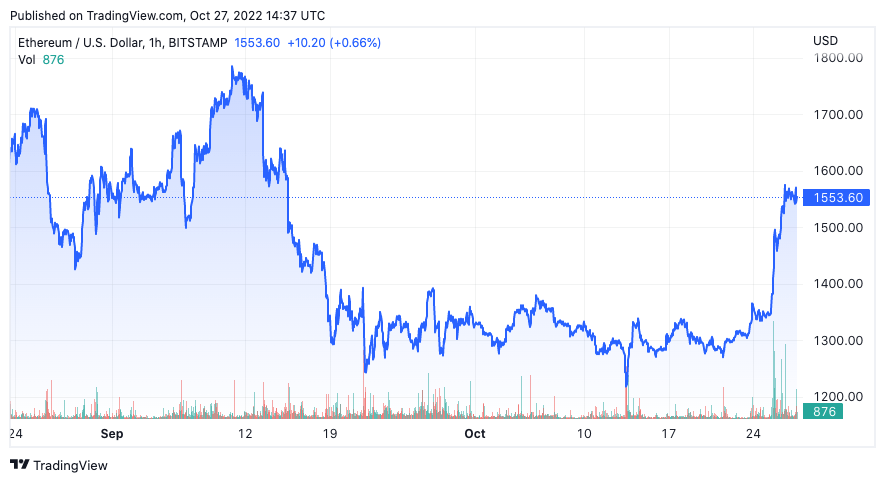
The ascent to the top 50 was driven by a sudden and aggressive price movement that broke a month-long period of horizontal trading. Throughout much of early October 2022, Ethereum had been characterized by low volatility, with its price oscillating narrowly around the $1,300 mark. However, a shift in market sentiment, likely bolstered by a combination of short liquidations and a slight softening of the U.S. Dollar Index (DXY), triggered a rapid appreciation.
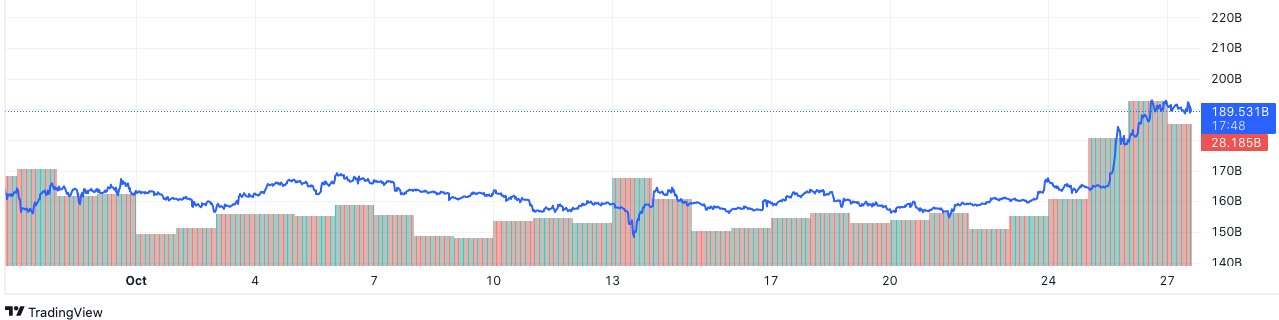
In less than 48 hours, Ethereum’s price surged from $1,300 to a peak of $1,560. This 20% increase added tens of billions of dollars to its total market capitalization, pushing it past the $190 billion threshold. This price action was particularly notable because it occurred during a period of macroeconomic uncertainty, where traditional markets were grappling with high inflation and rising interest rates. Ethereum’s ability to decouple, even temporarily, from the broader bearish trend in equities signaled renewed investor confidence in the protocol’s long-term value proposition.
Overtaking Legacy Giants: A Comparative Analysis
Ethereum’s entry into the top 50 is a symbolic victory for the blockchain industry, as it places a decentralized protocol ahead of companies with decades of history, massive physical infrastructure, and thousands of employees. By surpassing Cisco Systems, a backbone of global internet infrastructure, Ethereum has demonstrated the growing perceived value of decentralized "web3" infrastructure.
Furthermore, overtaking Alibaba, the Chinese e-commerce behemoth, and AstraZeneca, one of the world’s leading pharmaceutical firms, highlights the sheer scale of capital currently flowing into the digital asset space. At its current valuation of $190 billion, Ethereum is now trading head-to-head with industrial and entertainment titans like Toyota and the Walt Disney Company. Both Toyota and Disney maintain market caps in the $195 billion range, meaning a further 3-5% increase in ETH price could see the cryptocurrency outrank some of the most recognizable consumer brands in history.
Historical Chronology: From the Merge to the Top 50
To understand the significance of this milestone, it is essential to look at the timeline leading up to the October surge. The year 2022 was a transformative period for Ethereum, marked primarily by "The Merge."
- September 15, 2022 – The Merge: Ethereum successfully transitioned from a Proof-of-Work (PoW) consensus mechanism to Proof-of-Stake (PoS). This move reduced the network’s energy consumption by 99.9% and fundamentally changed the asset’s tokenomics by introducing staking and reducing the issuance of new ETH.
- Late September to Mid-October 2022 – The Accumulation Phase: Following the "sell-the-news" event immediately after the Merge, ETH entered a period of consolidation. Prices remained stagnant as investors assessed the new PoS environment and the impact of the EIP-1559 "burn" mechanism on supply.
- October 25-27, 2022 – The Breakout: A sudden influx of buying volume pushed ETH above the $1,400 resistance level. This technical breakout accelerated as short-sellers were forced to cover their positions, leading to the rapid climb toward $1,560 and the subsequent rise in global asset rankings.
This chronology suggests that the recent price action is not merely a speculative bubble but a delayed reaction to the successful fundamental upgrades the network underwent earlier in the year.
Supporting Data: Network Fundamentals and Scarcity
The rise in market cap is supported by robust on-chain data. Since the transition to Proof-of-Stake, the issuance of Ethereum has plummeted. Under the previous PoW system, miners were issued approximately 13,000 ETH per day. Under PoS, the issuance to stakers is roughly 1,600 ETH per day. When combined with the EIP-1559 mechanism, which burns a portion of the transaction fees, Ethereum has seen periods of "ultrasound money" status, where more ETH is burned than created.
As of late October 2022, the total amount of ETH staked on the Beacon Chain exceeded 14 million tokens, representing a significant portion of the supply that is effectively "locked" and unavailable for immediate sale. This reduction in liquid supply, coupled with a spike in demand, creates a supply-demand imbalance that facilitates rapid market cap expansion.
Furthermore, Ethereum’s ecosystem continues to lead the industry in terms of Total Value Locked (TVL) in Decentralized Finance (DeFi) and trading volume for Non-Fungible Tokens (NFTs). With over $30 billion in TVL across various Ethereum-based protocols, the network remains the primary layer for decentralized economic activity, providing a fundamental "floor" for the asset’s valuation.
Institutional Perspectives and Market Sentiment
While official statements from traditional corporate boards regarding Ethereum’s rise are rare, the institutional sentiment is reflected in the actions of major financial entities. The entry of Ethereum into the top 50 assets coincides with increased interest from firms like Fidelity, which recently announced plans to allow institutional clients to trade and custody Ethereum.
Market analysts suggest that the "institutionalization" of Ethereum is a primary driver of its climbing market cap. Unlike many other digital assets, Ethereum is increasingly viewed as "digital oil"—the essential fuel required to power a global, permissionless computer. Analysts from major investment banks have noted that as ESG (Environmental, Social, and Governance) concerns become paramount for institutional investors, Ethereum’s post-Merge energy efficiency makes it a more palatable investment compared to Bitcoin or traditional industrial firms with high carbon footprints.
The Bitcoin Comparison: A Dual-Asset Dominance
Ethereum is only the second cryptocurrency in history to penetrate the top 50 global assets. It follows in the footsteps of Bitcoin, which currently occupies the 14th position with a market capitalization of over $395 billion. At a current price of approximately $20,700, Bitcoin is positioned between the payments giant Visa and the retail behemoth Walmart.
The relationship between the two assets remains a focal point for investors. While Bitcoin is viewed as a "store of value" or "digital gold," Ethereum is valued for its utility and programmatic flexibility. Bitcoin’s historical peak in October 2021 saw its market cap reach $1.23 trillion, a figure that would currently place it above Alphabet (Google) and significantly higher than the total market value of silver ($1.10 trillion).
Ethereum’s rise to the 50th spot suggests that the market is beginning to value "utility-driven" blockchain assets with the same gravity as "store-of-value" assets. If Ethereum continues its current trajectory, the "flippening"—a hypothetical event where Ethereum’s market cap surpasses Bitcoin’s—remains a topic of intense debate among crypto-economic theorists.
Broader Implications and Future Outlook
The entry of Ethereum into the top 50 global assets has several long-term implications for the cryptocurrency market and the broader financial world:
1. Increased Regulatory Scrutiny: As Ethereum rivals the size of companies like Disney and Toyota, it becomes impossible for global regulators to ignore. The debate over whether ETH constitutes a security or a commodity will likely intensify, especially given the staking rewards inherent in the PoS model.
2. Inclusion in Diversified Portfolios: A top-50 ranking makes Ethereum a candidate for inclusion in broader "total market" indices. As the asset matures, the likelihood of an Ethereum Spot ETF (Exchange Traded Fund) increases, which would provide another avenue for massive capital inflows.
3. Validation of Decentralized Governance: The fact that a protocol governed by a global community of developers and validators can outvalue a centralized corporation like Alibaba is a testament to the power of open-source software. This milestone validates the decentralized business model as a viable competitor to traditional corporate hierarchies.
4. Reduced Volatility: Generally, as an asset’s market cap grows, its volatility tends to decrease. Entering the top 50 suggests that Ethereum is moving toward a stage of "maturity" where it may become less prone to the 80-90% drawdowns seen in its early years, making it more attractive to conservative pension funds and sovereign wealth funds.
In conclusion, Ethereum’s ascent to the 50th largest asset in the world is more than a price spike; it is a reflection of the shifting paradigm in global finance. By surpassing industry leaders in telecommunications, e-commerce, and pharmaceuticals, Ethereum has demonstrated that blockchain technology is no longer a niche interest but a heavyweight contender in the global economy. As the network continues to evolve and integrate with traditional financial systems, its climb up the leaderboard of global assets appears poised to continue.