admin
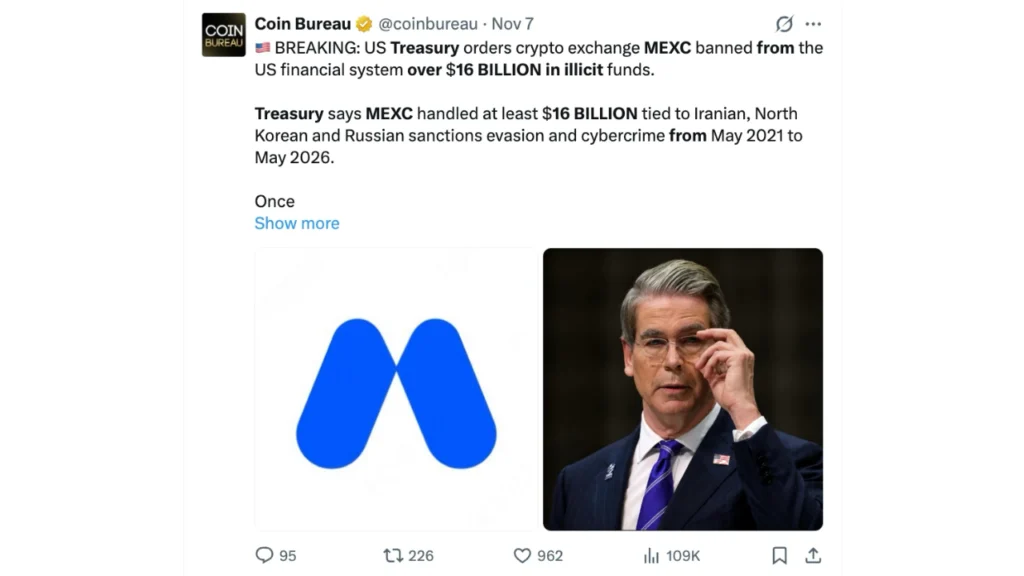
The U.S. Treasury Department has initiated a decisive move to isolate MEXC Global, one of the world’s largest cryptocurrency exchanges, from the American financial system, accusing it of facilitating over $16 billion in illicit financial transfers tied to sanctioned entities in Iran, North Korea, and Russia. On Friday, the Treasury’s Financial Crimes Enforcement Network (FinCEN) issued an order specifically prohibiting U.S. financial institutions from processing any funds transfers to or from MEXC Global. This landmark action underscores a heightened regulatory posture by the United States against digital asset platforms perceived as conduits for sanctions evasion and money laundering by hostile state actors and criminal organizations.
The directive, once formally published in the Federal Register, will take effect 30 days thereafter, marking a critical deadline for all U.S.-based financial entities. Any institution found to be continuing financial transactions with MEXC Global after this period could face severe civil or criminal penalties, signaling the Treasury’s uncompromising stance on adherence to its financial integrity mandates. Treasury Secretary Scott Bessent articulated the department’s position unequivocally, stating, "Financial institutions cannot have it both ways: Either you support the Iranian regime, or you have access to the U.S. financial system." He further emphasized the Treasury’s unwavering commitment to dismantling the economic lifelines of sanctioned regimes and thwarting their attempts to leverage digital assets to circumvent international sanctions. This move is not merely an isolated enforcement action but a strategic component of a broader, aggressive campaign by the U.S. government to reinforce the integrity of the global financial architecture against persistent threats posed by illicit actors exploiting emerging technologies.
FinCEN’s Detailed Findings: A Web of Illicit Finance
The Treasury’s 24-page order provides an exhaustive account of the alleged illicit activities, painting a grim picture of MEXC Global’s operational conduct. Far from being a peripheral player, MEXC, founded in 2018, holds a significant position within the global crypto landscape, ranking among the top 20 largest exchanges worldwide. FinCEN’s analysis reveals a platform of immense scale: processing over $1 billion in daily trades, holding approximately $5 billion in reserves, and listing more than 3,000 distinct tokens. Its global reach is extensive, operating in over 170 countries, and as of December 2025, it commanded roughly 9% of the global centralized crypto exchange market share. The exchange’s registration in the Seychelles, coupled with its lack of a virtual asset service provider (VASP) license in any major jurisdiction, has long raised red flags among compliance experts, suggesting a deliberate choice to operate in regulatory grey areas.
Between May 2021 and May 2026, FinCEN meticulously traced approximately $16.7 billion in transactions on the MEXC platform that were directly linked to illicit activities. This staggering sum highlights the profound impact such platforms can have on global financial crime. The exposure to high-risk entities was particularly widespread, with the order citing over $13 billion in transactions involving at least four high-risk exchangers previously sanctioned by the United Kingdom. These connections point to a sophisticated network of financial intermediaries dedicated to bypassing established international financial controls.
Perhaps the most damning detail in FinCEN’s findings concerns MEXC’s persistent engagement with Garantex, a Russian exchange that the U.S. Treasury had sanctioned in 2022. Despite the clear designation, FinCEN found that MEXC continued to trade with Garantex and its successor entity, Grinex, as recently as June 2026 – more than four years after the initial sanction was imposed. This prolonged interaction with a designated entity directly implicates MEXC in aiding Russia’s efforts to evade sanctions, thereby supporting its war economy and other destabilizing activities. Based on this egregious pattern, FinCEN formally designated MEXC as a "primary money laundering concern" in connection with Russian illicit finance, a classification that carries significant weight and triggers specific authorities under U.S. law to sever financial ties.
While MEXC Global nominally claimed to have anti-money laundering (AML) policies in place and publicly stated that it barred users from sanctioned jurisdictions like Iran and North Korea, FinCEN’s investigation concluded that, in practice, its compliance program suffered from "severe deficiencies." These deficiencies likely included inadequate Know Your Customer (KYC) procedures, insufficient transaction monitoring systems, and a general failure to effectively implement sanctions screening protocols. Such systemic failings allowed illicit funds to flow freely through the platform, enabling sanctioned regimes and criminal organizations to convert, transfer, and obscure the origins of their illicit wealth. The contrast between stated policy and actual practice forms the core of the Treasury’s accusations, emphasizing a profound lapse in governance and oversight at MEXC.
A Targeted Tool: Section 9714(a) of the Combating Russian Money Laundering Act
Crucially, the order against MEXC Global does not originate from the Office of Foreign Assets Control’s (OFAC) traditional sanctions list. Instead, FinCEN issued this directive under section 9714(a) of the Combating Russian Money Laundering Act. This distinction is significant and reflects an evolving strategy by the U.S. Treasury to combat financial crime in the digital asset space. Unlike an OFAC sanction, which typically entails a worldwide asset freeze and a broader prohibition on transactions with the designated entity, the FinCEN order under section 9714(a) specifically targets the ability of U.S. financial institutions to conduct correspondent banking or process transfers involving MEXC.
This targeted approach, while not a global asset freeze, effectively cuts off MEXC from direct or indirect access to the U.S. dollar-denominated financial system. For any international entity, especially a major crypto exchange, losing access to the world’s primary reserve currency is a crippling blow, significantly hampering its ability to conduct global business. FinCEN has increasingly leveraged this authority to address crypto platforms that operate outside the traditional correspondent banking system, where conventional sanctions mechanisms often have less immediate impact. The precedent for this specific application of authority was set in 2024 when FinCEN employed the same provision against the Russian exchanger PM2BTC, signaling a consistent and escalating strategy to confront illicit finance in the digital realm. This legal tool allows the U.S. to disrupt financial flows without necessarily imposing a full-scale global sanction, providing flexibility in its enforcement actions against entities deemed a primary money laundering concern.
Operation Economic Outcast: A Wider Campaign Against Illicit Finance

The action against MEXC Global is not an isolated incident but an integral piece of a much larger, comprehensive strategy by the U.S. Treasury known as "Operation Economic Outcast." Launched on August 24, 2026, this whole-of-Treasury effort aims to systematically dismantle Iran’s global financial, trade, and logistics connections. The inclusion of MEXC in this campaign highlights the critical role cryptocurrency exchanges can play in the intricate web of sanctions evasion employed by state actors and transnational criminal organizations. MEXC’s documented ties to Garantex, Grinex, and the A7 Network firmly place it within a broader sanctions-evasion network that the Treasury has been meticulously unraveling.
The scope of Operation Economic Outcast extends beyond Iran, encompassing a concerted effort to disrupt Russian and North Korean illicit financial activities. Just last month, the Treasury designated Russia’s A7 Network as a transnational criminal organization, proposing to cut its front companies off from U.S. finance. Investigations revealed that over $179 billion in transactions flowed through the A7A5 token, much of it routed through Garantex and Grinex, underscoring the interconnectedness of these illicit financial conduits. The campaign has also made significant inroads into Iran’s crypto sector, where the Treasury has gained broad authority to sanction any entity operating within it and has blacklisted the Iranian exchange Nobitex for funneling cryptocurrency to the Islamic Revolutionary Guard Corps (IRGC), a designated terrorist organization. In parallel with the MEXC order, the Treasury also sanctioned eight Canadian companies, accusing them of facilitating sanctions evasion for Iran, Russia, and North Korea, and moving funds linked to cybercrime and drug trafficking.
North Korea remains a central and persistent concern for U.S. authorities. Its state-sponsored hackers have become notorious for their sophisticated cyberattacks aimed at stealing cryptocurrency, accumulating over $6.7 billion since 2016, according to industry estimates. A staggering $2 billion of this amount was stolen in 2025 alone. In the first four months of 2026, North Korean actors were responsible for $577 million in crypto thefts, representing approximately 76% of all crypto losses globally during that period. The vast sums stolen highlight the urgent need for robust compliance measures across the crypto ecosystem to prevent these funds from being laundered and ultimately used to finance North Korea’s weapons programs and other illicit activities. The Treasury’s actions against platforms like MEXC are a direct response to this ongoing threat, aiming to close off avenues for these nefarious funds to enter the legitimate financial system.
MEXC’s Response and Immediate Market Fallout
In the wake of FinCEN’s announcement, MEXC Global issued a public statement acknowledging the November 6 order. The exchange stated that it was actively reviewing the directive in close consultation with its legal and compliance teams. Reassuring its user base, MEXC affirmed that its operations remained normal, and user assets were secure. The exchange also expressed its intent to engage constructively with FinCEN and announced the initiation of an independent review of its anti-money laundering and sanctions controls. While such statements are standard procedure for entities facing regulatory scrutiny, the effectiveness and thoroughness of this independent review will be critical in determining MEXC’s future standing within the global financial system. The announcement of such a review, particularly after a direct regulatory intervention, suggests that previous internal controls were either inadequate or poorly enforced.
Despite MEXC’s reassurances, the market’s immediate reaction was one of caution and concern. On-chain data revealed a significant flight of capital, with approximately $126 million in net outflows from MEXC in the 24 hours surrounding the announcement. This immediate reaction underscores a lack of confidence among users and investors, who often prioritize the security and accessibility of their assets in the face of regulatory uncertainty. The fear of potential asset freezes or future restrictions prompted many to withdraw their holdings, illustrating the profound impact of such regulatory actions on user behavior.
Beyond individual users, at least one token issuer, NatGold Digital, took swift action, requesting the immediate delisting of its NATG token from MEXC following the order. This proactive move by a business partner highlights the ripple effect of FinCEN’s directive, as other projects and liquidity providers may re-evaluate their relationships with MEXC to mitigate their own regulatory risks and avoid association with a "primary money laundering concern." The delisting signals a clear message that reputable projects are unwilling to jeopardize their own compliance standing by maintaining ties with an exchange facing such severe allegations.
Implications and The Road Ahead for the Crypto Industry
The 30-day clock for the ban to take effect has not yet officially started, as it commences only once the order is formally published in the Federal Register. However, the practical implications are expected to manifest much sooner. Payment processors, wallet providers, and other exchanges with U.S. exposure are highly likely to begin proactively screening or outright rejecting MEXC-linked funds well in advance of the legal deadline. Financial institutions operate with an abundance of caution when it comes to U.S. regulatory compliance, and the risk of penalties for non-compliance often outweighs the benefit of continuing business with a designated entity. This anticipatory response effectively accelerates MEXC’s isolation from the U.S. financial ecosystem.
For the wider cryptocurrency industry, the message emanating from Washington is stark and unambiguous. The U.S. Treasury has made it unequivocally clear that the size, global reach, or perceived decentralization of a digital asset platform will not serve as a shield against regulatory enforcement if it is found to be conducting business with sanctioned networks. The nexus between digital assets and illicit finance, particularly when linked to state actors in Tehran, Moscow, or Pyongyang, has become a top priority for U.S. authorities. The Treasury’s willingness to "cut off access to the dollar entirely" serves as a powerful deterrent, forcing exchanges worldwide to re-evaluate and significantly bolster their anti-money laundering and sanctions compliance frameworks.
This action against MEXC Global sets a significant precedent, reinforcing the expectation that all participants in the digital asset space must adhere to the same stringent financial integrity standards as traditional financial institutions. It signals a continued and escalating focus by global regulators on bringing the nascent crypto industry under tighter control, particularly concerning cross-border transactions and the mitigation of illicit finance risks. The era of exchanges operating with lax compliance in the hope of evading regulatory scrutiny appears to be drawing to a close, as the U.S. Treasury demonstrates its formidable capacity to extend its enforcement arm into the global digital asset landscape. The long-term implications for MEXC Global will likely include significant reputational damage, a potential loss of market share, and a struggle to regain trust within both the regulatory and user communities. For the broader industry, it is a clarion call for robust, proactive compliance or face the severe consequences of being cut off from the global financial system.