admin
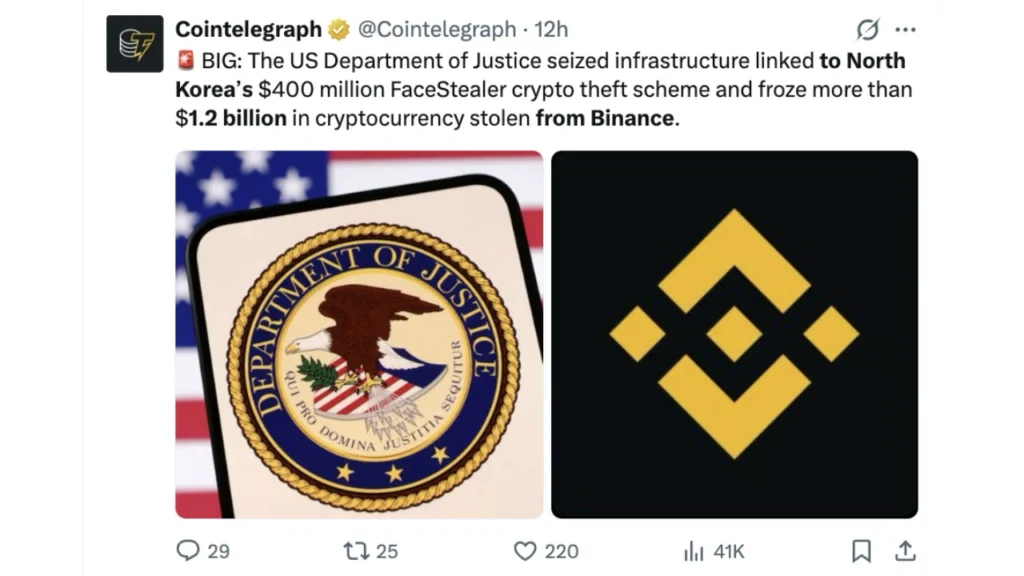
Washington has launched a significant counter-offensive against Pyongyang’s illicit cryptocurrency operations, securing court approval to seize or restrain over $1.2 billion in digital assets linked to the massive October 29 heist from Binance, the world’s largest cryptocurrency exchange. This action marks the U.S. Department of Justice’s most substantial legal strike to date against a record-breaking cyberattack that the Federal Bureau of Investigation (FBI) has squarely attributed to North Korea’s military-linked hacking syndicate, "TraderTraitor." The aggressive move, formally announced on Thursday, November 12, was accompanied by a second, equally critical blow: federal agents successfully dismantled the cloud infrastructure underpinning "FaceStealer," a sophisticated North Korean campaign that has siphoned more than $400 million in cryptocurrency over the past 18 months by luring victims into deceptive video calls, often employing AI-generated deepfakes.
These coordinated actions represent one of Washington’s most forceful and comprehensive efforts yet to disrupt the flow of stolen cryptocurrency that U.S. officials assert directly finances the Kim regime’s illicit weapons programs and sustains its rogue state apparatus. The twin operations underscore a growing resolve within the U.S. government to confront state-sponsored cybercrime head-on, leveraging advanced tracing capabilities and international cooperation to reclaim stolen digital assets and dismantle the technological infrastructure used by hostile nation-states.
The $1.2 Billion Seizure: A Major Dent in Pyongyang’s Crypto Holdings
The court-ordered seizure of $1.2 billion in cryptocurrency is a significant fraction of a much larger pool of funds that U.S. authorities and their private-sector partners have managed to freeze. Together, these entities have successfully frozen more than $2.7 billion of the approximately $6.3 billion initially pilfered from Binance. The $1.2 billion now subject to formal court order represents the portion the U.S. government has taken direct legal steps to control, moving it closer to potential forfeiture.
The FBI has unequivocally identified "TraderTraitor," a North Korean military-linked hacking operation, as the perpetrator behind the audacious Binance theft. This attribution aligns with a long-standing pattern of sophisticated cyber espionage and financial crime perpetrated by groups associated with the Democratic People’s Republic of Korea (DPRK), such as the notorious Lazarus Group. These groups are known to operate under various aliases and campaign names, with "TraderTraitor" being a specific designation for this particular series of attacks targeting cryptocurrency platforms.
M. Scott Proctor, Principal Deputy Assistant Attorney General for National Security, emphasized the strategic importance of these actions, stating, "North Korea’s government bankrolls its rogue regime and illicit weapons program through cryptocurrency theft. Today’s announcement shows that America will fight back against that corrupt regime’s effort to profit through cybercrime. The National Security Division will use every tool at its disposal to seize and return North Korea’s ill-gotten gains." This statement highlights the national security imperative driving the U.S. response, linking cyber theft directly to the DPRK’s proliferation activities.
Assistant Attorney General Tysen Duva commended the swift and effective response from the department’s Criminal Division, particularly its liaison to the burgeoning digital asset industry, for their instrumental role in halting approximately half of the stolen funds from being fully laundered. This rapid response underscores the increasing sophistication of U.S. law enforcement in navigating the complex and rapidly evolving landscape of blockchain forensics and cryptocurrency investigations.
North Korea’s Evolving Cyber War Chest: A Decade of Digital Plunder
North Korea’s reliance on cybercrime to circumvent international sanctions and fund its ballistic missile and nuclear weapons programs has become a critical national security concern for the United States and its allies. Decades of stringent sanctions, imposed in response to Pyongyang’s provocative weapons tests, have severely curtailed the regime’s access to traditional financial markets and legitimate trade revenues. In response, North Korea has cultivated a highly advanced and centralized cyber warfare capability, with state-sponsored hacking groups systematically targeting financial institutions, defense contractors, and, increasingly, the cryptocurrency sector.
Groups like the Lazarus Group (also known as APT38, Hidden Cobra, or Kimsuky) have been implicated in some of the largest cyberattacks in history. Notable incidents include the 2014 Sony Pictures Entertainment hack, the 2016 Bangladesh Bank heist (where $81 million was stolen), and numerous attacks on cryptocurrency exchanges and decentralized finance (DeFi) protocols. The 2022 hack of Axie Infinity’s Ronin Bridge, which saw over $625 million in crypto stolen, and the Harmony Bridge hack ($100 million) are just two prominent examples of their continued focus on the burgeoning digital asset space. U.S. intelligence estimates suggest that North Korea has stolen billions of dollars in cryptocurrency over the past few years, with these funds directly funneling into the regime’s weapons development. The Binance theft represents another significant escalation in this ongoing digital conflict.
The Binance Mega-Heist: Tracing Billions in Motion
The October 29 Binance hack, which saw approximately $6.3 billion in various cryptocurrencies siphoned from the exchange, sent shockwaves through the crypto world. While Binance quickly moved to cover user losses from its SAFU (Secure Asset Fund for Users) and insurance funds, the incident highlighted the persistent vulnerability of even the largest platforms to sophisticated state-backed actors.
Investigative efforts are far from over, as the court order covers less than a fifth of the total stolen amount. Investigators are meticulously tracing the remaining funds through a labyrinth of blockchain bridges, mixers, and various exchanges, hoping to freeze more assets. On-chain sleuths, utilizing advanced blockchain analytics tools, have provided a detailed picture of the laundering process. Analytics accounts like Onchain Lens, citing data from Arkham Intelligence, estimated the total stolen at around $6.34 billion shortly after the incident. Their analysis indicated that roughly $2.85 billion might still be accessible to the attackers, while approximately $891 million may have already been successfully moved or laundered beyond immediate recovery.
The hackers have employed sophisticated techniques to obscure their tracks, pushing funds through cross-chain protocols such as THORChain and Chainflip. This tactic, characteristic of North Korean operations, allows them to rapidly move assets between different blockchains, making it exceedingly difficult for defenders and law enforcement to react in real-time. Blockchain analytics firm Elliptic tracked approximately 1,650 Bitcoin (converted from other stolen assets) landing in fresh addresses by November 6, with some of these funds subsequently reaching the notorious Tornado Cash mixer, a service frequently used for anonymizing cryptocurrency transactions.
The FBI, Secret Service, and IRS Criminal Investigation have issued urgent advisories to crypto providers, urging them to block any addresses linked to the laundering activities. Concerns remain high within the intelligence community and among blockchain analysts that the hackers could move another $1 billion before platforms like THORChain and Chainflip implement effective restrictions on the identified wallets, underscoring the relentless cat-and-mouse game between cybercriminals and law enforcement in the digital realm.
Unmasking "FaceStealer": The Deceptive Con Beyond the Camera
If the Binance hack illustrates the sheer scale of North Korea’s financial ambitions in the digital space, the "FaceStealer" campaign exemplifies their ingenuity and increasing reliance on advanced social engineering and technological deception. Federal agents successfully dismantled the campaign’s core cloud infrastructure, dealing a significant blow to an operation that the FBI estimates has netted over $400 million in cryptocurrency over an 18-month period.
The "FaceStealer" scheme is a chilling demonstration of how sophisticated cybercriminals are weaponizing everyday communication tools. Hackers, often using compromised accounts, invite unsuspecting targets to what appear to be legitimate Zoom or Microsoft Teams meetings. The deception deepens when a familiar face appears on screen – either footage secretly recorded from earlier victims, or, increasingly, an AI-generated deepfake. This use of deepfake technology represents a dangerous evolution in social engineering, exploiting the inherent trust people place in visual communication and familiar faces.
The trap is then sprung under the guise of a "technical glitch." The attackers instruct the victim to install seemingly innocuous software or execute a command to "fix" the purported issue. This "fix," however, surreptitiously installs sophisticated malware onto the victim’s system. This malware is designed to empty cryptocurrency wallets and establish backdoors into other critical systems, potentially leading to further compromise. In some alarming instances, the actual theft of funds and takeover of communication accounts occurred months, even more than a year, after the initial computer compromise, highlighting the stealth and persistence of the attackers.
Patrick Grandy, assistant director in charge of the FBI’s Los Angeles Field Office, underscored the insidious nature of the attack: "It exploits our trust in ubiquitous video conference platforms and valued personal relationships. If you can’t imagine a scenario where you might fall prey to it, you are not thinking creatively enough." This statement serves as a stark warning about the evolving tactics of cybercriminals and the need for heightened vigilance.
The FBI’s investigation led to the seizure of more than 900 webcam videos of "FaceStealer" victims, providing critical intelligence about the scope and methods of the campaign. The agency has also issued public guidance for those potentially affected. A particularly worrying aspect for investigators is the hackers’ practice of using stolen contacts to target developers who maintain widely used open-source software. Compromising a single maintainer in such a scenario could grant attackers a pathway into countless downstream systems, transforming one fooled engineer into a catastrophic supply-chain breach affecting numerous organizations and individuals globally. This potential for widespread impact elevates "FaceStealer" from a mere financial scam to a significant national security threat.

Official Responses and Inter-Agency Collaboration: A United Front
The U.S. government’s response to North Korean cybercrime is characterized by robust inter-agency collaboration. The Department of Justice, particularly its National Security Division and Criminal Division, works in tandem with the FBI, the Secret Service, and IRS Criminal Investigation. This multi-pronged approach combines legal enforcement, intelligence gathering, and financial tracing expertise to identify, disrupt, and prosecute state-sponsored cyber actors.
The statements from DOJ and FBI officials clearly articulate the strategic intent behind these operations: to directly counter North Korea’s illicit funding mechanisms and to demonstrate that the U.S. possesses the capability and resolve to respond effectively in the digital domain. The speed at which the $1.2 billion seizure was authorized and executed, along with the takedown of the "FaceStealer" infrastructure, reflects a significant advancement in the U.S. government’s ability to respond to and mitigate large-scale cyber threats originating from hostile nation-states. This collaborative model allows for a more comprehensive attack on the cybercriminal ecosystem, from tracing stolen funds on the blockchain to dismantling the social engineering tactics used in initial compromises.
Industry Reactions and Responsibility: Binance’s Proactive Steps
For Binance customers, the government’s seizure of stolen funds will not directly alter their balances. Immediately following the October 29 hack, Binance publicly acknowledged losses of approximately $6.3 billion and proactively set aside an equivalent amount from its own treasury and insurance funds to cover all affected users. On the day of the U.S. government’s announcement, Binance confirmed it had completed coverage for all impacted assets and published a new proof-of-reserves snapshot to reassure its users. Consequently, any money the U.S. eventually forfeits from the hackers would not flow back into user accounts, as their losses have already been independently covered by the exchange.
The broader cryptocurrency industry views these government actions with mixed reactions. While there is general support for efforts to combat illicit finance and state-sponsored hacking, there is also an ongoing dialogue about the balance between regulation, privacy, and innovation. The incident highlights the critical responsibility of exchanges and decentralized protocols to implement robust security measures, conduct thorough "Know Your Customer" (KYC) and Anti-Money Laundering (AML) checks, and cooperate with law enforcement agencies to track and freeze illicit funds. The use of mixers like Tornado Cash, which has been sanctioned by the U.S. Treasury, further complicates tracing efforts and places pressure on other crypto platforms to block transactions linked to such services.
Broader Geopolitical and Economic Implications: A Continuous Digital Battle
The geopolitical stakes of this digital conflict are immense. Every frozen dollar is one less dollar that can fund North Korea’s aggressive weapons programs, which pose a direct threat to regional and global security. However, with billions more still moving through a sophisticated and rapidly evolving laundering pipeline, the challenge remains formidable. The U.S. government’s actions send a clear message to Pyongyang and other state-sponsored cyber actors that their illicit activities will be pursued relentlessly.
These operations contribute to a broader strategy of economic pressure and cyber deterrence. By systematically disrupting North Korea’s revenue streams, the U.S. aims to degrade the regime’s capacity to develop and deploy advanced weaponry. The focus on both large-scale direct hacks (Binance) and insidious social engineering campaigns ("FaceStealer") demonstrates an understanding of the multifaceted nature of North Korea’s cyber threat.
The fight against state-sponsored cybercrime is now clearly being waged on multiple fronts: the intricate chase of stolen coins across myriad blockchains and the dismantling of the social-engineering machinery designed to orchestrate the next generation of heists. While Washington scored significant wins on both fronts this week, the enduring question is whether it can consistently keep pace with an adversary that is both highly adaptable and seemingly limitless in its ingenuity and resolve to exploit the digital frontier for its nefarious aims. The battle for digital financial security, and by extension, global stability, is far from over.