Dwi Wanna
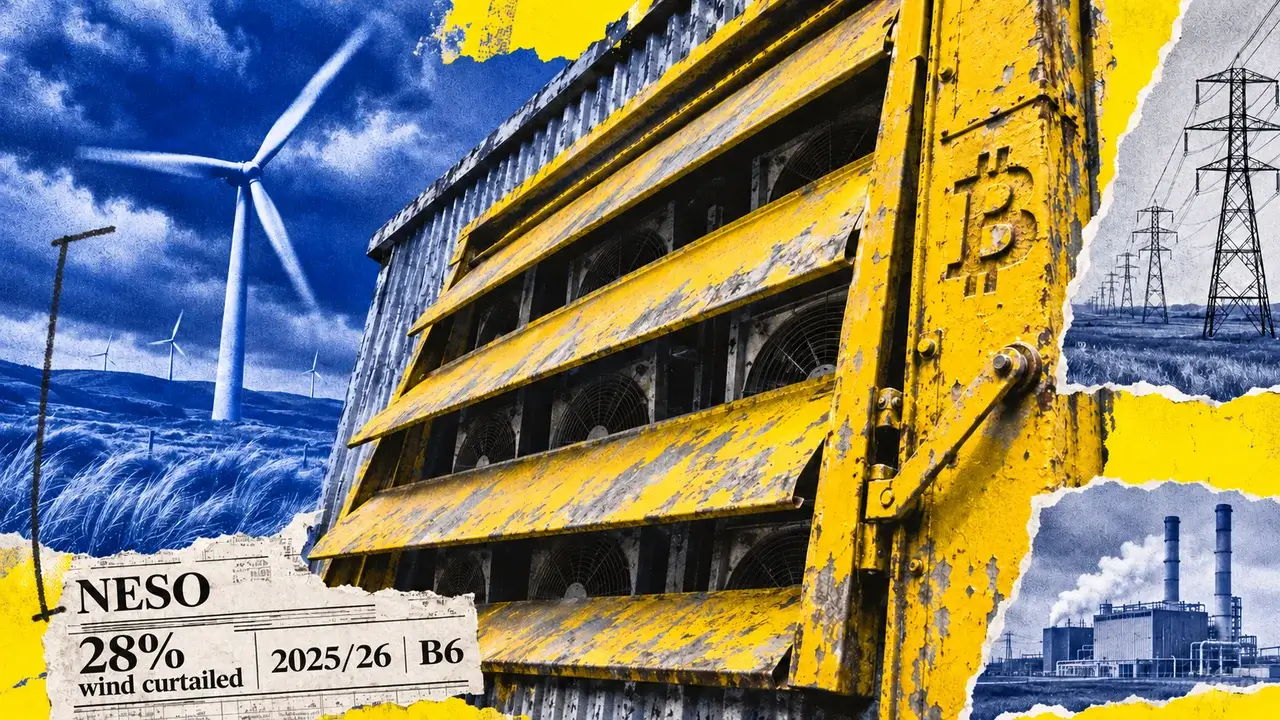
The United Kingdom’s energy infrastructure is facing a multi-billion-pound crisis as transmission bottlenecks prevent surplus renewable energy from reaching the populations that need it most. According to the latest forecasts from the National Energy System Operator (NESO), the costs associated with managing these "thermal constraints" are expected to soar to approximately £4 billion by 2027. This burgeoning financial burden has reignited a debate among energy policy experts and technology advocates: can flexible, high-intensity loads like Bitcoin mining serve as a productive sink for Scotland’s wasted wind power, or do the structural limitations of the grid render such solutions ineffective?
The challenge lies in the geographical disconnect between where electricity is generated and where it is consumed. While the winds of the North Sea and the Scottish Highlands provide a massive source of clean energy, the transmission lines—specifically those crossing the critical B6 boundary between Scotland and England—frequently reach their maximum safe capacity. When these lines are congested, NESO is forced to pay Scottish wind farms to shut down (curtailment) while simultaneously paying gas-fired power plants in the south to increase production to meet demand. This dual-payment system not only inflates consumer bills but also hampers the UK’s progress toward its Net Zero targets.
The Scale of the Bottleneck Crisis
The financial implications of grid congestion are becoming increasingly difficult for the government and consumers to ignore. In its "Balancing Act" report published on November 12, 2024, NESO detailed the escalating costs of maintaining grid stability. For the 2025/26 period, total balancing costs—the expenses incurred to ensure supply perfectly matches demand in real-time—are projected to reach £3 billion. Of this, roughly £2 billion is attributed specifically to thermal constraints.
By 2027, this figure is expected to climb to £4 billion, driven by an increase in renewable capacity that continues to outpace the rate of grid reinforcements. NESO’s data reveals a stark regional disparity: during the 2025/26 period, 28% of wind energy generated north of the B6 boundary was curtailed. In contrast, the curtailment rate across Great Britain as a whole stood at a much lower 13%. This suggests that nearly a third of Scotland’s potential wind output is being discarded because the "energy highways" to the south are perpetually jammed.
The cost of this waste is compounded by the "replacement power" problem. NESO’s outturn explanation from November 9, 2024, noted that approximately 75% of thermal constraint costs were spent on securing replacement energy. Because the surplus wind cannot travel south, the grid operator must rely on flexible, fast-acting gas units located closer to southern demand centers. This means that even as the UK builds more wind turbines, its reliance on fossil fuels for grid balancing remains stubbornly high.
Bitcoin Mining as a Flexible Demand Sink
In this context, the Bitcoin mining industry has positioned itself as a potential ally to grid operators. Unlike traditional industrial processes or residential demand, Bitcoin mining is "location-agnostic" and "highly interruptible." A mining data center can, in theory, be built directly next to a wind farm in a constrained area and programmed to operate only when there is excess electricity that cannot be exported to the grid.
The Cambridge Centre for Alternative Finance (CCAF) provided empirical weight to this argument in its 2023 mining survey. The report found that miners globally are increasingly participating in demand-response programs. Survey respondents, representing approximately 48% of the Bitcoin network’s total hashrate, reported curtailing 888 GWh of electrical load in 2023 to support grid stability.
For a Scottish wind farm, a co-located Bitcoin mine could offer a "floor price" for energy. Instead of being paid a small fee by the government to turn off, the wind farm could sell its excess power to the miner. This would theoretically reduce the "turn-down" payments funded by taxpayers and ensure that the green energy produced is actually utilized for a productive economic activity—the securing of a global decentralized financial network.
The Constraints of the Solution
However, the reality of grid physics and energy economics presents significant hurdles to the Bitcoin-as-a-solution narrative. NESO’s technical analysis suggests that adding demand in the north does not inherently solve the problem in the south.
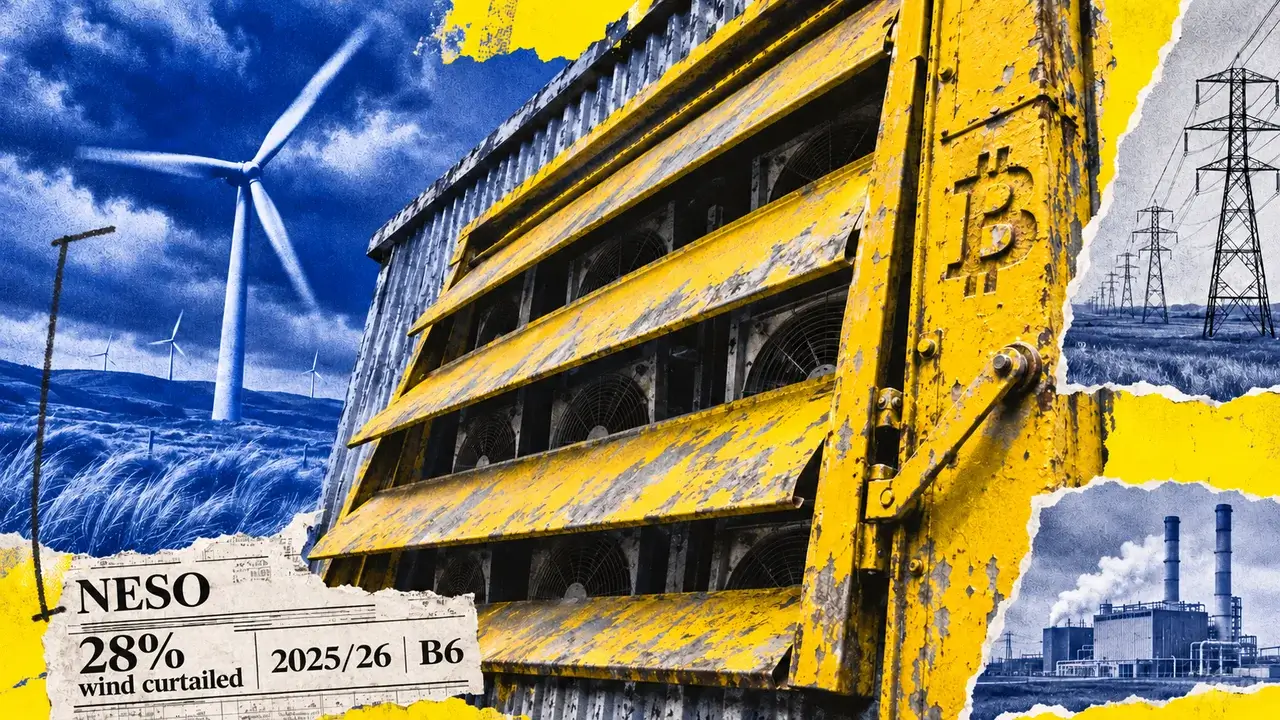
The primary issue is that while a Bitcoin mine in Scotland could consume "trapped" wind power, it does nothing to alleviate the need for replacement power in London or Birmingham. As long as the B6 boundary remains binding and southern demand remains unchanged, NESO must still pay gas plants in the south to run. Therefore, while mining might reduce the specific "turn-down" costs paid to wind generators (which accounted for just under £500 million in 2025/26), it does not necessarily reduce the much larger expenditure on gas-powered replacement energy.
Furthermore, the business case for "intermittent" mining is difficult to sustain. Electricity typically accounts for more than 80% of a miner’s cash-based operating expenses. To remain profitable, miners generally require high "uptime" to amortize the significant capital expenditure (CAPEX) of their specialized hardware (ASICs). If a mine only operates during periods of wind curtailment, it may not run enough hours in the year to pay back its equipment costs before that equipment becomes obsolete.
Chronology of Regulatory Response and Future Proposals
The UK’s regulatory framework is slowly evolving to accommodate new types of flexible demand, though the timeline remains conservative.
- March 5, 2024: NESO (then operating as National Grid ESO) published its "Demand for Constraints" (DfC) design. This proposal focused specifically on the Scottish boundaries, contemplating a system where new and existing assets could be dispatched through the Balancing Mechanism to create "turn-up" demand during periods of surplus.
- November 9, 2024: NESO released its outturn explanation, confirming the £3 billion balancing cost for the current cycle and highlighting the 28% curtailment rate in Scotland.
- November 12, 2024: The forecast for 2027 was updated to £4 billion, signaling an urgent need for mitigation strategies.
- 2028 (Projected): The "Demand for Constraints" service is scheduled for full delivery. This timeline suggests that any significant participation from Bitcoin miners or other flexible loads would not impact the grid until after the 2027 peak in costs.
NESO has been careful to state that its "Demand for Constraints" design is technology-agnostic. It does not offer Bitcoin-specific approval or payment entitlements. Any mining operation would have to compete on a level playing field with other forms of flexible load, such as large-scale battery storage, green hydrogen electrolysis, or industrial heat pumps.
Technical and Economic Implications for the Future
The debate over using Bitcoin to balance the grid is part of a broader global trend. In Texas, the grid operator ERCOT has successfully integrated Bitcoin miners into its "Controllable Load Resource" program. During periods of high demand or low supply, miners are signaled to power down within seconds, providing the grid with a virtual "surge" of available power.
In the UK, the focus is the opposite: the grid needs a "virtual battery" to soak up excess power during periods of oversupply. For Bitcoin mining to fill this role effectively, several conditions must be met:
- Grid Connection Reform: Currently, the queue to connect new demand or generation to the UK grid can last over a decade. NESO is working on "First Ready, First Served" reforms to expedite projects that help balance the system.
- Dispatch Efficiency: Miners would need to be fully integrated into the Balancing Mechanism, allowing NESO to direct their consumption in real-time.
- Economic Viability: The price of curtailed wind power would need to be low enough to offset the losses incurred by miners during periods of inactivity.
The broader impact of the £4 billion bottleneck cost is a potential drag on the UK’s industrial competitiveness. High balancing costs are ultimately passed through to businesses and households via network charges. If the UK cannot find a way to utilize its "trapped" wind energy, it risks becoming a high-cost energy island despite its vast renewable resources.
Conclusion: A Tool, Not a Panacea
NESO’s forecast of £4 billion in constraint costs by 2027 serves as a stark reminder of the physical limitations of the UK’s aging energy network. While Bitcoin mining offers a unique form of flexible demand that can be deployed relatively quickly compared to massive infrastructure projects, it is not a silver bullet.
The ability of miners to use "wasted" wind depends on a complex interplay of geography, regulatory approval, and hardware economics. While a mine might help a specific wind farm stay profitable and reduce turn-down payments, the underlying transmission bottleneck remains. Until the "energy highways" between the North and South are reinforced—a process involving the construction of massive subsea cables like the Eastern Green Link—the UK will continue to pay a high price for its geographical energy mismatch.
For now, Bitcoin mining remains a theoretical mitigation strategy rather than a central pillar of UK energy policy. As the 2028 start date for the "Demand for Constraints" service approaches, the industry will have to prove that it can deliver genuine savings to consumers without adding further complexity to an already strained system. The scale of the grid problem has been priced at £4 billion; the value of the mining solution has yet to be determined.