admin
In a significant development for the cryptocurrency ecosystem, Paul Sztorc’s long-anticipated Bitcoin fork, christened the eCash network, officially went live on October 29, 2026. This launch, occurring amidst a period marked by high-profile industry events like the Binance hack and the intensity of the US midterms, introduced a new contender in the ongoing debate over Bitcoin’s scalability and future direction. Sztorc, the visionary founder of LayerTwo Labs and the principal architect behind the influential Bitcoin Drivechain proposals (BIP300 and BIP301), has now deployed a distinct Bitcoin fork. Its primary ambition is to infuse the network, built from Bitcoin’s foundational code, with enhanced capabilities for payments, privacy, and a broader spectrum of decentralized applications.
Sztorc’s motivation stems from a profound dissatisfaction with what he perceives as a stagnant, overly conservative trajectory for the flagship cryptocurrency. "We need to actively sabotage the ‘degrowth’ policies killing Bitcoin," Sztorc conveyed to industry publications, articulating a clear intent to disrupt the status quo. He further emphasized his goal: "We want to find the true Bitcoin builders and give them the tools to actually innovate. We just need the open-minded, risk-taking contrarians to come and build." This hard fork not only offers a new architectural vision but also presents eligible Bitcoin holders with an immediate, intriguing windfall: an equivalent balance of the new chain’s native token, ECX, mirroring their BTC holdings at the time of the fork. This raises immediate questions for developers about the benefits eCash offers, and for Bitcoin HODLers, what practical uses their newly acquired ECX coins might hold.
A Decade of Dissension: Paul Sztorc’s Vision for Bitcoin’s Evolution
Paul Sztorc’s journey to launching eCash is rooted in a decade-long advocacy for a specific type of Bitcoin scaling solution: Drivechains. His frustration, as he describes it, with the "complacency narratives" and "cult-like toxicity" that he believes have stifled Bitcoin’s organic growth and innovation, ultimately led him to establish LayerTwo Labs and pursue a hard fork. This move is not merely a technical deviation but a philosophical statement against what he views as Bitcoin’s self-imposed limitations.
For years, the Bitcoin community has grappled with fundamental questions about its future. Should Bitcoin remain a minimalist, secure store of value, with any scaling relegated to off-chain solutions like the Lightning Network? Or should its base layer be more adaptable, facilitating a wider array of applications and a higher transaction throughput? Sztorc firmly aligns with the latter perspective. His proposed Bitcoin Improvement Proposals (BIP300 and BIP301) for Drivechains have been at the heart of this debate. BIP300 outlines the concept of "Blind Merged Mining," a mechanism allowing Bitcoin miners to validate sidechain blocks without needing to understand the sidechain’s specific rules. BIP301 introduces "Hashrate Escrows," which enable a secure two-way peg between Bitcoin and a sidechain, allowing BTC to be moved to and from the sidechain with a degree of security derived from Bitcoin’s own proof-of-work.
These proposals aimed to enable significant innovation without altering Bitcoin’s core consensus rules, a critical point of contention in a community highly protective of its protocol’s stability. However, their integration into the main Bitcoin protocol faced considerable resistance, primarily due to concerns about security implications, potential centralization of mining power, and a general reluctance within the core development community to introduce new complexities to the base layer. This prolonged impasse became the catalyst for Sztorc’s decision to fork Bitcoin, effectively creating a network where his Drivechain vision could be fully realized without requiring the consensus of the broader Bitcoin development collective.
Introducing Drivechains: A New Layer-Two Paradigm
At its core, eCash differentiates itself through the implementation of Drivechains, its main innovation. This system empowers developers to construct independent sidechains, or Layer 2 (L2) networks, each endowed with distinct features and functionalities. Crucially, these sidechains operate without necessitating any modifications to eCash’s foundational protocol – a significant departure from traditional Bitcoin development, where even minor changes to the base layer are subject to rigorous scrutiny and often protracted debate.
The architectural design of Drivechains offers a compelling proposition: developers gain unprecedented freedom to experiment. They can deploy novel applications spanning payments, enhanced privacy features, digital asset issuance, and even prediction markets, all within the security umbrella provided by the main eCash chain’s miners. For miners, this translates into a tangible incentive: the ability to "maximize their revenues" by earning additional transaction fees generated from activity across these diverse sidechains. This contrasts with Bitcoin’s current model, where miner revenue primarily derives from mainnet transaction fees and block subsidies.
The launch of eCash’s mainnet was accompanied by the simultaneous rollout of five distinct sidechains, showcasing the immediate utility of the Drivechain architecture:
- BitNames: Likely a decentralized naming service, similar to ENS on Ethereum, offering human-readable addresses.
- BitAssets: A platform for issuing and managing various digital assets, potentially akin to colored coins or token standards on other blockchains.
- Thunder: Possibly designed for high-speed, low-cost payments, aiming to improve transaction throughput.
- Truthcoin: Historically associated with Sztorc’s work on prediction markets, allowing for decentralized forecasting and betting.
- zSide: Suggests a focus on privacy, potentially leveraging zero-knowledge proofs or similar cryptographic techniques to obscure transaction details.
Furthermore, LayerTwo Labs has announced plans for two additional sidechains to be integrated in the near future:
- Photon: Touted as quantum-resistant, signaling an ambition to address potential threats from quantum computing to cryptographic security.
- CoinShift: A decentralized exchange (DEX), aiming to facilitate trustless trading of assets issued on eCash sidechains.
Sztorc’s long-held belief is that Bitcoin’s notoriously conservative development philosophy has acted as a significant impediment to its full potential. "Anything that isn’t maximizing network usage is simply a distraction," he argues, emphasizing a pragmatic, user-centric approach. "Users, the ones who actually pay transaction fees to miners, will win in the long run." This perspective underscores eCash’s commitment to fostering an environment where innovation is prioritized, and practical utility drives adoption, rather than adherence to strict, immutable protocol conservatism.
The ECX Windfall: Accessing New Assets and Navigating Risks
The eCash fork officially occurred at Bitcoin block 973,728. At this precise moment, a snapshot of the Bitcoin blockchain was taken, meaning that anyone who held the private keys to their Bitcoin (BTC) at that specific block received an equivalent balance in the new chain’s native token, ECX. LayerTwo Labs succinctly described the process: "If you held the keys to your BTC at that exact block, you now own the exact same amount of ECX. It is that simple, and you can access them right now."
However, as is often the case in the nuanced world of cryptocurrency forks, "simplicity" can be subjective. For Bitcoiners who practice self-custody – holding their own private keys rather than relying on a third party – accessing their ECX requires a careful, multi-step process. They will need to utilize a wallet specifically designed to support the eCash network and diligently follow its guidelines to safely separate their newly acquired ECX from their existing BTC holdings.
A critical warning accompanies this process, rooted in the shared transaction history between the two networks. Because eCash is a direct fork of Bitcoin, for a period, both chains may recognize the same transaction data. This phenomenon creates the risk of a "replay attack," where an unprotected transaction broadcast on one chain could be validly re-broadcast and executed on the other chain, potentially leading to unintended loss of funds. LayerTwo Labs has issued clear guidance: "Never move your BTC first, as an ordinary, unprotected BTC spend can easily be replayed on the ECX network." While the protocol includes built-in replay controls, the company strongly advises holders to initiate a transaction with their ECX first, which typically incorporates specific data that invalidates it on the BTC chain, before proceeding to spend their BTC. This precautionary measure is paramount to prevent accidental loss of funds on either network.
For those Bitcoin holders who store their BTC on centralized exchanges, the situation is different. Their ability to access ECX tokens is entirely "at their mercy regarding distribution," as LayerTwo Labs notes. Centralized exchanges act as custodians, and their policies dictate whether they will recognize the fork, distribute the new tokens to their users, and facilitate trading. Users are therefore advised to check their specific exchange’s announcements regarding eCash support and ECX distribution plans. This aspect highlights a broader theme in cryptocurrency: the trade-off between the convenience of third-party custody and the control and autonomy offered by self-custody.
Market Entry and Nascent Liquidity Challenges
While gaining access to ECX tokens represents a potential windfall for eligible Bitcoin holders, the ability to readily trade or liquidate these assets is a separate challenge, particularly for a newly launched token. At present, ECX is not widely available on major, high-liquidity cryptocurrency exchanges, a common hurdle for new projects aiming for broader market adoption. Furthermore, depending on a holder’s jurisdiction, receiving tokens from a hard fork can have complex tax implications, necessitating a review of local tax regulations before any transactions are made.

Initial trading avenues for ECX have begun to emerge:
- NeoxEX: This exchange announced on October 29 that it had opened native ECX deposits, withdrawals, and trading, offering pairs against USDT, USDC, and BTC. This provided one of the first direct gateways for users to engage with ECX in a trading environment.
- CoinW: This platform communicated plans to distribute ECX to eligible Bitcoin holders, with specific dates for deposits, withdrawals, and trading to be announced at a later stage. Such announcements are crucial for legitimizing a new fork and providing avenues for its community.
- Orca (Solana DEX): A decentralized exchange operating on the Solana blockchain, Orca has enabled users to swap USDC for wrapped ECX (wECX) through a liquidity pool. This offers an alternative route for trading exposure to ECX, but it’s important to note that wECX is a wrapped representation of the native token on a different blockchain, not direct trading on the eCash network itself. This introduces additional considerations regarding bridging and potential counterparty risks.
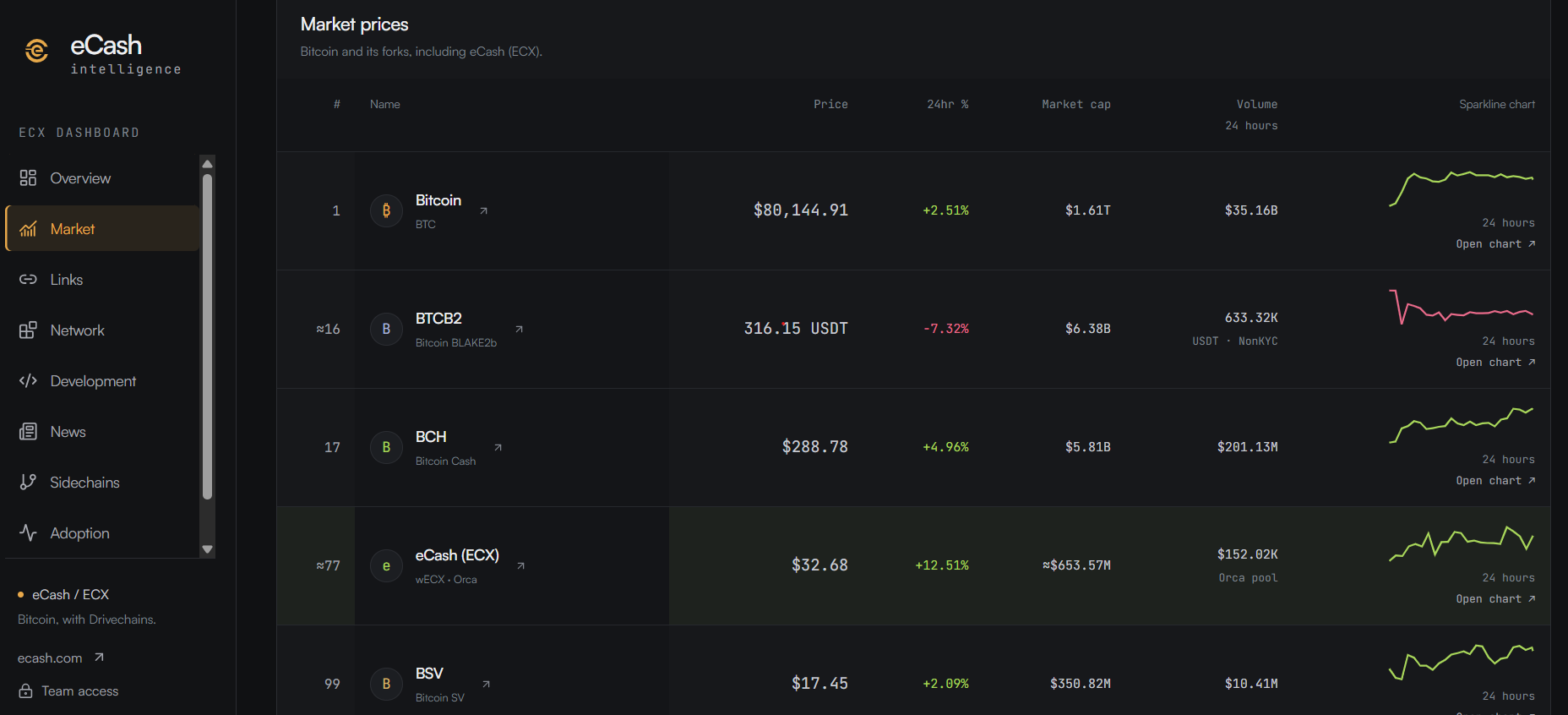
The nascent state of ECX’s market presence is further reflected in the limited and often inconsistent market data available. As of November 5, CoinMarketCap reported ECX at a price of $32.63, with a relatively modest 24-hour trading volume of approximately $355,000. In contrast, CoinGecko listed the token as a "preview listing," indicating no readily available price or tracked exchange markets. Furthermore, Kaiko, a prominent crypto market data provider, explicitly stated that it does not track ECX, further limiting the availability of independent, verifiable market data.
LayerTwo Labs has acknowledged the early market volatility, reporting that initial trading saw ECX fluctuate between $40 and $50. However, the company did not provide granular supporting data such as order book depth or specific trading volume figures for these price points. Instead, it pointed to the Orca pool’s Total Value Locked (TVL) as an indicator for users to assess available liquidity, a common metric in the decentralized finance (DeFi) space.
Drawing parallels to historical Bitcoin forks, Sztorc expressed optimism about future liquidity: "If our fork replicates even a fraction of [Bitcoin Cash] BCH’s initial performance, the liquidity will be staggering." Bitcoin Cash (BCH), a prominent fork from 2017, initially saw significant trading volume and price action. Sztorc’s statement implies that current low liquidity is a temporary phase for a nascent asset. He also offered a pragmatic outlook to early recipients: "Otherwise, you’re welcome to take your free money and leave," while assuring that "We are actively adding new exchanges and trading pairs, so the user experience will only improve." This reflects the ongoing effort required for any new cryptocurrency to establish itself in the competitive global market.
Security Debates and Sztorc’s Unwavering Stance
The concept of Drivechains, while innovative, has not been without its detractors, particularly concerning its security model. A persistent point of criticism, notably articulated by prominent Bitcoin developers and maximalists, revolves around the theoretical vulnerability of miner collusion. The argument posits that a sufficiently large cartel of miners could potentially coordinate to steal funds held on sidechains. This "51% attack" scenario, where a majority of mining power could manipulate the blockchain, is a fundamental concern in proof-of-work systems.
Sztorc, however, remains largely unfazed by these criticisms, often dismissing them as "superstition." His counter-argument is rooted in economic rationality and the immense capital investment required for mining. He posits that any group of miners attempting such a theft on an L2 (sidechain) would risk irrevocably damaging their own "billion-dollar operations" by undermining the very trust that underpins their revenue stream. "If you genuinely believe miners will torch their own billion-dollar operations for a short-term theft on an L2, then you shouldn’t trust Bitcoin’s L1 either," he argues.
This perspective highlights a critical economic security model in Bitcoin: the incentive structure for miners. Miners invest heavily in specialized hardware and electricity to secure the network, and their profitability is directly tied to the integrity and perceived value of the Bitcoin (or in this case, eCash) network. A malicious act, even if technically feasible, could trigger a catastrophic loss of confidence, plummeting the asset’s value and rendering their mining investments worthless. Sztorc’s argument suggests that the economic disincentive for large-scale miner collusion is so profound that it acts as a robust defense mechanism, not just for the main chain but for its integrated sidechains as well.
The debate over Drivechain security also touches upon the broader philosophical differences regarding Bitcoin’s risk tolerance. The Bitcoin core development community is famously conservative, prioritizing network stability and security above all else. New features or architectural changes are scrutinized intensely for any potential attack vectors, however theoretical. Sztorc’s approach, by contrast, suggests a greater willingness to embrace calculated risks in pursuit of expanded functionality and innovation, believing that the economic incentives of a robust mining ecosystem are sufficient to mitigate many theoretical threats. This divergence in philosophy underscores the fundamental reasons behind the eCash fork.
Broader Implications: Innovation vs. Fragmentation in the Crypto Landscape
The launch of eCash, with its distinct vision for Bitcoin’s evolution, carries significant implications for the broader cryptocurrency landscape. It represents another chapter in the ongoing narrative of innovation versus fragmentation within the Bitcoin ecosystem, a story that has seen numerous forks, each attempting to carve out a niche based on differing technical or philosophical principles.
Potential for Innovation: eCash’s Drivechain architecture genuinely offers a sandbox for developers. By offloading complex applications to sidechains, it could foster a vibrant ecosystem of specialized services – from privacy-centric transactions to novel financial instruments and decentralized identity solutions – without burdening the main chain. This model could potentially attract developers who find Bitcoin’s mainnet too restrictive or slow for their creative endeavors. If successful, eCash could demonstrate a scalable, modular approach to extending Bitcoin’s utility, potentially inspiring similar architectures in other foundational blockchains.
Risk of Fragmentation: Conversely, the proliferation of Bitcoin forks, each with its own token, community, and development roadmap, can lead to fragmentation. This can dilute network effects, confuse new users, and divert resources that might otherwise contribute to the main Bitcoin network. While eCash aims to be a complementary layer, its existence as a separate blockchain with its own token, ECX, means it competes for attention, liquidity, and developer talent. The success of eCash will depend heavily on its ability to build a compelling use case that justifies its independent existence, rather than being perceived as merely another "altcoin" spawned from Bitcoin’s code.
Developer Freedom vs. Protocol Conservatism: eCash embodies a powerful statement about developer freedom. Sztorc’s project essentially says: if the main chain won’t adopt progressive scaling solutions, we will build a new one that does. This approach challenges the established norms of protocol governance and development, particularly in a decentralized system like Bitcoin where consensus is paramount. It highlights the tension between maintaining the "digital gold" narrative of a stable, immutable Bitcoin and the desire to evolve it into a more versatile platform for everyday utility.
Economic Impact and Adoption Challenges: The long-term viability of ECX and the eCash network will hinge on its ability to generate real-world utility and attract sustained user adoption. Initial market data suggests a nascent ecosystem, struggling with liquidity and widespread exchange support. Historically, many Bitcoin forks have struggled to gain significant traction beyond an initial surge fueled by speculative interest or "free money" airdrops. eCash will need to overcome the significant network effects enjoyed by Bitcoin and other established cryptocurrencies. Its success, as Sztorc himself notes, will be measured by "paying customers and transaction fee revenue" – tangible indicators of economic activity and utility.
Regulatory and Tax Implications: For users, the existence of a new fork also adds layers of complexity, especially regarding regulatory compliance and taxation. Jurisdictions globally are still grappling with how to classify and tax cryptocurrencies, and the advent of fork tokens introduces further ambiguities that holders must navigate responsibly.
The Road Ahead: Adoption and Utility as the Ultimate Arbiters
Ultimately, the true value and impact of eCash will not be determined by its technical ingenuity alone, nor by the initial windfall it provides to Bitcoin holders. As Paul Sztorc himself acknowledges, its future hinges on whether developers embrace the Drivechain architecture to build genuinely useful applications, and more critically, whether users are willing to engage with and pay for these services. For LayerTwo Labs, the project’s success in its inaugural year will be primarily gauged by the tangible metrics of paying customers and the revenue generated from transaction fees. These indicators will provide concrete evidence of real-world adoption and utility, moving beyond mere speculative interest.
For now, eCash presents a compelling new asset for Bitcoiners and an intriguing new development playground for blockchain innovators. However, whether ECX can transcend its current status as a speculative asset and become a meaningful, widely utilized digital currency and platform will depend entirely on the market’s verdict. The coming months and years will reveal if eCash can indeed "sabotage the ‘degrowth’ policies" and usher in a new era of innovation built on Bitcoin’s robust foundations, or if it will join the ranks of numerous forks that struggled to gain sustained traction in a fiercely competitive and rapidly evolving decentralized landscape. The crypto world will be watching to see if eCash can translate its ambitious vision into tangible, lasting impact.