admin

The Ethereum network, the world’s second-largest blockchain by market capitalization and the foundational layer for hundreds of billions of dollars in decentralized finance (DeFi) and digital assets, is approaching a historic pivot. Around the middle of 2022, the protocol is slated to undergo "The Merge," a transition from its current Proof-of-Work (PoW) consensus mechanism to a Proof-of-Stake (PoS) system. This transition is frequently compared by engineers to the act of replacing a jet engine while the aircraft remains in mid-flight; the network must maintain 100% uptime and continue producing valid blocks without interruption. While the technical milestones for this transition are being met, a significant concern has emerged regarding the concentration of node software—specifically the dominance of the Prysm client—which poses a potential systemic risk to the network’s stability and decentralization.

The Architectural Evolution: Execution and Consensus Layers
Unlike the Bitcoin network, which relies on a relatively monolithic software architecture, the Ethereum community has purposefully fostered a multi-client ecosystem. This strategy, encouraged by the Ethereum Foundation (EF), aims to ensure that no single software bug can take down the entire network. Post-merge, the operation of an Ethereum node will be split into two distinct functional layers: the Execution Layer and the Consensus Layer.
The Execution Layer remains the domain of the Ethereum Virtual Machine (EVM). This layer is responsible for processing transactions, executing smart contract code, and maintaining the state of the network. Existing software like Geth (Go-ethereum) will continue to perform these duties, albeit with modifications to hand off block validation to a separate component.
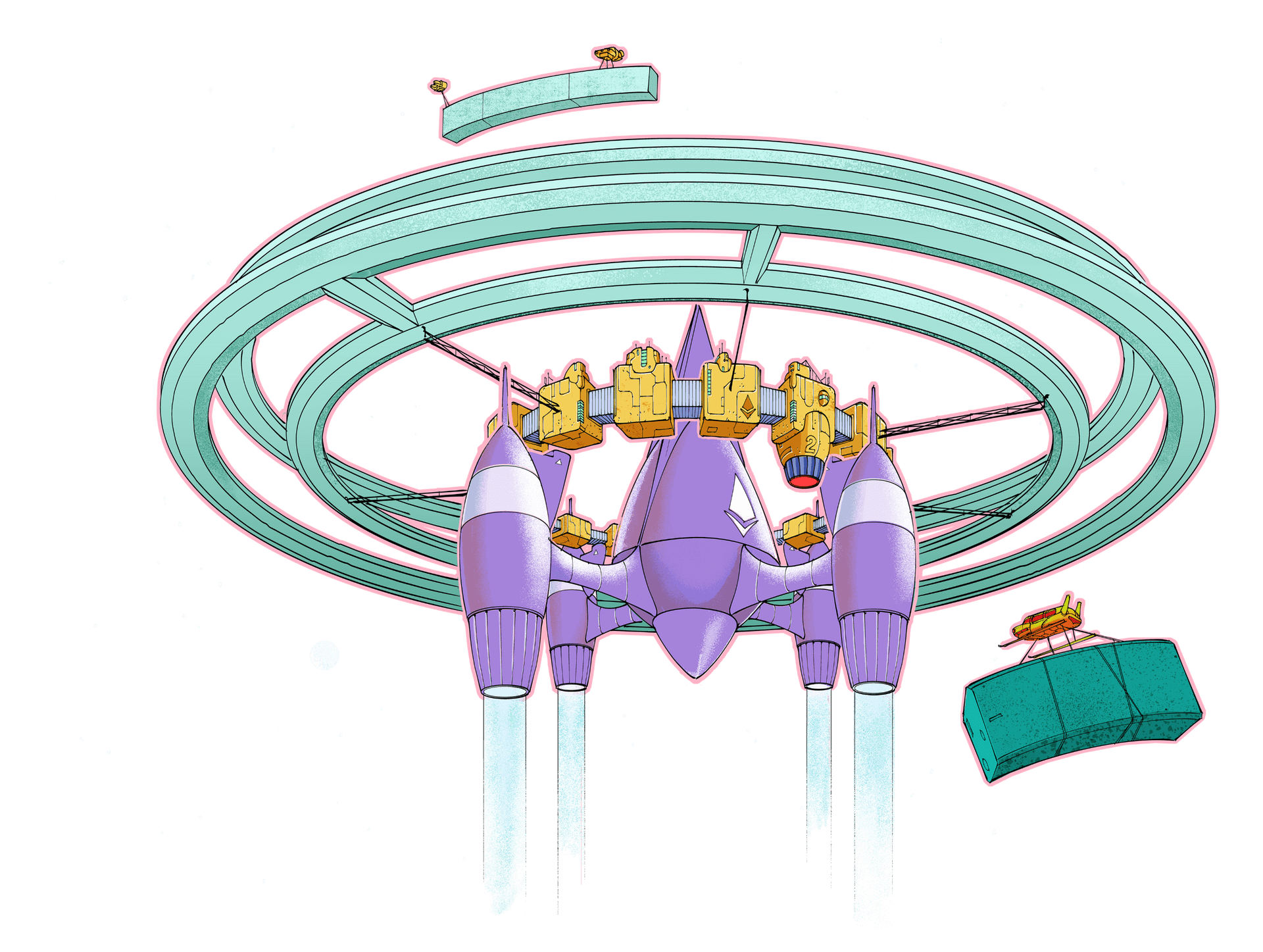
The Consensus Layer, often referred to as the Beacon Chain, has been running in parallel to the main Ethereum network since December 2020. This layer handles the Proof-of-Stake logic, including the coordination of validators and the finalization of blocks. The Merge represents the moment these two layers are formally integrated. At a specific block height, the PoW mining process will cease, and the Execution Layer will begin sourcing its validity from the PoS consensus provided by the Beacon Chain.
The Mathematics of Consensus Risk
The primary motivation for maintaining multiple versions of client software—developed in different programming languages by independent teams—is to mitigate the impact of a critical software vulnerability. In a healthy decentralized network, no single client should control a supermajority of the staking power. The risks associated with client concentration are categorized by specific mathematical thresholds within the Ethereum PoS protocol:
- The 33% Threshold: If a single client controls more than one-third of the staked Ether (ETH), a bug in that client could prevent the network from reaching "finality"—the point at which a block is considered irreversible. While the network would continue to process transactions, the lack of finality would create significant uncertainty for exchanges and high-value applications.
- The 50% Threshold: If a client used by more than half of the network fails, the chain could experience a split or a significant disruption in block production, though automated recovery mechanisms are designed to eventually restore order.
- The 66% (Supermajority) Threshold: This is the "critical failure" zone. If a client with more than two-thirds of the staking power experiences a bug that causes it to follow an invalid chain, that invalid chain will be finalized. In this scenario, the network essentially forks into a "buggy" version and a "correct" version. The non-buggy clients would be unable to finalize their own chain, forcing a choice between a permanent chain split or a manual intervention to reconcile with the buggy supermajority.
The Dominance of Prysm and the First-Mover Advantage
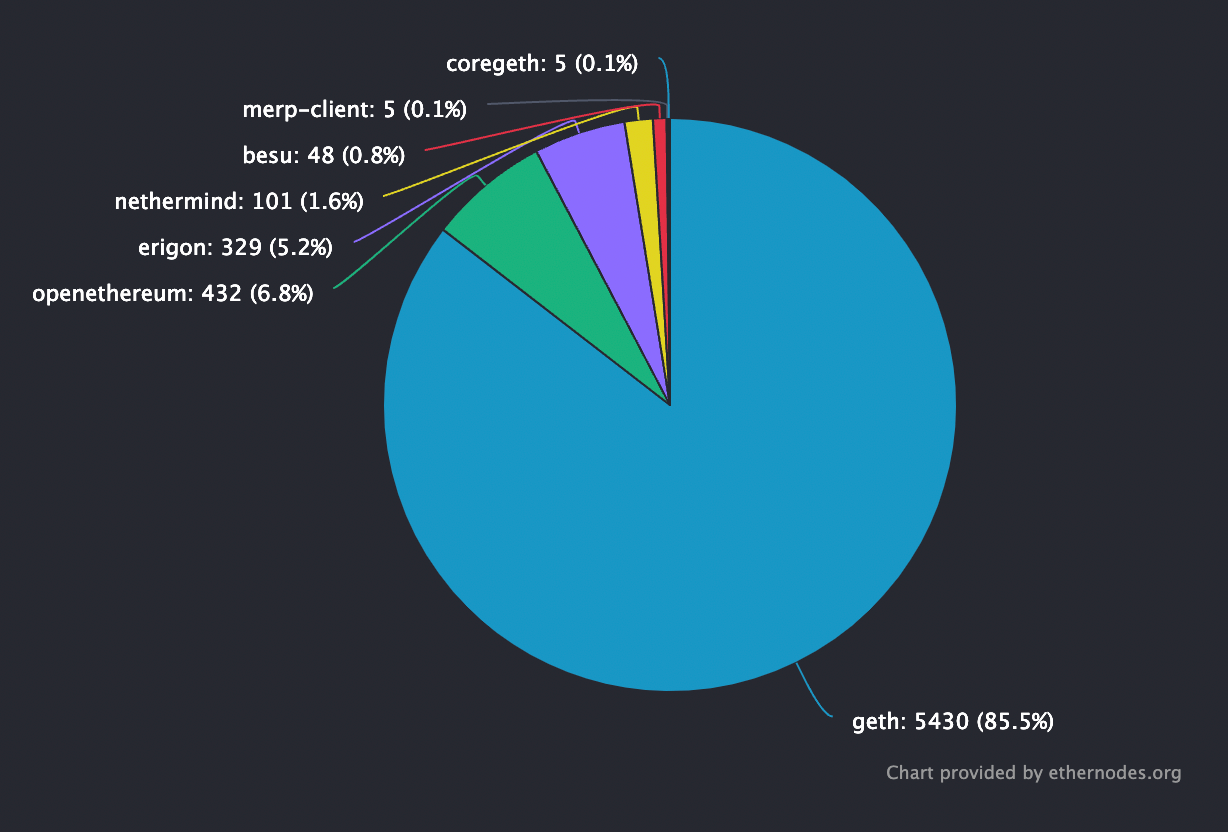
As the transition nears, data from clientdiversity.org and other monitoring tools indicate that the Prysm client, developed by Prysmatic Labs, currently commands nearly two-thirds of the network’s staking power. This level of dominance undermines the security benefits of a multi-client ecosystem.
Marius van der Wijden, an Ethereum core developer, attributes Prysm’s success to a combination of timing and accessibility. Prysm was the first client to offer a functional prototype for the Beacon Chain, allowing it to build a robust suite of tools, comprehensive documentation, and a user-friendly web interface long before its competitors. Furthermore, Prysm is written in Go (Golang), the same language used by Geth, the dominant Execution Layer client. This allowed developers and node operators already familiar with Ethereum’s existing infrastructure to transition or audit the new software with minimal friction.
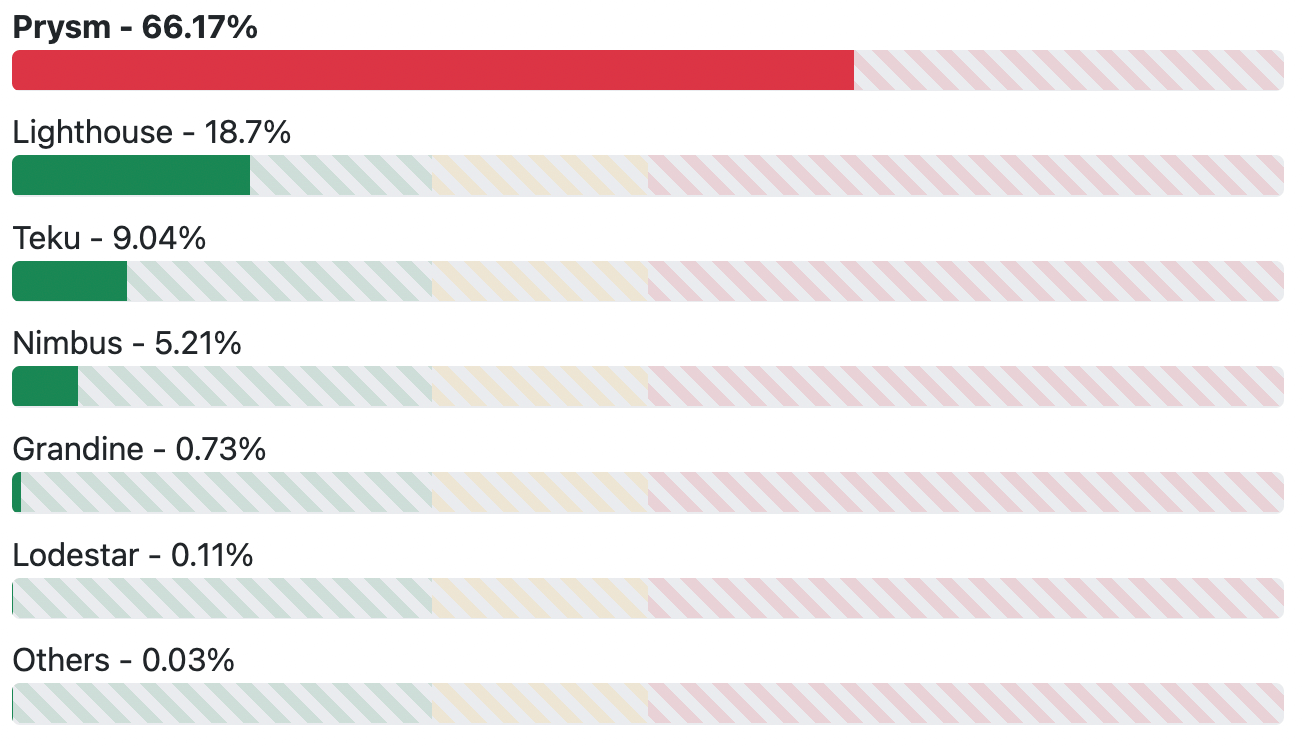
Other consensus clients, such as Lighthouse (written in Rust), Teku (Java), and Nimbus (Nim), offer high performance and security but have struggled to capture significant market share from the incumbent leader. As of the current press time, Lighthouse and Teku represent the most viable alternatives for diversifying the network, while newer entries like Grandine and Loadstar remain below 1% usage.
Institutional Responsibility: The Role of Major Staking Providers
The concentration of client software is largely driven by institutional staking services and centralized exchanges. Because these entities manage thousands of validator nodes on behalf of their users, their choice of software has a disproportionate impact on network health.
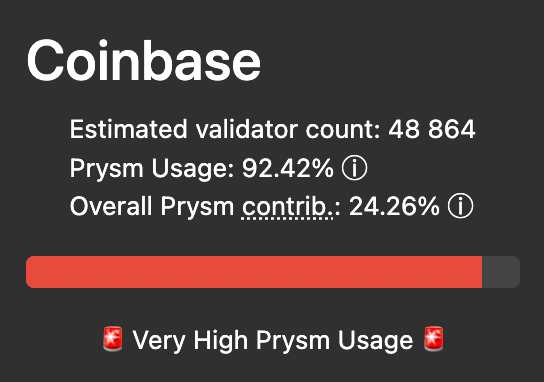
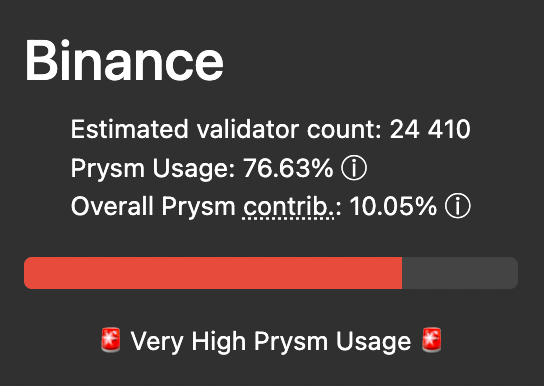
Data reveals that three of the largest centralized exchanges—Coinbase, Kraken, and Binance—are significant contributors to the Prysm supermajority. Coinbase, for instance, manages over 48,000 validators, with approximately 92% of them running on Prysm. When questioned about this concentration, Coinbase Cloud pointed to the maturity of Prysm’s security features, specifically its early support for "remote signers." This feature allows validators to store private keys in isolated environments, a requirement for institutional-grade security.
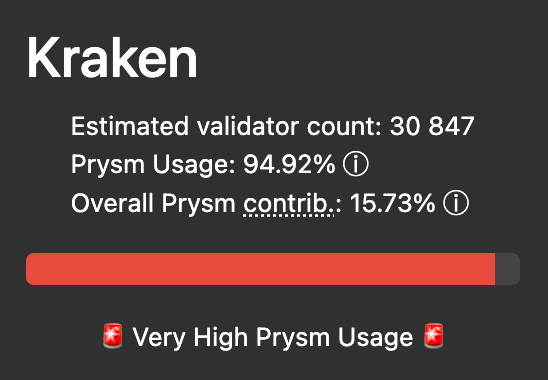
Kraken, which manages roughly 11% of the network’s validators, reported a 94.9% reliance on Prysm. However, the company has acknowledged the risk and stated it is working with the Ethereum Foundation to migrate a portion of its infrastructure to Teku. Similarly, the decentralized staking protocol Lido, which holds a massive 18% share of the total staked ETH, has a Prysm usage rate of approximately 42.8%. While lower than its centralized counterparts, it still contributes significantly to the imbalance.
In contrast, the decentralized staking pool Rocket Pool has emerged as a model for diversity. Only 10.6% of its validators use Prysm, with the remainder distributed across other clients. This suggests that decentralized, community-driven node operators are more likely to heed the calls for client diversity than large centralized entities focused on operational uniformity.
Chronology of the Transition
The path to The Merge has been defined by a series of rigorous testing phases and upgrades:
- December 2020: The launch of the Beacon Chain, introducing the Proof-of-Stake consensus layer without yet affecting the main Ethereum execution chain.
- October 2021: The Altair upgrade, the first scheduled update to the Beacon Chain, which refined validator penalties and rewards.
- March 2022: The successful implementation of the Merge on the Kiln testnet, providing a "dress rehearsal" for the mainnet transition.
- Mid-2022 (Projected): The final transition of the Ethereum Mainnet, where the total terminal difficulty (TTD) will trigger the switch from PoW to PoS.
Analysis of Implications and Future Outlook
Despite the looming threat of client concentration, the Ethereum core development team remains confident in the safety of the transition. The community has established a "no-bailout" consensus; if a supermajority client fails and causes a consensus error, the resulting financial losses via "slashing" or the "inactivity leak" will be borne by the operators of those clients. This creates a strong financial incentive for large stakers to diversify their software stack before the Merge occurs.
The "inactivity leak" is a particularly potent mechanism. If the network stops finalizing due to a client failure, validators that are offline or on the wrong side of the fork will see their staked ETH slowly bleed away. This process continues until the compliant validators once again represent a two-thirds majority, allowing the network to resume finalization.
The transition to Proof-of-Stake is expected to reduce Ethereum’s energy consumption by more than 99.9%, addressing one of the primary criticisms of blockchain technology. Furthermore, it sets the stage for future scalability upgrades, such as sharding, which will increase the network’s throughput.
However, the "Prysm problem" serves as a reminder that decentralization is not merely a matter of distributing coins, but also of diversifying the underlying infrastructure. While the technical logic of the Merge is sound, the social and operational pressure on exchanges and staking pools to move away from a single-client monoculture remains the final hurdle in ensuring Ethereum’s long-term resilience. The coming months will determine whether the network enters its next era as a truly robust, multi-client ecosystem or one that remains vulnerable to the flaws of a single software implementation.