admin
admin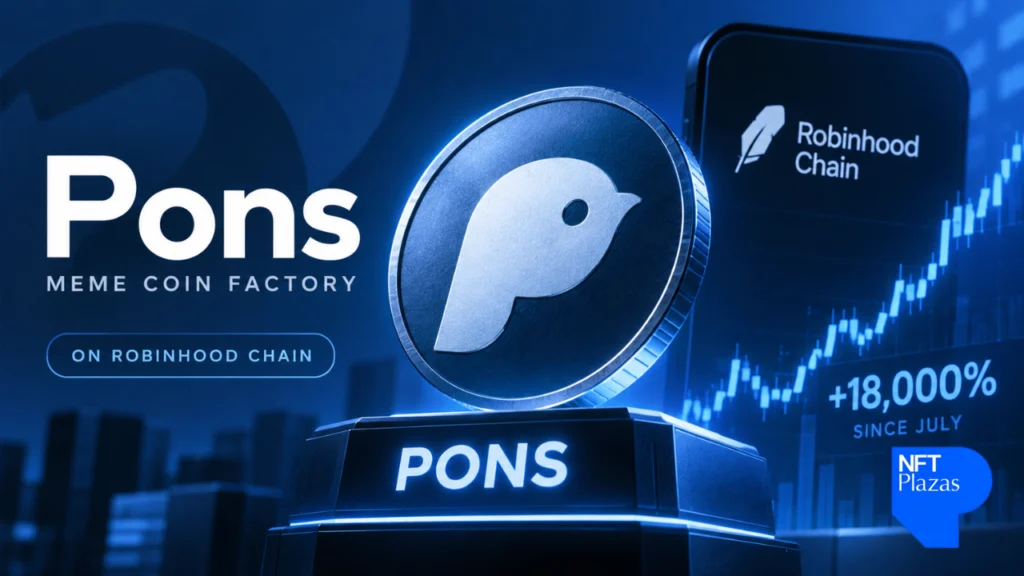
Pons, a decentralized token launchpad operating on the newly introduced Robinhood Chain, has rapidly ascended to become a pivotal driver of activity on the layer-2 network, demonstrating an extraordinary trajectory of growth within just two months of its operational launch. The platform, which enables users to effortlessly create and trade tokens, primarily meme coins, without extensive technical knowledge, has witnessed its native PONS token skyrocket by approximately 18,000% from its July low. This meteoric rise is underpinned by a confluence of explosive speculative trading, substantial daily fee generation, and a robust buyback-and-burn tokenomics model, yet its deep reliance on the volatile meme-coin phenomenon presents both unprecedented opportunity and inherent risks for its sustained future.
The Genesis of Pons: A New Era for Token Creation
Pons positions itself as a streamlined, permissionless gateway for token creation, echoing the successful model established by platforms like Pump.fun on Solana. Launched in tandem with Robinhood Chain’s debut in July 2026, Pons capitalized on the nascent ecosystem’s potential, offering a user-friendly interface for individuals to design, launch, and trade tokens. The platform empowers users to define basic token parameters—such as name, ticker symbol, image, and description—while Pons shoulders the complexities of smart contract deployment and the establishment of initial liquidity pools. This non-custodial approach ensures that user funds remain within their wallets, with all transactions executed directly on-chain, reinforcing a core tenet of decentralized finance. However, Pons explicitly cautions users about the inherent volatility and potential for total loss of value associated with newly launched tokens, a critical disclosure in the speculative landscape it navigates.
Robinhood Chain itself embarked on its journey on July 1, 2026, with an initial strategic focus on facilitating tokenized stocks and expanding decentralized finance (DeFi) capabilities within a more scalable and cost-efficient environment. While these foundational objectives remain, the early adoption and overwhelming success of platforms like Pons have unveiled an unanticipated, yet powerful, growth vector for the network: the meme coin market. This shift highlights a broader trend within the cryptocurrency space, where community-driven, often humor-centric, tokens can rapidly generate significant network activity and liquidity, sometimes overshadowing more conventional DeFi applications in early-stage ecosystems.
Robinhood Chain’s Unexpected Catalyst: The Meme Coin Phenomenon

The rapid ascendance of Pons underscores a fascinating dynamic playing out on Robinhood Chain, where the network’s initial vision is being rapidly reshaped by user-driven trends. Robinhood, a well-established name in traditional finance, extended its reach into the blockchain space with the launch of its Layer-2 solution, aiming to bridge the gap between traditional financial assets and the burgeoning world of decentralized finance. The expectation was a measured growth, perhaps driven by institutional interest in tokenized equities or sophisticated DeFi protocols. Instead, the raw, unfiltered demand for meme coins has become an undeniable force.
Industry observers note that this phenomenon is not unique to Robinhood Chain. New Layer-1 and Layer-2 networks often seek an "application killer app" to drive adoption and transaction volume. While some find this in DeFi innovations or NFT marketplaces, others, like Solana with Pump.fun or now Robinhood Chain with Pons, discover it in the vibrant, albeit chaotic, world of meme coins. This creates a challenging but intriguing scenario for the underlying blockchain, as it must balance supporting speculative, high-volume activity with its long-term strategic goals for stability and regulatory compliance. The sheer volume of transactions and fees generated by Pons demonstrates that the meme coin engine, for better or worse, is a potent catalyst for early network traction.
Explosive Growth Metrics: A Snapshot of Pons’s Dominance
The scale of Pons’s expansion since its inception is nothing short of remarkable. By early September 2026, a mere two months into its operation, the platform had facilitated the creation of approximately 646,000 unique tokens. This staggering figure was generated by a user base exceeding 167,000 unique creator addresses, illustrating the widespread appeal and accessibility of Pons’s low-cost, low-barrier launch model. The platform’s peak activity saw nearly 25,000 new tokens launched on September 2 alone, a testament to its efficiency and the insatiable demand for new speculative assets. Correspondingly, 24-hour trading volume on the platform soared to an estimated $544 million on the same day, showcasing the immense liquidity and transactional flow Pons commands.
Beyond token creation and trading volume, Pons has also emerged as an exceptionally powerful fee generator, a critical metric for any blockchain protocol’s sustainability and value accrual. On September 3, 2026, Pons generated an estimated $5.95 million in fees over a 24-hour period, placing it fourth among all protocols tracked by DeFiLlama and, notably, temporarily surpassing Robinhood Chain itself, which recorded approximately $4 million in fees during the identical timeframe. This inversion highlights the disproportionate impact Pons has had on its host chain’s early economic activity. Within just a few months, Pons had accumulated nearly $57 million in total fees, cementing its position as a financial powerhouse within the nascent Robinhood Chain ecosystem. This level of fee generation, typically seen in much more established protocols, underscores the unprecedented demand for simplified token creation and speculative trading on Robinhood Chain.
The PONS Token: Fueling the Ecosystem with Deflationary Mechanics

At the heart of Pons’s economic model lies its native utility token, PONS, which has demonstrated an exceptional price performance directly linked to the platform’s activity. A defining feature of PONS tokenomics is its innovative buyback-and-burn mechanism, designed to create a deflationary pressure on the token’s supply. Approximately 80% of all protocol fees generated by Pons are systematically allocated to automated purchases of PONS tokens from the open market, executed via a Time-Weighted Average Price (TWAP) mechanism to minimize market impact. These acquired tokens are then sent to a designated burn address, permanently removing them from circulation. The remaining 20% of fees are channeled towards funding infrastructure development, operational costs, and team expansion, ensuring the project’s continued growth and innovation.
This direct correlation between platform activity and token value has been a significant driver of PONS’s appreciation. As more tokens are launched and traded, generating increased fees, a larger quantity of PONS tokens are bought back and burned. By early September, approximately 288 million PONS tokens, representing about 28.8% of the initial 1 billion supply, had been permanently removed from circulation, leaving roughly 712 million tokens outstanding. This consistent reduction in supply, coupled with surging demand, creates a powerful upward price pressure, a model highly attractive to speculative investors. The transparency of this mechanism, verifiable on-chain, builds confidence among participants that the success of the platform directly translates into value for PONS holders.
PONS Price Trajectory and Market Impact: An 18,000% Ascent
The PONS token’s journey has been marked by extreme volatility and exponential growth. Beginning its trading life in July at a fraction of a cent, PONS quickly dipped to a low of approximately $0.0033 on July 17. However, this proved to be a foundational low before its dramatic ascent. The token demonstrated its first significant rally, climbing to around $0.066 by July 27. This initial surge faced a temporary setback with the introduction of Uniswap’s competing Pools.trade launchpad on Robinhood Chain, causing PONS to retract towards $0.016.
Nevertheless, PONS staged an even more formidable recovery in the latter half of August, surging from roughly $0.03 to nearly $0.49 by early September. The momentum continued unabated, with PONS reaching approximately $0.6846 on September 5, representing an astounding 341.8% increase in just seven days. The token briefly pushed above $0.70 before a slight pullback, stabilizing its market capitalization at around $475 million. This incredible performance propelled PONS to become one of Robinhood Chain’s largest native tokens by market capitalization, briefly surpassing established cryptocurrencies like CashCat within the ecosystem. The sheer scale of this appreciation has drawn significant attention, positioning PONS as a bellwether for the speculative fervor and rapid wealth generation potential on Robinhood Chain.
Operational Mechanics: From Creation to Graduation

Pons offers a straightforward, multi-stage process for token lifecycle management.
Create: The initial Pons v1 launch mechanism simplifies token creation. Users specify core details—name, symbol, image, description, and relevant links—along with a designated fee wallet. Pons then automates the deployment of the token with a fixed supply of 1 billion and establishes its corresponding Wrapped Ethereum (WETH) liquidity pool on Robinhood Chain. This automation is key to its accessibility.
Trade: Once launched, tokens become instantly tradable against WETH on Robinhood Chain. Pons v1 imposes a 1% trading fee, which fuels the platform’s revenue and the PONS buyback-and-burn mechanism. To mitigate early market manipulation and concentration, Pons implements temporary protections during the initial blocks post-launch, restricting purchase sizes and holding limits for individual wallets.
Graduate: Under the v1 model, a token "graduates" when the WETH liquidity in its pool reaches approximately 4.2 ETH. Unlike some other launchpads that might migrate tokens to new pools or exchanges at this stage, Pons ensures continued trading within the original, now more robust, liquidity pool, maintaining continuity and reducing fragmentation.
The Evolution: Pons V2 and Bonding Curves
In a strategic move to refine its launch process and enhance token stability, Pons introduced v2, a significant upgrade to its core mechanism. Pons v2 fundamentally alters the token launch paradigm by moving away from immediate conventional liquidity pools. Instead, a new token begins its journey on a bonding curve. This mechanism gradually releases the token’s supply as buying pressure accumulates, providing a more structured and often fairer distribution process. Once the bonding curve is successfully completed—signifying sufficient early interest and price discovery—the token seamlessly transitions into a permanently locked Uniswap v4 liquidity pool.
This v2 model is designed to standardize launches, reduce the initial volatility often associated with immediate open market listings, and significantly minimize the burden on creators to manually arrange and secure liquidity. By integrating with Uniswap v4 and ensuring permanently locked liquidity, Pons v2 aims to provide a more robust and secure foundation for newly launched tokens, potentially attracting a broader range of creators and investors seeking more predictable launch conditions.
Challenges and Considerations: Navigating Speculation and Anonymity
Despite its undeniable success, Pons operates amidst significant challenges and inherent risks that warrant careful consideration. The project’s heavy reliance on speculative meme-coin trading means its growth is inextricably linked to market sentiment and the broader "frenzy" on Robinhood Chain. Should this speculative enthusiasm wane, the platform’s activity, fee generation, and the PONS token’s value could face substantial pressure. This dependence on transient market trends poses a long-term sustainability question.

Furthermore, Pons currently maintains a degree of anonymity regarding its core development team and external investors. While operating under the "pons family" brand, the identities of its founders and technical personnel have not been publicly disclosed. In the decentralized space, anonymity can be viewed as both a feature (enhancing decentralization and privacy) and a bug (raising concerns about accountability, regulatory compliance, and potential "rug pulls" or project abandonment). The absence of detailed information on external fundraising or institutional backing also means the project’s long-term strategic support structure is less transparent than many established blockchain ventures.
The regulatory landscape for cryptocurrencies, particularly for highly speculative assets and token launchpads, is evolving rapidly. Platforms like Pons, which facilitate the creation of potentially unregulated financial instruments, could face increasing scrutiny from global financial authorities. The very nature of meme coins, often lacking intrinsic utility beyond community sentiment and speculation, places them in a regulatory grey area that could attract stricter oversight.
Broader Implications for Robinhood Chain and the Crypto Market
Pons’s meteoric rise carries profound implications for Robinhood Chain and the wider cryptocurrency market. For Robinhood Chain, Pons has served as an unexpected, yet powerful, growth engine, demonstrating the network’s technical capability to handle immense transaction volumes and generate substantial fees. It has undeniably put Robinhood Chain on the map, attracting attention and users that might not have engaged with its initial DeFi or tokenized stock offerings. However, it also presents a strategic dilemma: how to leverage this meme-coin driven momentum while simultaneously fostering the development of more sustainable, utility-focused applications that align with Robinhood’s broader financial vision. The chain’s long-term success will likely depend on its ability to diversify its application layer beyond pure speculation.
For the crypto market, Pons exemplifies the enduring power of community, speculation, and accessible technology in driving adoption. It reiterates that innovation in token creation and distribution can emerge from unexpected corners, challenging traditional venture capital models and demonstrating that even in a maturing market, the "wild west" spirit of crypto remains potent. The success of Pons also highlights the continued appetite for high-risk, high-reward opportunities among retail investors, pushing the boundaries of what constitutes a "valuable" digital asset.
In conclusion, Pons represents a compelling case study in the dynamic and often unpredictable evolution of new blockchain ecosystems. Its rapid ascent, driven by a powerful confluence of user-friendly technology, strong tokenomics, and the pervasive meme-coin frenzy, has cemented its position as a dominant force on Robinhood Chain. While its extraordinary growth and financial metrics speak volumes about its current impact, the project’s heavy reliance on speculative trading and its anonymous operational structure underscore the inherent risks and complexities it must navigate for sustained success in the ever-changing landscape of decentralized finance. The coming months will be crucial in determining whether Pons can evolve beyond a speculative phenomenon to establish a more enduring and diversified role within the burgeoning Robinhood Chain ecosystem.