admin
admin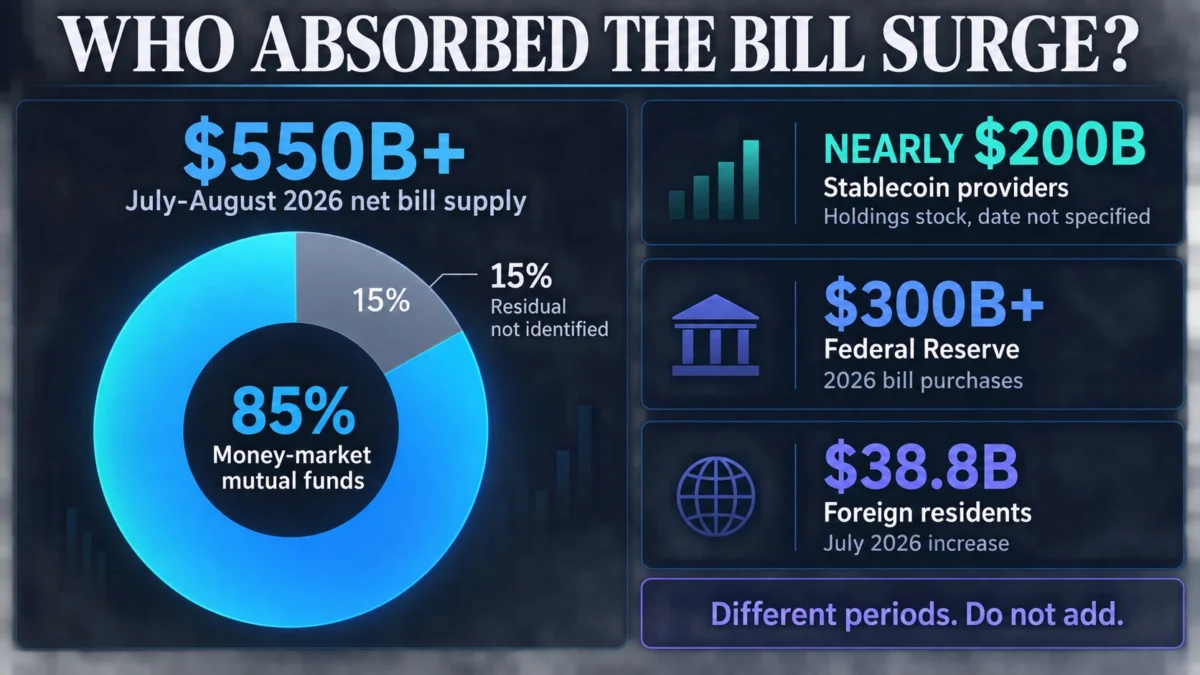
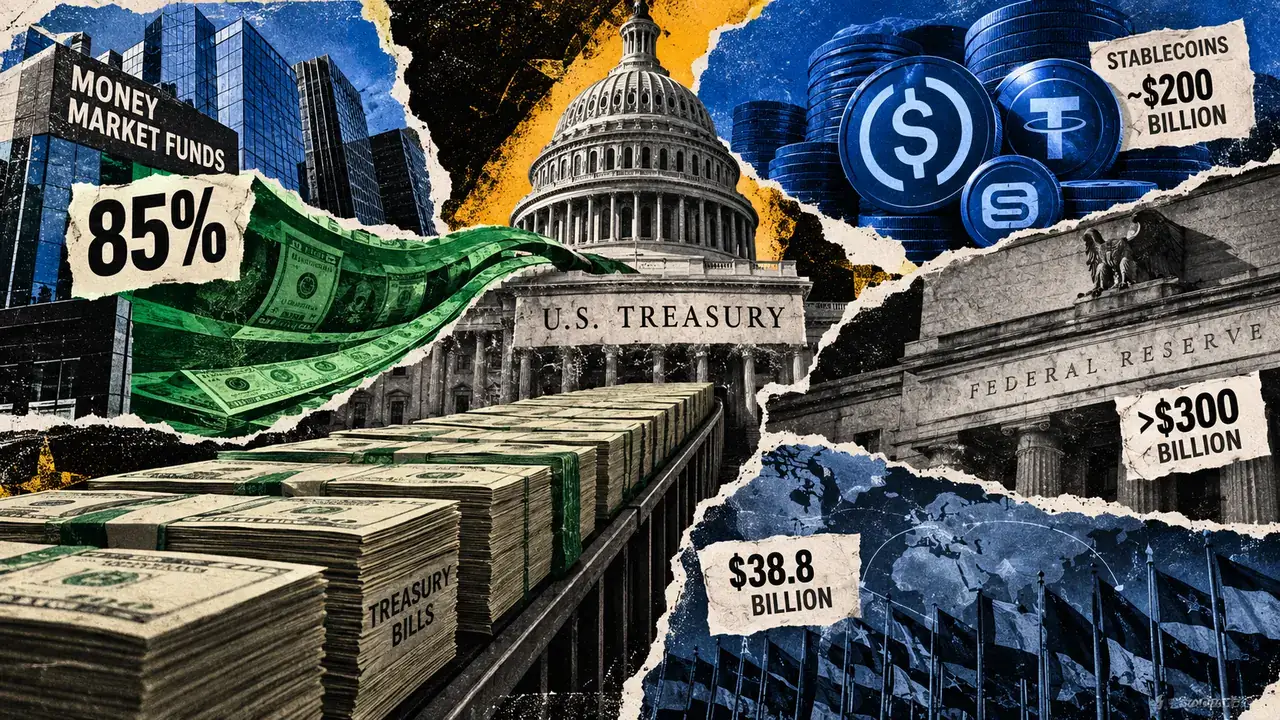
The U.S. government’s latest wave of Treasury bill issuance, totaling over $550 billion in July and August, saw an overwhelming majority – approximately 85% – absorbed by money-market mutual funds. This significant influx into money funds solidifies their position as the primary marginal demand for short-term U.S. debt during this period. The Treasury Department’s Deputy Secretary, Francis Brooke, highlighted this trend in remarks delivered on September 22, underscoring the critical role these funds play in financing government operations.
This substantial absorption by money funds provides a clear picture of where the demand originated for the newly issued Treasury bills. The $550 billion represents an increase of about 8% in the net bill supply over a two-month span, a notable acceleration in government borrowing. While other market participants also hold Treasury securities, the data specifically points to money funds as the dominant force behind this particular surge in issuance.
Understanding the Diverse Landscape of Treasury Bill Holders
To fully comprehend the dynamics of Treasury bill demand, it’s essential to distinguish between various categories of buyers and the metrics used to assess their holdings. The Treasury Department’s reporting offers a nuanced view, differentiating between the stock of securities held and the flow of new purchases.
-
Money-Market Mutual Funds: These funds are crucial for absorbing the incremental supply of Treasury bills. The reported 85% figure specifically quantifies their share of the additional bills issued during July and August 2026, not their total holdings of all Treasury securities. This metric directly addresses the immediate demand generated by the summer issuance.
-
Stablecoin Providers: While significant holders of short-dated government debt, their reported holdings of nearly $200 billion represent a stock of Treasury bills and other near-maturity securities. The exact date of acquisition for this amount is not specified, and it does not directly correlate with the specific July-August issuance increase. However, stablecoin issuers are recognized as material investors in Treasury-linked assets.
-
Federal Reserve: The Federal Reserve has emerged as a substantial buyer of Treasury bills throughout 2026, acquiring over $300 billion through various channels. These purchases are designed to manage the Federal Reserve System’s balance sheet and maintain ample liquidity within the banking system.
-
Foreign Residents: Demand from foreign investors has shown recent positive movement. In July 2026, foreign residents increased their bill holdings by $38.8 billion, signaling a return of overseas interest after a period of declining holdings in the preceding months.
It is crucial to recognize that these figures are not directly additive. They employ different measurement windows and capture distinct aspects of the market. For instance, the stablecoin figure represents a snapshot of their existing portfolio, while the money fund figure reflects their participation in a specific issuance period. The overlap between categories, particularly between stablecoin reserves and money fund investments, further complicates a simple summation.
The Interplay Between Stablecoins and Money Funds
The role of stablecoin providers in the Treasury market is complex and evolving. While they hold substantial amounts of short-dated government debt, their investment strategies often intersect with traditional money market instruments. For example, Circle, a prominent issuer of the USDC stablecoin, reported in its second-quarter filing that approximately 84% of its USDC reserves were held in the Circle Reserve Fund as of June 30, 2026. This fund is described as a Rule 2a-7 government money-market fund.
This operational detail illustrates how demand originating from stablecoin reserves can manifest within the money-market fund category. While Circle’s allocation is specific to one issuer, it highlights the accounting overlap that exists. Furthermore, the assets within these money market funds demonstrate a broader exposure to Treasury markets than direct bill ownership alone. The annual shareholder report for a representative fund showed significant holdings in both direct Treasury obligations and repurchase agreements (repos) collateralized by Treasuries. While repos are a separate asset class, they effectively represent an indirect form of Treasury market engagement.
The Treasury Department views stablecoin issuers as a potential growth area for future demand. Deputy Secretary Brooke indicated that as regulations for the stablecoin industry, such as those stemming from the GENIUS Act, are finalized, providers may expand their Treasury holdings. This conditional outlook suggests that regulatory clarity could unlock further demand, but it does not currently account for the substantial absorption observed in the July-August issuance wave.
The Federal Reserve’s Growing Role in the Bill Market
The Federal Reserve’s activity in the Treasury bill market has been a significant factor throughout 2026. The central bank’s purchases, exceeding $300 billion, are channeled through two primary avenues: reserve-management operations and the reinvestment of principal payments from agency securities. These operations are distinct from direct government financing or traditional quantitative easing. They are strategic tools employed to manage the Federal Reserve’s balance sheet, ensure sufficient liquidity for the banking system, and influence the composition of its asset holdings.
The Fed’s July monetary policy report provided early indications of this activity, recording nearly $250 billion in bill purchases through July 1. Reserve-management purchases accounted for approximately $160 billion, while the reinvestment of agency mortgage-backed security principal contributed around $90 billion. The later Treasury figure of over $300 billion reflects a more up-to-date assessment of these purchases.
Analysis of the Fed’s published balance sheet further corroborates the expanding footprint of Treasury bills within its portfolio. Holdings increased from $233.592 billion on December 31, 2025, to $550.482 billion by September 16, 2026. While this represents a net stock movement and not a direct measure of purchases during the July-August issuance period, it underscores the rapid growth of the Fed’s Treasury bill holdings.
Foreign Investor Rebound and the Nuances of Treasury International Capital Data
After several months of declining holdings, foreign investors demonstrated renewed interest in U.S. Treasury bills in July 2026. The Treasury International Capital (TIC) release indicated an increase of $38.8 billion in bill holdings by foreign residents during that month. This rebound followed successive declines of $20.0 billion in April, $43.5 billion in May, and $29.0 billion in June, suggesting a shift in overseas sentiment towards U.S. short-term debt.
Within this July increase, private foreign holdings rose by $45.0 billion, while foreign official holdings saw a decrease of $6.3 billion. This divergence suggests that private asset managers and institutional investors were more active in increasing their allocations during July. However, the TIC data has inherent limitations. It is based on custody reports and can obscure the true beneficial owner when securities are held through third countries or managed by foreign portfolio managers. This means that the reported figures might not capture the complete picture of foreign demand.
Implications for U.S. Fiscal Management and Market Stability
The robust demand for Treasury bills, particularly from money-market funds, has several implications for U.S. fiscal management and broader financial market stability.
Firstly, it underscores the continued reliance on short-term debt issuance to finance government operations. The ability of money funds to absorb such large volumes of new supply is a testament to the liquidity and perceived safety of U.S. Treasury bills, a cornerstone of the global financial system.
Secondly, the dynamic interplay between traditional financial players like money funds and emerging entities like stablecoin issuers highlights the evolving landscape of fixed-income markets. As regulatory frameworks for stablecoins mature, their potential to channel significant capital into U.S. government debt could become more pronounced, offering the Treasury diversified funding sources.
Thirdly, the Federal Reserve’s active participation as a buyer, while serving its monetary policy objectives, also influences market liquidity and the availability of Treasury bills for other investors. The scale of its operations necessitates careful monitoring to ensure it does not unduly distort market functioning.
The U.S. Treasury Department’s latest issuance surge, therefore, offers a granular view of the immediate demand drivers for its short-term debt. While stablecoin issuers represent a significant and potentially growing segment of the investor base, the most clearly identified and dominant buyer class for this specific wave of issuance remains traditional money-market mutual funds. The sustained demand for these instruments is a critical factor in the Treasury’s ability to manage its debt obligations effectively and maintain confidence in the U.S. government’s financial standing. The ongoing evolution of regulatory frameworks for digital assets and the persistent role of central banks will undoubtedly shape these dynamics further in the coming fiscal periods.