Dwi Wanna
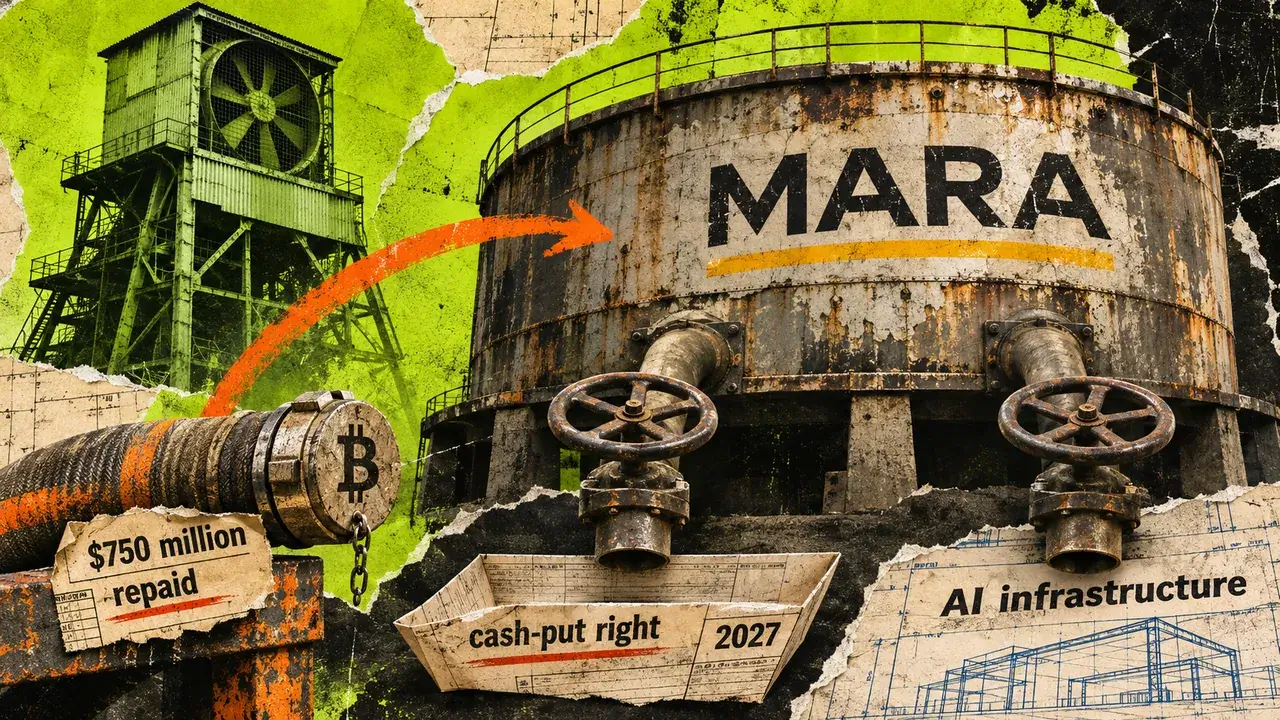
MARA Holdings, a global leader in the digital asset mining sector, has officially announced the full repayment of $750 million in Bitcoin-backed loan facilities, a move that effectively eliminates the company’s exposure to collateral-liquidation risks that had previously shadowed its balance sheet. This significant deleveraging event was facilitated by the strategic sale of a substantial portion of the company’s Bitcoin treasury, marking a pivot in MARA’s capital management strategy from pure asset accumulation toward operational diversification and shareholder returns. According to a Nov. 9 regulatory filing, the company liquidated 13,597 Bitcoin following the conclusion of the third quarter on Sept. 30, generating approximately $1.1 billion in gross proceeds. Of this capital, $750 million was immediately directed toward retiring the outstanding debt, while the remaining $350 million has been earmarked for a multi-pronged growth strategy involving artificial intelligence (AI) infrastructure, debt retirement, and an aggressive share buyback program.
Strategic Deleveraging and the Shift in Treasury Management
The decision to liquidate a portion of the Bitcoin treasury represents a departure from the "HODL" strategy that characterized the company’s approach during previous market cycles. By retiring the $750 million in loans, MARA Holdings has removed a critical vulnerability: the risk of forced liquidation. Bitcoin-backed loans typically require the borrower to maintain a specific loan-to-value (LTV) ratio. In periods of extreme market volatility, a sharp decline in the price of Bitcoin could trigger a "margin call," forcing the miner to either post more collateral or see its assets liquidated by lenders at unfavorable prices.
By clearing these obligations, management has secured the company’s core asset base and provided itself with greater maneuverability. The Nov. 9 disclosure indicates that the company realized an average price of roughly $80,900 per Bitcoin during its liquidation phase, capitalizing on a period of relative strength in the digital asset markets. This capital infusion has bolstered MARA’s "bridge" liquidity to an estimated $1.3 billion when combined with existing cash reserves reported at the end of September.
Navigating the 2027 Liability Horizon
While the immediate Bitcoin-backed debt has been settled, MARA Holdings remains focused on a series of upcoming financial milestones related to its convertible senior notes. The company’s quarterly shareholder letter highlights two critical dates in 2027 that will require significant cash reserves. As of Sept. 30, MARA carried $291.6 million in notes due in June 2031, which feature a "cash-put" right exercisable by bondholders on June 4, 2027. Additionally, the company has $632.5 million in notes due in March 2030, which carry a similar cash-put right on Dec. 1, 2027.
A cash-put right is a contractual provision that allows bondholders to require the company to repurchase the notes at their face value, plus any accrued interest, before the actual maturity date. If all eligible holders choose to exercise these rights, MARA could face a combined cash demand of approximately $924.1 million in 2027. While the company is not legally obligated to sell Bitcoin today to meet these future demands, the recent monetization of its treasury suggests that management is proactively building a cash buffer to ensure it can satisfy these obligations without resorting to dilutive equity raises or high-interest emergency financing.
Furthermore, a smaller obligation of $48 million in notes is scheduled to mature on Dec. 1 of the current year. Given the company’s strengthened cash position, this near-term liability is expected to be managed through existing liquidity.
The Pivot to AI Infrastructure and Data Center Expansion
Beyond debt management, MARA Holdings is aggressively positioning itself as a key player in the burgeoning AI infrastructure sector. This transition mirrors a broader trend within the Bitcoin mining industry, where firms are leveraging their access to large-scale power infrastructure and cooling technologies to host high-performance computing (HPC) and AI workloads.
The company’s quarterly letter explicitly identifies AI infrastructure as a primary destination for the capital raised through recent Bitcoin sales. A cornerstone of this strategy is the pending acquisition of Long Ridge, a power-generation and data-center business. The acquisition carries an enterprise value of approximately $1.5 billion, which includes the assumption of up to $900 million in existing debt. To support this transaction, MARA has secured a bridge commitment of up to $785 million, ensuring that the deal can proceed even as the company navigates the complexities of the debt markets.
In addition to the Long Ridge acquisition, MARA is advancing a data-center development agreement with Starwood. This partnership involves the development of specialized sites tailored for the energy-intensive requirements of modern AI clusters. As of Sept. 30, MARA had approved $136.3 million for pre-development pursuit costs across various sites, with $17.7 million already incurred. These projects are expected to be structured with non-recourse project financing, a move designed to protect the parent company’s balance sheet from the specific risks associated with individual construction projects.
The company is also involved in the HIF site-development project, which carries a potential price tag of $600 million. This investment is tied to specific post-closing milestones, reflecting a disciplined approach to capital expenditure where payments are contingent upon the successful achievement of development goals.
Shareholder Returns: The $500 Million Buyback Authorization
In a move to signal confidence in its long-term valuation and to provide value to its investors, MARA’s Board of Directors authorized a common-share repurchase program of up to $500 million on Nov. 9. This authorization allows the company to buy back its own stock in the open market or through private transactions.
Share buybacks are often used by companies to offset the dilutive effects of stock-based compensation or the potential conversion of senior notes into equity. By reducing the total number of shares outstanding, the company can increase earnings per share (EPS) and potentially support the stock price. However, the board noted that the program does not require the purchase of any specific number of shares and can be adjusted or terminated based on market conditions and competing capital needs. This flexibility is crucial as the company balances the desire to reward shareholders with the capital requirements of its AI and infrastructure pivots.
Financial Performance and Operational Cash Flow
Despite the massive influx of cash from Bitcoin sales, MARA’s core operations continue to require significant capital. During the first nine months of 2026, the company reported a net cash outflow of $642.7 million from operating activities. It is important to note that under standard accounting practices, the proceeds from Bitcoin sales are classified as "investing cash flows" rather than "operating cash flows." Therefore, while the company’s treasury sales have created a massive cash surplus, the underlying mining operations have not yet reached a point of self-sustainability in the current post-halving environment.
As of Sept. 30, MARA reported $946.5 million in cash and equivalents. This figure included approximately $104 million held in euros by its majority-owned subsidiary, Exaion. These funds are contractually designated for Exaion’s specific operations over the next year, limiting their availability for the parent company’s general corporate purposes. However, the subsequent $350 million in net proceeds from the Q4 Bitcoin sales has significantly bolstered the total liquidity pool, providing what management describes as "flexibility to meet obligations and fund growth over the next twelve months and beyond."
The company also maintains an "at-the-market" (ATM) share issuance program, which had $1.5 billion in unused capacity at the end of the third quarter. This program acts as a secondary liquidity lever, allowing MARA to raise additional capital by selling shares directly into the market if favorable conditions arise or if infrastructure costs exceed current cash reserves.
Industry Context and Market Implications
The maneuvers by MARA Holdings reflect the evolving landscape of the digital asset mining industry. Since the most recent Bitcoin halving—an event that halved the rewards for mining a block—profit margins for pure-play miners have been squeezed. This has forced industry leaders to seek more stable, non-cyclical revenue streams. By diversifying into AI infrastructure, MARA is following in the footsteps of other major miners like Core Scientific and HIVE Digital Technologies, who have successfully pivoted toward high-performance computing.
The liquidation of 13,597 Bitcoin also serves as a notable supply signal for the broader market. While MARA remains one of the largest corporate holders of Bitcoin, its willingness to sell over $1 billion worth of the asset suggests a more pragmatic, "treasury-first" approach. Investors and analysts will be closely watching future disclosures to see if the company continues to monetize its holdings or if it intends to rebuild its Bitcoin reserves as the 2027 debt hurdles approach.
Conclusion: A New Chapter for MARA
The repayment of $750 million in debt and the simultaneous pivot toward AI and shareholder returns mark the beginning of a new chapter for MARA Holdings. By cleaning up its balance sheet and securing a massive cash bridge, the company has transitioned from a high-risk mining operation to a diversified infrastructure and technology firm.
The success of this transition will depend on management’s ability to execute the Long Ridge and Starwood projects while navigating the potential $924 million cash-put demands in 2027. For now, the elimination of collateral-liquidation risk provides a stable foundation for MARA to pursue its ambitious growth agenda in the competitive landscape of digital infrastructure. The next several quarters will be instrumental in determining whether this "Bitcoin-to-Infrastructure" bridge can deliver the long-term value promised to shareholders and bondholders alike.