admin
JPMorgan Asset Management, a division of one of the world’s leading financial institutions, has released its 2027 Long-Term Capital Market Assumptions (LTCMA) report, projecting that Bitcoin (BTC) is poised to deliver stronger annualized compound returns over the next 10 to 15 years compared to traditional asset classes such as US large-cap stocks, gold, and real estate investment trusts (REITs). This landmark forecast, detailed in a widely anticipated annual publication that guides institutional asset allocation decisions, underscores a notable shift in how established financial players are evaluating the digital asset, despite persistent warnings about its inherent volatility.
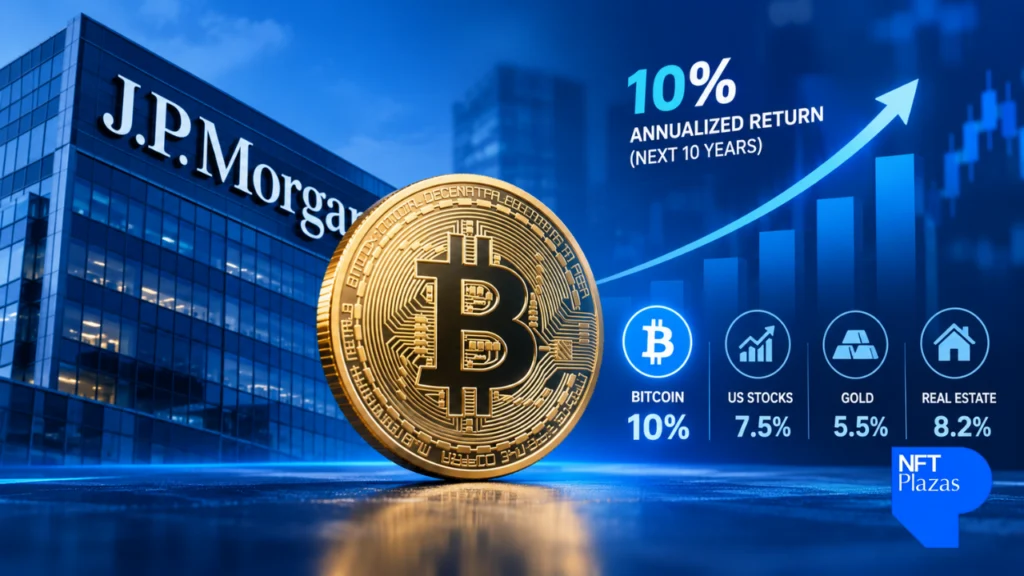
According to the firm’s comprehensive analysis, Bitcoin is expected to generate an impressive 10% annualized compound return through 2027. This projection places it ahead of US real estate investment trusts (REITs), which are forecast at 8.2%, US large-cap equities at 7.5%, and gold at 5.5%. The explicit inclusion of Bitcoin in such a prominent long-term outlook from a firm historically associated with skepticism towards cryptocurrencies marks a significant milestone in its journey towards mainstream financial integration. While the forecast carries crucial caveats regarding Bitcoin’s elevated risk profile, its position atop the return table signals a growing recognition of its potential for long-term growth within sophisticated investment frameworks.
JPMorgan’s Long-Term Capital Market Assumptions: A Deep Dive into the Forecast
The Long-Term Capital Market Assumptions (LTCMA) report is an annual strategic document published by JPMorgan Asset Management, designed to provide institutional investors with a forward-looking perspective on potential returns across a broad spectrum of asset classes over an extended horizon, typically 10 to 15 years. These assumptions are critical for pension funds, endowments, sovereign wealth funds, and other large institutional clients in constructing diversified portfolios and setting realistic long-term investment objectives. The methodology behind these forecasts involves extensive macroeconomic analysis, fundamental valuation models, and a careful assessment of historical performance trends, adjusted for future expectations.
Bitcoin’s commanding lead in JPMorgan’s projected compound returns is not merely a statistical anomaly but reflects a calculated assessment of its future growth potential relative to more mature asset classes. The 2.5 percentage point advantage over US large-cap stocks and a substantial 4.5 percentage point lead over gold highlights the perceived opportunity in the digital asset space. For investors focused on wealth accumulation over a decade or more, such differences, magnified by the power of compounding, can lead to profoundly divergent outcomes.
However, it is crucial to distinguish between compound and arithmetic average returns, a nuance explicitly addressed by JPMorgan. While Bitcoin’s projected compound return stands at 10%, its arithmetic average annual return is estimated at a much higher 20.9%. This significant gap illustrates the profound impact of volatility on long-term wealth creation. In highly volatile assets like Bitcoin, periods of exponential gains can be offset by steep, rapid declines. The arithmetic average captures the sum of yearly returns divided by the number of years, while the compound annual growth rate (CAGR) reflects the actual year-over-year growth rate of an investment over a specified period, assuming profits are reinvested. The latter is a more accurate measure of an investor’s real wealth accumulation over time, especially in volatile markets.
The Enduring Challenge: Bitcoin’s High Volatility
Central to JPMorgan’s nuanced outlook is the explicit acknowledgment of Bitcoin’s projected annualized volatility of 55%. This figure stands in stark contrast to the volatility profiles of traditional asset classes, which typically range from 10-20% for major equity indices like the S&P 500, and often below 15% for gold. For instance, the S&P 500 has historically exhibited an annualized volatility around 15-20%, while gold’s volatility has often been in the 10-15% range. This significant difference implies that while Bitcoin may offer higher potential returns, investors must be prepared for substantially sharper price swings, including significant drawdowns, which can test even the most resilient investment strategies.
JPMorgan has consistently cautioned against treating Bitcoin as a conventional portfolio holding. The firm’s decision not to incorporate Bitcoin into its main covariance matrices—tools used by asset managers to evaluate how different assets move in relation to one another and to optimize diversification—underscores this apprehension. The firm stated, "The volatility and unstable correlation of assets like bitcoin (BTC) remain an obstacle to their widespread inclusion in portfolios." This distinction is critical for institutional investors whose primary mandate often involves sophisticated risk management, portfolio construction, and liquidity planning. An asset with attractive expected returns but unpredictable correlations and extreme volatility poses unique challenges that cannot be addressed with standard diversification models. For individual investors, this serves as a potent reminder that higher potential returns are intrinsically linked to greater uncertainty and risk. Bitcoin’s long-term trajectory will be influenced by a complex interplay of market demand, regulatory developments, broader institutional participation, and prevailing macroeconomic conditions.
A Chronology of Shifting Institutional Sentiment Towards Bitcoin
The journey of Bitcoin from a niche digital currency to a subject of serious institutional analysis by firms like JPMorgan has been marked by a dramatic evolution in sentiment.
- Early Years (2009-2015): Bitcoin was largely dismissed by traditional finance, often viewed as a speculative curiosity, a tool for illicit activities, or a technological experiment with no intrinsic value. Its extreme volatility and lack of regulatory oversight made it anathema to risk-averse institutional players.
- Growing Recognition (2016-2019): As Bitcoin gained traction and its market capitalization grew, some forward-thinking hedge funds and family offices began to explore its potential. The launch of Bitcoin futures contracts on regulated exchanges like the CME in December 2017 provided the first regulated avenue for institutional exposure, albeit indirectly.
- Mainstream Adoption Wave (2020-Present): The COVID-19 pandemic and subsequent fiscal stimulus accelerated interest in alternative assets. Key milestones include:
- August 2020: MicroStrategy adopted Bitcoin as its primary treasury reserve asset, triggering a wave of corporate interest.
- February 2021: Tesla announced a $1.5 billion Bitcoin purchase, further legitimizing the asset.
- April 2021: Coinbase, the largest U.S. cryptocurrency exchange, went public on Nasdaq, signaling a maturing infrastructure.
- January 2024: The U.S. Securities and Exchange Commission (SEC) approved several spot Bitcoin Exchange-Traded Funds (ETFs), a watershed moment that opened the floodgates for easier, regulated access for both retail and institutional investors. The immediate influx of billions of dollars into these ETFs, particularly from major players like BlackRock and Fidelity, solidified Bitcoin’s status as a viable investment vehicle in the eyes of many traditional finance participants.
This historical context underscores that JPMorgan’s current forecast is not an isolated event but rather a significant data point in a broader trend of institutional re-evaluation and increasing, albeit cautious, acceptance of digital assets.
JPMorgan’s Complicated Relationship with Bitcoin: From Skepticism to Strategic Analysis

The release of this forecast by JPMorgan Asset Management is particularly noteworthy given the firm’s historically complicated, and often contradictory, stance on Bitcoin. JPMorgan CEO Jamie Dimon has been one of the most vocal critics of Bitcoin, famously calling it a "fraud" in 2017 and threatening to fire any JPMorgan trader caught dealing in it. His criticisms have evolved over time, likening it to a "Ponzi scheme" and a "pet rock," consistently expressing deep personal reservations about its utility and legitimacy.
However, beneath Dimon’s public skepticism, JPMorgan has paradoxically engaged with blockchain technology and digital assets in various capacities. The firm launched JPM Coin in 2020, a permissioned stablecoin used for wholesale payments, demonstrating a clear interest in the underlying distributed ledger technology. It also established Onyx, a dedicated blockchain and digital assets division. Moreover, as reported in May 2025 (as per the original article’s context), Dimon acknowledged that JPMorgan would allow clients to buy Bitcoin, even while maintaining his personal skepticism.
This duality highlights a critical distinction within large financial conglomerates: the personal views of a chief executive, however influential, do not always fully dictate the analytical output or client service offerings of specialized divisions like asset management. The LTCMA report represents an objective, data-driven investment projection from a division focused on long-term asset allocation, rather than a declaration of corporate support or a blanket recommendation. Bitcoin’s prominent placement in this report therefore signifies that while the debate about its fundamental nature continues, its potential as an investable asset can no longer be ignored by serious financial analysis.
Broader Market Context and Institutional Holdings
Beyond JPMorgan’s internal projections, broader market data offers additional context regarding institutional engagement with Bitcoin. Data from Santiment, an on-chain analytics firm, indicates that investment funds have consistently maintained holdings of over 1 million BTC for several months. While these stable holdings do not necessarily signify new money entering the market or an increase in buying pressure, they do illustrate a sustained conviction among existing institutional holders. It suggests that once institutions acquire Bitcoin, they tend to hold it, reflecting a long-term investment horizon rather than short-term trading.
To assess fresh demand and active institutional buying, investors typically look at metrics such as net inflows into spot Bitcoin ETFs, changes in fund balances, and daily trading volumes. Since their launch in January 2024, US spot Bitcoin ETFs have seen significant fluctuations in inflows and outflows, but cumulatively, they have attracted billions of dollars in net new capital, signaling robust institutional and retail interest in a regulated product. Major players like BlackRock’s IBIT and Fidelity’s FBTC have rapidly accumulated substantial amounts of Bitcoin, indicating active demand beyond merely maintaining existing positions. This inflow data provides a more dynamic picture of institutional participation compared to static fund holding figures.
The macroeconomic environment also plays a role. In a climate of persistent inflation and rising interest rates, assets like gold and Bitcoin are often viewed as potential hedges. However, higher interest rates can also increase the appeal of income-generating assets, potentially drawing capital away from non-yield-bearing assets. The interplay of these factors will continue to shape Bitcoin’s price trajectory.
Reactions and Implications for Investors
Matt Hougan, Chief Investment Officer at Bitwise, a prominent crypto asset manager, welcomed JPMorgan’s projections as further evidence of Bitcoin’s growing mainstream acceptance. In a public statement, Hougan highlighted the stark contrast between Bitcoin’s early dismissal by traditional finance and its current inclusion in a major asset manager’s long-term return assumptions. While acknowledging the report’s caveats regarding volatility and maturity, he described its mere inclusion as a "notable development," signaling a broader shift towards integrating digital assets into formal investment frameworks rather than dismissing them outright.
For individual investors, JPMorgan’s forecast is a dual message. On one hand, it validates the long-term potential of Bitcoin as a high-growth asset. On the other, it serves as a stark reminder that such potential comes hand-in-hand with significantly elevated risk. A projected 10% compound annual return paired with 55% annualized volatility presents a clear trade-off: explosive growth potential against a path likely riddled with steep corrections and psychological challenges. Investors must conduct thorough due diligence, understand their personal risk tolerance, and consider Bitcoin as a potentially small, but high-conviction, component of a well-diversified portfolio, rather than a core holding.
For institutional investors, the report provides a crucial analytical framework. While it doesn’t equate to a mandate for mass allocation, it offers a sophisticated justification for exploratory allocations or maintaining existing positions. It also creates a precedent for other traditional financial institutions to undertake similar analyses, potentially leading to more widespread acceptance and product development in the future. The report acknowledges that Bitcoin’s long-term performance will depend on continued market demand, the evolution of regulatory clarity, and sustained institutional participation. Conversely, a weakening of these factors, coupled with stricter regulation or more attractive competing investments, could see Bitcoin fall short of these ambitious projections.
Conclusion
JPMorgan Asset Management’s forecast for Bitcoin’s long-term returns marks a pivotal moment in the digital asset’s journey. It symbolizes a significant shift from outright skepticism to a more pragmatic, analytical approach within traditional finance. By projecting Bitcoin to outperform established asset classes over the next decade and beyond, JPMorgan lends considerable credibility to the notion of Bitcoin as a legitimate, if unconventional, investment.
However, the core message remains nuanced: while Bitcoin offers compelling growth potential, its extraordinary volatility demands a sophisticated understanding of risk. The 55% projected annualized volatility is a stark reminder that this is not a low-risk investment. Instead, it presents investors with a clear and potent trade-off between aspirational growth and substantial risk. The trajectory of Bitcoin over the coming decade will be a testament to its resilience, its ability to navigate regulatory landscapes, and its continued integration into the global financial ecosystem, proving whether this high-stakes bet on innovation will ultimately pay off.