admin
admin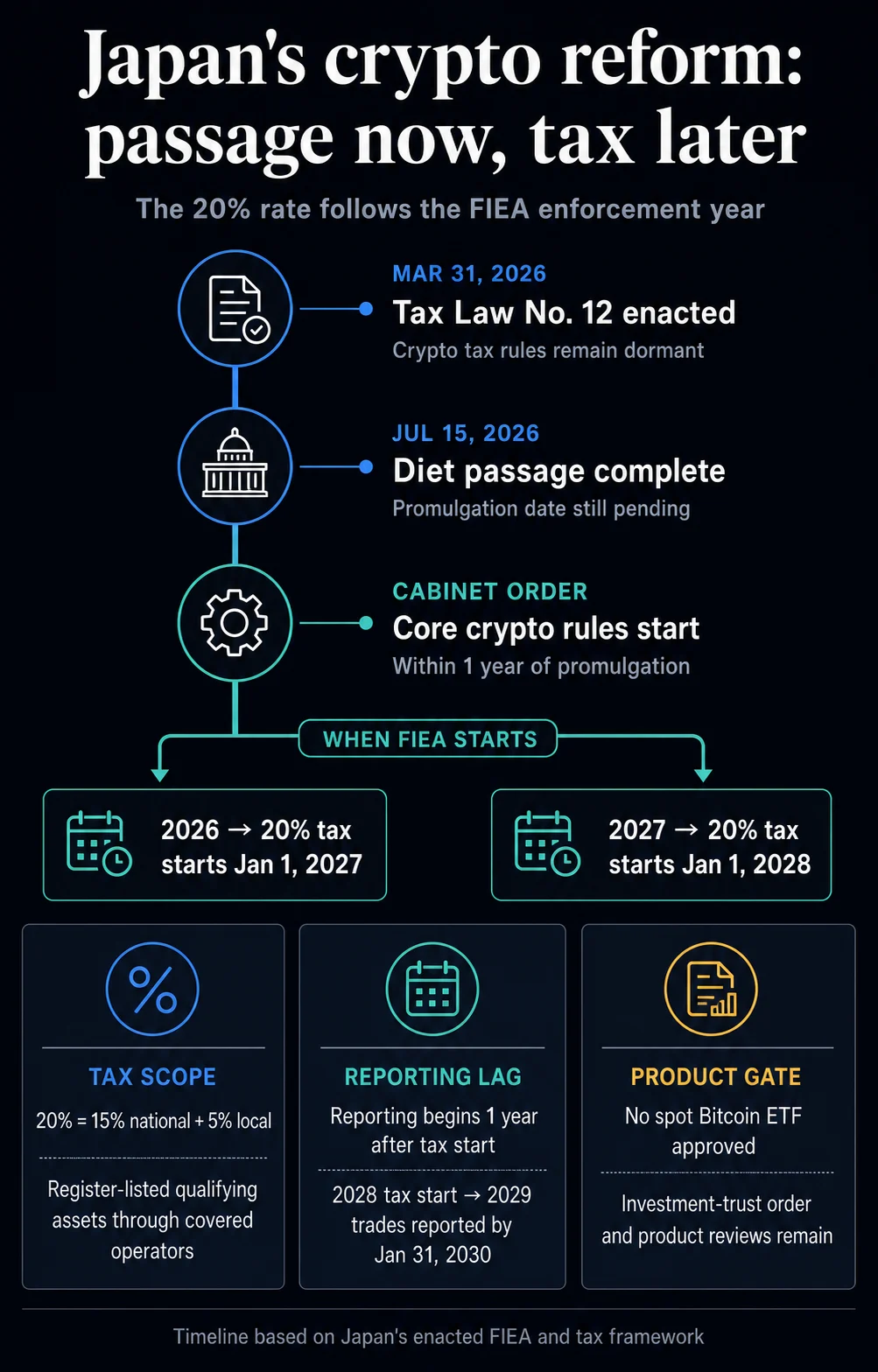
Japan’s House of Councilors has approved Cabinet Bill 57 by a majority vote on July 15, 2026, marking a significant legislative milestone that will integrate regulated cryptocurrency activities under the purview of the Financial Instruments and Exchange Act (FIEA). While the legal framework is now established, industry stakeholders and traders are keenly awaiting the precise timing for the implementation of new market rules and the much-anticipated 20% tax rate, which could potentially take effect in 2027 or extend to 2028. The final commencement date hinges on a Cabinet order that must be issued within one year of the law’s promulgation, creating a crucial juncture for the nation’s burgeoning digital asset sector.
A New Regulatory Era for Digital Assets
The core provisions of this transformative legislation are set to become effective on a date determined by Cabinet order, which must be declared within a year of the bill’s promulgation. This means that if the Cabinet designates an enforcement date within 2026, the new tax regulations would commence on January 1, 2027. Conversely, if enforcement is delayed until 2027, the tax benefits would not be realized until January 1, 2028. This staggered approach underscores the government’s deliberate pace in ushering in these significant changes.
Previously, cryptocurrency transactions were governed by the Payment Services Act. The new legislation shifts this paradigm by bringing crypto assets under the FIEA, a move that aligns them more closely with traditional securities. While cryptocurrencies will maintain their distinct legal classification from securities, the operational and compliance framework for regulated activities will adopt a securities-market-style approach.
Key Provisions and Regulatory Shifts
According to explanatory materials released by the Financial Services Agency (FSA), the updated framework will introduce enhanced disclosure and registration requirements for various crypto-related activities. These include the sale of cryptocurrencies, token offerings controlled by issuers, and borrowing of digital assets. Furthermore, the legislation mandates stringent asset screening processes, secure custody solutions, robust customer safeguards, and comprehensive insider-trading controls, mirroring the compliance standards expected in established financial markets.
Exchanges and intermediaries operating within the digital asset space can begin preparations for these new obligations, which will only become mandatory after the official commencement date. The FSA is expected to issue detailed operating requirements through subsequent Cabinet orders and its own ordinances, providing further clarity on the practical implementation of these reforms.
Tax Reform: A Long-Awaited Change
The tax component of this reform package has already been legislated, with Japan’s fiscal 2026 tax amendments enacted as Law No. 12 on March 31, 2026. This law introduces a unified 20% tax rate on qualifying cryptocurrency gains, comprising a 15% national income tax and a 5% local inhabitant tax. However, this beneficial tax rate will only come into effect once the FIEA trigger is satisfied, linking the tax benefits directly to the operational commencement of the new regulatory regime.

Crucially, the 20% tax rate is contingent upon investors selling eligible tokens through registered crypto businesses and ensuring that these assets are listed on Japan’s official register of qualifying cryptocurrencies. This provision aims to encourage participation in the regulated market and enhance transparency.
Loss Carry-Forward Provisions and Reporting Obligations
A significant development for traders is the introduction of a loss carry-forward mechanism. Under the new rules, unused losses within the same tax-defined crypto category can be carried forward for up to three years, subject to specific conditions. This provision is designed to mitigate the impact of market volatility on individual investors and encourage long-term holding strategies. It is important to note that tokens, trading venues, and transactions operating outside this defined regulated channel will continue to be subject to existing tax treatments.
Reporting obligations are slated to commence one year after the tax-and-loss rules become active. The Ministry of Finance framework indicates that businesses will be required to submit customer identities, Japan’s My Number (social security and tax identification number), and transaction details to tax authorities by January 31st of the year following the trade year. For instance, if the 20% tax regime begins in 2028, reporting would encompass transactions from 2029, with the initial reports due by January 31, 2030.
A Pathway for Crypto Investment Products
The reform package also lays the groundwork for the potential introduction of cryptocurrency investment products. The legislation brings crypto investment management and advisory services under the FIEA. It anticipates the establishment of certain investment trusts that can hold tax-qualifying, registered crypto assets. However, to facilitate this, a separate amendment to the Investment Trusts Act’s enforcement order will be necessary.
It is important to clarify that the current legislative text does not explicitly name or approve spot Bitcoin Exchange-Traded Funds (ETFs). The FSA had previously stated in October 2025 that the formation and sale of domestic crypto ETFs were prohibited under the prior regulatory framework. Sponsors seeking to launch such products will need to navigate applicable product and listing reviews once the new regulatory routes are clearly defined.
The Path Forward: Key Dates and Dependencies
The ultimate timeline for the implementation of these sweeping reforms remains subject to several critical factors. The formal enactment of the law, the timing of the Cabinet’s order to bring the FIEA changes into force, and the completion of detailed rules by the FSA are all pivotal. Once these steps are fulfilled, the 20% tax rate will then apply from the subsequent tax year.
Background and Context: Japan’s Evolving Stance on Crypto
Japan has historically been at the forefront of cryptocurrency regulation, particularly after the infamous Mt. Gox hack in 2014, which spurred early legislative action. The country was one of the first to recognize cryptocurrencies as legal tender and implement registration requirements for exchanges. However, the regulatory landscape has been a dynamic one, with continuous efforts to balance innovation with investor protection and financial stability.

The recent legislative push reflects a growing recognition of the potential economic benefits of digital assets, coupled with a desire to foster a more robust and secure domestic crypto market. The integration into the FIEA signals a maturing approach, moving away from treating crypto as a novelty and instead embedding it within the established financial regulatory architecture. This move is expected to attract more institutional interest and provide greater clarity for businesses and investors alike.
Industry Reactions and Potential Implications
While the overarching sentiment within the crypto industry is positive, acknowledging the significant step forward, there is also an element of cautious anticipation regarding the implementation timelines. Industry associations have expressed support for the regulatory clarity provided by the FIEA integration, believing it will foster greater trust and encourage mainstream adoption.
The shift to a securities-market-style regulatory framework is likely to impose higher compliance costs on businesses, particularly smaller exchanges. However, it is also expected to weed out less compliant players and elevate the standards of operation within the sector. For traders, the prospect of a clarified tax regime, including the loss carry-forward provision, is a welcome development that could stimulate more active participation in the market.
The potential for regulated crypto investment products, such as ETFs, remains a key area of interest. If Japan successfully navigates the path towards approving such products, it could position the country as a significant hub for institutional investment in digital assets, attracting global capital and talent.
The timeline for these changes, while subject to governmental discretion, is a crucial element for strategic planning by all market participants. The government’s approach, characterized by a phased implementation, suggests a commitment to thoroughness and risk mitigation. As the details of Cabinet orders and FSA ordinances emerge, a clearer picture will undoubtedly form regarding the precise trajectory of Japan’s digital asset future. The passage of this bill represents a pivotal moment, signaling Japan’s intent to be a leader in the responsible development of the global cryptocurrency economy.