admin
admin
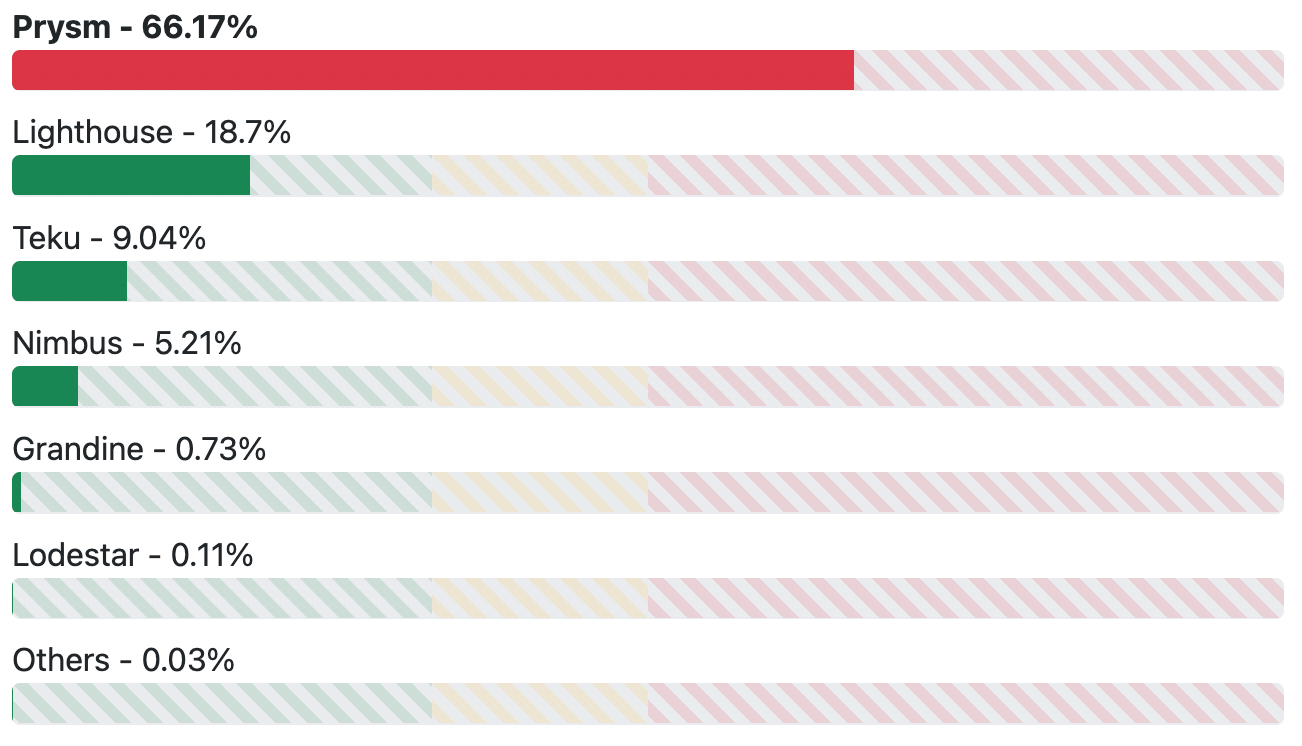
As Ethereum prepares for the most significant technical upgrade in the history of decentralized finance, the community finds itself at a crossroads. The network, which currently secures hundreds of billions of dollars in digital assets and provides the foundational infrastructure for thousands of decentralized applications (dApps), is slated to transition from its legacy Proof-of-Work (PoW) consensus mechanism to a more energy-efficient Proof-of-Stake (PoS) system. This transition, colloquially known as "The Merge," has been likened by developers to "changing the engine of a jet while it is still in flight." Central to the success of this maneuver is the concept of client diversity—a safeguard intended to prevent a single software bug from crippling the entire network. However, current data suggests that Ethereum faces a precarious situation: a single client, Prysm, currently commands approximately 66% of the network’s staking power.

The Architectural Blueprint of The Merge
To understand the risks associated with client concentration, one must first grasp the technical nuances of the upcoming transition. The Merge is not a simple software update but a fundamental fusion of two independent layers. The first is the existing Ethereum Mainnet, which handles transactions and smart contract execution. The second is the Beacon Chain, a PoS coordination layer that has been running in parallel since December 2020.
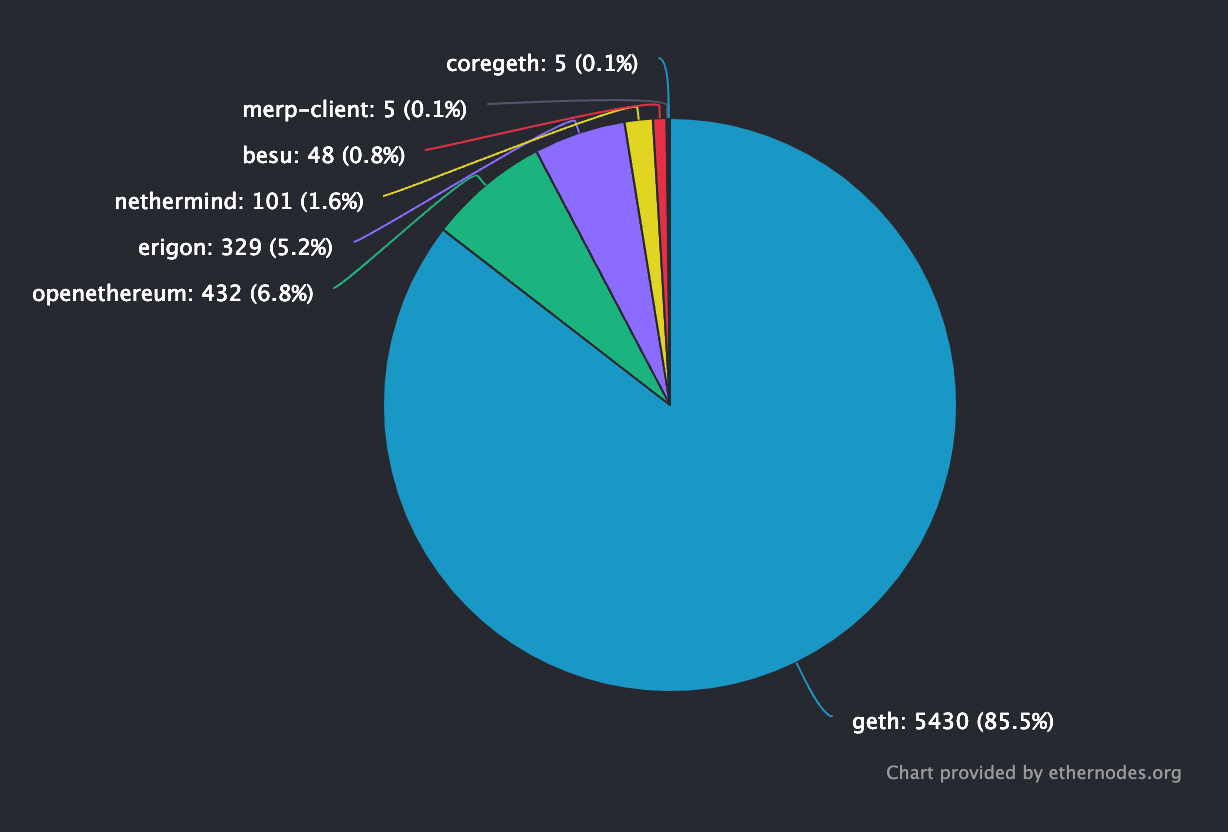
Post-merge, the duties of an Ethereum node will be bifurcated into two distinct roles. Execution clients, such as Geth (Go-ethereum), will continue to manage the Ethereum Virtual Machine (EVM), processing transactions and updating the state of the blockchain. Meanwhile, consensus clients—the software that implements the PoS protocol—will handle the validation of blocks and the reaching of agreement across the network.

Unlike Bitcoin, which relies almost exclusively on a single software implementation (Bitcoin Core), Ethereum’s philosophy has always been rooted in multi-client resilience. By encouraging different teams to build clients in various programming languages (such as Go, Rust, Java, and Nim), the Ethereum Foundation (EF) aimed to ensure that a critical vulnerability in one codebase would not result in a total network failure.
The Mathematics of Consensus Failure
The danger of client dominance is rooted in the mathematical thresholds of the Proof-of-Stake protocol. Ethereum’s consensus mechanism requires a two-thirds majority to "finalize" blocks, making them immutable. If a single client software is used by more than 66% of the network’s validators, it achieves a "supermajority."

If a client with a supermajority suffers a critical bug that causes it to deviate from the protocol, the consequences are existential. Because the buggy client represents more than two-thirds of the network, it has the power to finalize an invalid chain. In this scenario, the non-buggy clients (the minority) would be unable to finalize the correct chain. The network would effectively split, and the "buggy" chain would be recognized as the official state by the majority.
The recovery process for such an event is draconian. Non-buggy nodes would either have to follow the buggy chain—potentially compromising the integrity of all transactions—or the network would undergo an "inactivity leak." This mechanism gradually burns the stakes of the majority (the buggy nodes) until they no longer hold a two-thirds share, allowing the minority to regain control and finalize the correct chain. For stakers using the dominant client, this could result in the total loss of their staked capital.
The Current Landscape: Prysm’s Dominance
As of the current assessment, the Prysm client, developed by Prysmatic Labs, holds a market share hovering at the critical 66% mark. While other clients exist—including Lighthouse (Sigma Prime), Teku (ConsenSys), Nimbus (Status), and newer entries like Grandine and Lodestar—none have managed to significantly erode Prysm’s lead.
The reasons for Prysm’s dominance are largely historical and pragmatic. Speaking to CryptoSlate, Marius van der Wijden, an Ethereum core developer, attributed the client’s success to a "first-mover advantage." Prysm was the first implementation to offer a stable prototype for the Beacon Chain, allowing it to build a robust ecosystem of documentation and developer tools early on. Furthermore, Prysm is written in Golang, a language that is highly performant and widely understood by the existing developer base that maintains Geth, the dominant execution client.
The Role of Institutional Stakers and Exchanges
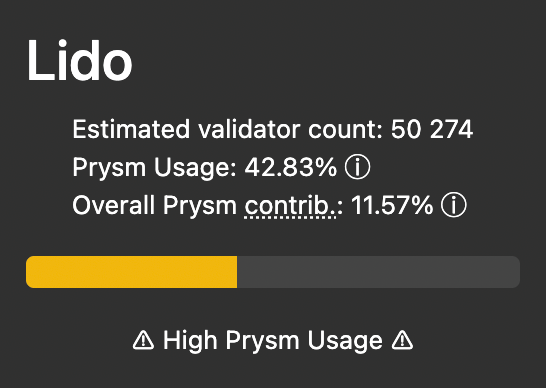
The concentration of staking power is not merely a result of individual hobbyists choosing the same software. It is driven by the massive "staking-as-a-service" providers and centralized exchanges that manage thousands of validator nodes on behalf of their users.
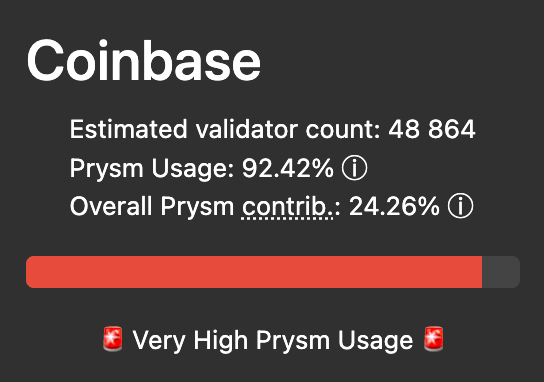
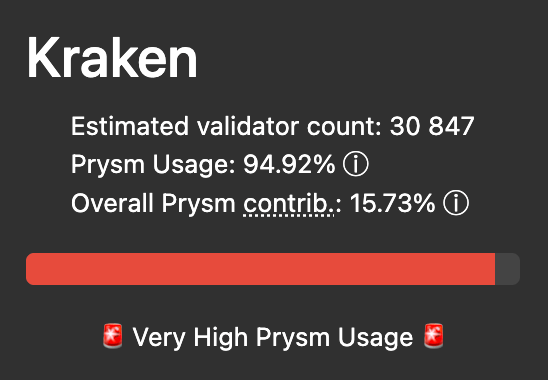
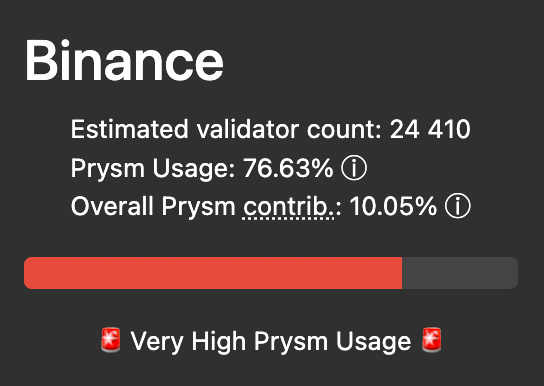
Major players such as Coinbase, Kraken, and Binance represent a significant portion of the validator set. Data indicates that Coinbase alone manages nearly 18% of all validators on the Beacon Chain, with over 92% of those nodes running Prysm. Kraken follows a similar pattern, with approximately 95% of its 30,000+ validators relying on the same software.
When questioned about this concentration, institutional providers often cite security and stability. Coinbase Cloud noted that at the time of their launch, Prysm was the only client that supported "remote signers." This feature allows validator keys to be stored in isolated, highly secure environments rather than on the validator server itself, a prerequisite for institutional-grade security.
However, the tide is beginning to turn. Kraken’s Senior Product Manager, Brian Hoffman, confirmed that the exchange has begun discussions with the Ethereum Foundation to diversify its infrastructure. "We have started to roll out new validators built on Teku, as well as migrate some existing ones," Hoffman stated, signaling a growing awareness of the systemic risk posed by client uniformity.
A Chronology of Ethereum’s Path to Proof-of-Stake
The journey toward The Merge has been a multi-year endeavor marked by several key milestones:
- July 2015: Ethereum launches with a long-term roadmap that includes an eventual move to PoS.
- December 2020: The Beacon Chain goes live, allowing users to begin staking ETH, though the assets remain locked.
- August 2021: The London Hard Fork introduces EIP-1559, altering Ethereum’s fee structure and setting the stage for the economic changes of PoS.
- December 2021: The Kintsugi testnet is launched, providing the first public venue for testing the Merge transition.
- March 2022: The Kiln testnet successfully simulates the Merge, marking the final public testnet before moving to existing long-lived testnets like Ropsten and Sepolia.
- Mid-2022 (Projected): The official Merge on the Ethereum Mainnet is expected to occur, provided client diversity and stability metrics are met.
Risk Mitigation and the Path Forward
Despite the risks, Ethereum core developers remain confident in the safety of the transition. The community has implemented rigorous "fuzzing" and testing protocols where different clients are pitted against each other in simulated environments to identify consensus discrepancies before they can manifest on the mainnet.
Furthermore, the social layer of Ethereum acts as a final backstop. There is a strong consensus among developers that stakers who contribute to a supermajority risk will not be "bailed out" if their client fails. This "anti-correlation" incentive is designed to make it economically rational for large stakers to switch to minority clients. If a bug occurs in a minority client (one with less than 33% share), the network continues to function without interruption, and only those specific stakers are penalized. If a bug occurs in a majority client, the penalties are exponentially more severe.
Marius van der Wijden emphasized that while the situation is not ideal, it is not a reason to delay the upgrade indefinitely. "The chances of a consensus failure happening are very small," he noted. "We have the infrastructure to push out new releases and resolve forks quickly."
Broader Implications for the Blockchain Industry
The resolution of the client diversity issue will have lasting implications for the broader cryptocurrency market. If Ethereum successfully navigates The Merge despite the Prysm concentration, it will set a gold standard for decentralized governance and technical resilience. It would validate the "multi-client" approach as a viable, albeit difficult, path for securing global-scale blockchains.
Conversely, a failure would likely trigger a massive loss of confidence in the Ethereum ecosystem, potentially benefiting competing Layer-1 blockchains such as Solana, Avalanche, or Cardano, which have different approaches to consensus and decentralization.
As the countdown to The Merge continues, the pressure remains on major exchanges and staking pools to diversify their software stacks. The Ethereum Foundation continues to provide grants and support for minority clients like Nimbus and Lodestar, hoping to achieve a more balanced distribution before the final block of the Proof-of-Work era is mined. The stakes are clear: the security of the world’s most active smart contract platform depends not just on the code itself, but on the diversity of the machines running it.