admin
admin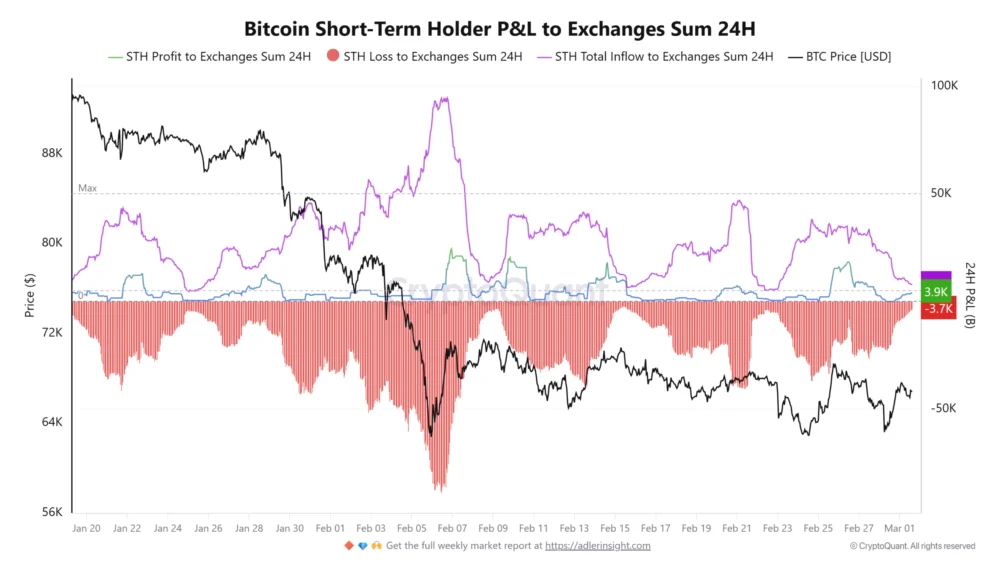
Bitcoin (BTC) embarked on a notable rally on Monday, breaching the $70,000 threshold, even as geopolitical instability cast a lengthening shadow across the Middle East. This surge comes at a time when traditional financial markets often exhibit caution, prompting a closer examination of the underlying dynamics driving the cryptocurrency’s performance. Crucial on-chain metrics, particularly those concerning short-term holders, indicate a significant shift in market behavior, pointing towards a newfound resilience that contrasts sharply with previous periods of price volatility.
Data from Glassnode, a leading on-chain analytics firm, reveals that the transfer of losses from short-term holders (STHs) to cryptocurrency exchanges has fallen to a two-week low over the past 24 hours. This deceleration in loss-driven selling activity on exchanges stands in stark contrast to the aggressive selling observed earlier in February, suggesting a maturing market response to external pressures. The slowing exchange flows signal a notable reduction in immediate sell-side pressure from the cohort most susceptible to panic selling during periods of market stress.
Geopolitical Undercurrents and Bitcoin’s Resilience
The backdrop to Bitcoin’s recent ascent is a heightened state of geopolitical tension, primarily centered on escalating dynamics between the United States and Iran within the Middle East. Such regional conflicts typically introduce significant uncertainty into global financial markets, often leading to a flight to perceived safe-haven assets like gold or government bonds. Bitcoin’s performance in this environment has sparked renewed debate about its role as a digital alternative to traditional safe havens, particularly given its decentralized nature and independence from state-controlled financial systems.
Historically, Bitcoin’s reaction to geopolitical events has been mixed, sometimes acting as a risk-on asset that dips with broader markets, and at other times demonstrating uncorrelated or even inverse behavior. The current rally, occurring simultaneously with rising geopolitical concerns, lends weight to the argument that a segment of investors views Bitcoin as a hedge against systemic instability or currency debasement. This narrative gains traction especially when the perceived stability of fiat currencies or the accessibility of traditional assets comes into question due to political or economic crises.
Short-Term Holders Exhibit Unwavering Resolve
A key indicator of market sentiment and potential future price movements is the behavior of short-term holders. These participants, defined as Bitcoin holders who have acquired their assets relatively recently (typically within the last 155 days), are often considered the most reactive to price fluctuations and external news events. Their profit/loss (P&L) transfer to exchanges metric, tracked by CryptoQuant, provides insight into how much Bitcoin these recent buyers are sending to exchanges, either to realize profits or cut losses. This cohort is known for amplifying volatility during stress events, making their current restraint particularly noteworthy.
On March 1, for instance, even as geopolitical tensions between the United States and Iran escalated, leading to a dip in Bitcoin’s price to $63,000, the realized losses transferred to exchanges by STHs fell significantly to approximately 3,700 BTC. This figure represents a dramatic decrease compared to earlier periods of intense selling. For a stark comparison, between February 5 and 6, STHs transferred a staggering 89,000 BTC to exchanges at a realized loss within a mere 24-hour window. That period marked a clear capitulation event, characterized by widespread panic selling among newer market entrants.
Since that peak capitulation in early February, the loss-driven inflows to exchanges have steadily compressed. This trend indicates a significant shift in the psychological landscape of the market. Crypto analyst MorenoDV, commenting on the CryptoQuant platform, highlighted this resilience, noting that the most event-sensitive holders have not accelerated their distribution, exhibiting "zero panic." This observation underscores a heightened level of conviction among recent buyers, suggesting that many are choosing to hold onto their assets despite price dips and external uncertainties, rather than succumbing to fear and selling at a loss. The sustained drop in loss transfers is a strong signal that the immediate sell pressure from short-term buyers has considerably cooled, laying a more stable foundation for potential price appreciation. The sustainability of the current rally, therefore, heavily relies on whether these realized losses remain contained or if they reaccelerate towards prior capitulation levels, especially as geopolitical uncertainty persists.

Deleveraging Fuels a Healthier Market Structure
Beyond spot market dynamics, the derivatives market for Bitcoin has also undergone significant adjustments, contributing to a healthier overall market structure. Data from BTC derivatives indicates a substantial reduction in risk, particularly on major platforms. Crypto analyst Darkfost pointed out that Binance’s Open Interest (OI), a measure of the total number of outstanding derivatives contracts that have not been settled, has declined by 25% since the beginning of the year. Specifically, it fell from 130,800 BTC to 97,680 BTC. This contraction signifies a considerable deleveraging trend among traders.
The estimated leverage ratio, which assesses the relationship between open interest and the amount of BTC held in exchange reserves, has also seen a significant reduction. It fell to a weekly average of 0.146. Historically, levels below 0.15 have coincided with aggressive deleveraging phases throughout this market cycle. A lower leverage ratio implies that the market is less susceptible to cascading liquidations, where a small price movement can trigger a chain reaction of forced selling due to over-leveraged positions. This reduction in leverage creates a more stable trading environment, allowing for more organic price discovery rather than movements driven by technical liquidations. The market’s ability to absorb recent geopolitical shocks without triggering a widespread deleveraging event, similar to those seen in previous volatile periods, suggests an increased maturity and robustness in its derivatives infrastructure.
Technical Reclaim and Liquidity Targets
From a technical analysis perspective, Bitcoin’s price action further reinforces the bullish sentiment. The cryptocurrency is actively attempting to reclaim its Monthly Volume-Weighted Average Price (RVWAP), which currently hovers around the high-$68,000 region. The Monthly RVWAP serves as a crucial technical indicator, representing the average price of Bitcoin adjusted for trading volume since the start of the month. Trading above this level is often interpreted as a bullish signal, indicating that the average monthly participant is now in profit. This shift can significantly alter the short-term positioning bias of traders, encouraging further buying interest and reinforcing upward momentum.
Examining the four-hour chart, Bitcoin’s price has forcefully pushed through the $70,000 mark and is now approaching a significant external liquidity pocket situated between $70,000 and $71,500. This range represents a concentration of sell orders and potential resistance. Successfully converting this range into a new support level could act as a catalyst for further price expansion, potentially targeting the $80,000 region. This $80,000 level previously acted as a supply zone, capping upside movements in January, and would represent a significant psychological and technical hurdle to overcome.

Crypto trader LP articulated the importance of these liquidity zones, stating, "On the HTF [higher timeframe], low-leverage liquidation clusters are stacking near and just above the range highs, sitting between 70–73K. These higher timeframe liquidity pools often act as magnets when they build in size." This suggests that a substantial amount of capital is positioned at these levels, and breaking through them could trigger further buying, as those on the sidelines or short positions are forced to cover. The accumulation of these liquidity clusters reinforces the idea that breaching this initial resistance band could pave the way for a more pronounced rally.
Spot Demand Underpins the Rally
The recent price surge is not merely a derivatives-driven phenomenon; robust spot market activity provides a strong foundation for the rally. Analyzing Bitcoin spot flow data across major exchanges offers additional context. During the breakout leg, Binance, one of the world’s largest cryptocurrency exchanges, recorded approximately $7.79 million in positive delta. Coinbase, another significant player, contributed about $1.16 million in positive delta, while OKX added nearly $3.7 million.
A "positive delta" in this context signifies aggressive spot bidding, meaning that more market participants are actively buying Bitcoin at market price than selling. This collective positive delta across multiple prominent exchanges is a critical indicator. It suggests that the price movement is being driven by genuine demand in the underlying asset, rather than being an isolated or transient event primarily fueled by leveraged derivatives trading. When spot demand is strong, it provides a more sustainable basis for price increases, as it reflects a deeper conviction from buyers who are acquiring the actual asset rather than just speculating on its price movements with leverage.
With leverage use significantly reduced across derivatives markets and loss-driven selling from short-term holders subsiding, market attention is now firmly fixed on how Bitcoin’s price will interact with the $71,500 liquidity band. A decisive breach and conversion of this level into support could signal the continuation of the current bullish trend, further solidifying Bitcoin’s position in a complex global financial landscape.

Broader Market Implications and Outlook
Bitcoin’s ability to rally in the face of heightened geopolitical uncertainty in the Middle East offers compelling insights into its evolving role within the global financial system. The observed restraint from short-term holders, coupled with significant deleveraging in the derivatives market, suggests a maturation of the Bitcoin market. This indicates that participants are becoming less prone to panic selling and more resilient to external shocks, perhaps reflecting a growing understanding of Bitcoin’s long-term value proposition.
The strong spot buying activity further validates the current upward momentum, indicating a genuine appetite for the asset. This contrasts with previous rallies that were sometimes viewed as overly reliant on speculative derivatives trading. As global economic and political landscapes continue to shift, Bitcoin’s performance in such turbulent times will be closely watched. Its perceived safe-haven qualities, particularly its decentralized nature and limited supply, are increasingly being tested and, in this instance, appear to be reinforcing its value proposition to a segment of investors.
Looking ahead, the market will be keenly observing if Bitcoin can sustain its position above key technical levels and effectively convert the $70,000-$71,500 resistance zone into robust support. The successful navigation of this psychological and technical barrier could pave the way for further exploration of higher price territories, potentially revisiting and surpassing previous all-time highs. The convergence of reduced selling pressure, a healthier derivatives market, and strong spot demand creates a fertile ground for continued upside, positioning Bitcoin as a significant asset to monitor amidst ongoing global complexities. This dynamic performance suggests that Bitcoin is not merely reacting to events but is increasingly carving out its unique narrative in the context of global financial and geopolitical developments.
This article does not contain investment advice or recommendations. Every investment and trading move involves risk, and readers should conduct their own research when making a decision. While we strive to provide accurate and timely information, Cointelegraph does not guarantee the accuracy, completeness, or reliability of any information in this article. This article may contain forward-looking statements that are subject to risks and uncertainties. Cointelegraph will not be liable for any loss or damage arising from your reliance on this information.