admin
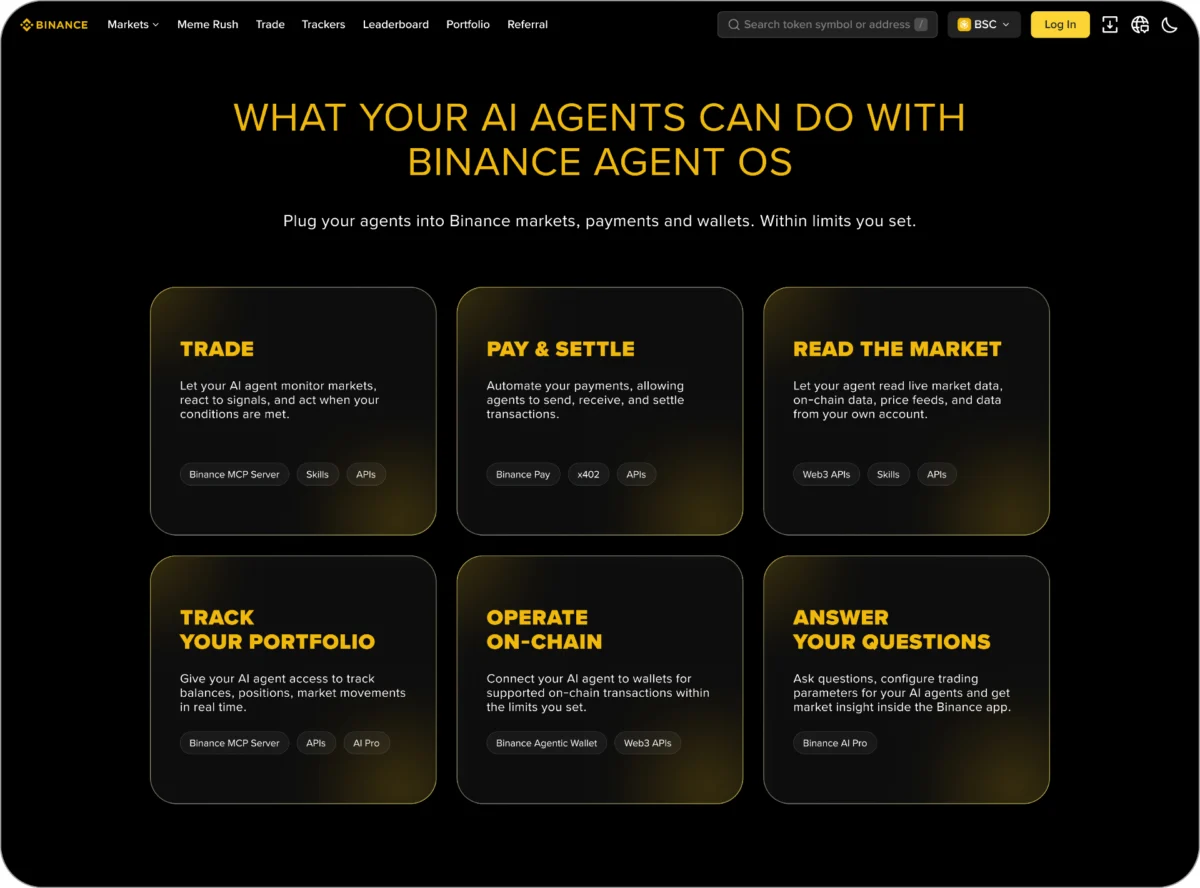
Binance, the world’s largest cryptocurrency exchange by trading volume and user base, has officially entered the era of autonomous finance with the launch of Agent OS. This new platform, unveiled on Thursday, represents a significant shift in the cryptocurrency landscape, transitioning from simple human-led trading to a sophisticated ecosystem where artificial intelligence agents can analyze market trends, manage portfolios, and execute high-speed transactions on behalf of users. With over 300 million registered users, Binance’s move to integrate autonomous AI directly into its financial infrastructure signals a major milestone in the intersection of decentralized finance (DeFi) and generative artificial intelligence.
The Agent OS platform is designed as a bridge between the world’s most advanced AI models and the complex liquidity of the global crypto markets. By providing a unified interface, Binance allows developers to connect AI applications—ranging from custom-built algorithms to mainstream models like OpenAI’s ChatGPT and Anthropic’s Claude—directly to the exchange’s core services. This integration is facilitated through several key technical components, including the Binance API, the Binance Wallet Agentic Hub, and the Binance x402 transaction verification system, which acts as a payment facilitator for AI-driven workflows.
Technical Architecture and the Model Context Protocol
At the heart of the Agent OS launch is Binance’s support for the Model Context Protocol (MCP). Developed as an open standard, MCP allows AI agents to maintain a consistent "context" or understanding of data across different applications and servers. In the context of Binance, this means an AI agent can simultaneously pull real-time pricing data from the exchange, monitor social media sentiment via external tools, and check a user’s account balance to make an informed trading decision without human intervention.
The platform’s compatibility extends to several industry-leading developer tools. Users can authorize agents within environments such as Cursor or Claude Code to access market data and execute trades. This level of integration aims to lower the barrier to entry for algorithmic trading, which was previously the exclusive domain of high-frequency trading firms and institutional investors with deep technical resources. Now, a developer using a standard LLM (Large Language Model) can theoretically deploy a sophisticated trading strategy with a few lines of natural language instruction.
User Control and the Subaccount Safety Model
The transition from "chatbots that answer questions" to "agents that take action" introduces significant risks, particularly regarding the security of funds and the potential for runaway algorithms. To address these concerns, Binance has implemented a governance model that places the ultimate responsibility and control in the hands of the human user. Jeff Li, Vice President of Product at Binance, emphasized that the platform is built on a foundation of granular access control rather than unrestricted autonomy.
The primary mechanism for this protection is the use of "subaccounts." When a user deploys an AI agent via Agent OS, the agent does not gain access to the user’s entire portfolio. Instead, it is confined to a dedicated subaccount that acts as a financial sandbox. These subaccounts are configured with specific permissions—such as limiting the agent to spot trading only or futures trading—while withdrawals are blocked by default. This ensures that even if an agent’s logic fails or it is compromised by an external attack, the potential loss is limited to the funds manually transferred into that specific subaccount.
Binance has stated that it does not impose a secondary "loss limit" on these agents; the amount of capital a user allocates to the subaccount serves as the effective hard cap on risk. Furthermore, users retain the ability to require manual approval for every trade an agent proposes, or they can opt for full autonomy once they are comfortable with the agent’s performance and parameters.
The Challenge of AI Transparency and Security
One of the most complex aspects of autonomous trading is the "black box" nature of AI decision-making. During the platform’s unveiling, Jeff Li noted that the reasoning behind any specific trade occurs outside of Binance’s internal systems—either on the user’s local machine or within the infrastructure of the AI provider (like OpenAI or Anthropic). Consequently, while Binance can monitor the resulting trade activity for signs of market manipulation or money laundering, it cannot see the internal "thought process" that led the agent to execute a buy or sell order.
This lack of visibility highlights a growing concern in the tech industry: prompt injection and adversarial manipulation. If an AI agent is monitoring a news feed to inform its trading strategy, a malicious actor could theoretically publish a "poisoned" news article designed to trigger a specific response from the AI. Binance’s defense against such scenarios relies heavily on its existing risk-control frameworks and the aforementioned subaccount restrictions. The company maintains that all existing anti-money laundering (AML) and security protocols that apply to standard API trading will also be enforced for all activity originating from Agent OS.
A Growing Trend: The Competitive Landscape of AI Agents
Binance is not the first major player to recognize the potential of the "agentic web" in finance. The launch of Agent OS follows a series of similar moves by rival exchanges, indicating a broader industry trend toward the automation of the retail trading experience.
- Kraken: In March 2024, Kraken released an open-source command-line tool equipped with an MCP server. This allowed developers to build agents that could interact with Kraken’s spot and futures markets using standardized protocols.
- Coinbase: In June 2024, the U.S.-based exchange launched "Coinbase for Agents." This suite of tools was specifically marketed as a way to give AI agents a "bank account," allowing them to hold balances, make payments, and execute financial workflows autonomously.
- OKX: Earlier this year, OKX introduced its Agent Trade Kit, an open-source toolkit designed to simplify the process of connecting LLMs to its trading engine.
The race among these platforms is driven by the realization that as AI models become more capable of reasoning, they will increasingly become the primary interface through which users interact with the blockchain. In this future, the "user" of an exchange may not be a human clicking buttons on a screen, but an agent working 24/7 to optimize a portfolio.
Economic Implications and Market Impact
The widespread adoption of AI agents in the cryptocurrency market could have profound implications for market liquidity and volatility. On one hand, agents can provide constant liquidity by reacting to market inefficiencies faster than any human could, potentially narrowing spreads and making markets more efficient. On the other hand, the "herding" effect—where multiple AI agents using similar models react to the same signal simultaneously—could lead to "flash crashes" or periods of extreme, unexplained volatility.
Furthermore, Agent OS extends beyond simple trading. By integrating with the Binance x402 protocol and the Agentic Wallet, these agents can participate in the decentralized finance (DeFi) ecosystem. This includes interacting with lending protocols, providing liquidity to automated market makers (AMMs), and settling micro-payments. Binance has established daily transaction limits for these activities to prevent systemic shocks:

- Token Swaps: Capped at $50,000 per day.
- DeFi Transactions: Default limit of $100,000 per day.
- x402 Payments: Limited to a conservative $20 per day.
These limits suggest that while Binance is eager to foster innovation, it remains cautious about the potential for autonomous agents to cause large-scale financial disruption or facilitate illicit transfers at scale.
Timeline of the AI-Crypto Convergence
The journey to Agent OS has been shaped by several key technological milestones over the past two years:
- Late 2022: The launch of ChatGPT sparks global interest in generative AI, leading crypto developers to experiment with AI-generated trading code.
- Mid-2023: Early "AutoGPT" projects attempt to give AI access to the web and local files, though they struggle with reliability in financial contexts.
- Early 2024: The emergence of "Agentic Frameworks" and protocols like MCP provides the necessary standardized "plumbing" to connect AI models to financial APIs securely.
- August 2024: Binance officially launches Agent OS, marking the entry of the world’s largest liquidity provider into the agentic space.
Analysis of the Road Ahead
The launch of Agent OS is a "first step," according to Binance leadership. The ultimate goal is to create a platform where AI-powered applications can act seamlessly across both crypto-native and traditional financial markets. However, the success of this initiative will depend on how well Binance navigates the regulatory scrutiny that inevitably follows the automation of finance.
Regulators in the United States, Europe, and Asia are already grappling with how to categorize AI-driven financial advice and execution. If an AI agent makes a "bad" trade based on faulty logic, the question of liability remains legally murky. By placing the control and responsibility squarely on the user’s shoulders through the subaccount model, Binance is attempting to mitigate its own legal exposure while providing the tools for the next generation of financial innovation.
As the industry moves forward, the focus will likely shift from the "intelligence" of these agents to their "reliability." For the 300 million users on Binance, Agent OS offers a glimpse into a future where managing wealth is no longer a manual chore, but a supervised, automated process driven by the most advanced technology of the 21st century. Whether this leads to a more stable or a more chaotic market remains to be seen, but the era of the autonomous financial agent has undeniably arrived.