admin
Bitcoin experienced a significant downturn, dropping below the $63,000 mark on Wednesday, as Wall Street opened to widespread investor apprehension fueled by persistent inflation concerns. This sharp decline in the premier cryptocurrency mirrored a broader dip across U.S. equity markets, underscoring the tight interconnectedness between the nascent digital asset space and traditional finance, especially when macroeconomic pressures intensify. The market jitters were significantly amplified by hawkish commentary from a key Federal Reserve official, suggesting a more aggressive approach to combating inflation than currently anticipated by investors.
The Federal Reserve’s Inflation Battle Intensifies
The catalyst for much of Wednesday’s market volatility stemmed from remarks by Federal Reserve Governor Christopher Waller, who articulated a compelling case for a more forceful intervention in monetary policy. Speaking to CNBC, Waller suggested that the Federal Open Market Committee (FOMC) might need to implement an interest-rate "shock" by raising rates by 50 basis points (bps) at its upcoming December meeting. This proposal significantly deviates from the prevailing market consensus, which largely forecasts a more modest 25-basis-point increase. The difference between a 25 bps hike and a 50 bps hike, while seemingly small, carries substantial weight in market psychology and economic forecasting. A 50 bps move is often interpreted as an "aggressive action" by the central bank, signaling a heightened sense of urgency regarding inflationary pressures.
Waller’s argument was rooted in the troubling observation that the Consumer Price Index (CPI) inflation has consistently remained above the Fed’s long-term 2% target for an extended period, now spanning five years. This prolonged period of elevated prices indicates that inflationary forces are not merely transitory but potentially becoming embedded within the economic fabric. He expressed particular concern that businesses have grown "comfortable" with the idea of passing on annual price increases of "3% or higher" to consumers. This normalization of higher price hikes presents a significant challenge to the Fed’s mandate of price stability. Waller emphasized the psychological aspect of such an aggressive rate hike, stating, "You might need to, like, shock people to say, ‘Wait a minute; 3% is not the number you should be thinking about going forward.’" This indicates a desire to firmly anchor inflation expectations back towards the Fed’s target, preventing a self-fulfilling prophecy of continuously rising prices.
Furthermore, Waller pointed out that inflationary trends were no longer confined to sectors directly impacted by specific geopolitical events, such as the ongoing US-Iran conflict and the associated spikes in global oil prices. This broader spread of inflation suggests that underlying domestic demand and structural factors are now contributing significantly to price pressures, making the task of reigning it in more complex for the central bank. The Fed’s dual mandate includes achieving maximum employment and stable prices. When inflation runs hot, the focus often shifts decisively towards price stability, even if it entails potential trade-offs with employment growth in the short term. The prospect of "aggressive actions" highlights the Fed’s commitment to restoring equilibrium, even if it means disrupting market complacency.
Market Expectations Versus Fed Rhetoric
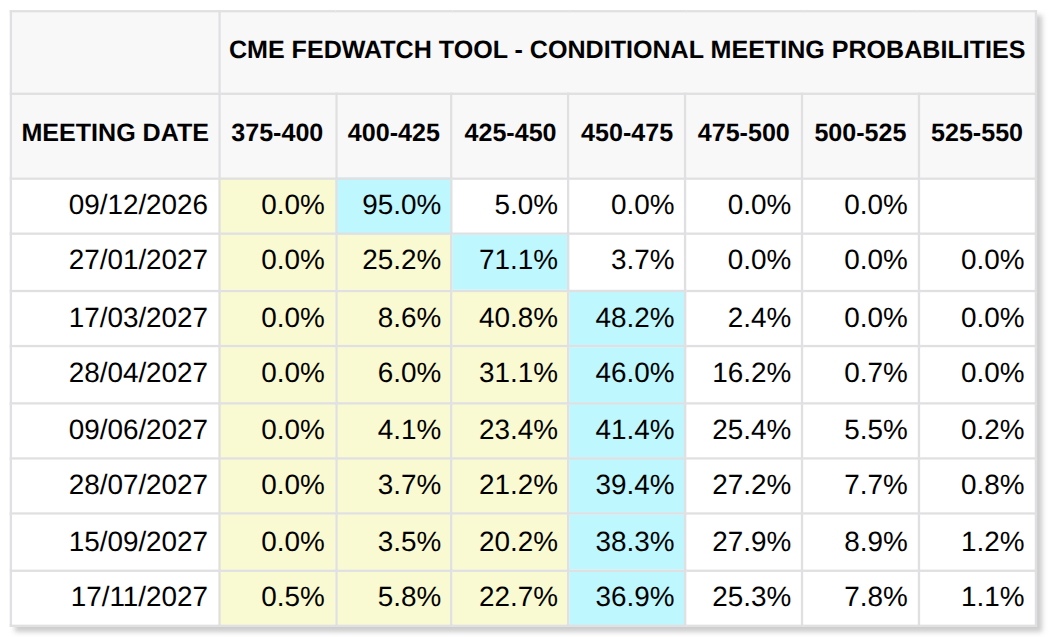
Despite Governor Waller’s decidedly hawkish stance, market participants, as gauged by the CME Group’s FedWatch Tool, continued to largely favor a less aggressive approach. The tool, which calculates the probability of various interest rate changes based on fed funds futures pricing, showed an overwhelming likelihood—above 95%—for a 25-basis-point hike in December. This significant divergence between a prominent Fed governor’s public statements and market expectations underscores a disconnect that could lead to heightened volatility if the Fed were to surprise markets with a larger hike. Investors typically price in anticipated policy moves, and a deviation from these expectations can trigger sharp reactions across asset classes.
The market’s persistent expectation of a 25 bps hike could be attributed to several factors. Firstly, there might be a belief that Waller’s comments represent an extreme view within the FOMC, and the committee as a whole might adopt a more cautious approach. Secondly, investors might be anticipating further economic data releases that could influence the Fed’s decision, potentially softening the need for a 50 bps hike. Thirdly, there’s often an inherent skepticism about the Fed’s willingness to enact "shocks" given the potential for market disruption and economic slowdowns. A more gradual approach allows markets to adjust and reduces the risk of triggering a recession.
Bitcoin’s Decline and Broader Market Performance
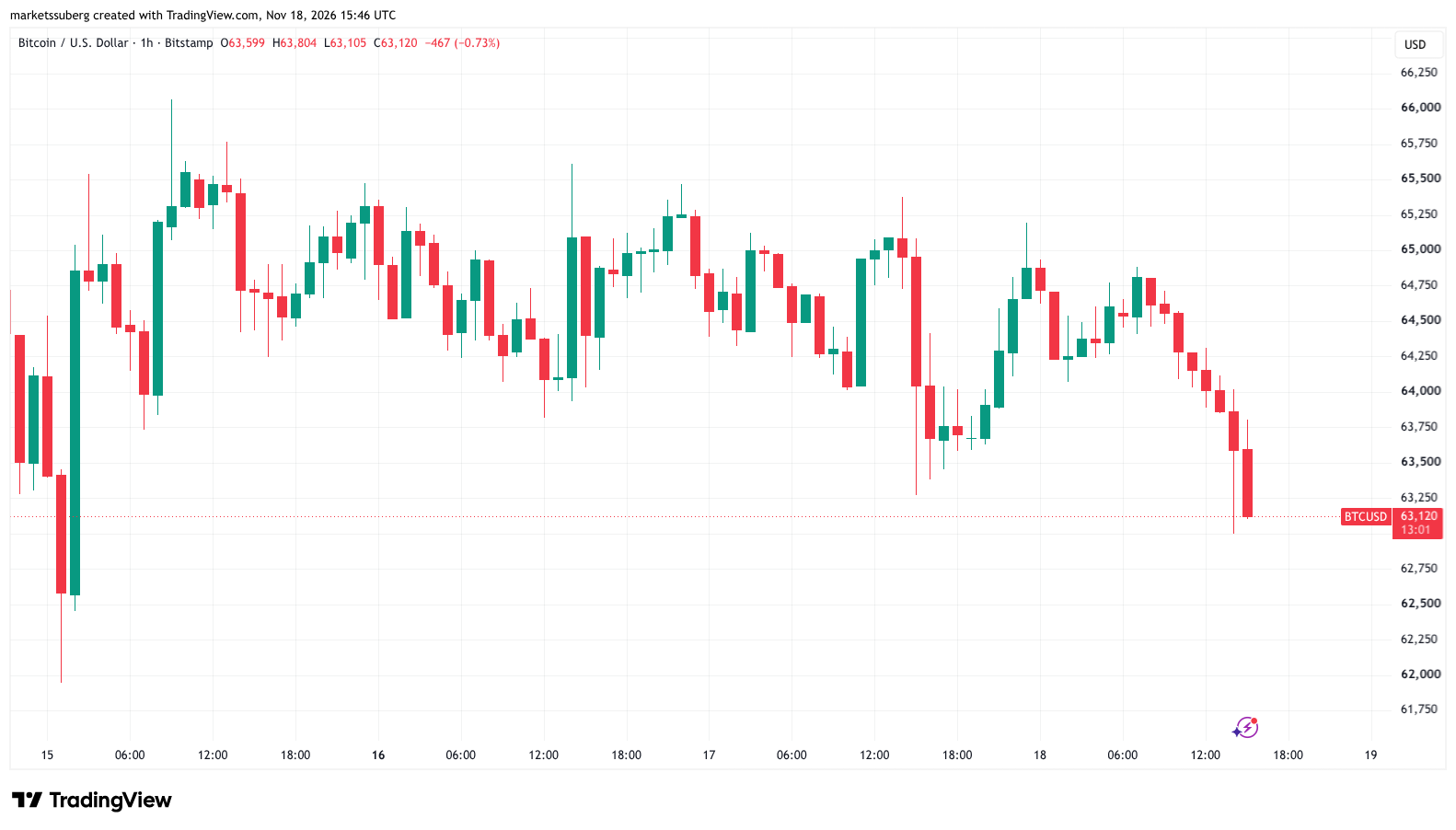
The cryptocurrency market reacted swiftly to the confluence of inflation concerns and Waller’s comments. Data from TradingView indicated that Bitcoin (BTC) was trading down 3% on the day, having incrementally sold off in the hours preceding the U.S. trading session. This downward trajectory pushed Bitcoin below the psychologically significant $63,000 level, extending a period of consolidation and struggle for upward momentum. For several days prior, Bitcoin had been largely range-bound between $64,000 and $66,000 since November 15, indicating a lack of strong conviction from either bulls or bears. The latest macro news provided the impetus for a decisive move lower.
The weakness in Bitcoin was not an isolated event but mirrored the performance of traditional U.S. equity markets. Following the Wall Street open, major indices initially dipped, attempted a brief turnaround, but ultimately slid back into negative territory. The S&P 500, a broad indicator of U.S. stock market health, was down 0.3% on the day. The tech-heavy Nasdaq Composite Index, often more sensitive to interest rate expectations due to its concentration of growth stocks, fluctuated around its daily open. This occurred despite renewed optimism in the artificial intelligence (AI) sector following Nvidia’s robust Q3 earnings beat. Nvidia’s strong performance provided a sector-specific tailwind, yet it was insufficient to counteract the broader macroeconomic headwinds of inflation concerns and hawkish Fed signals, highlighting the pervasive nature of these fears. Higher interest rates typically make future earnings less valuable in present terms, disproportionately affecting growth companies whose valuations are heavily dependent on future revenue streams.
The Counter-Narrative: An Economist’s Dissent
Not all economic observers were in agreement with the case for aggressive policy tightening. Economist Robin Brooks presented a contrasting view, arguing that the Federal Reserve might be making a "terrible mistake" by pursuing further rate hikes. In his analysis published on Tuesday, Brooks contended that the recent cooling in global oil prices negated the necessity for upping rate-hike commitments. Oil prices, a significant component of headline inflation, have indeed shown signs of moderation, which could alleviate some of the cost-push inflationary pressures.
Brooks articulated his skepticism by stating, "I don’t think any of the hawks on the FOMC have made a convincing case that underlying inflation – taking supply shocks out – is running hot." This perspective suggests that much of the elevated inflation seen recently could be attributed to temporary supply-side disruptions (like the geopolitical catalysts Waller mentioned) rather than a persistent, demand-driven overheating of the economy. If inflation is primarily a function of supply shocks, then aggressive monetary policy tightening, which primarily targets demand, might be less effective and could unnecessarily stifle economic growth. His argument implies that once these supply-side issues resolve or normalize, inflation would naturally subside without the need for drastic rate increases that could risk pushing the economy into a recession. This debate highlights a fundamental disagreement within economic circles regarding the nature and persistence of current inflationary pressures.
Bitcoin’s Institutional Flows Under Scrutiny
Adding another layer of concern for Bitcoin investors, independent analyst David Eng issued a stark warning regarding the persistent "extreme" sell-side pressure affecting the cryptocurrency. Eng’s analysis highlighted significant capital outflows from the Bitcoin ecosystem, painting a challenging picture for its immediate price recovery. Over the past 30 days, a staggering $8.7 billion in capital had exited the market. Compounding this, the relatively new U.S. spot Bitcoin exchange-traded funds (ETFs), once hailed as a major catalyst for institutional adoption, have recorded net outflows of $2.1 billion year-to-date. These outflows from institutional vehicles are particularly concerning as they suggest a waning appetite among sophisticated investors who were expected to provide sustained buying pressure.
Eng argued that Bitcoin’s recovery doesn’t necessarily require another $8.7 billion in monthly buying to offset these outflows. Instead, he emphasized the critical need for an improvement in the balance between buying and selling pressure. He quantified this need, stating that a "a $290M/day improvement would eliminate the measured net outflow." This translates to roughly $8.7 billion over a 30-day period, underscoring the magnitude of the shift required to stabilize the market. The launch of spot Bitcoin ETFs earlier in the year was seen as a watershed moment, promising to open up Bitcoin to a broader institutional audience and inject fresh capital. The fact that these vehicles are now experiencing net outflows suggests that initial enthusiasm might be tempering, or that investors are re-evaluating their positions in the face of macroeconomic uncertainty and a challenging regulatory environment.
The implications of sustained outflows are manifold. They can lead to increased selling pressure, potentially driving prices lower. They also signal a cautious or even bearish sentiment among institutional players, which can influence retail investor behavior. For Bitcoin to reclaim higher price levels, a reversal in these flow trends will be crucial, necessitating renewed institutional interest and a more favorable macroeconomic backdrop.
Broader Economic Implications and Outlook
The unfolding scenario presents several critical implications for the broader economy and financial markets. If the Federal Reserve were to adopt a more aggressive stance, such as a 50-basis-point hike, it could significantly impact economic growth. Higher interest rates increase borrowing costs for businesses and consumers, potentially dampening investment, hiring, and consumer spending. This could lead to a slowdown in economic activity, raising concerns about a potential recession. The delicate balance the Fed must strike between taming inflation and avoiding an economic downturn is a constant challenge.
Furthermore, a "shock" rate hike could trigger increased volatility across all asset classes. Traditional equities might face further downward pressure as higher discount rates reduce the present value of future earnings, and as the cost of capital rises for corporations. Bond markets could see yields adjust sharply, and the dollar might strengthen as capital flows towards higher-yielding U.S. assets. For the cryptocurrency market, which often exhibits higher volatility, such a move could exacerbate price swings and potentially lead to further capital rotation out of riskier assets like Bitcoin.
The long-term credibility of the Federal Reserve is also at stake. If inflation proves more persistent than anticipated, the Fed’s ability to anchor inflation expectations becomes paramount. A failure to act decisively could lead to a de-anchoring of expectations, where businesses and consumers begin to anticipate higher inflation as a norm, making it even harder to control in the future. Waller’s comments, therefore, can be seen as an attempt to reassert the Fed’s commitment to its price stability mandate.
Looking ahead, the December FOMC meeting will be a pivotal event, with market participants keenly watching for clues regarding the Fed’s policy trajectory. The tension between the need to combat inflation, the risk of an economic slowdown, and the divided opinions among policymakers and economists will likely continue to fuel market uncertainty. For Bitcoin and other risk assets, the path forward remains highly contingent on the evolving macroeconomic landscape and the Federal Reserve’s response to the persistent challenge of inflation. Investors will need to carefully monitor not only official policy statements but also the underlying economic data and the nuanced interpretations offered by key central bank figures.