admin
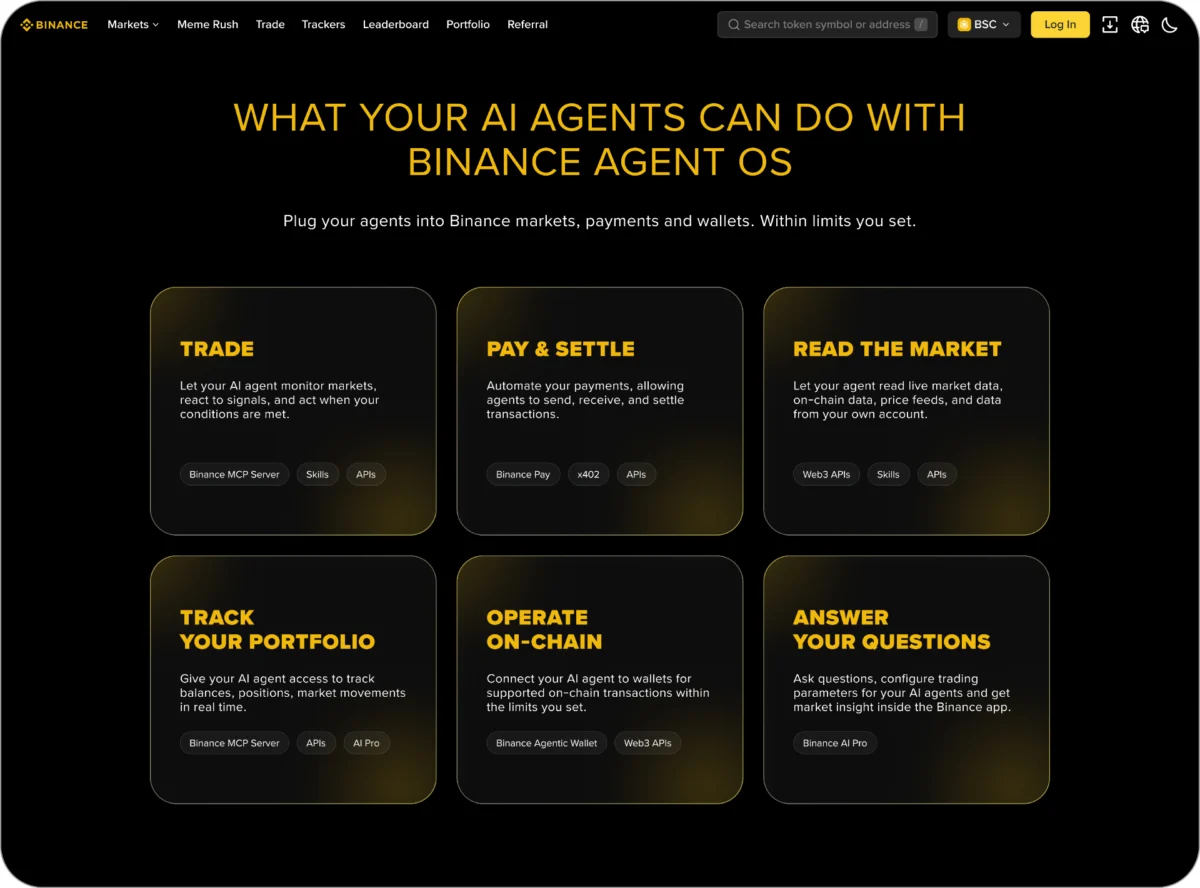
Binance, the global leader in cryptocurrency exchange services with a registered user base exceeding 300 million, has officially announced the launch of Agent OS. This new platform is designed to facilitate the integration of autonomous artificial intelligence agents into the core of financial management, allowing these digital entities to analyze market trends, interpret complex data sets, and execute trades on behalf of users. The move signals a significant shift in the industry, moving beyond simple automated scripts toward sophisticated, agentic AI that operates with a degree of independence previously reserved for human institutional traders.
By introducing Agent OS, Binance aims to bridge the gap between advanced generative AI models and the practical execution of financial transactions. The platform provides a comprehensive environment where developers can link AI applications directly to Binance’s robust financial infrastructure. This launch represents a consolidation of the exchange’s existing technological offerings with new, specialized tools designed specifically for the era of agentic workflows.
The Architectural Framework of Agent OS
At its core, Agent OS is a developer-centric ecosystem that leverages several key components of the Binance technical stack. Central to this is the integration of the Model Context Protocol (MCP), an open standard that allows AI models to seamlessly connect to external data sources and tools. By adopting MCP, Binance enables AI agents to maintain a consistent understanding of the market environment across different platforms and applications.
The platform incorporates several existing and newly refined tools:
- Binance APIs: Providing the foundational data feeds and execution pathways for market interaction.
- Binance Wallet Agentic Hub: A specialized interface designed to allow AI agents to manage digital assets securely.
- Binance x402 Transaction Verification: A payment facilitator API that ensures transactions are verified and settled with high precision.
- Binance Skill Hub: A repository of predefined capabilities that developers can "teach" to their agents, ranging from basic asset swaps to complex multi-step financial strategies.
Furthermore, Agent OS is built to be compatible with the industry’s most prominent AI models and development environments. This includes OpenAI’s ChatGPT and Codex, Anthropic’s Claude Code, and the AI-powered code editor Cursor. By providing these integrations, Binance allows users to authorize their preferred AI agents to access real-time market data, view account balances, and execute buy or sell orders within a controlled framework.
A Strategic Shift: From Chatbots to Autonomous Action
The launch of Agent OS comes at a pivotal moment in the evolution of artificial intelligence. For much of the past two years, the focus of the AI industry has been on "chatbots"—models that process information and answer questions. However, the frontier has moved toward "agents," which are defined by their ability to take autonomous action in the physical or digital world.
In the context of finance, this means an AI is no longer just telling a user that Bitcoin is undervalued; it is actively placing the order to buy it when specific conditions are met. Jeff Li, Vice President of Product at Binance, emphasized that while the technology offers significant freedom, the platform has been built with a focus on granular control. "Instead of total freedom, we put the power in users’ hands to give them the granular access control of what they can do through the agent," Li stated. This approach ensures that while the AI can act autonomously, it does so within the strict "guardrails" established by the human account holder.
Security and the "Sandbox" Methodology
One of the primary concerns regarding autonomous financial agents is the risk of catastrophic loss due to software errors, market volatility, or malicious manipulation. To mitigate these risks, Binance has implemented a "subaccount" strategy. Users are encouraged to create dedicated subaccounts specifically for their AI agents.
These subaccounts function as a digital sandbox. By default, withdrawals from these accounts are blocked, preventing an agent—or a malicious actor who has compromised an agent—from draining the user’s primary holdings. Users can configure these subaccounts for specific activities, such as spot trading or futures contracts, and can decide whether the AI requires manual approval for every trade or is permitted to operate autonomously.
Notably, Binance does not impose a centralized cap on the total volume an agent can trade or the potential losses it can incur within a subaccount. Instead, the responsibility falls on the user to manage risk by controlling the amount of capital transferred into the subaccount. This "transfer-as-limit" model places the ultimate financial responsibility on the user, reinforcing the importance of cautious deployment.
The Challenge of AI Transparency and Reasoning
A significant technical hurdle in the deployment of AI agents is the "black box" nature of their decision-making. When an AI agent executes a trade, the reasoning behind that trade often happens off-chain or on the user’s local hardware. Jeff Li noted that Binance’s systems are designed to see the result of the action, but not necessarily the rationale behind it. "We really cannot see the reasoning of what the user’s action is," Li explained.
This lack of visibility means that if an agent is influenced by faulty data, a "hallucination," or a prompt-injection attack (where a malicious actor tricks the AI into performing an unauthorized action via deceptive input), the exchange may not be able to intervene until the trade is already processed. To counter this, Binance relies on its existing suite of security protocols, including anti-money laundering (AML) monitors and risk-control filters that apply to all API-driven trading.
Use Cases: Beyond Simple Trading
While market execution is the most immediate application for Agent OS, the potential use cases extend across the broader decentralized finance (DeFi) ecosystem. Binance envisions agents performing several high-level functions:

- Market Monitoring: Agents can scan thousands of trading pairs simultaneously, identifying patterns that are invisible to human traders.
- Risk Analysis: Autonomous agents can calculate real-time Value-at-Risk (VaR) and adjust positions to maintain a specific risk profile.
- Arbitrage: Agents can react to price discrepancies between different liquidity pools or exchanges in milliseconds, executing trades to capture small price gaps.
- On-Chain Activity: Through the Agentic Wallet and x402 integration, agents can interact with DeFi protocols, participate in yield farming, or manage cross-chain payments.
To ensure stability in the broader financial system, Binance has set specific daily limits for on-chain transactions conducted via the Agentic Wallet. Daily swaps are capped at $50,000, while DeFi-specific transactions have a default limit of $100,000. For smaller, high-frequency payments, the x402 system is limited to $20 per day, providing a safety net for automated micro-transactions.
Chronology of the AI-Crypto Integration Race
Binance’s entry into the agentic AI space follows a series of moves by its primary competitors, highlighting a broader industry trend toward the "AI-fication" of crypto trading.
- March 2024: Kraken launched an open-source command-line tool equipped with a built-in MCP server. This allowed early adopters to begin experimenting with AI-driven spot and futures trading via a standardized interface.
- June 2024: Coinbase introduced "Coinbase for Agents," a suite of tools that allowed AI models to interact with the Coinbase ecosystem. This included the ability to make payments and execute financial workflows within user-defined limits, emphasizing the role of AI as a personal financial assistant.
- Early 2024: OKX released an open-source MCP toolkit, enabling its user base to integrate LLMs (Large Language Models) directly into their trading strategies.
- Late 2024: Binance officially enters the fray with Agent OS, leveraging its massive user base and deep liquidity to position itself as the primary hub for AI-driven finance.
Implications for the Financial Ecosystem
The proliferation of AI agents in the cryptocurrency market has profound implications for both retail and institutional participants. For the retail user, Agent OS democratizes access to sophisticated quant-style trading tools that were previously the exclusive domain of hedge funds and high-frequency trading firms. By lowering the barrier to entry, Binance is effectively allowing individual users to run their own "miniature funds" powered by AI.
However, the rise of autonomous agents also introduces systemic risks. If a large number of agents are trained on similar data or use similar models, they may react to market events in a synchronized fashion, potentially exacerbating flash crashes or increasing market volatility. Furthermore, the reliance on third-party AI providers like OpenAI or Anthropic introduces a new layer of dependency; an outage in an AI model’s API could theoretically freeze the trading strategies of thousands of users simultaneously.
From a regulatory perspective, the emergence of Agent OS presents new challenges. Regulators have long struggled with the "who is responsible" question in automated trading. By placing the control and responsibility firmly with the user, Binance is navigating a complex legal landscape where the software is an instrument, but the human remains the accountable party.
Conclusion: The First Step in a Larger Journey
Jeff Li described Agent OS as Binance’s "first step" toward a future where AI and finance are inextricably linked. The platform is not merely a trading tool but a foundational layer for a new generation of AI-powered applications that can operate across both crypto and traditional financial markets.
As AI models continue to evolve in their reasoning capabilities and as blockchain infrastructure becomes more integrated with global payment systems, the role of the human trader may shift from an executor of trades to a supervisor of digital agents. For Binance, the launch of Agent OS is a strategic bet that the next 300 million users will not just be looking for an exchange to trade on, but an operating system to build and manage their financial future through artificial intelligence.