
 Dwi Wanna
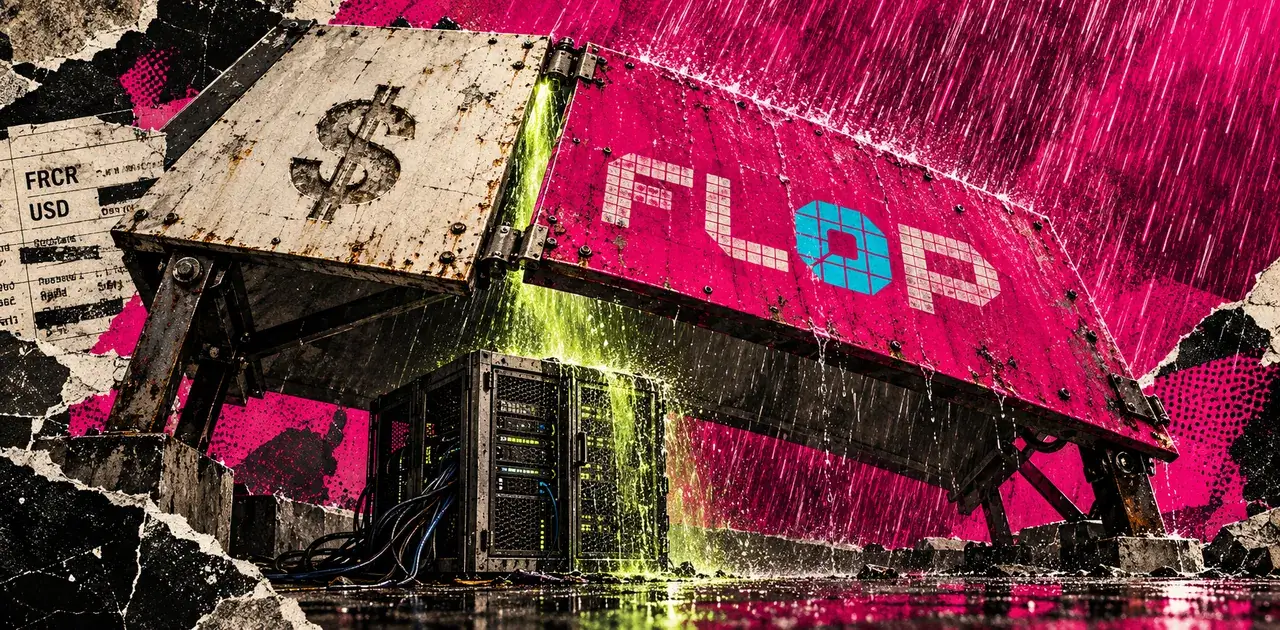
The evolution of decentralized physical infrastructure networks (DePIN) has reached a critical juncture with the introduction of specialized financial instruments designed to stabilize the costs of artificial intelligence. Arthur Hayes, the co-founder of BitMEX and a prominent figure in crypto-derivative innovation, recently unveiled a comprehensive blueprint titled "The Trifecta," which outlines a framework for AI-compute futures and perpetual swaps. These proposed contracts aim to allow businesses to hedge against the rising costs of "inference"—the computational process of running trained AI models to generate responses—by linking financial payouts to a standardized benchmark of computing power.
The Mechanism of Compute-Linked Derivatives
At the center of the proposal is the Flop Reference Compute Rate (FRCR), a theoretical index designed to track the hourly volume-weighted price of computing power on the FLOP Network. This index is measured in FLOP tokens per GigaFLOPS, creating a bridge between the digital asset market and physical computational throughput. The proposed quarterly futures contracts would utilize U.S. Dollar (USD) margin with a multiplier of $1 per index point, allowing market participants to gain exposure to the cost of compute without necessarily holding the underlying hardware or tokens.
For an AI startup or an enterprise utilizing decentralized GPU clusters, the cost of operations is typically dual-layered. First, there is the raw amount of computational work required, measured in floating-point operations. Second, there is the market price of the token used to pay for that work. Hayes’s blueprint explicitly addresses the "quanto" nature of these contracts. In traditional finance, a quanto is a derivative where the underlying asset is denominated in one currency but the instrument is settled in another. In this context, pricing the contracts requires a sophisticated adjustment for covariance—the measure of how the compute index and the FLOP-dollar exchange rate move in relation to one another.
Analytical Breakdown of the Hedging Scenarios
The efficacy of these futures depends heavily on the alignment between the buyer’s workload and the index’s movements. Because the bill for AI inference is paid in FLOP tokens, a buyer is exposed to both the "price" of compute in tokens and the "price" of the token in dollars.
To illustrate the financial dynamics, consider a hypothetical scenario where a firm requires 100,000 FLOP for its daily AI processing. If the FRCR index is at 100 points and the exchange rate is $1 per FLOP, the daily bill is $100,000. By entering 1,000 long futures contracts at 100 points, the firm creates a hedge. If the index doubles to 200 points while the token price remains stable, the bill rises to $200,000, but the $100,000 gain from the futures contract offsets the increase, maintaining a net cost of $100,000.
However, the "residual exposure" identified by Hayes occurs when the token’s exchange rate fluctuates independently of the compute index. If the index remains at 100 but the FLOP token doubles in value to $2, the firm’s dollar bill still doubles to $200,000, but the index-linked futures provide zero payout. Conversely, if the index doubles but the token value halves, the firm might find itself with a $100,000 bill and a $100,000 futures gain, effectively reducing the net cost to zero. This highlight underscores that a matched index hedge alone does not eliminate dollar-denominated spending volatility unless the currency exposure is also managed or the token is anchored to a stable value.
Chronology and Development Roadmap
The proposal for these financial instruments arrives as the FLOP Network itself remains in a nascent stage of development. The project’s official timeline and technical documentation provide a clear sequence of events leading toward a functional compute market:
- August 19, 2024: The Commodity Futures Trading Commission (CFTC) launched a formal consultation regarding compute cash-market liquidity and the potential for perpetual futures in the sector, signaling regulatory interest in compute as a commodity.
- October 26, 2024: Arthur Hayes published "The Trifecta," providing the theoretical framework for FRCR-linked derivatives.
- October 30, 2024: The FLOP Network updated its GPU-provider guide, clarifying that the system currently operates as a development network with no "real money" or live tokens in circulation.
- November 3, 2024: Provisional target for the launch of the FLOP testnet, intended for calibration and economic modeling.
- Q1 2027: Current target for the mainnet launch and official Token Generation Event (TGE).
This multi-year roadmap indicates that while the mathematical and financial blueprints are being laid today, the actual execution of these trades is several years away. The network currently exists as a "bootstrap" environment where inference prices are often anchored to dollar values to provide stability for early developers, a practice that may change once a liquid secondary market for FLOP tokens emerges.
Technical Hurdles and Verification Protocols
For a compute futures market to function, the underlying "commodity" must be standardized and verifiable. The FLOP Network addresses this through FLOP Compute Units (FCUs). An FCU represents a specific amount of reference work performed under a predefined metering profile for a specific AI model.
This standardization is necessary because not all GPU work is equal. Different AI models (e.g., Llama-3 vs. Stable Diffusion) have different computational requirements and latency sensitivities. Hayes notes that a trader seeking synthetic exposure to the broad compute market would need to hold a basket of model-specific FCUs. Changes in the popularity or efficiency of specific AI models could alter the "basket" of the index, creating a "basis risk" for users whose specific model does not track with the broader composite index.
Furthermore, the network must ensure that the work was actually performed. The FLOP architecture utilizes a tiered verification system:
- SOFT Tier: A preliminary verification layer that handles initial settlement and dispute paths. As of late 2024, this tier remains in development.
- HARD Tier: A more rigorous, cryptographically secured bridge for high-assurance tasks, which is currently labeled as "not deployable" in technical manuals.
Without these verification tiers being fully operational, the risk of "faulty delivery"—where a provider claims to have run an inference task but provides a low-quality or hallucinated output—remains a significant barrier to the adoption of compute-backed derivatives.
Market Context and Regulatory Implications
The push for compute futures is part of a broader trend of "commoditizing" AI resources. With Nvidia’s H100 and B200 GPUs becoming some of the most sought-after assets globally, the financial world is looking for ways to trade compute similarly to oil or electricity. Traditional cloud providers like AWS and Azure offer "reserved instances," but these are rigid bilateral contracts. A decentralized futures market would, in theory, offer more transparency and liquidity.
However, the regulatory landscape is complex. The CFTC’s inquiry into compute markets suggests that federal regulators may eventually classify compute power as a commodity under the Commodity Exchange Act. This would subject exchanges offering these futures to stringent oversight, including requirements for anti-money laundering (AML) protocols and consumer protection measures. Hayes’s blueprint suggests that these contracts could live on both traditional finance (TradFi) exchanges and native crypto platforms, but the bridge between the two will require significant legal legwork.
Broader Impact on the AI Industry
If successfully implemented, Hayes’s proposed compute futures could democratize access to AI development. Currently, only large tech conglomerates with massive balance sheets can afford to pre-purchase GPU capacity in bulk. Small to mid-sized AI startups are often at the mercy of spot pricing, which can spike during periods of high demand or hardware shortages.
The ability to "lock in" a compute rate through a perpetual swap would allow a startup to forecast its burn rate with much higher precision. It transforms a volatile operational expense into a predictable one. Moreover, it creates a new asset class for investors. Hedge funds and market makers could provide liquidity to the compute market, earning a spread while allowing AI companies to offload their price risk.
Ultimately, the success of the FLOP Network and Hayes’s "Trifecta" depends on the transition from a development testnet to a robust, high-throughput physical network. While the financial math provides a pathway to stability, the underlying hardware must still deliver the bits and bytes. As the 2027 mainnet target approaches, the industry will be watching to see if compute can truly be tamed by the tools of modern finance.