
 Dwi Wanna
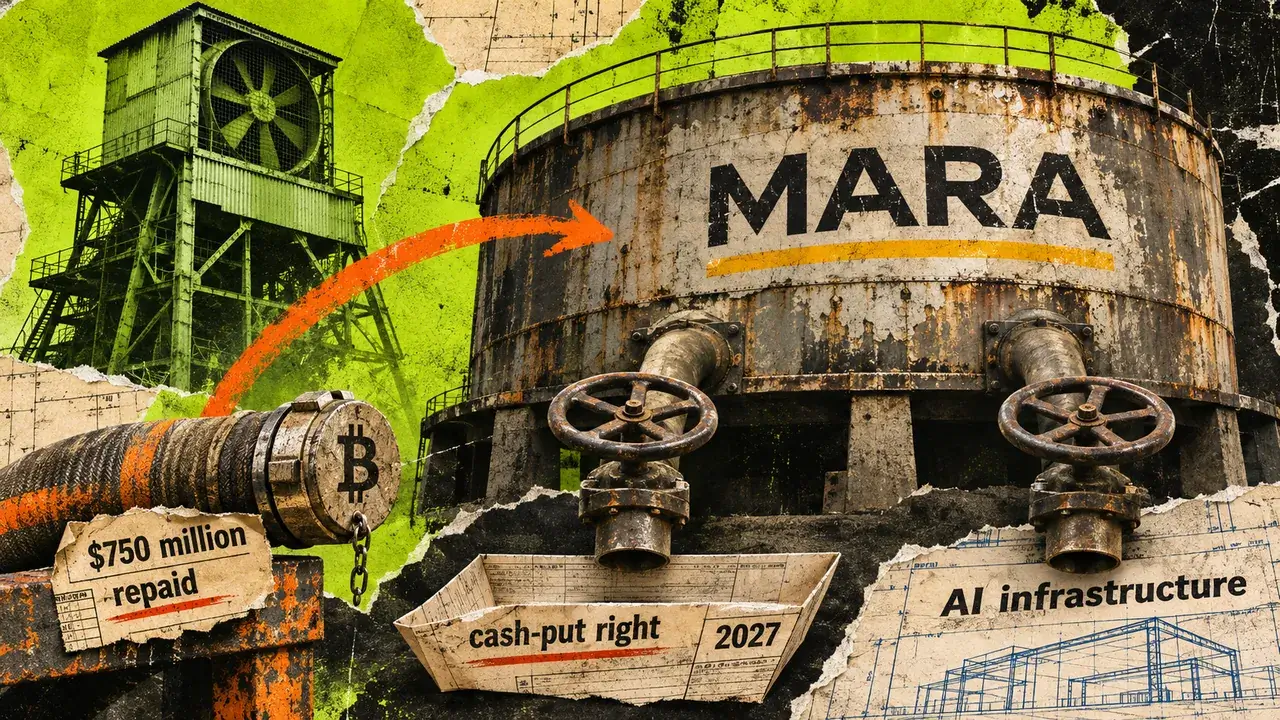
MARA Holdings, formerly known as Marathon Digital Holdings, has officially extinguished its $750 million outstanding balance of Bitcoin-backed loans, effectively removing the threat of collateral liquidation that has historically loomed over its balance sheet during periods of market volatility. The move, disclosed in a series of federal filings and shareholder communications in November, signals a profound shift in the company’s capital management strategy. By decoupling its debt obligations from the price of Bitcoin, the company is positioning itself to redirect its substantial liquidity toward high-growth sectors, specifically artificial intelligence (AI) infrastructure, and a newly authorized $500 million share repurchase program.
The decision to retire these facilities follows a massive liquidation of the company’s Bitcoin treasury. According to a Nov. 9 filing with the Securities and Exchange Commission (SEC), MARA sold 13,597 Bitcoin following the conclusion of the third quarter on Sept. 30. These sales generated approximately $1.1 billion in gross proceeds. Of this amount, $750 million was immediately deployed to satisfy the company’s Bitcoin-backed loan obligations in full. The remaining $350 million in surplus cash from these transactions has bolstered the company’s already significant cash reserves, providing a buffer against operational costs and future capital expenditures.
A Strategic De-Risking of the Balance Sheet
The repayment of Bitcoin-backed loans marks the end of a specific type of financial vulnerability for MARA. In traditional Bitcoin-backed lending, the borrower pledges BTC as collateral. If the price of Bitcoin drops below a certain threshold, the lender can trigger a margin call or liquidate the collateral to cover the loan. For a large-scale miner like MARA, these "forced liquidation" events can create a downward spiral, where selling pressure from lenders further depresses the market price of the asset. By clearing these debts, MARA’s management has effectively removed this systemic risk, allowing the company to hold or sell its remaining Bitcoin assets on its own timeline rather than under the duress of market-driven covenants.
This de-leveraging comes at a time when the broader Bitcoin mining industry is undergoing a structural transformation. Following the April 2024 halving event, which reduced the block reward for miners by 50%, many firms have sought to diversify their revenue streams. MARA’s pivot toward AI infrastructure and high-performance computing (HPC) mirrors moves made by other industry leaders, such as Core Scientific and Hive Digital, who are repurposing their power capacity for the burgeoning AI sector.
Navigating the 2027 Maturity Horizon
While the Bitcoin-backed loans are now a thing of the past, MARA Holdings still faces a complex debt calendar related to its convertible senior notes. As of the end of the third quarter on Sept. 30, the company reported two significant tranches of debt that carry "cash-put" rights in 2027. These rights allow bondholders to demand that the company repurchase the notes at face value (par) plus any accrued interest before the actual maturity date of the bonds.
The first tranche consists of $291.6 million in notes due in June 2031, which carry a cash-put right exercisable on June 4, 2027. The second and larger tranche involves $632.5 million in notes due in March 2030, with a cash-put right exercisable on Dec. 1, 2027. Combined, these obligations represent a potential $924.1 million cash requirement in 2027.
Management has emphasized that while these put rights exist, they are elective. Whether holders choose to exercise them will depend largely on the prevailing interest rate environment and the performance of MARA’s stock price relative to the conversion price of the notes. However, the company is proactively building a "cash bridge" to ensure it can meet these demands without being forced into emergency asset sales. The recent $350 million surplus from the Bitcoin sales, added to the $946.5 million in cash and equivalents held as of Sept. 30, creates a liquidity pool of approximately $1.3 billion. This figure excludes a separate $48 million obligation maturing in December 2024, which the company expects to handle through existing liquidity.
Expansion into AI and Energy Infrastructure
Central to MARA’s long-term growth strategy is its aggressive expansion into energy and data center infrastructure. The company’s planned acquisition of Long Ridge, a significant power and data center business, remains a cornerstone of this strategy. With an enterprise value of approximately $1.5 billion, the Long Ridge deal includes the assumption of up to $900 million in debt. To support this transition, MARA has secured a bridge commitment of up to $785 million, ensuring that the acquisition can proceed even if traditional debt markets fluctuate.
Furthermore, MARA is heavily invested in site development through a partnership with Starwood. As of late 2026, the company had approved $136.3 million for pre-development pursuit costs across multiple sites, with $17.7 million already incurred. These projects are designed to be financed through non-recourse project financing, a move that protects the parent company’s balance sheet while allowing for large-scale infrastructure scaling.
The company is also moving forward with its "HIF" site-development project, which carries a price tag of up to $600 million. Payments for this project are structured around post-closing development milestones, providing a pay-as-you-go model that mitigates the risk of over-extension. By shifting from a pure-play Bitcoin miner to a diversified infrastructure provider, MARA is attempting to capture the higher valuation multiples typically afforded to data center and AI companies compared to the more volatile mining sector.
Capital Allocation: Share Buybacks vs. Operations
In a move that signals confidence in its intrinsic value, MARA’s board of directors authorized a $500 million share repurchase program on Nov. 9. This authorization allows the company to buy back its common stock in the open market or through private transactions. Share buybacks are often used by companies to signal that management believes the stock is undervalued or to offset the dilutive effects of stock-based compensation and convertible note issuances.
However, the buyback program must compete for capital with the company’s operational needs. During the first nine months of 2026, MARA used $642.7 million in cash for operating activities. While the company classifies its Bitcoin sale proceeds as "investing cash flows," the underlying operating outflow highlights the high cost of maintaining and expanding a global mining and infrastructure footprint. To maintain its flexibility, MARA continues to utilize an "at-the-market" (ATM) share issuance program, which had $1.5 billion in unused capacity as of Sept. 30. This ATM facility allows the company to raise equity capital opportunistically, providing a secondary source of liquidity alongside its Bitcoin holdings.
Industry Implications and Future Outlook
MARA’s aggressive de-leveraging and pivot toward AI represent a broader trend among "Tier 1" North American miners. As the difficulty of mining Bitcoin increases and rewards decrease, the value of a mining company is increasingly tied to its "power pipeline"—the gigawatts of energized land it controls. MARA’s ability to monetize its Bitcoin holdings to clear debt and then reinvest that capital into long-term infrastructure assets is being watched closely by Wall Street as a potential blueprint for the industry’s survival.
The company’s majority-owned subsidiary, Exaion, also plays a role in this international expansion. Holding approximately 11% of the company’s cash in euros, Exaion is contractually focused on European operations over the coming year, providing MARA with geographic diversification and exposure to different regulatory environments.
The next critical signal for investors will be MARA’s subsequent disclosures regarding further Bitcoin sales. As the company navigates the remainder of the fourth quarter, the market will look for clarity on how much of the "monetization" strategy is dedicated to immediate infrastructure payments versus the long-term goal of retiring the 2027 convertible notes.
By eliminating $750 million in debt, MARA Holdings has effectively hit the "reset" button on its financial structure. With a cleaner balance sheet, a massive cash position, and a clear path toward the AI and HPC sectors, the company is attempting to transition from a cyclical commodity producer to a foundational player in the global digital infrastructure landscape. Whether this pivot can deliver sustained shareholder value will depend on the successful integration of its power acquisitions and the continued performance of the Bitcoin market, which remains the primary source of the company’s investment capital.