admin

US-listed spot Bitcoin exchange-traded funds (ETFs) experienced a notable extension of their recent downward trend on Monday, marking a challenging period for the burgeoning institutional investment vehicles. BlackRock’s iShares Bitcoin Trust (IBIT), a bellwether for the sector and the largest spot Bitcoin ETF by assets under management, recorded its seventh consecutive day of net withdrawals, signaling a broader retreat from the digital asset class. This persistent outflow challenges the narrative of continuous institutional accumulation that characterized the initial months following the ETFs’ historic approval.
On Monday alone, BlackRock’s IBIT registered a significant $213 million in outflows. This single-day figure contributed to a more substantial trend, bringing the total outflow streak for the fund since October 30 to an alarming $1.66 billion, according to comprehensive data compiled by Farside Investors. The consistent divestment from such a prominent fund underscores a shift in investor sentiment, moving from the initial euphoria that accompanied the launch of these products earlier in the year.
The broader spot Bitcoin ETF market mirrored IBIT’s performance, shedding an additional $201 million on Monday. While this figure was partially offset by a modest $22 million in inflows to the Morgan Stanley Bitcoin Trust ETF (MSBT), it failed to stem the tide of net capital leaving the sector. Over the past six trading sessions, the collective market for these funds has recorded approximately $1.5 billion in net outflows, highlighting a widespread reevaluation of Bitcoin exposure among institutional and retail investors utilizing these regulated products. This recent wave of withdrawals has pushed the year-to-date net withdrawals for the entire US spot Bitcoin ETF market to $1.1 billion. This contrasts sharply with the substantial net inflows observed in prior periods, specifically the roughly $25 billion recorded by early November in both 2024 and 2025 (likely a typo in the original source, meaning early 2024 following the January launch, and projecting forward). The sustained weakness in these funds persists despite what would typically be considered positive news for the crypto ecosystem: Coinbase’s newly effective US national trust bank charter, which took effect on Friday.
A Week of Retreat: BlackRock Leads the Downturn
The current streak of outflows represents a significant pivot from the overwhelming success observed shortly after the US Securities and Exchange Commission (SEC) granted approval for spot Bitcoin ETFs in January. For weeks following their debut, these funds, particularly those from major players like BlackRock and Fidelity, saw unprecedented inflows, attracting billions of dollars from institutional and retail investors seeking regulated exposure to Bitcoin without directly holding the cryptocurrency. This initial enthusiasm propelled Bitcoin’s price to new all-time highs, with many analysts forecasting a new era of mainstream adoption.
However, the landscape has visibly shifted. The past week has been particularly brutal for the funds. Friday, for instance, saw a staggering $412 million in outflows across the market, making Monday’s $201 million a relative deceleration, yet still indicative of strong selling pressure. This trend suggests that while the pace of withdrawals might have eased slightly, the underlying sentiment driving investors to pull capital out of these funds remains firmly entrenched. The cumulative impact of these daily withdrawals paints a picture of growing caution among market participants, leading to a significant reduction in the net asset value under management for many of these products.
The consistent outflows from IBIT, in particular, are noteworthy given BlackRock’s status as the world’s largest asset manager. The firm’s entry into the Bitcoin ETF space was widely seen as a major legitimizing factor for the digital asset. Sustained withdrawals from such a high-profile product could influence perceptions of Bitcoin’s stability and investment appeal among a broader range of traditional finance players who often look to BlackRock for market leadership.
The Genesis of Institutional Access: A Brief History of Spot Bitcoin ETFs
The journey to the approval of US spot Bitcoin ETFs was long and arduous, spanning over a decade of applications and rejections by the SEC. Proponents argued that such products would provide a safer, more regulated, and more accessible gateway for investors to gain exposure to Bitcoin, mitigating risks associated with direct custody on unregulated exchanges. The SEC, however, consistently expressed concerns about market manipulation, investor protection, and the nascent nature of the underlying Bitcoin market.
The breakthrough finally came in January 2024, following a landmark court ruling against the SEC in its dispute with Grayscale Investments regarding the conversion of its Grayscale Bitcoin Trust (GBTC) into a spot ETF. This judicial pressure, coupled with evolving market infrastructure and increased regulatory clarity, paved the way for the simultaneous approval of several spot Bitcoin ETFs. This moment was hailed as a monumental step for the cryptocurrency industry, promising to unlock trillions of dollars in institutional capital.
Indeed, the initial performance exceeded expectations. Funds like IBIT and Fidelity’s FBTC quickly accumulated billions in assets, often setting new records for ETF launches. This influx of capital was a significant driver of Bitcoin’s rally from under $40,000 to nearly $74,000 within a few months. The narrative was clear: institutional adoption was here, and it was driving prices higher. The current period of outflows, therefore, represents a crucial test of the long-term viability and resilience of these products and the broader institutional interest they represent. It prompts questions about whether the initial inflows were primarily driven by pent-up demand and speculative fervor, or if they represented a fundamental shift in asset allocation strategies.
Decoding the Data: Net Withdrawals and Market Dynamics
A deeper look into the outflow data reveals complex market dynamics. While BlackRock’s IBIT has been a significant contributor to the net outflows, it’s important to consider the role of other funds. Grayscale’s GBTC, for example, which converted from a trust to an ETF, experienced substantial outflows in the initial weeks post-conversion as investors took advantage of arbitrage opportunities and migrated to newer, lower-fee alternatives. While GBTC’s outflows have largely stabilized, their initial impact significantly skewed the overall net flow figures for the sector.
The current $1.1 billion year-to-date net withdrawals, when contrasted with the initial enthusiasm and multi-billion dollar inflows, underscore a critical shift. This figure indicates that more capital has exited the spot Bitcoin ETF ecosystem than entered it since its inception, once the early, massive inflows are balanced against the more recent, sustained outflows. This net negative position, while not catastrophic for a market of Bitcoin’s size, is certainly a bearish signal for the immediate term. It suggests that the "new money" entering the market via ETFs has not been sufficient to offset profit-taking, reallocation, or a general reduction in risk appetite among existing holders and recent entrants.
Moreover, the inflows into the Morgan Stanley Bitcoin Trust ETF (MSBT) are a minor counterpoint. While any inflow is positive, $22 million is a relatively small sum compared to the hundreds of millions being withdrawn from other funds. This suggests that while some selective capital allocation might still be occurring, it is not enough to reverse the prevailing trend.
Beyond Bitcoin: Ether ETFs Also Under Pressure
The current wave of selling pressure is not confined solely to Bitcoin ETFs. The broader digital asset market, particularly its institutional products, is experiencing similar headwinds. Outflows from US spot Ether ETFs have also accelerated, reaching approximately $185 million on Monday. This marks their largest daily withdrawals since October 6, indicating a generalized reduction in risk exposure across major cryptocurrencies within regulated investment vehicles.
The correlation between Bitcoin and Ether ETF performance is often strong, given Ether’s position as the second-largest cryptocurrency and its significant institutional interest. When Bitcoin faces selling pressure, Ether often follows suit, and vice-versa. The accelerated outflows from Ether ETFs suggest that investors are not merely reallocating within the crypto space but are potentially reducing their overall exposure to digital assets, perhaps moving capital back into more traditional, less volatile investment classes or holding cash. This broader trend reinforces the idea that macro factors or a fundamental shift in investor sentiment are at play, rather than issues specific to Bitcoin alone.
Market Sentiment: Navigating Fear and Uncertainty
The prevailing mood in the cryptocurrency market is reflected in sentiment indicators. The Crypto Fear & Greed Index, a popular metric that gauges market sentiment, improved marginally to 32 on Monday, up from 29 earlier in the day and 26 a week prior, according to Alternative.me. While this represents a slight uptick from recent lows, the index remains firmly entrenched in "Fear" territory.
The Fear & Greed Index incorporates various market factors, including volatility, market momentum, social media sentiment, dominance, and trends, to provide a snapshot of collective investor emotion. A score below 50 indicates "Fear," suggesting investors are worried and potentially selling, while a score above 50 indicates "Greed," implying optimism and potential buying pressure. The sustained presence in "Fear" territory, despite the marginal improvement, highlights that deep-seated concerns persist among market participants. This sentiment can be a self-fulfilling prophecy, as fear often leads to selling, which in turn reinforces further fear and selling, creating a downward spiral. The current environment suggests that despite positive fundamental developments like Coinbase’s charter, market psychology is currently dominated by apprehension.

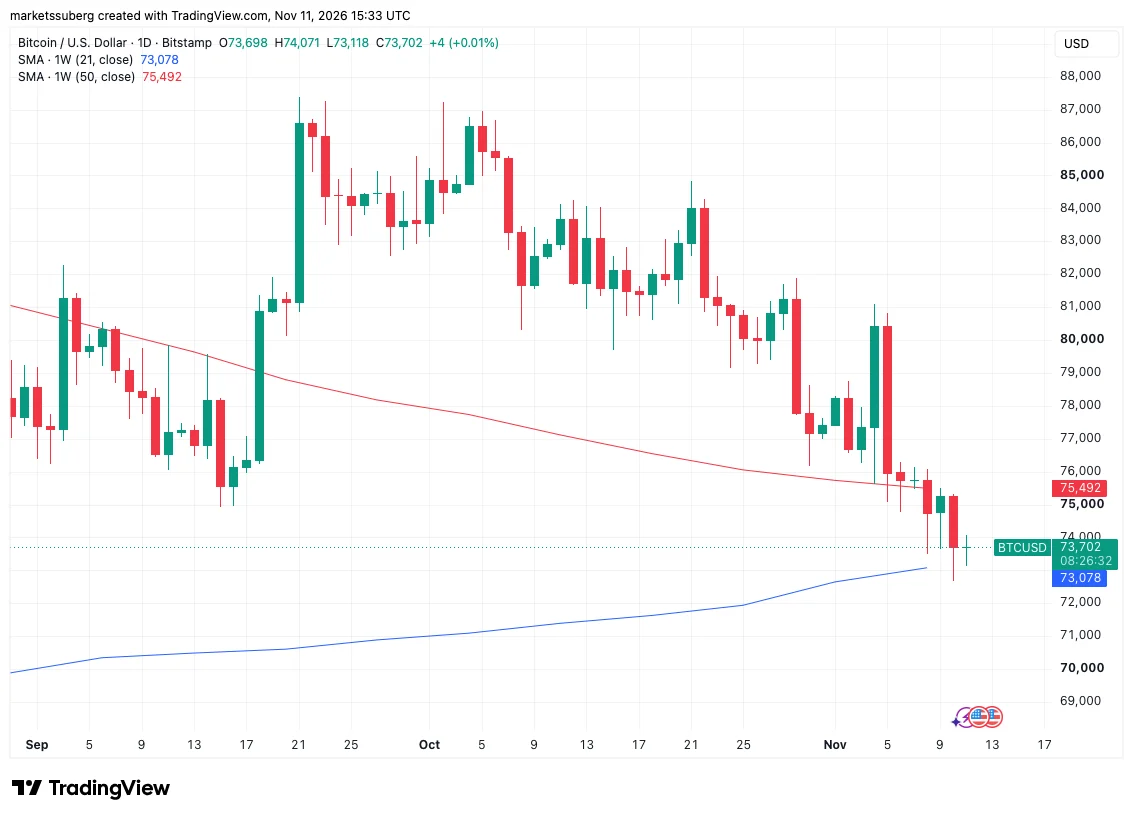
At the time of publication, Bitcoin was trading at approximately $74,594. This figure represents a 2.8% decline over the past seven days, although it had seen a slight uptick over the previous 24 hours, according to CoinGecko data. This volatile price action, coupled with the outflows, underscores the current uncertainty gripping the market.
Coinbase’s Milestone Meets Muted Reaction
The market’s muted reaction to Coinbase’s significant regulatory achievement — the activation of its US national trust bank charter — has been particularly striking to industry observers. This charter, which became effective on Friday, permits Coinbase to hold digital assets on behalf of clients under federal oversight, a crucial development for institutional adoption and security. It signifies a major step towards integrating digital asset custody into the traditional financial system, offering enhanced regulatory clarity and investor protection.
Typically, such a development from a leading cryptocurrency exchange, especially one involving federal oversight, would be met with a positive market response, potentially driving up crypto asset prices due to increased confidence and accessibility for institutional investors. However, as noted by Kevin Boeve, a veteran trader and business development executive at tokenized real estate platform Palladium Network, the market’s response was noticeably subdued. "Stocks are up while crypto keeps falling, even with the big Coinbase news," Boeve told Cointelegraph. "In the past, news like that would’ve sent crypto flying, but now it barely moves the needle."
This divergence between the fundamental positive news and the negative market price action is a key indicator of the current challenging environment. It suggests that either the market is heavily influenced by external factors overshadowing positive internal developments, or that the "good news" has already been priced in, or perhaps even that the market is so saturated with selling pressure that even strong positive catalysts struggle to ignite a rally.
Expert Perspectives: Disconnects and Dire Warnings
Boeve’s observations extend beyond just the muted reaction to Coinbase’s charter. He highlighted a broader "disconnect" between the performance of traditional equity markets, which have generally been on an upward trajectory, and the struggling cryptocurrency market. This divergence is a source of concern for many analysts. Historically, Bitcoin and other cryptocurrencies have often shown some correlation with tech stocks and other risk-on assets, performing well during periods of broad market optimism. The current situation, where stocks are rising while crypto declines, suggests a decoupling or a specific aversion to digital assets among investors.
Boeve explicitly called this divergence a "warning sign," predicting a major stock market correction that could escalate into a broader sell-off across all asset classes. This perspective suggests that the current crypto outflows might be a precursor to a wider de-risking trend, with sophisticated investors pulling capital from the most volatile assets first. If traditional markets do experience a significant downturn, it could exacerbate the challenges facing Bitcoin and other cryptocurrencies, potentially leading to further price depreciation and outflows from ETFs.
Other analysts have offered various explanations for the current outflows. Some suggest it’s a natural period of profit-taking after Bitcoin’s significant rally earlier in the year. Investors who bought in at lower prices, or even those who entered via ETFs and saw substantial gains, might be opting to secure profits, especially in an environment of macroeconomic uncertainty. Another perspective posits that investors might be reallocating capital in anticipation of interest rate decisions by central banks or in response to shifting global economic forecasts. High interest rates, for instance, can make less risky assets like government bonds more attractive, drawing capital away from speculative assets like cryptocurrencies.
Macroeconomic Headwinds and Investor Reallocation
The current outflows from spot Bitcoin ETFs cannot be fully understood without considering the broader macroeconomic landscape. Global economic indicators, including persistent inflation in some regions, varying central bank policies regarding interest rates, and geopolitical tensions, all contribute to an environment of heightened uncertainty. In such conditions, investors often become more risk-averse, opting to reduce exposure to volatile assets.
Central banks, particularly the US Federal Reserve, have been navigating a delicate balance between controlling inflation and supporting economic growth. Signals regarding future interest rate hikes or cuts can significantly impact investor appetite for risk. If rates are expected to remain high or increase, the opportunity cost of holding non-yielding assets like Bitcoin rises, making fixed-income investments more appealing. Conversely, if rates are expected to fall, risk assets often become more attractive. The current period of ambiguity regarding future monetary policy could be prompting investors to adopt a more cautious stance, leading to the observed outflows.
Furthermore, the performance of traditional equity markets, while currently strong, may be viewed with skepticism by some investors who anticipate a correction, as suggested by Boeve. If investors believe a significant market correction is imminent, they might preemptively sell off their most volatile holdings, including Bitcoin ETFs, to reduce their overall portfolio risk. This reallocation strategy is a common feature of investor behavior during periods of perceived market instability.
Implications for the Digital Asset Ecosystem
The sustained outflows from spot Bitcoin ETFs represent a critical moment for the digital asset ecosystem. While these funds initially symbolized a new era of institutional acceptance and mainstream integration, their current performance raises questions about the long-term trajectory of institutional capital flows into crypto.
One implication is that the market may be maturing, moving beyond the initial speculative fervor that often accompanies new asset classes. Periods of significant inflows followed by corrections and outflows are common in traditional markets as well. This could be seen as a healthy, albeit painful, process of price discovery and market consolidation.
Another implication relates to the role of these ETFs in price formation. While they were initially powerful drivers of Bitcoin’s price appreciation, their current outflows are exerting downward pressure. This highlights the double-edged sword of institutional integration: while it brings liquidity and legitimacy, it also exposes the asset to the same macroeconomic pressures and investor sentiment swings that affect traditional financial markets.
For the future, the industry will be closely watching whether these outflows are a temporary blip, driven by short-term profit-taking and macro concerns, or if they signify a more fundamental reassessment of Bitcoin’s role in institutional portfolios. The resilience of Bitcoin’s underlying technology and its long-term value proposition will be tested in this challenging environment. The ability of the market to absorb these outflows without catastrophic price crashes could be a testament to its growing robustness, even if the immediate outlook remains cautious.
Conclusion: A Test of Resilience for Institutional Crypto
The extended streak of outflows from US-listed spot Bitcoin ETFs, spearheaded by BlackRock’s IBIT, marks a significant period of recalibration for institutional investors in the digital asset space. While the initial launch of these products heralded a new era of accessibility and capital influx, the current trend of net withdrawals, coupled with a muted market response to positive news like Coinbase’s national trust bank charter, points to a prevailing sentiment of caution and risk aversion.
The disconnect between rising traditional equity markets and falling cryptocurrency prices, as observed by market experts, serves as a warning sign, potentially foreshadowing broader market corrections. The interplay of profit-taking, macroeconomic uncertainties, and a shift in investor sentiment appears to be driving capital away from these once-hot investment vehicles. As the Crypto Fear & Greed Index remains in "Fear" territory, the immediate future for spot Bitcoin and Ether ETFs will likely be defined by a test of resilience. The industry must navigate these headwinds, demonstrating its ability to weather periods of contraction and reinforcing the long-term value proposition of digital assets to retain and attract institutional capital beyond the initial hype cycle. The ongoing performance of these ETFs will continue to serve as a crucial barometer for the health and maturity of the institutional cryptocurrency market.