admin
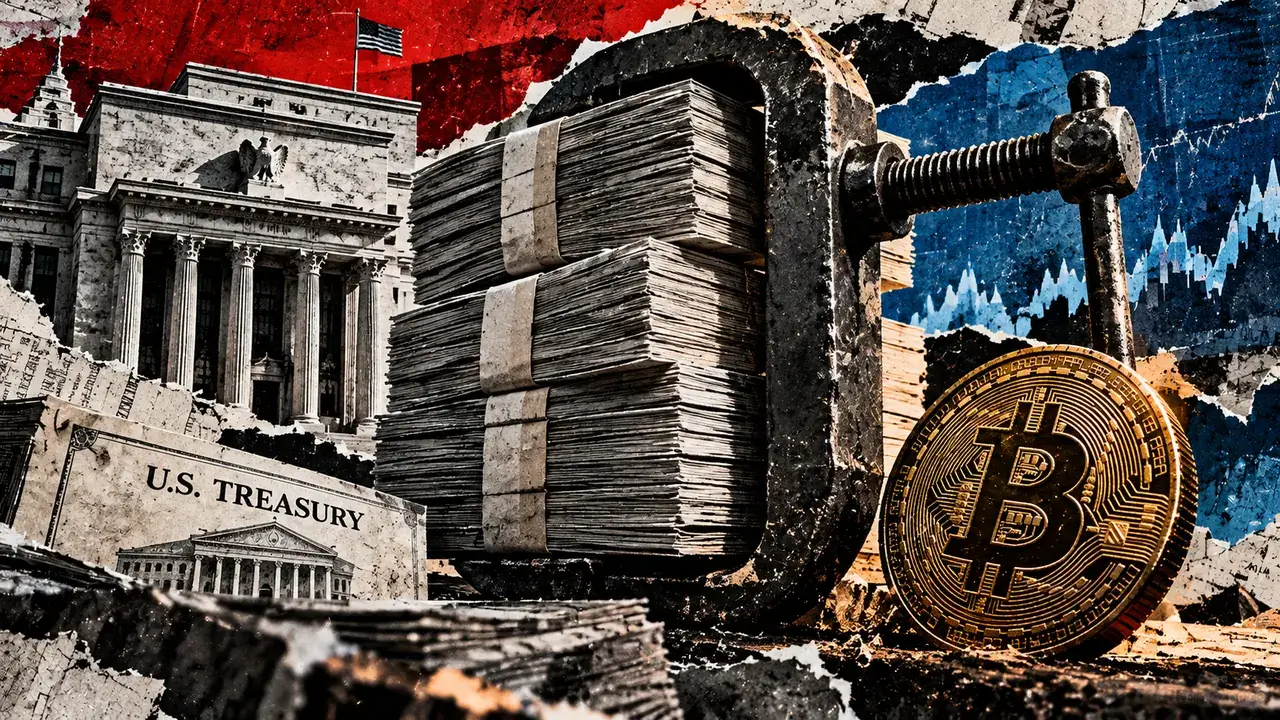
Treasury dealers’ net holdings of short-term U.S. government debt, commonly known as Treasury bills, have surged to a two-year peak, according to a significant update from the Federal Home Loan Bank of New York (FHLBNY) on October 23. This substantial accumulation of short-term U.S. debt places considerable scrutiny on dealer financing capacity as the crucial date of October 30 approaches. While overnight dollar funding markets currently appear calm, the underlying pressures within the dealer network warrant close observation, with potential, albeit conditional, spillover effects into digital asset markets such as Bitcoin.
The FHLBNY’s latest assessment attributes the widening of bill spreads—the difference between the buying and selling prices of Treasury bills—to a confluence of factors. A surge in Treasury bill issuance, a standard mechanism for governments to finance their operations, has flooded the market. Simultaneously, money market funds, major purchasers of short-term debt, have been actively shortening their portfolios. This strategic adjustment by money market funds is largely driven by prevailing uncertainty surrounding the Federal Reserve’s future monetary policy. In response to these market dynamics, some capital has reallocated away from direct bill purchases and towards overnight and short-term repurchase agreements (repos). This shift in allocation, while potentially supporting overnight lending liquidity, creates a complex liquidity environment where intermediaries must manage substantial bill inventories.
Understanding the distinction between the availability of cash and the capacity of financial intermediaries to channel that cash is critical. A detailed study published in 2024 by Federal Reserve staff members shed light on dealer balance sheet constraints across various repo market segments. The research posited that when cash is channeled from money funds to leveraged borrowers via the repo market, it effectively expands dealer balance sheets. The authors of this study hypothesized that tighter constraints on these balance sheets would likely lead dealers to demand higher compensation for their services, manifesting as increased financing costs. This dynamic is particularly relevant as dealers are central to the functioning of the U.S. Treasury market, acting as crucial intermediaries between the government and investors.
The Interplay of Treasury Bill Holdings and Repo Markets
The Federal Home Loan Bank of New York’s October 23 report highlighted a concerning trend: Treasury dealers’ net holdings of Treasury bills have reached a two-year high. This means that primary dealers, the institutions authorized to trade directly with the Federal Reserve, are holding a larger inventory of short-term U.S. government debt than they have in recent years. This accumulation is often a sign that demand from end-investors is not keeping pace with the significant issuance of new bills by the U.S. Treasury.
To manage these large inventories, dealers rely on the repo market. In a repurchase agreement, a dealer sells securities (in this case, Treasury bills) to an investor with an agreement to repurchase them at a later date, usually overnight, at a slightly higher price. This essentially functions as a short-term collateralized loan, providing dealers with the necessary liquidity to hold their inventory.
The FHLBNY’s update suggests that while overnight dollar funding markets, as measured by the Secured Overnight Financing Rate (SOFR), have remained relatively stable, this stability is partly supported by the flow of cash into these repo agreements. The SOFR, a key benchmark for dollar funding, was observed at 3.9% on October 22, a marginal increase from 3.88% on October 21, according to data from the New York Fed. Crucially, the FHLBNY noted that SOFR remained at or below the Federal Reserve’s target rate for reserve balances, which stood at 3.9% during the reporting week. This indicates that, on the surface, overnight borrowing costs have not spiked dramatically.
However, the FHLBNY’s analysis delves deeper, identifying potential upcoming pressures on this seemingly calm liquidity environment. Two key events are flagged for October 30:
- Canadian Bank Year-End: Many financial institutions, including Canadian banks, observe fiscal year-endings at different times. The end of October can coincide with the need for these entities to rebalance their portfolios, potentially leading to shifts in capital flows and demand for funding.
- Cash Outflows from Repo to Mortgage-Backed Securities (MBS) Holders: Significant cash held within the repo market may be earmarked for payments to holders of mortgage-backed securities. As these payments become due, cash could be withdrawn from the repo market, reducing the available liquidity for dealers to finance their Treasury bill holdings.
These forthcoming pressures suggest that SOFR might test the 3.9% level more consistently in the near term. Counterbalancing these risks, however, were calmer Treasury bill auctions held earlier in the week compared to the preceding week. This indicates a potentially more balanced demand and supply dynamic for Treasury bills on certain days, offering a measure of stability amidst broader concerns.
Background Context: The Role of Treasury Dealers and Market Liquidity
Treasury dealers play a pivotal role in the U.S. financial system. They are a select group of banks and broker-dealers that are primary dealers of the Federal Reserve Bank of New York. Their responsibilities include participating in Treasury auctions, providing liquidity in the secondary market, and acting as counterparties for the Federal Reserve’s open market operations.
The health of the Treasury market is paramount for the global financial system, as U.S. Treasury securities are considered among the safest assets in the world. Disruptions in this market can have cascading effects on other asset classes and financial institutions.
The concept of "dealer capacity" refers to the ability of these intermediaries to absorb market shocks, intermediate trades, and provide liquidity. When dealers’ balance sheets are constrained, their capacity to perform these functions can be diminished. This can lead to wider bid-ask spreads, reduced market depth, and increased volatility. The recent accumulation of Treasury bills by dealers suggests they are taking on more inventory risk, which requires robust financing capabilities.
The repo market is a critical source of short-term funding for dealers. Any stress in the repo market, whether due to reduced cash availability or increased demand for funding, can quickly translate into broader market stress. The FHLBNY’s report is essentially sounding an alarm that while overnight funding rates (SOFR) appear stable, the underlying mechanics of dealer financing are facing increasing pressure due to the sheer volume of Treasury bills being held.
The Bitcoin Connection: A Conditional Spillover Scenario
The article also draws a parallel to the cryptocurrency market, specifically Bitcoin, examining its financing conditions as a separate, yet potentially interconnected, indicator. Bitcoin’s positioning data, as reported by Coinbase Institutional on October 23, indicates a rebuilding of leverage within the crypto market. Perpetual futures funding rates—a metric that reflects the cost of maintaining leveraged long or short positions in perpetual futures contracts—have surged. These rates rose from a low of 0.1% annualized on October 13 to 7.2% one week later, on October 20.
This sharp increase in funding rates suggests that more traders are taking leveraged positions in Bitcoin, and the cost of holding these positions is escalating. In essence, longs are paying shorts to maintain their positions, a sign of bullish sentiment and increased speculative activity. Coinbase Institutional’s Prime Trading commentary interpreted this as momentum longs adding to their exposure, a common behavior in speculative markets.
It is crucial to understand that these crypto derivatives payments measure the cost of maintaining leveraged positions and are not directly comparable to traditional repo borrowing rates. However, they offer insights into the risk appetite and leverage employed by market participants in the digital asset space.
For comparative borrowing context, Coinbase’s financing table from October 22 provided indicative overnight rates for centralized finance markets, ranging from 4.25% to 12.5%, and a Bitcoin borrowing range of 1.25% to 4.75%. Without specific details on the collateral used and the exact terms of these loans, it is difficult to definitively establish a new tightening in credit conditions within the crypto market based solely on these ranges.
The concept of "futures basis" in crypto, which represents the premium of futures prices over spot prices, also requires careful interpretation. Research from the Bank for International Settlements (BIS) has indicated that interest-rate differentials explain only a small portion of the variation in crypto futures basis. Instead, leveraged investor demand and the relative scarcity of arbitrage capital play more significant roles. Therefore, the futures basis should be analyzed in conjunction with borrowing conditions and overall market positioning.
Analyzing the Transmission Mechanism and Implications

A direct transmission of stress from the U.S. Treasury market to Bitcoin would become more plausible under a specific set of circumstances. This scenario would likely unfold if:
- Persistent Repo Market Pressure: The financing pressures within the U.S. repo market continue to intensify, leading to higher borrowing costs for all participants.
- Worsening Crypto Borrowing and Rollover Terms: Comparable borrowing or rollover terms within the cryptocurrency market also deteriorate, signaling broader liquidity constraints.
- Thinned Market Depth: The liquidity in both traditional finance and cryptocurrency markets becomes significantly reduced, making it harder to execute trades without impacting prices.
Conversely, if crypto financing conditions remain stable or improve, it would weaken the argument for a direct spillover effect from Treasury market liquidity issues.
Even if both markets experience simultaneous deterioration, establishing a definitive causal link remains challenging. The critical missing piece of evidence is concrete proof that constrained intermediaries in the traditional financial system are actively reducing the financing available to Bitcoin markets. Without such direct evidence, the observed correlations might be coincidental or driven by other macro-economic factors influencing both markets.
Potential Official Responses and Market Expectations
While no official statements have been made directly addressing the current situation by the Federal Reserve or the Treasury Department regarding dealer financing, their actions and communications in the coming days will be closely watched. Historically, during periods of significant stress in the Treasury market, the Federal Reserve has tools at its disposal to inject liquidity, such as expanding its balance sheet through asset purchases or adjusting the terms of its lending facilities. However, the current situation, as described by the FHLBNY, appears to be more nuanced, focusing on the distribution and capacity of intermediation rather than a complete evaporation of liquidity.
Market participants, including large asset managers and hedge funds, are likely to be scrutinizing dealer balance sheets and repo market conditions with heightened attention. The upcoming October 30 date represents a potential inflection point where any underlying fragility could be exposed. The Federal Reserve’s upcoming monetary policy meeting and any statements regarding its liquidity management strategies will also be crucial in shaping market expectations.
Broader Impact and Long-Term Implications
The current situation underscores the interconnectedness of modern financial markets. Even seemingly niche issues, such as the financing capacity of Treasury dealers, can have broader implications. The accumulation of Treasury bills by dealers, driven by factors like increased issuance and shifts in money market fund behavior, highlights the ongoing demand for safe assets. However, the reliance on the repo market for financing this inventory exposes a potential vulnerability.
The potential spillover into Bitcoin, while conditional, serves as a reminder of how liquidity dynamics in traditional finance can influence even the most nascent asset classes. As cryptocurrency markets mature and become more integrated with the broader financial system, their sensitivity to traditional financial plumbing is likely to increase.
Ultimately, the events leading up to and following October 30 will provide valuable insights into the resilience of the U.S. Treasury market and the extent to which liquidity pressures can propagate across different asset classes. The Federal Reserve’s ongoing monitoring of financial stability, alongside the transparent reporting from institutions like the FHLBNY, will be essential in navigating these complex market dynamics. The careful calibration of monetary policy, alongside a deep understanding of market plumbing, will be critical in ensuring the continued smooth functioning of the global financial system.