admin
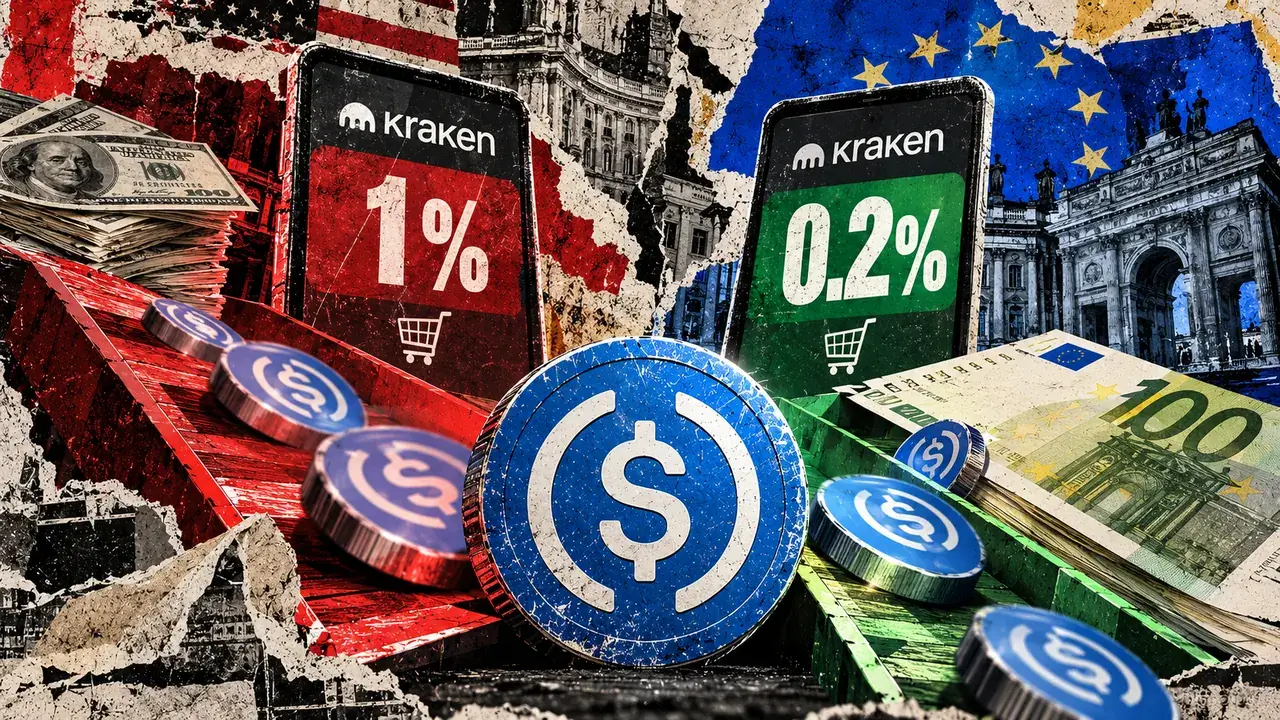
A recent analysis of stablecoin conversion fees on Kraken, a prominent cryptocurrency exchange, reveals significant discrepancies that challenge the perception of digital assets as a universally cheaper alternative for international money transfers. Converting $10,000 worth of USD Coin (USDC) to euros can incur a trading fee of either $100 or $20 on Kraken, a difference of $80, before accounting for execution and withdrawal costs. This disparity, highlighted in an examination of Kraken’s fee schedule as of October 20, underscores the intricate pricing models governing digital asset transactions and their competition with traditional financial services.
The Bank for International Settlements (BIS) echoed these concerns in its Working Paper 1385, "Competing Rails: Cross-border Payments by Banks, Fintechs and Stablecoins," published on October 19. Researchers Wenxin Du, Catherine Huang, and David Scharfstein compared the cost-effectiveness of various cross-border payment methods, including traditional banking channels, fintech transfer providers, and stablecoin routes. Their findings indicated that for transfers of $10,000 from the United States to developed market currency groups, median costs typically range between $40 and $60. The BIS paper emphasizes the importance of separating exchange-rate markups from explicit fees to accurately assess the true cost of conversion products. The ultimate competitive question for any payment method, the report suggests, is not just the initial fees but the total amount of the target currency that reaches the recipient’s bank account for the sender’s complete dollar outlay.
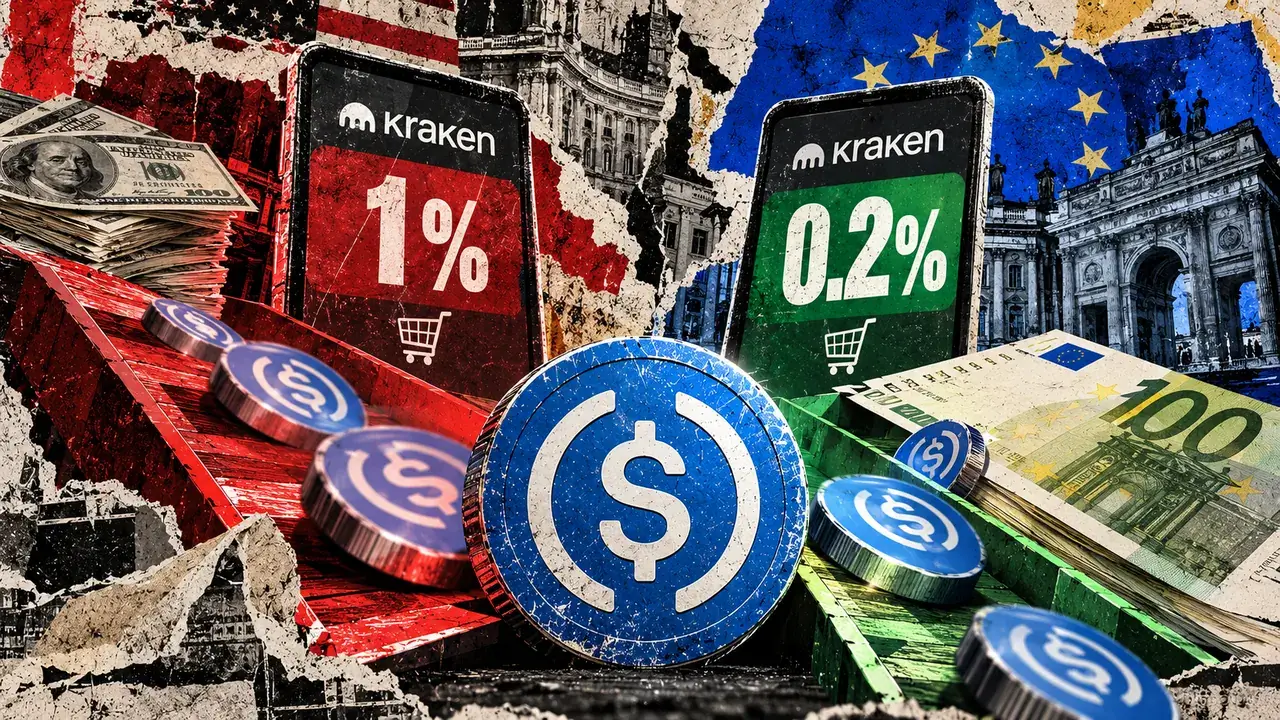
Examining Kraken’s fee structure provides a concrete illustration of these complexities. The exchange’s standard "Instant Buy/Sell" feature for stablecoin conversions typically carries a 1% trading fee, which can amount to $100 on a $10,000 transaction. This fee often includes an embedded spread, further increasing the effective cost. However, Kraken also offers a different execution route through an eligible entry-tier USDC/EUR order book. For trades within this specific market, the standard stablecoin/FX schedule drops significantly to 0.20% for both maker and taker orders, resulting in a $20 fee for the same $10,000 conversion. This 80-basis-point difference, amounting to $80, highlights how the choice of trading mechanism can dramatically alter the upfront cost.
The impact of these fees is amplified when considering smaller transaction amounts. For a $200 conversion, the 1% standard fee would be $2, while the 0.20% order book fee would be $0.40, a difference of $1.60. However, at these lower thresholds, fixed bank payout charges begin to consume a much larger proportion of the total transfer value, diminishing the competitive advantage that stablecoin routes might otherwise offer compared to established money transfer services.
Kraken’s "Convert" features, designed for USD-to-USDC and USDC-to-USD conversions, offer a compelling incentive by allowing conversions at a 1:1 rate with no spread or conversion fee, up to $100,000 daily in each direction. While this feature effectively waives the initial 1% fee for acquiring USDC with dollars, it does not render the subsequent conversion of USDC into euros free. The total cost equation therefore necessitates a holistic view, encompassing not only the initial stablecoin acquisition but also the subsequent conversion to the desired fiat currency and the final withdrawal to a bank account.
Unpacking the Fee Structure: A Tale of Two Kraken Routes
Kraken’s pricing model for converting USDC to EUR demonstrates how different pathways can lead to vastly different outcomes. The "standard instant and recurring trades" operate with a 1% trading fee, augmented by a variable spread and potential payment-method fees. This is the default for many users seeking quick transactions. In stark contrast, Kraken advertises a dedicated USDC/EUR market, which functions as an order book where USDC is the base asset being exchanged for euros. This route is subject to a different fee schedule, starting at a more competitive 0.20% for both maker and taker orders, according to Kraken’s stablecoin fee explanations. This distinction is crucial: it categorizes markets where a stablecoin is the primary asset being traded versus those where it serves merely as a quote currency.
It is important to note that the comparison of the 1% instant fee versus the 0.20% order book fee assumes the standard instant fee is indeed applied. Kraken’s premium service, Kraken+, can waive qualifying instant trading fees on up to $10,000 in monthly trading volume. However, even with this waiver, the embedded spreads and card processing charges remain a cost factor.
The "Convert" feature, while attractive for dollar-to-stablecoin conversions, is a separate offering. This feature allows users to acquire USDC with USD at a 1:1 rate, free of spreads and conversion fees, up to a daily limit. However, this exemption does not extend to the subsequent conversion of USDC into other fiat currencies like euros. The entire process, from acquiring dollars to receiving euros, must be evaluated end-to-end.
For individuals sending money to another person, a receiver-side route can be considered. In this scenario, the sender acquires and sends USDC, and the recipient then converts it within their own eligible Kraken account before withdrawing to a bank account in their name. This strategy hinges on Kraken’s "same-name withdrawal requirement," which mandates that the withdrawal account be verified under the same identity as the Kraken account holder. This regulatory compliance measure means the recipient’s account setup is integral to the feasibility of this approach.
To illustrate the cost implications, consider two scenarios: a $200 conversion and a $10,000 conversion, using $1 per USDC for simplicity. These calculations exclude the costs associated with funding the account, acquiring the token, network charges for token withdrawal, execution spreads, slippage, and any additional bank charges.
Illustrative Cost Component Comparison
| Illustrative Cost Component | $200 Conversion | $10,000 Conversion |
|---|---|---|
| Standard instant trading fee (1%) | $2.00 | $100.00 |
| Eligible order-book trading fee (0.20%) | $0.40 | $20.00 |
| Difference in trading fee alone | $1.60 | $80.00 |
| One €1 SEPA payout (at assumed rate) | $1.10 | $1.10 |
| Instant conversion fee + payout | $3.10 | $101.10 |
| Order-book conversion fee + payout | $1.50 | $21.10 |
These subtotals include only the specified conversion fees and a single bank payout. The unresolved route costs, which can include network fees, potential slippage, and other banking charges, are not factored in.
Kraken’s withdrawal schedule lists a €1 SEPA bank payout option through Bank Frick or Banking Circle, subject to eligibility, with a minimum charge of €2. For illustrative purposes, this €1 payout is translated at an assumed rate of €1 = $1.10.
The Shadow Costs: Beyond the Sticker Price
The true cost of a stablecoin transfer extends far beyond the initial trading fees. When comparing Kraken’s illustrated subtotals with a hypothetical fintech competitor offering a 0.50% all-in fee, the picture becomes clearer. For a $200 transfer, the hypothetical competitor would cost $1. In this instance, both of Kraken’s calculated subtotals ($3.10 for the instant route and $1.50 for the order book route) already exceed this hypothetical cost, even before accounting for any additional, non-negative route costs or favorable exchange rate offsets.
The disparity widens significantly at the $10,000 level. The hypothetical competitor would cost $50. Kraken’s order-book route subtotal leaves $28.90 to cover additional net route costs before reaching the competitor’s price point. The standard instant subtotal of $101.10 already surpasses the hypothetical competitor’s cost before any potential exchange rate benefits are considered.
A critical observation from these calculations is the disproportionate impact of fixed charges. A fixed euro payout weighs much more heavily on smaller transactions like the $200 example, while the percentage-based conversion charge becomes the dominant factor for larger amounts such as $10,000. The $80 difference identified earlier is purely a fee-based discrepancy on the identical $10,000 conversion amount, illustrating the significant savings achievable by selecting the optimal trading route.
Furthermore, senders who incur charges earlier in the process – for instance, to acquire the initial USDC – will face a different complete-route cost calculation. These upstream fees directly reduce the amount available for the final conversion and withdrawal, thereby impacting the overall efficiency of the stablecoin transfer.
Recipient Eligibility: A Critical Bottleneck
The viability of stablecoin transfers for payments to another person hinges critically on the recipient’s ability to utilize the chosen route. A simple conversion and withdrawal from the sender’s exchange account is insufficient if the recipient cannot seamlessly receive the funds. Kraken’s policy on third-party payments mandates that bank withdrawal accounts must be in the name of the verified Kraken holder. This means the recipient must possess their own verified Kraken account that supports the required asset, conversion process, and bank payout mechanism. The sender’s choice of acquisition venue and transfer network also plays a role, as these must be available and competitively priced. The mere existence of a public USDC/EUR market listing does not guarantee that all individual permissions for a seamless transaction are in place for both parties.
Even when both sender and receiver can access the same advertised trading rates, their individual access requirements can differ significantly. Kraken’s regional restrictions are a material factor, influencing product access and eligibility for specific trading pairs, funding methods, and payout providers. This localized eligibility cannot be assumed simply by viewing a public conversion page.
The burden placed on the recipient in an exchange-based stablecoin transfer differs markedly from services like Wise (formerly TransferWise). Wise advertises its US-to-Europe bank transfer service as requiring only local bank details from the recipient, without necessitating a Wise account. In contrast, an exchange-based route compels the recipient to engage with an additional account and undergo a separate conversion process, adding layers of complexity and potential friction.
Funding and Payout Dynamics: The Unseen Timelines
The sender’s initial funding of a Kraken account also introduces variable timelines and costs. Kraken’s cash deposit table reveals that US ACH Plaid deposits are free and nearly instantaneous for trading purposes. However, these deposits are subject to a seven-day withdrawal hold for both crypto and fiat assets. For those requiring faster access to funds for international transfers, eligible US Dart Bank FedWire deposits are also free at Kraken, with a processing estimate of 0-1 business days and no listed withdrawal hold.
On the receiving end, the standard €1 SEPA methods typically have estimated processing times of 0-5 business days. Faster alternatives include €1 payouts through Banking Circle and €0.90 through ClearJunction, though these come with differing minimums and availability. The efficiency of even these "instant" options can be impacted by bank processing times, and Kraken advises users to consult their signed-in funding screen for the most current applicable terms, as these can fluctuate.
These various stages—funding, token transfer, network confirmation, exchange conversion, and fiat withdrawal—collectively explain why a "fast token transfer" and "immediate access to euros" are distinct metrics. The BIS authors, in their working paper, also draw a parallel by distinguishing foreign-exchange markups from explicit costs related to exchange, blockchain networks, and fiat withdrawals. They identify conversion and bank processing as key areas where delays can occur, impacting the overall speed and predictability of cross-border payments.
The Future of Stablecoin Competitiveness
The competitive landscape for cross-border payments is constantly evolving. Services like Wise employ sophisticated comparison methodologies, often estimating rival displayed rates using a combination of historical markups and current market data, such as the Bloomberg midpoint. They may also apply a higher collected amount threshold for their comparisons.
For a truly matched observation of costs, the net euro receipt can be translated back into dollars using a contemporaneous benchmark expressed in euros per dollar. This figure, when subtracted from the sender’s total dollar debit, provides a clearer picture of the net cost. The illustrative rankings presented earlier underscore why smaller payments are more susceptible to fixed payout charges, while product selection offers a more substantial cost-saving potential for larger transactions. Whether this potential translates into a genuinely cheaper payment depends on the availability of usable accounts for both parties, the resolution of all associated costs, and, ultimately, the precise amount of euros that finally arrive in the recipient’s bank account. As the digital asset ecosystem matures, clarity and transparency in fee structures will be paramount for stablecoins to realize their promise as a truly efficient and cost-effective alternative for global remittances.