Dwi Wanna
In a move that signals a significant shift in the capital structure and strategic direction of the North American digital asset mining sector, Hut 8 Corp. has finalized a $1.07 billion senior secured revolving credit facility. The four-year agreement, announced on September 28, 2024, provides the company with a massive liquidity cushion designed to facilitate its aggressive expansion into artificial intelligence (AI) infrastructure and high-performance computing (HPC). This financing milestone comes at a critical juncture for the industry, as traditional Bitcoin miners seek to diversify their revenue streams in the wake of the 2024 halving event, which slashed block rewards and tightened operational margins across the board.
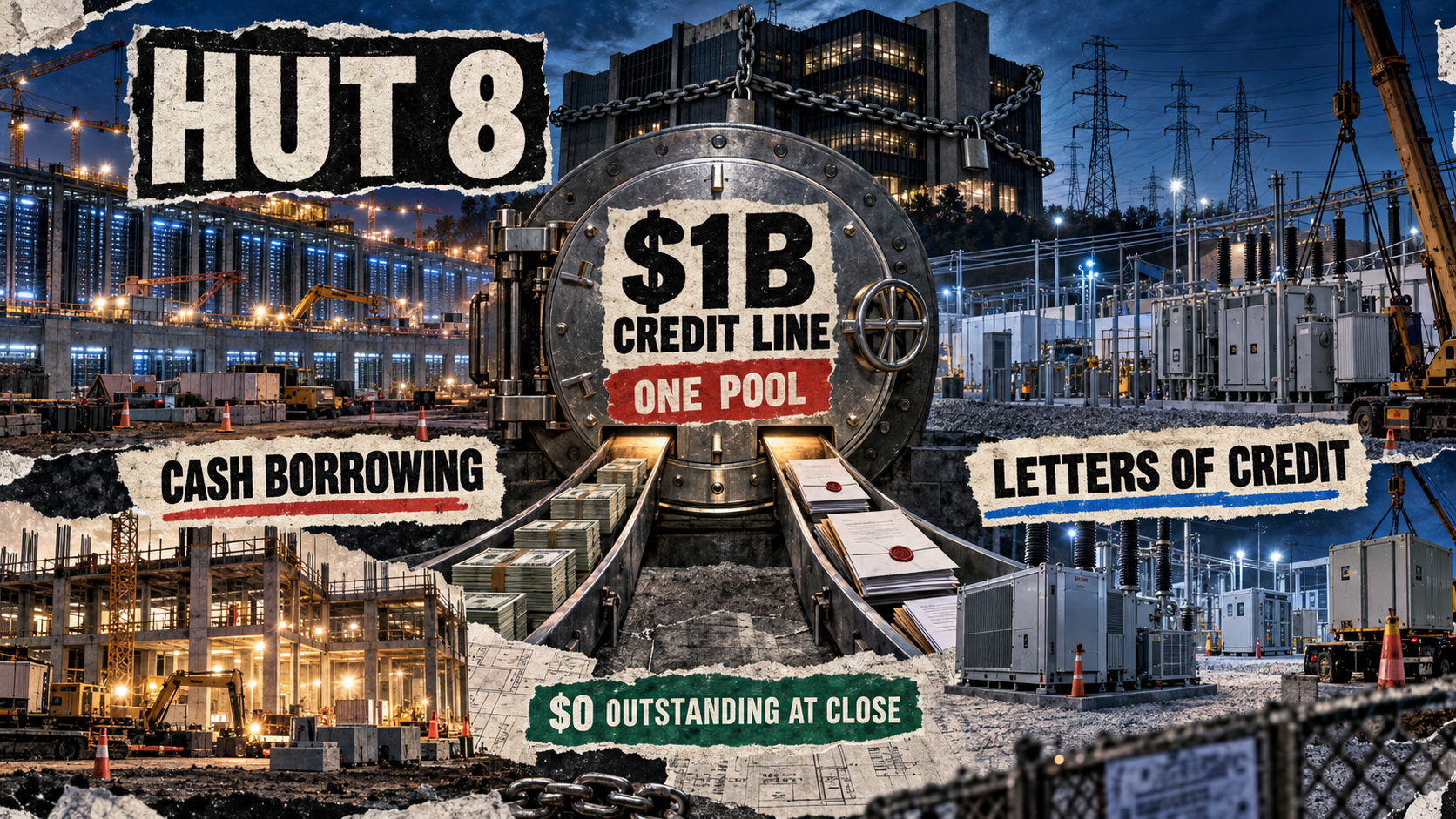
The credit facility, which officially closed on September 24, 2024, establishes a robust framework for parent-level financing. According to the company’s regulatory filings with the Securities and Exchange Commission (SEC), no amounts were outstanding at the time of closing, suggesting that Hut 8 intends to use the line as a strategic reservoir for upcoming capital expenditures rather than for immediate debt refinancing. The arrangement includes a $1 billion sublimit for letters of credit, a technical but vital component that allows the company to secure power interconnection agreements and equipment procurement contracts without the need to tie up vast amounts of restricted cash.
Structural Details and Financial Mechanics
The $1.07 billion facility is structured as a senior secured revolver, naming Hut 8 Corp. as the primary borrower. The debt is backed by first-priority liens on substantially all assets of the borrower and certain restricted subsidiaries that act as guarantors. This "parent-level" exposure distinguishes the new credit line from the company’s previous financing arrangements, which were largely structured as non-recourse project financing.
The pricing of the facility is tied to the Term Secured Overnight Financing Rate (SOFR), the standard benchmark that replaced LIBOR in recent years. Hut 8 will initially pay a margin of 1.75 percentage points above the SOFR benchmark. However, this margin is subject to a grid-based adjustment mechanism: depending on the company’s debt-to-market-capitalization ratio, the margin can fluctuate between a floor of 1.50% and a ceiling of 2.00%. This structure incentivizes the company to maintain a strong equity valuation relative to its leverage, aligning the interests of creditors with those of shareholders.
One of the most notable aspects of the agreement is the inclusion of a minimum-liquidity covenant. Starting with the fiscal quarter ending March 31, 2027, Hut 8 must maintain a liquidity threshold of 40% of its total commitments. This requirement remains in place until a defined "stabilization date," after which the threshold drops to 25%. Liquidity, in this context, is measured according to specific definitions within the agreement and is subject to "equity cure rights," which allow the company to rectify potential breaches by raising additional capital.
Bridging the Gap: From Bitcoin Mining to AI Infrastructure
The primary driver behind this billion-dollar credit line is Hut 8’s pivot toward high-performance computing and AI data center development. As the demand for AI processing power skyrockets, Bitcoin miners find themselves in a unique position of strength due to their ownership of high-capacity power interconnections and large-scale industrial sites.
Hut 8 has already laid the groundwork for this transition with its River Bend and Beacon Point campuses. These projects were previously supported by approximately $7.5 billion in non-recourse project financing. The new $1.07 billion revolver acts as a secondary layer of financial flexibility. By using letters of credit from the revolver, Hut 8 can satisfy the massive deposit requirements demanded by utility providers for grid interconnections. In many jurisdictions, securing hundreds of megawatts of power requires upfront deposits that can reach tens of millions of dollars; the credit line allows Hut 8 to meet these obligations using the bank’s creditworthiness rather than depleting its own cash reserves.
As of June 30, 2024, Hut 8’s balance sheet showed $233.6 million in cash and cash equivalents. While a healthy sum for a mid-cap mining firm, it is insufficient for the multi-billion-dollar build-outs required for Tier 3 and Tier 4 data centers suitable for AI workloads. The new facility essentially quadruples the company’s immediate financial firepower, allowing it to move forward on construction while it negotiates longer-term, project-specific debt or equity deals.
A Chronology of Strategic Growth
The securing of this credit line is the latest in a series of transformative moves by Hut 8. The company’s trajectory changed significantly following its merger with US Bitcoin Corp (USBTC) in late 2023, which expanded its geographic footprint and diversified its business model to include managed services and hosting.
- Late 2023: Completion of the merger between Hut 8 Mining Corp. and US Bitcoin Corp, forming the current Hut 8 Corp.
- Early 2024: The company announces a strategic pivot toward "Energy-First" infrastructure, focusing on acquiring sites with undervalued power assets.
- April 2024: The Bitcoin Halving occurs, reducing the daily production of BTC and increasing the "hash price" pressure on miners.
- June 2024: Hut 8 reports a cash balance of $233.6 million, signaling a strong but capital-intensive growth phase.
- September 24, 2024: The $1.07 billion credit facility officially closes.
- September 28, 2024: Public disclosure of the facility, outlining the SOFR-based interest rates and the $1 billion letter-of-credit sublimit.
Industry Context: The Great Diversification
Hut 8 is not alone in its pursuit of AI-driven revenue. The broader cryptocurrency mining industry is currently undergoing a "Great Diversification." Companies like Core Scientific and Northern Data have similarly announced massive pivots toward hosting GPUs for AI startups and enterprises. The logic is simple: while Bitcoin mining revenue is volatile and subject to the four-year halving cycle, AI data center hosting offers long-term, stable contracts with "sticky" enterprise clients.
However, the capital requirements for AI infrastructure are orders of magnitude higher than those for Bitcoin mining. A Bitcoin mining rig can be housed in relatively simple "mining containers" with basic evaporative cooling. In contrast, AI clusters involving NVIDIA H100 or B200 chips require sophisticated liquid cooling, redundant power supplies, and high-tier security certifications. Hut 8’s decision to lock in a $1 billion credit line reflects the reality that to compete in the AI space, a company must have a balance sheet that looks more like a traditional real estate investment trust (REIT) or a utility company than a speculative tech startup.

Market Reactions and Analyst Perspectives
While the company has not released specific statements from external partners, the structure of the deal suggests a high level of confidence from the lending syndicate. Securing a billion-dollar facility at Term SOFR + 1.75% is a testament to the perceived value of Hut 8’s underlying assets—specifically its power permits and land holdings.
Market analysts note that the 40% liquidity covenant is a double-edged sword. On one hand, it ensures that Hut 8 remains conservatively managed and prevents the kind of over-leveraging that led to the bankruptcy of several major miners during the 2022 crypto winter. On the other hand, it means that Hut 8 must keep a significant portion of its capital—potentially hundreds of millions of dollars—in liquid form, which could limit its ability to deploy every dollar into hardware.
The "equity cure rights" are particularly important for a company whose valuation is often tied to the volatile price of Bitcoin. If a market downturn were to affect Hut 8’s market capitalization and trigger a covenant breach, the company has a contractual path to fix the issue by issuing new shares, thereby protecting the lenders and avoiding a default.
Broader Implications for the Digital Infrastructure Sector
The closing of this facility may set a new precedent for how digital asset firms interface with traditional high-finance institutions. By successfully navigating the complexities of a $1.07 billion senior secured revolver, Hut 8 is demonstrating that "crypto-native" companies can meet the rigorous due diligence requirements of major commercial banks.
Furthermore, the emphasis on letters of credit highlights the bottleneck of the current energy transition. Across North America, the queue for power grid interconnection is years long. Companies that already hold "golden" interconnections—the right to draw massive amounts of power—possess an asset that is arguably more valuable than the Bitcoin they mine. Hut 8 is effectively leveraging its power-priority status to build a secondary business that could eventually eclipse its original mining operations in terms of valuation and stability.
As the company moves toward the March 2027 "stabilization date" mentioned in the filings, the industry will be watching closely to see how effectively this capital is deployed. If Hut 8 can successfully convert this credit into operational AI campuses, it will have provided a blueprint for the survival and evolution of the mining sector in a post-halving world. For now, the $1 billion credit line stands as one of the largest votes of confidence in the "miners-to-AI" thesis to date, providing Hut 8 with the financial runway to transform from a digital currency processor into a foundational pillar of the modern computing economy.