admin
admin
The transformative power of tokenization is increasingly evident across traditional financial markets, with equities emerging as a significant focus. While the reported $3.3 billion in tokenized equities currently onchain, as tracked by RWA.xyz, garners substantial attention, some of the most profound shifts are occurring in how and when these assets are traded. A key innovation lies in the extension of trading hours far beyond the conventional Wall Street schedule.
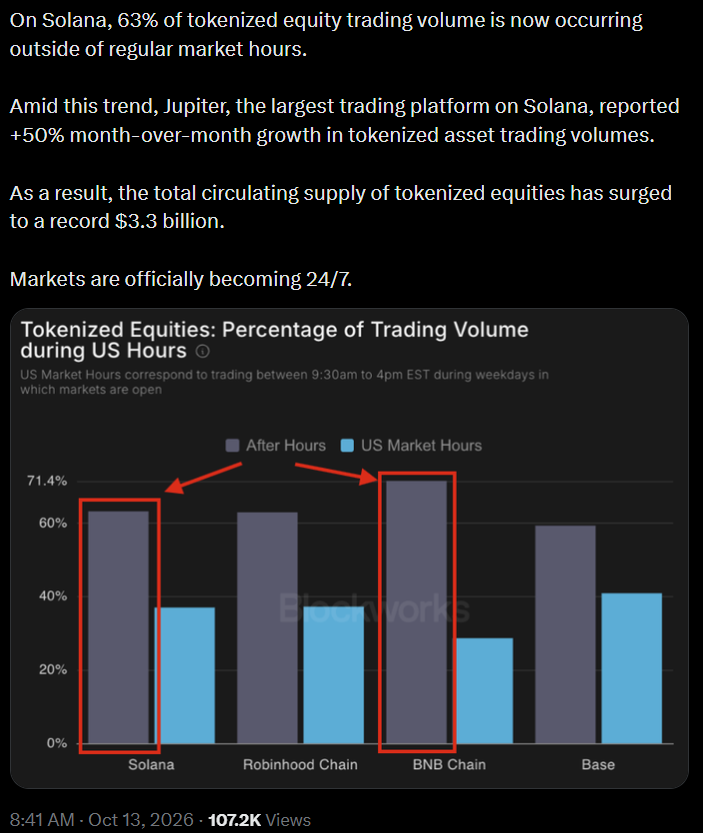
Recent industry data reveals a dramatic pattern: more than 70% of tokenized stock trading volume on BNB Chain now transpires outside regular U.S. market hours. Similar trends are rapidly materializing on other prominent blockchain platforms like Solana and Base, signaling a fundamental re-evaluation of market access and liquidity distribution. This paradigm shift, driven by the inherent 24/7 nature of blockchain technology, allows investors to engage with U.S. stocks across diverse global time zones without being constrained by the opening and closing bells of traditional exchanges. This perpetual market access has the potential to fundamentally alter global liquidity dynamics, offering continuous price discovery and execution opportunities.
However, despite this burgeoning activity and the growing recognition from U.S. regulators, many of the leading platforms facilitating tokenized stock trading remain inaccessible to American investors. This creates a fascinating dichotomy where innovation flourishes globally, while domestic participation is often curtailed, even as the regulatory framework slowly begins to accommodate these novel financial instruments. This evolving landscape forms a critical component of the broader discussion in the digital asset space, alongside other significant developments such as the complex economics of Bitcoin mining, proposed accounting rules that could elevate stablecoins to cash equivalents, and the expanding Bitcoin treasury holdings of companies like Strive.
The Rise of 24/7 Global Equities Trading via Tokenization
The concept of tokenized equities, which represent traditional stocks on a blockchain, is not merely a technological novelty; it is a profound structural change enabling unprecedented flexibility and accessibility. By converting shares into digital tokens, investors gain the ability to trade these assets on decentralized or centralized platforms operating continuously, unburdened by geographical or time-zone limitations. This "always-on" characteristic is proving to be a major draw, particularly for investors in Asia, Europe, and other regions whose local trading hours often align poorly with the 9:30 am to 4:00 pm Eastern Time window of U.S. markets.
According to data compiled by Blockworks and highlighted by The Kobeissi Letter, the overwhelming majority of tokenized stock transactions on certain blockchains occur outside traditional U.S. market hours. On BNB Chain, this figure exceeds 70%. Solana and Base, rapidly growing ecosystems, report similar statistics, with 63% and nearly 60% of their tokenized stock trading volumes occurring during off-hours, respectively. This demonstrates a clear demand for extended market access, suggesting that the traditional market structure, with its limited trading window, may be increasingly anachronistic in a globally interconnected financial world.
The growth in this segment is not just in off-hours activity but also in overall volume and value. Jupiter, a prominent decentralized exchange aggregator, recently reported a robust 50% month-over-month increase in tokenized asset trading volume. Concurrently, data from RWA.xyz indicates that the total value of tokenized stocks has climbed 15% over the past 30 days, now nearing an impressive $3.3 billion. This acceleration points to a maturing market and increasing institutional and retail interest in the asset class.
Navigating the Regulatory Labyrinth: U.S. Stance and Global Disparities

While the technological and market adoption of tokenized equities surges, the regulatory environment, particularly in the United States, remains a critical factor shaping its trajectory. The U.S. Securities and Exchange Commission (SEC) has, through its innovation exemption, shown a willingness to explore the integration of tokenized U.S.-listed stocks onto public blockchains. This exemption, however, comes with stringent conditions, mandating comprehensive disclosure requirements and robust shareholder protection mechanisms. It represents a cautious but significant step towards acknowledging and potentially integrating these digital innovations into the existing regulatory framework.
Despite this regulatory overture, the practical reality for U.S. investors is that many of the existing and most active tokenized stock platforms, such as xStocks and Ondo Global Markets, are largely unavailable to them. This restriction stems from a complex interplay of current securities laws, licensing requirements, and the platforms’ own compliance strategies, which often prioritize operations in jurisdictions with clearer or more accommodating regulatory stances. This disparity creates a situation where U.S. investors are effectively sidelined from a rapidly expanding global market segment, limiting domestic participation and potentially hindering the U.S.’s leadership in this emerging financial frontier. Industry analysts suggest that this regulatory lag could inadvertently push innovation and capital flight to more crypto-friendly jurisdictions, posing a challenge to the U.S.’s long-term competitiveness in digital finance.
Strive’s Bold Bet: Expanding Bitcoin Treasury Amidst Market Fluctuations
Beyond the realm of tokenized equities, the corporate adoption of Bitcoin as a treasury asset continues to gain traction, with Strive emerging as a significant player. The company recently announced a substantial increase in its Bitcoin holdings, acquiring an additional 3,311 BTC. This strategic move, which bolstered its total reserves to 32,773 BTC, positions Strive as the fifth-largest publicly traded corporate holder of Bitcoin globally, a testament to its conviction in the digital asset’s long-term value.
This expansion was primarily funded by the proceeds from warrant exercises, where investors converted their warrants into shares, injecting fresh capital into the company. In a filing with the SEC, Strive disclosed that it completed $208 million in warrant exercises during the week ending October 9. With approximately $15.3 million in warrants still outstanding ahead of their Tuesday expiration, the company demonstrated a clear strategy to leverage investor confidence into expanding its cryptocurrency reserves, thereby increasing Bitcoin exposure per share for its stockholders. The average purchase price for this latest batch of Bitcoin was approximately $84,500 per coin.
Strive’s CEO, Matt Cole, has consistently articulated a vision centered on Bitcoin as a strategic asset, viewing it as a hedge against inflation and a store of value in an increasingly uncertain economic landscape. The company also took steps to solidify its capital structure by amending its governing documents to establish a binding $100 minimum issuance price for its SATA preferred shares. This move aims to protect shareholder value and maintain financial stability, particularly given that the preferred shares were trading slightly below this threshold at $99.40, while Bitcoin itself traded near $83,300, marginally below Strive’s average purchase price for the week. Strive’s common stock, ASST, saw minimal change, holding steady at $27.52. This ongoing accumulation by publicly traded companies like Strive underscores a growing institutional acceptance of Bitcoin as a legitimate component of corporate treasury management, signaling a shift from speculative asset to strategic holding for a growing number of firms.
Bitcoin Miners Eye AI Diversification but Face Steep Financing Costs
The landscape of Bitcoin mining is undergoing a significant transformation, with many companies actively exploring diversification into artificial intelligence (AI) and high-performance computing (HPC). This strategic pivot is driven by a confluence of factors, including increasing competition in Bitcoin mining, fluctuating profitability, and the burgeoning demand for AI computing infrastructure. While the synergy between mining (requiring extensive power infrastructure and data centers) and AI (demanding similar resources) seems logical, Bitcoin mining companies embarking on this transition are confronting substantial challenges, particularly concerning financing.
According to BlocksBridge Consulting’s Miner Weekly report, securing AI customers is merely the initial hurdle. The more formidable obstacle lies in obtaining the billions of dollars required to construct new facilities, procure advanced AI-specific equipment, and upgrade power infrastructure. Lenders are approaching these large-scale data center projects with heightened scrutiny, leading to a widening gap in borrowing costs. Financing terms are increasingly contingent on the certainty of securing long-term AI customers and the overall likelihood of project completion and profitability.
This divergence in financing costs is evident in recent deals within the sector. IREN, a prominent Bitcoin miner, secured $3.65 billion in financing in June at a blended interest rate of 6%. However, just two months later in August, it obtained another $2.4 billion at a higher fixed rate of 9%. While these agreements covered different projects and specific terms, making direct comparisons complex, they illustrate the escalating cost of capital for these ambitious diversification efforts. Financial experts note that the higher rates reflect lenders’ assessment of increased risk associated with the capital-intensive, technologically evolving, and somewhat unproven business model of AI-powered data centers run by former crypto miners.
The scale of capital required for this pivot is staggering. A June analysis by BlocksBridge, citing estimates from VanEck, suggested that publicly traded Bitcoin miners collectively need an estimated $50 billion to fund their AI infrastructure ambitions. Breaking this down, IREN alone faced an estimated $21.1 billion funding gap, followed by Riot Platforms at $7.2 billion, and HIVE Digital Technologies at $4.6 billion. These figures underscore the immense financial undertaking involved and the pressure on these companies to secure favorable financing terms in a competitive and risk-averse lending environment. The success of this pivot will not only depend on technological prowess but also on their ability to attract and retain significant capital.
FASB Proposal: A Potential Boost for Corporate Stablecoin Adoption
In a development that could significantly impact corporate treasuries and the broader adoption of digital assets, a proposed change to U.S. accounting standards could make stablecoins far more attractive to businesses. The Financial Accounting Standards Board (FASB) has put forth a proposal that, if adopted, would allow qualifying stablecoins to be treated as cash equivalents on company balance sheets, according to a report from payments blockchain Tempo.
Under existing U.S. accounting practices, stablecoin holdings often face an unfavorable classification. They may not be counted towards a company’s reported cash reserves, instead being categorized as intangible assets or other investments. This misclassification can have significant repercussions, potentially distorting liquidity ratios, impacting loan covenants, and presenting a less accurate picture of a company’s financial health, even when these tokens are fully backed by U.S. dollars and are readily redeemable. The current treatment has been a significant deterrent for many corporations considering holding stablecoins for operational or treasury purposes.
The FASB proposal aims to rectify this by providing a framework for certain stablecoins to be recognized as cash equivalents. However, Tempo’s analysis emphasizes a crucial condition: companies would need to possess direct redemption rights with the stablecoin issuers to qualify for this classification. This means that simply acquiring USDC, for example, through a cryptocurrency exchange might not suffice. Instead, a direct relationship or contractual arrangement with the issuer, such as Circle in the case of USDC, would likely be necessary to meet the proposed criteria. This nuance is vital for corporate treasurers evaluating the feasibility of integrating stablecoins into their financial operations.
Significantly, some companies have already proactively taken steps in anticipation of such changes. Coinbase, for instance, classified USDC and other payment stablecoins as cash equivalents in its 2025 annual report. This was facilitated by its established redemption arrangement with Circle, demonstrating a forward-thinking approach to digital asset accounting. The FASB proposal is currently open for public comment until November 19. Following this period, FASB will meticulously review the feedback from industry stakeholders, accounting professionals, and the public before finalizing the rules and determining their effective date. Should this proposal pass, it is widely expected to significantly de-risk stablecoin adoption for corporate treasuries, potentially unlocking a new wave of institutional engagement with the digital asset ecosystem and further solidifying the role of the U.S. dollar in its tokenized form.